An expert’s guide on how to approach exam questions
GCSE and A-level exams are now only a few weeks away and students across the UK are getting prepared.
Alongside our expert-led Easter revision course, and recent ‘Revision tips and tricks’ article, we asked former examiner Alex Sarychkin to create this 5-point guide on how to approach exam questions.
Over to you Alex…
 After months of preparation, you’re finally in the exam hall, a pen in your hand and the time ticking down.
Whether you’re sitting Maths or English, there are a few general points to consider that will help you achieve your very best.
-
Answer the question they give you, not the question you want to answer
Every student in the country has a hope about what will be on their exam paper. It’s important not to let that anticipation cloud your answering of the question on the paper itself. You may well have an incredible essay plan prepared for Sheila Birling or how the circulatory system functions, but if the question is on Gerald Croft or gene mutation, you’re going to have to leave those to the side. Be sure to read and underline the key focus of the question.
-
Show your planning, show your working out
Examiners love to see your thought process on the page. It’s a sign that you are taking a considered approach to the question and not writing without thinking. Students who plan have something to refer back to as they write the answer. It’s a way of settling your nerves in an exam while also directing your examiner towards the ideas that you have.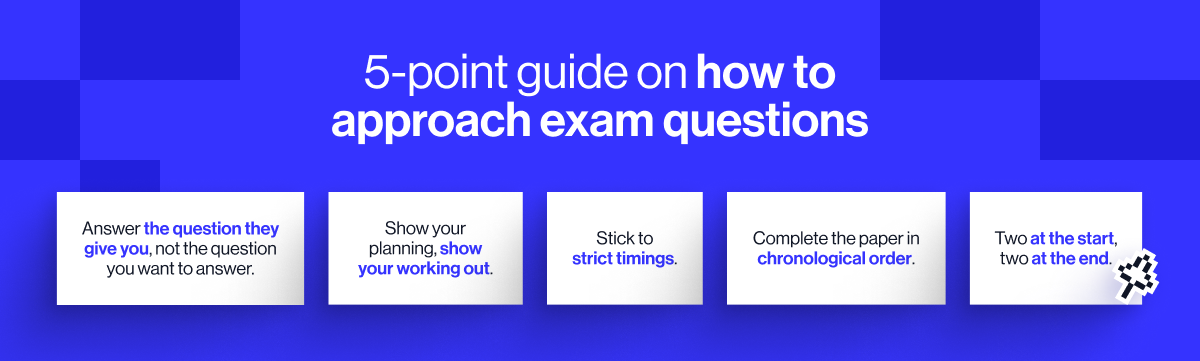
-
Stick to strict timings
One of the biggest obstacles when you start preparing for exams is timings. For certain exams, there may be upwards of 20 questions, with only a set amount of time to complete it. Being strict with your timings will ensure that you give each question the attention it deserves. This may mean leaving a question midway through your response, particularly if you’re struggling. Rather than spend too long agonising over an answer that won’t come, the best thing to do is trust the process, continue through the paper, and return to it once you’ve covered the other questions.
-
Complete the paper in chronological order
Exam papers are designed by experts in the subject in order to support students in the exam environment. Quite often this will mean that the questions increase in complexity as you move through the paper. Beginning with the simpler questions is a great way to build your confidence in the exam and set you up for success in the later questions, where the level of challenge increases.
-
Two at the start, two at the end
Once you have mastered the timings of the paper, you may want to aim to give yourself two minutes at the start to flick through and two minutes at the end to check over. While this may mean you have slightly less time to complete certain questions, if you can allow yourself this buffer, it’s a great way to settle yourself in at the beginning and allow yourself some moments of reflection as the paper concludes. This may be a great opportunity to upgrade your vocabulary in a creative writing task, or reattempt an algebraic equation that defeated you the first time.
Exams are difficult, but we’re here to help. Remember, alongside these great tips, we’re running Exam Masterclasses across all of our subjects to help you revise and prepare for your examinations. Register now to avoid missing out.
I hope to see you there.