How to prepare for exams: The 6 Ts (+1)
Exam season is upon us. GCSE examinations begin in only three weeks.
Three weeks means three weekends of study. It means maybe 10 more school lessons for each subject. And it means that, quite reasonably, students across the country are seeking guidance about how to ensure this tiny window of time is used most effectively.
If that’s you, you’ve come to the right place.
As an educational researcher, and a qualified English teacher for over a decade, it pains me to see revision strategies everywhere that make no sense. The studies have been done. The years of practice have shown us things. The information about how to study efficiently is all out there. But, it rarely finds its way into the hands of those who need it most: the students.
This is where I come in.
In this article, I’ll be giving you the best, most research-backed and applicable strategies to make revision work for you, right now. Conveniently for those of us who love alliteration (presumably everyone, right?), they all begin with T.
(Oh, and if you read through all six, maybe you will find an Easter egg bonus strategy… I know – Easter was last week, but who can say ‘No’ to eggs?)
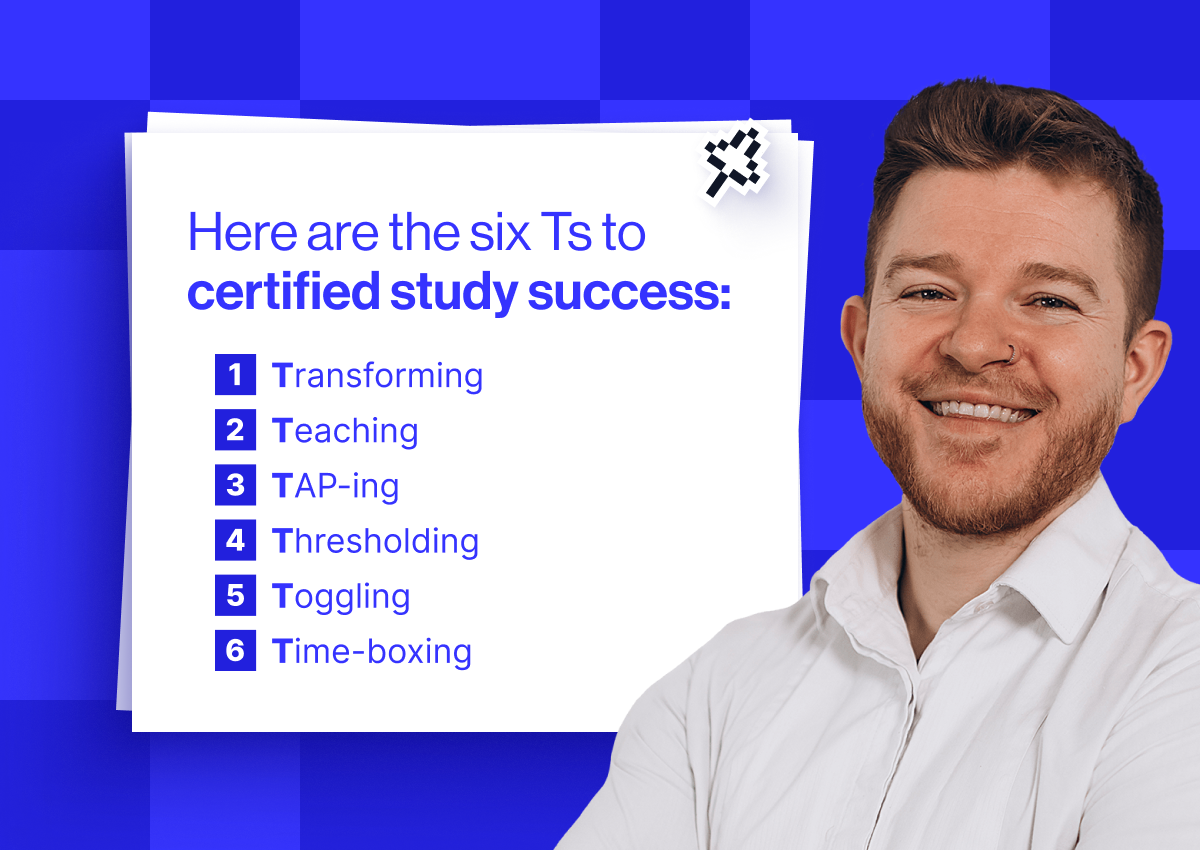
Enough preamble. Here are the six Ts to certified study success:
-
Transforming
-
Teaching
-
TAP-ing
-
Thresholding
-
Toggling
-
Time-boxing
 Taking them one at a time, let’s see why these work – and what they mean…
-
Transforming
Sitting in front of your notes with a highlighter is a colourful waste of your time. There, I said it. Unless you are gifted with a photographic memory and one of those special minds that keeps on churning what you read into new forms, then re-reading and highlighting is not the way forward.
Instead, research tells us, you should be transforming your notes and knowledge into something new. Anything new. Even re-writing your notes verbatim is more effective than reading them – but why be dull? Be creative with it. If you can turn a page of notes into a colour-coded mindmap, or a textbook’s diagram into a catchy song, or even a character profile into a series of quote flashcards, you’re going to benefit enormously.
In pedagogical research, we call transforming your notes into something new the “Generation effect” – but it’s nothing to do with your genes. The generation part in this context refers to producing; when you generate knowledge, actively, instead of absorbing it, passively, it sticks in your head much better.
Better still, by doing this, you are also creating resources for the next step. Research shows that the combined effect of the first two Ts is more than the sum of its parts.
-
Teaching (and learning)
If I ever want to become an expert on something, I will do two things, every time. I will teach others, and I will test myself.
Believe me, facing down 30 eagle-eyed teenage geniuses in a classroom gets me motivated to be on the top of my game, and quickly. And putting my money where my mouth is, by sitting an actual GCSE paper (I do this every year), really forces me to perform well. But, you don’t need 30 people – just one or two will do.
When you teach, you’re without notes, and the stakes are high. You very quickly learn that things you thought were fixed in your brain were in fact only accessible for retrieval when you had the safety net of your notes at hand. The up-side, though, is that the people you’re explaining topics to will be interacting with you, and that conversation is a surefire way to stimulate the memory – and to securely lock in new memories. Then, when you’re next being tested, you’ll know where to start.
Next, reverse the roles and become the student. Studies confirm that “active recall” (that is, having your memory tested, without your notes) is dramatically more effective than working with those notes at hand.
That said, your notes will still come in handy in the study process…
-
TAP-ing
The best way to think of your notes is as scaffolding. The more rickety the structure, the more scaffolding is needed; the more solid it becomes, the more scaffolding can be stripped away. How do you know when to strip it, and when to reinforce it, though? You TAP it. Not with a hammer, but with an acronym.
TAP-ing is ‘Transfer-Appropriate Processing’ and boils down to the idea that memory formation is most effective when the encoding processes match the retrieval processes. Essentially, if you revise by doing practice papers, against the clock, without notes and revision resources, then you’ll do better in exams.
(More broadly, we call this the principle of specificity and it also applies to sports. For example, if you want to get better at penalties, it’s better to physically practise shooting, with a goalkeeper, from the spot… rather than passing a ball against a wall in a gym.)
In short, you need to be doing past or practice papers. And, as time passes, you should move closer to exam conditions, gradually reducing your use of notes, the amount of background noise, and the amount of “extra time” you give yourself, until you are practically living that exam-hall life on a daily basis.
This depends on memorising those notes, of course, which is a fresh challenge.
-
Thresholding
In exams, memory matters. A lot of your exam success comes down to solid recall in the end. Some people are blessed with brains that just retain things like glue. The rest of us mere mortals, though, need to hack our brains’ infrastructure to maximise retention. By that, I mean, we can make our memories better by paying attention to “thresholds of forgetting”.
You may well have seen the so-called ‘Forgetting Curve’ before.
In that graph, a simplified version of psychologist Herman Ebbinghaus’ 19th-Century experimental data (since replicated as recently as 2015), we see the following: we start rapidly forgetting what we learn almost immediately after learning it, and it is gone forever if we don’t return to it regularly.
Talking numbers, about 70% of what we learn in one lesson is gone by the same time the next day.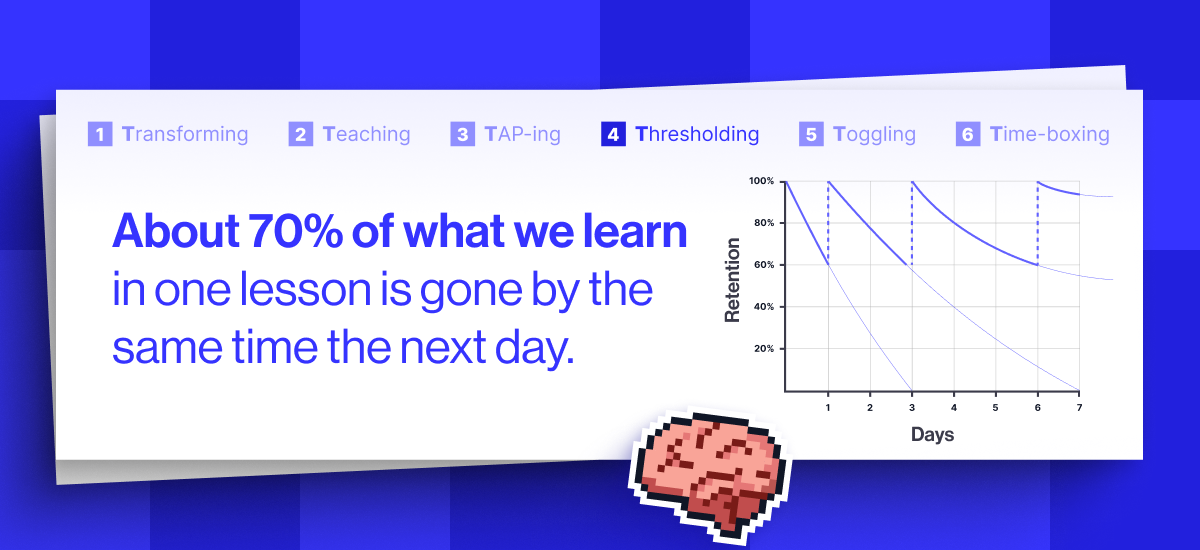
Spaced practice is the solution. As soon as you approach the threshold of forgetting, you should be revisiting the learning. You can revisit it after a day, at first, but then the spaces between revisiting can grow. Roughly double the gap each time: one day, then two days, then four, then about a week, then two, then a month… eventually, you will be able to leave something for years and recall it with ease.
To clarify: anything worth doing is worth doing repeatedly. There is no such thing as a one-and-done approach to learning (unless you are one of the aforementioned gifted individuals) and each return to an idea flattens the Forgetting Curve.
-
Toggling
The only issue with the kind of repetition I keep describing is that it gets boring. This is one reason we “toggle”.
To toggle is to switch between topics regularly, and it works – but the benefits go way beyond just alleviating boredom. 
When you “interleave”, as the educational scientists call it (although I prefer “toggle” – way more fun to say), you structure the learning that you do in your own time in the same way that you have done for you in school. You move from one subject (English Literature, English Language, Maths) or topic (Macbeth, A Christmas Carol, An Inspector Calls) to another, every hour or so.
It is harder, but that is also sort of the point. Forcing your brain to switch, to discriminate, to be flexible – it makes you better… in fact, it can make a you a HUGE two to three times better than you would be if you “blocked” all your study into full days per topic, according to a study by Rohrer and Taylor (2007).
-
Time-boxing
I mentioned doing revision in “blocks” of an hour, but not all of an hour needs to be blinkered, heads-down revising. My sixth piece of advice to you today is to “box” your time.
Now, as much as revision makes many 16-year-olds want to don their gloves and punch things, I actually mean a nicer kind of “boxing”: boxing things up, carefully, and popping a pretty bow on top.
In practice, most people are not equipped for focusing for more than half an hour at a time – and forcing it (outside of exam and cramming contexts) is not helpful. So, we box our time up into 30-minute chunks.
This is known as the Pomodoro technique, and it is pure gold. Basically, you work, with no distractions or pauses, for 25 minutes, and then take a five-minute break. Then, rinse and repeat. And, that’s it.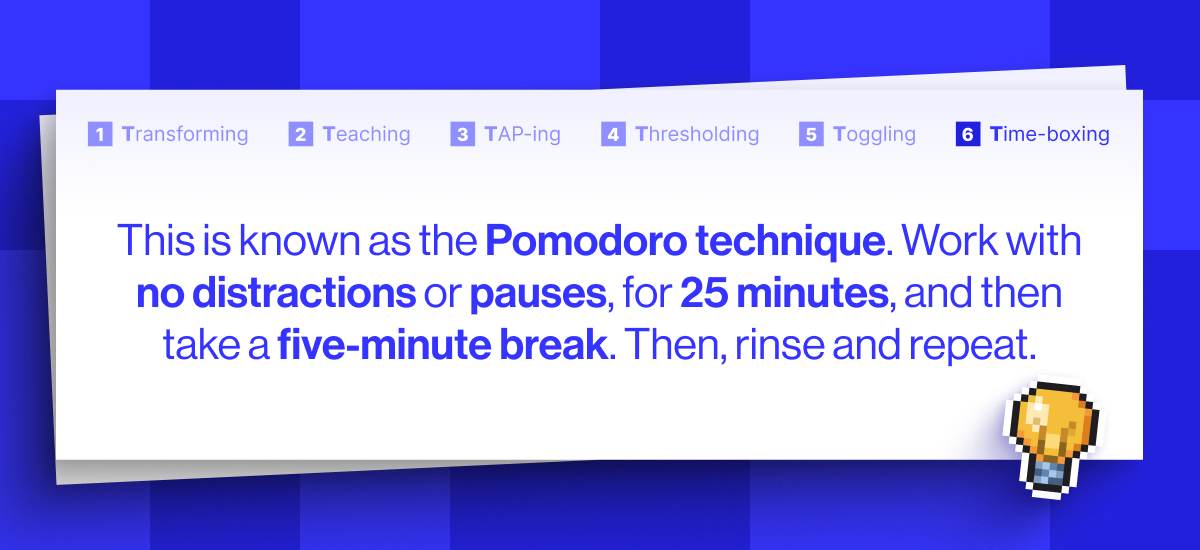
Last year, researcher Eren Ogut conducted a scoping review of more than 130 studies on the Pomodoro technique. He concluded that “Time-structured Pomodoro interventions consistently improved focus, reduced mental fatigue, and enhanced sustained task performance, outperforming self‑paced breaks.” So, there you have it: the perfect justification for picking up your phone every 25 minutes for a quick doomscroll to break up the effort of studying hard. You have my blessing. (Maybe you could even turn it into an education scroll by following us on TikTok).
Of course, there is a time and a place for extended study sessions. GCSE exams can easily exceed two hours (English Literature Paper 2, for AQA, for example), so as the exam date nears, you need to learn to force it for extended spells of focus and output. As I said before, specificity is crucial, so build your stamina.
-
Talk to the experts (the secret seventh T)
This seventh strategy is special and gets pride of place in the list because it overcomes the number one problem that affects all independent revision the world over. You’re riding solo.
Right when you need them to explain to you what nominative determinism means in the context of your set texts, your teachers are at home, tucked up in their beds. Without experts at hand, without feedback, without interaction, there is always the risk that you are cramming the wrong stuff into your head. 
Contrary to popular wisdom, practice sadly does not always equal perfect. Instead, practice equals permanent. As you have seen, the more you practise, the more you retain, right or wrong. That is why we at MyEdSpace refuse to let you take on this challenge alone.
Get ahead and stay ahead this year
Whether your child is getting started with Year 5, preparing for the 11+, heading towards their KS2 SATs in Year 6, or moving through KS3 in Year 7, Year 8, and Year 9, starting their GCSEs or their A-levels, now is the time to get ahead.
The secret to achieving academic success in the UK? Studying with top-quality teachers and former examiners, handpicked for their ability to make things click for their students and working hard. Do that and results follow. This year, it's your child's turn to get ahead and stay ahead.
And, it’s more affordable than you might think. With us, you can get a full year of expert teaching for less than a few classes with the average private tutor.