Understanding and managing exam stress: A guide for parents
Exam season is well and truly underway. Understandably, young people are feeling the pressure.
Understandably, too, their parents and guardians (and teachers) are finding themselves stressed about the prospect.
This is no way to live. In today’s article, I will be sharing the benefit of my experience as a teacher (for over a decade) and educational researcher who is frankly obsessed with the data on exam stress.
First, let’s consider exactly what the picture is when it comes to exam period stress: why and how we feel the way we do about exams.
Why we worry: the importance of exam performance on life outcomes
 The available literature on the subject actually makes our stress seem quite reasonable, at least initially.
A study from the Department for Education in 2021 analysed a population-scale dataset to explore exactly what we have always wanted to know about GCSEs (how they correlate with life outcomes), and found, in short, that they may matter a great deal – if lifetime earnings are our metric.
If we take a typical 16-year-old, who is predicted mostly Grade 4s (what we might call a “borderline” student in the school system), who goes on to excel, achieving a raft of 5s and a handful of 6s, they might expect to earn an extra £300,000 in their working life.
Let’s put that into perspective. If the average lifetime earning potential for a British citizen is about £1.3million, then our student who exceeded expectations at GCSE can retire about 10 years earlier than if he’d performed as predicted. That’s pretty impressive, isn’t it?
Of course, correlation does not automatically mean causation, and this study is not mechanistic. Indeed, there are plenty of other factors involved in lifetime earnings that research shows will have a greater impact than GCSE results: lifetime health, family support, and choice of industry, to name just a few.
In the short term, though, we do know that GCSE performance can heavily influence the next life step: the caliber of the Further Education institution to which a child can apply, the competitiveness of the apprenticeship for which they’re eligible, and the accessibility of the most prestigious university courses in a few years.
Historically, most entry-level jobs have also expected a “passing grade” (these days that is a 4) in English and Maths as a minimum – though of course employers can legally set their own standards. In short, exams should be taken seriously.
It’s both empowering and frightening to know all this, so let’s get personal. How does a knowledge of this kind of pattern and precedent make us feel?
How we worry: who’s concerned and how concerned they are
 Well, if the data is anything to go by, it makes us feel stressed – very stressed.
The mental health charity, YoungMinds, have reported that nearly two thirds (63%) of young people struggle to cope with exam stress at both GCSE and A-level, and the NSPCC have declared that the vast majority (91%) of Secondary teachers think their students worry too much about the impact of exam performance on their lives.
But it isn’t just the students sitting their exams who worry; parents are very much suffering too – in many cases more than their children are.
Our own research, on a thousand parents of children sitting exams this year, found that more than half of the households (51%) have been negatively affected by the stress that surges throughout the exam period. Nearly half of the parents surveyed, indeed, find that they are more stressed than their kids (45%).
Aviva’s research from last year told a similar story, there – noting that 79% of parents versus 47% of young people felt stressed about the latter’s exams, with 44% of parents also reporting that their own mental health suffered. When stress progresses into neurosis and anxiety, entire households suffer. Indeed, in our survey, about a quarter of parents (24%) have been kept awake by this stress, and nearly one in five (17%) have cancelled social engagements to stay home and support their children with revision and exam anxiety.
So, what can be done?
We all know that stress is unhelpful in such abundance. A little can be a motivator, but an excess both hinders performance and also harms our bodies. There is research – and plenty of compelling anecdotal evidence – that can guide us when it comes to supporting our children with their concerns and anxieties, as well as easing our own woes when we remember we can’t sit the exams for them.
Let’s explore them one at a time and be a salve to our inflamed worry hubs.
Quelling the worry, part 1: supporting your child
 The first thing to remember is that tension is acutely infectious.
If your child is in a panic, your own heart rate will soar; but the reverse is equally true, so help for one of you is help for you all. Keeping calm, and keeping any rogue concerns of your own as surreptitious as possible will improve your child’s state of mind – and self-sacrifice is nothing new to parents, so this shouldn’t be beyond the realms of possibility.
Next, as insensitive as it sounds, it is a fact that at least some of the stress felt by young people is correlated with unpreparedness.
It is also true that being in a “better” position academically will build confidence and thus soothe worries. So, if you’re encouraging your child to be doing anything this close to the exams, it should be practice papers. The more experience an exam candidate has in “exam conditions”, the less stressful it will be, come showtime. Your child should be gradually removing the scaffolding of notes, “ideal” questions, unlimited time, background music, and word-processing (if they will be handwriting in the exam), to build towards exam day.
The learning environment in which your child studies can make or break their successes. To any extent possible, it should be quiet, well-lit, and well-resourced. Your presence should be one of support rather than pressure (‘How can I help?’ is more useful than ‘What are you doing to improve?’), and your role should be to protect the non-negotiables: plenty of sleep, good nutrition, and a loving environment.
You cannot sit the exams for them, but you can still be there, ensuring that the version of your child who sits the exam is the best version of themself.
Also, it should go without saying, but don’t feel compelled to help your child with the study itself – regardless of your expertise, intellect and wisdom, if you are not a teacher intimately familiar with the specification, you run the risk of steering your child wrong. Trust in the education process.
There’s also research suggesting that both the practice of mindfulness and regular exercise can be beneficial for non-clinical exam anxiety… but that is another thing your child needs to do. What about you? How can you find calm?
Quelling the worry, part 2: easing your own woes
 For your own peace of mind, you must accept that no amount of worrying can change your child’s performance.
That said, it is human nature to worry – and it is a parent’s prerogative to absorb their child’s fears. So, how do we resolve this? The simplest answer to that is to say: worry will happen, but it mustn’t be all-consuming. Anxiety is to be expected when the stakes are high, but it can be contained and controlled.
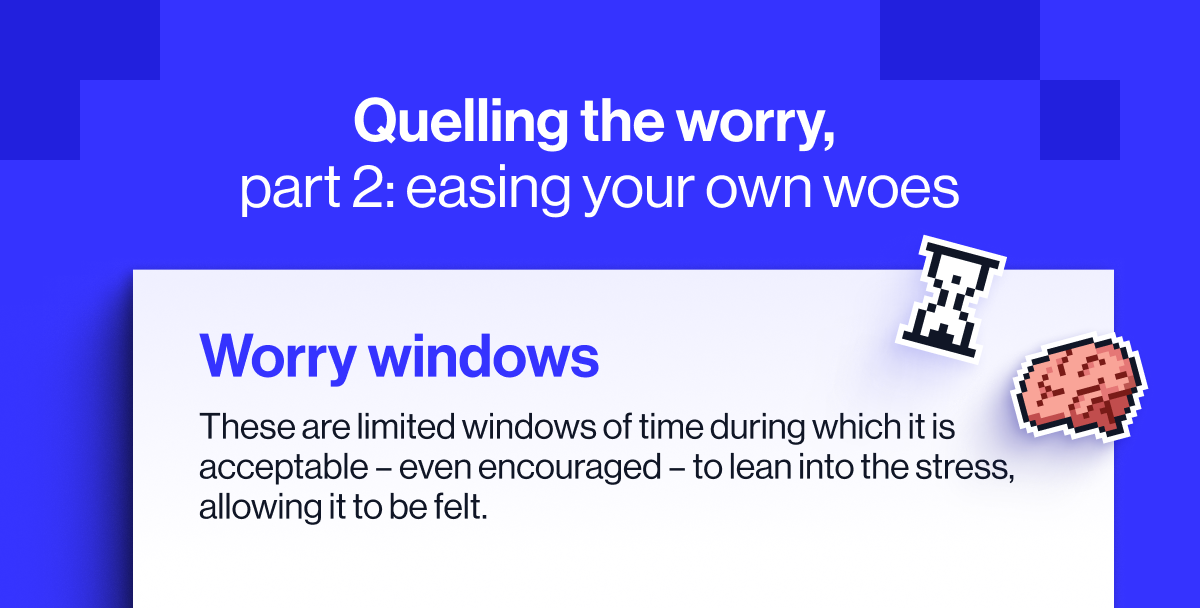
This is why I approve of the concept of “worry windows”. Intuitively enough, given the name, these are limited windows of time during which it is acceptable – even encouraged – to lean into the stress, allow it to be felt, to tease out the complex ball of worrying thread to see it all splayed out… and then put a lid on it all when the bell chimes. Some people call this the 1730 Rule: all ruminating ceases at 5:30pm. Others call it “going out to the car for a rant”... I won’t explain that one. Suffice it to say: attempts at full suppression at all times will be fruitless, and carte blanche engagement with all worry engenders a toxic environment, so worry windows are a happy medium. You will feel better.
The “window” framing in “worry windows” refers to time, traditionally, but I also believe strongly that its delineation should be spatial too. That is, if you’re having a worry in your office, you pocket it as you step out into the hallway. We are deeply grounded as a species, attaching significance to our embodied experience of a space, and psychology attests to the value of changing spaces once you are ready to move on from cycles of negative or overwrought thinking. It also serves the secondary benefit of keeping your stress your own, lest it should leak into your child’s atmosphere as they sit at their desk making flashcards.
The other method that works is more fundamentally “psychey”. It involves getting critical with your own cognition, so you can make peace with uncertainty and reframe maladaptive thinking.
There are a few mantras that many find helpful in this process.
One is: ‘Nothing that anyone in history has been through has been pre-determined or irrefutably known in advance – other than the certainty of death – and yet things happen, and the earth keeps spinning, so accept that your role is to react and not to pre-empt.’
Another is: ‘An unexpected outcome, even an undesirable one, only exists in the present moment and then is past – thereby becoming a comfortable certainty that puts an end to speculation and catastrophising… and unlocks a new door.’ Lovely stuff. If you can mull these over in your reverie, some peace can be found.
Exams are no fun, but they are here to stay – especially in a world where AI makes it ever-easier to cheat in coursework environments – so the best you can do is give your child the best chance at success.
Get ahead and stay ahead this year
Whether your child is getting started with Year 5, preparing for the 11+, heading towards their KS2 SATs in Year 6, or moving through KS3 in Year 7, Year 8, and Year 9, starting their GCSEs or their A-levels, now is the time to get ahead.
The secret to achieving academic success in the UK? Studying with top-quality teachers and former examiners, handpicked for their ability to make things click for their students and working hard. Do that and results follow. This year, it's your child's turn to get ahead and stay ahead.
And, it’s more affordable than you might think. With us, you can get a full year of expert teaching for less than a few classes with the average private tutor.