
What are the easiest and hardest A-level subjects?
The ease or difficulty of any subject, at any level, is subjective and depends on a variety of factors, including interest levels, natural aptitude for the subject, and even how they’ve been taught, and by who.
No A-level is ‘easy’ however, and earning any A-level qualification - let alone the top grades - requires dedication and lots of hard work.
However, while no course is without its challenges, each has different elements which can make them feel easier or harder - depending on individual learning styles.
For example, some students prefer a single written exam, or subjects which require more pattern-recognition skills. Meanwhile, others can prefer practical work, or subjects which require more individual expression and creativity.
Comparing ‘pass’ rates and the percentages of students achieving top A-level grades
One way to determine the relative difficulty of different A-level subjects is to compare ‘pass’ rates and percentages of students who achieve the higher grades. In this instance, we have taken ‘pass’ to be a C or above.
While this is not a perfect system, the higher the ‘pass’ rate and the greater the percentage of students achieving an A*, the ‘easier’ the subject would appear to be.
2025 A-level results by subject 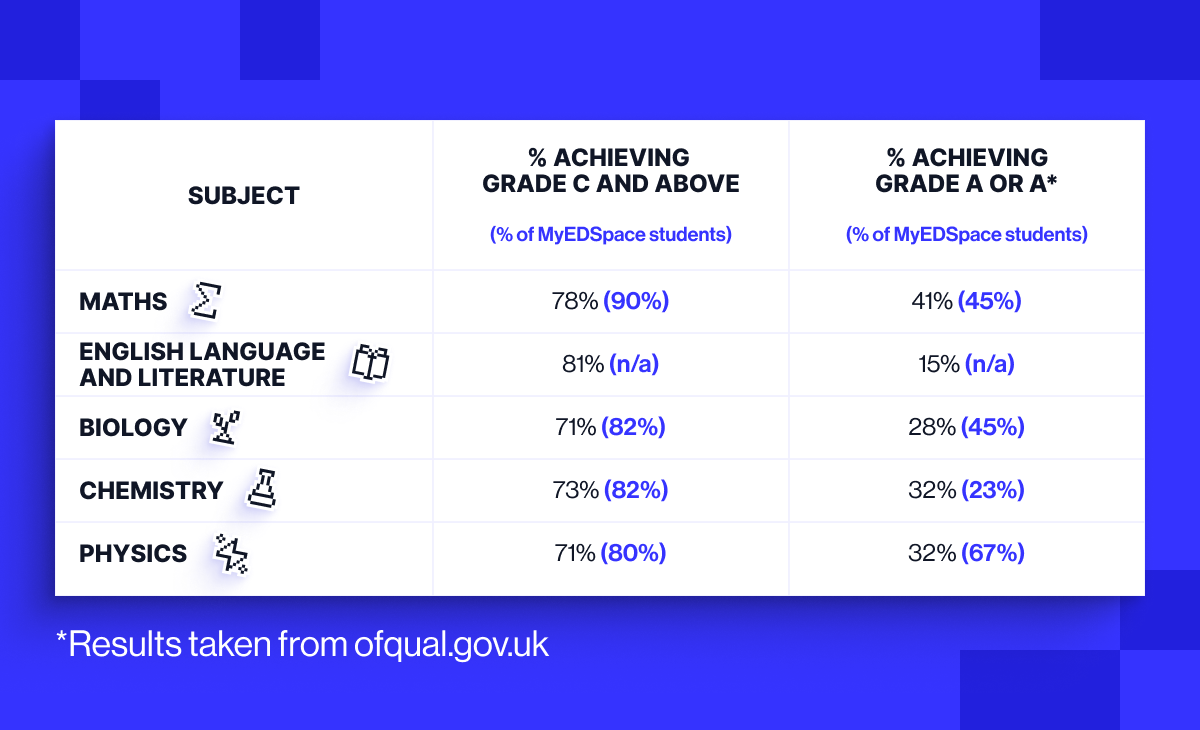
|
Subject |
% achieving grade C and above |
% achieving grade A or A* |
|
Maths |
78% (90%) |
41% (45%) |
|
English language and literature |
81% (n/a) |
15% (n/a) |
|
Biology |
71% (82%) |
28% (45%) |
|
Chemistry |
73% (82%) |
32% (23%) |
|
Physics |
71% (80%) |
32% (67%) |
|
Art and Design |
89% (n/a) |
35% (n/a) |
|
Music |
77% (n/a) |
25% (n/a) |
|
Geography |
80% (n/a) |
24% (n/a) |
|
History |
84% (n/a) |
25% (n/a) |
|
Physical Education |
70% (n/a) |
17% (n/a) |
|
Media Studies |
82% (n/a) |
15% (n/a) |
|
Drama |
89% (n/a) |
23% (n/a) |
|
Economics |
82% (n/a) |
30% (n/a) |
|
German |
89% (n/a) |
47% (n/a) |
|
French |
85% (n/a) |
39% (n/a) |
|
Spanish |
86% (n/a) |
36% (n/a) |
|
Computing |
70% (n/a) |
25% (n/a) |
|
Classical studies |
86% (n/a) |
34% (n/a) |
* Results taken from ofqual.gov.uk
The ‘easiest’ A-level subjects
So, going by the percentages of people scoring C or above, the ‘easiest’ A-levels in 2025 were; Art and Design, Drama and German, followed by Classical studies, Spanish, and French.
When you look at the percentages of students achieving top grades, the story is different and highlights the problem of classifying subjects as ‘easy’ or ‘hard’.
Despite being one of the hardest subjects to achieve a C or above in, Maths was one of only two subjects to see over 40% of students achieve an A or A*, (the other was German).
The ‘hardest’ A-level subjects
Meanwhile, the hardest were Computing, Physical Education, Biology and Physics, followed by Chemistry, Music and Maths.
It is worth noting however, that MyEdSpace students significantly outperformed their peers in the subjects we teach; Biology, Chemistry, Physics and Maths.
Interestingly, while Biology, Physics and Chemistry were among the ‘hardest’ A-level subjects, that same year they were among the ‘easiest’ GCSE subjects.
In terms of the hardest subjects in which to achieve top grades, only 15% of UK students achieved A or A* in either Media Studies (traditionally seen as an ‘easier’ option), or English Language and English Literature. Another subject often cited as being ‘easier’- Physical Education - also saw less than 20% achieve top grades, making it one of the hardest subjects by this measure.
Get ahead this summer with the MyEdSpace Summer School
If you're starting your A-levels this September, now is the time to get ahead. Most kids lose the equivalent of 2 months progress over summer because there's nothing keeping their momentum ticking.
Summer School fixes that without taking over the summer holidays. 3 weeks with expert teachers now can be worth months of extra progress next year - and they can be joined from anywhere. Beach days stay the same, but September is a whole lot easier. Find out more and get ahead this summer.