Arithmetic Sequences
Neil Trivedi
Teacher

Arithmetic Sequences
An arithmetic sequence is one whose terms increase/decrease through addition/subtraction
of a constant value.
Notation:
- The term's position
- The term's value
- The first term
- The common difference
Formula:
For an arithmetic sequence, each term is defined deductively as,
An arithmetic sequence with terms can be written as,
Example 1:
The term of each of the following sequences is given by . Find the values of the constants and in each case.
Step 1: Recognise the first term common difference .
Step 2: Substitute the numbers into the formula.
No answer provided.
Example 2:
The third and seventh terms of an arithmetic series are and , respectively.
a) Write down two equations relating the first term, , and the common difference, , of the series.
Single Step: Write the second and seventh term in terms of and by the formula.
b) Find the values of and .
Single Step: Solve the simultaneous equations.
By elimination ,
Substitute back to any of the two equations, here we pick ,
c) Find the term of the sequence.
Single Step: Substitute the values of and into the formula.
No answer provided.
Arithmetic Series
Arithmetic Summation Formula:
For an arithmetic sequence, the summation of terms is defined deductively as,
where is the first term, is the common difference and is the number of terms.
Alternative formula: Given the last term :
Proof (You need to know this):
We first write two simultaneously, in ascending order and one in descending order, and sum them up:
________________________________________________________________________________________________________
There are a total of terms on the RHS, summing gives,
Note that there are terms in and hence we have the in our formula.
Example 3:
The first three terms of an arithmetic series are , , and respectively.
a) Find the value of the constant .
Single Step: We know that an arithmetic series has common difference between terms, so we equate the differences between terms.
b) Find the sum of the first terms of the series.
Step 1: Find and .
Step 2: Substitute the values of and into the arithmetic summation formula.
No answer provided.
Example 4:
Find the least number of terms for the sum of to exceed .
Step 1: Recognise the first term , common difference and the inequality needed.
, ,
Step 2: Solve the inequality.
Expanding and simplifying inside the squared brackets and multiplying both sides by ,
Expanding the brackets and moving to the left side,
Applying the quadratic formula to find the roots of the quadratic,
or
Sketch the graph to show which region is relevant:
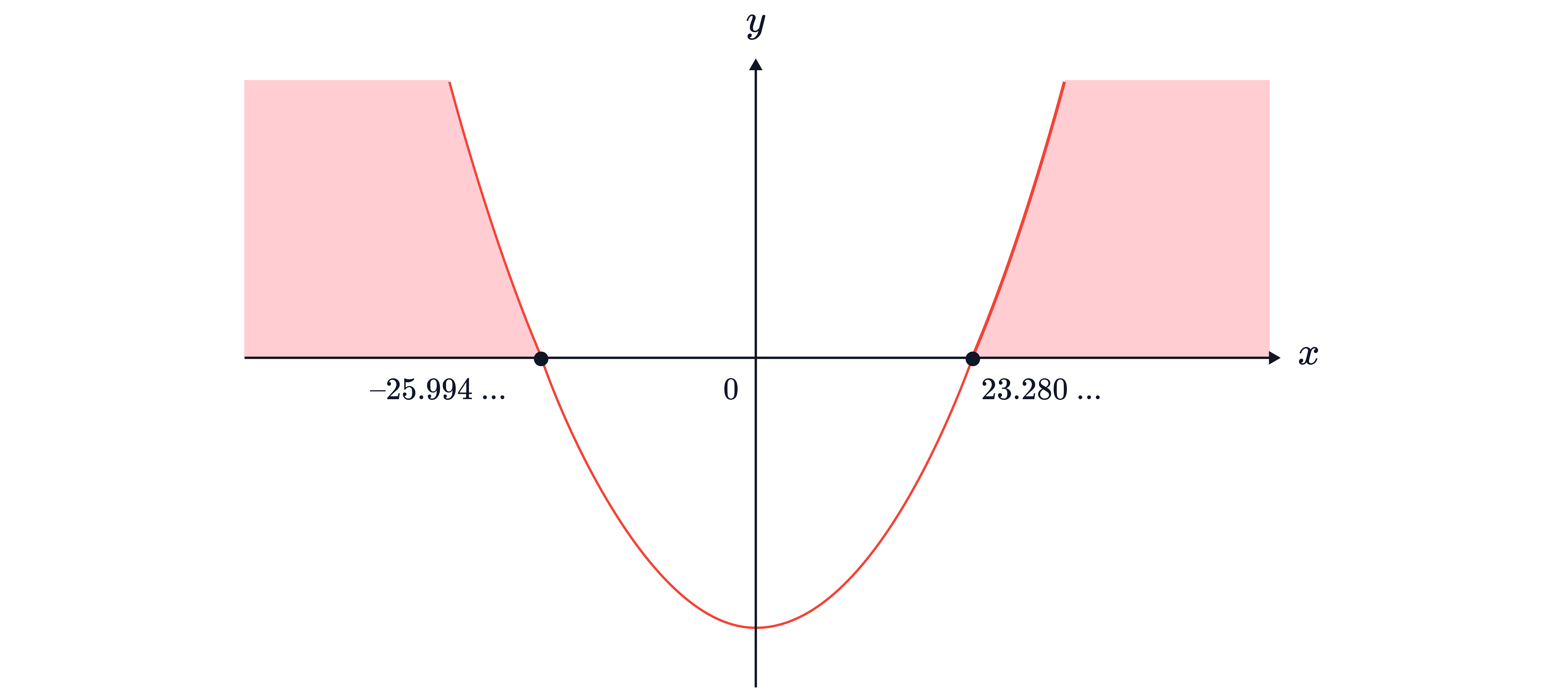
We know that the blue region correspond to the equality . So,
or (reject because is non-negative)
Therefore, the least number of terms for the sum of to exceed is .
No answer provided.
Example 5:
A fitness centre decides to expand its membership base. In the first year, the gym registers new members. The management forecasts that the number of new memberships will increase by each year.
a) According to this forecast, find the number of memberships added in the tenth year.
Step 1: Identify and from the information given.
The gym registers new members in the first year, so . The number of memberships is forecasted to increase by each year, so .
Step 2: Apply the term formula.
b) According to this forecast, show that the gym will register a total of members in the first seven years.
Single Step: Apply the arithmetic summation formula.
c) If the number of members registered in subsequent years increases by each year, instead of by , find to the nearest integer the value of , such that the company would sell a total of panels during the first seven years of production.
Single Step: Apply the arithmetic summation formula with instead of
No answer provided.
Challenging Question