Differentiating Composite Functions
Neil Trivedi
Teacher

Differentiating Composite Functions
Reminder: The “angle” of a function is what you have to set to equal “” when applying the chain rule.
Please make sure you have read our Chain Rule note before this one.
Example 1:
Differentiate.
a)
Single Step: Identify the angle and apply the chain rule process to an exponential function.
Here, we are differentiating an exponential function, so the angle is the power. Remember that the is a multiplier so we write that down first, then differentiate the angle.
The angle, , differentiates to , then the function of stays the same in differentiation as well as its power.
So,
Multiplier Angle stays the same
Differentiated angle
b)
Single Step: Identify the angle and apply the chain rule process to a logarithmic function.
Here, we are differentiating a logarithmic function, so the angle is the argument (what we are taking log of).
Following the same steps, the angle, , differentiates to , then the function of reciprocates the angle.
When is differentiated, the angle is reciprocated.
Differentiated angle
c)
Step 1: Identify the type of function.
Although this looks like a trigonometric function, where there are powers, that becomes the primary function. This is a power function, and we need to rewrite the function as
.
Step 2: Identify the angle and apply the chain rule process to a power function.
The angle of a power function is what is inside the bracket. Here, that is .
To differentiate this, we first differentiate its angle which gives us ,
then differentiates to , then make sure the angle stays the same.
So,
Angle stays the same
Differentiated angle
Now, applying the chain rule process:
We have differentiated the angle already to give . This is a power function, so we bring down the power, knock one off the power, then keep the angle the same.
Angle stays the same
Differentiated angle Differentiated power function
No answer provided.
Example 2:
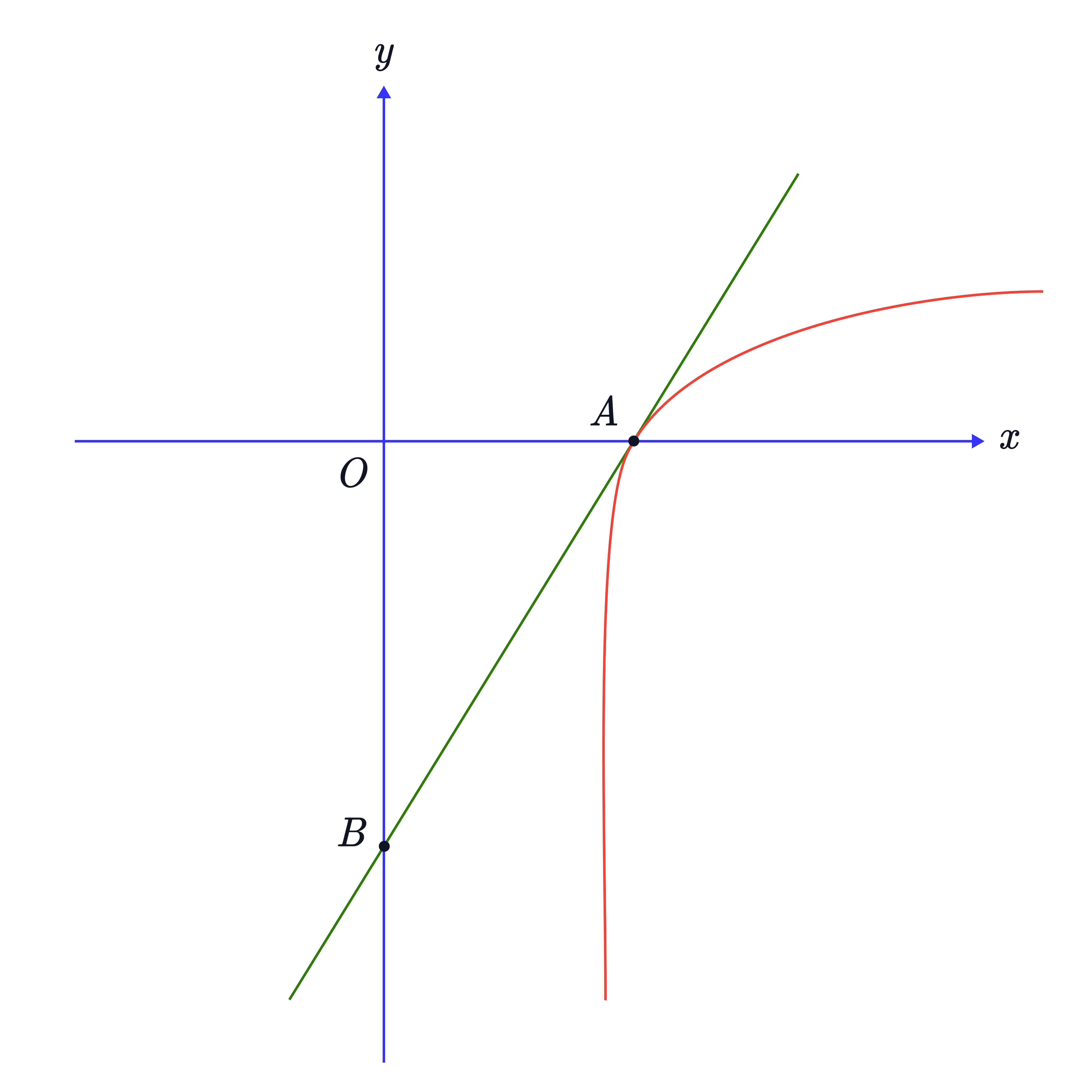
The diagram shows the curve , which crosses the axis at the point .
a) Find the coordinates of .
Single Step: Find the value of when .
Therefore, the coordinates of are .
b) Find in terms of .
Single Step: Identify the angle and apply the chain rule process to a power function.
The equation can be rewritten as
The angle is , which differentiates to .
Since we have a power function, we bring down the power and knock off the power.
So,
Angle stays the same
Differentiated angle Differentiated power function
The tangent to the curve at crosses the axis at the point .
c) Show that the area of triangle , where is the origin, is .
Step 1: Find the equation of the tangent and the coordinates of .
We know is a point on the tangent and is in terms of so we need to substitute and then reciprocate to find the gradient.
Then reciprocating,
Then, using with and , we have
The point is where the tangent crosses the axis which we can see from our equation is , hence .
Step 2: is right-angled, so we can find its area now that we have both and .
The diagram below illustrates the .
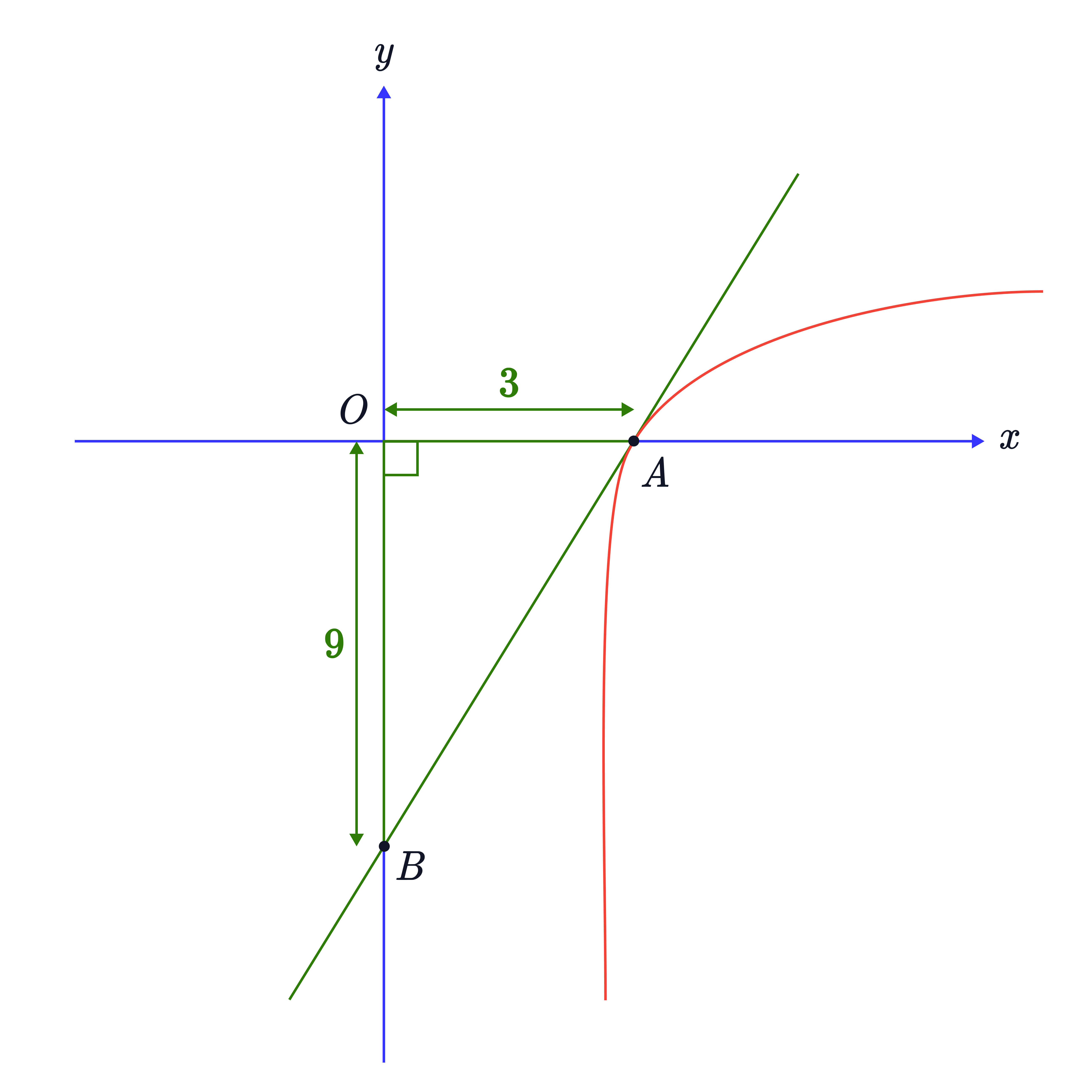
Area of base height units
No answer provided.
Challenging Questions