Forming and Solving Differential Equations
Neil Trivedi
Teacher

Forming and Solving Differential Equations
A differential equation is an equation that relates a function to its derivatives. It tells us how something is changing, rather than telling you directly what it is such as how a population is growing/declining over time.
To form a differential equation, we first identify the quantity that is changing. Questions often include key phrases that indicate the form of the differential equation. Here are some examples.
Note: The word ‘rate’ implies that we are looking at a quantity (let’s call it for instance) changing with respect to time and the derivative is therefore .
1) “A tank is being filled with water at a constant rate of litres per minute.”
• The rate of change of the volume, , with respect to time, is .
• The rate is constant at litres per minute.
This gives the differential equation
2) “A quantity increases at a rate proportional to .”
• The rate of change of , with respect to time, is .
• “Proportional to ” means some multiple of , which we denote as , were . So, the rate is .
This gives the differential equation
3) “The mass of a substance decreases at a rate inversely proportional to .”
• The rate of change of , with respect to time, is .
• “Decreases at a rate inversely proportional to ” means the rate is (where ).
This gives the differential equation
To solve a differential equation, we separate the variables, then integrate both sides, and then use any initial conditions to find the constant of integration.
Example 1:
A quantity has a value at time hours and is increasing at a rate proportional to .
a) Write down a differential equation relating and .
Note: This is the most basic differential equation they can ask in A-Level Mathematics.
Single Step: Form the differential equation.
The quantity is increasing at a rate proportional to , which means
So,
where is the constant of proportionality.
b) Show that = , where and are constants with .
Step 1: Separate the variables so that all the terms are on the LHS and the terms are on the RHS.
To separate the variables, we multiply both sides by to bring all the terms to the right and divide both sides by to bring all the terms to the left. is a constant so we can leave it on the right side.
Step 2: Integrate both sides.
On the LHS, integrates to , where is the constant of integration (see the Separation of Variables study note for an explanation of this approach). The constant will integrate, with respect to , to .
Applying to both sides to cancel out the ,
Dividing both sides by , gives us on the RHS but as it’s also a constant, we can call it . Therefore,
The initial value of is and when , .
c) Find the exact values of and .
Single Step: Form two equations based on the conditions given above and solve for and .
When (initial value), .
When , .
Applying to both sides to cancel out the function of on the right side,
Therefore, and .
No answer provided.
Example 2:
At time seconds, a circular puddle has radius cm and area cm. The area of the puddle is increasing at a rate inversely proportional to its area at that time.
a) Show clearly that , where is a positive constant.
Step 1: Identify the rate of change given in the question.
• The rate of change in the area, , with respect to time is .
• is increasing at a rate inversely proportional to , which means
So,
where is the constant of proportionality.
Step 2: We have found , but we need to find . To do this, we use the
want got need method (aka the chain rule), firstly finding out what we want,
what we’ve got, and what we need.
Note: For more on want, got, need, see the Related Rates of Change study note.
Want: the rate at which is increasing with respect to .
Got: the rate at which is increasing with respect to .
want got need
need
To find the need, we have to balance the RHS which can only be done with . This is because
Step 3: Find .
We know that the area of a circle is given by . We then find by differentiating the area with respect to .
Reciprocating,
Therefore, we now have the “need” part of the equation.
Step 4: Find .
To note, and (highlighted) combine to give an unknown constant which we can call .
The initial radius of the puddle is cm and when , it has increased to cm.
b) Show further that .
• We have .
Step 1: Separate the variables to bring all the terms to the LHS and all the terms to the RHS.
We multiply both sides by to bring the terms to the RHS and multiply both sides by to bring the terms to the LHS.
Step 2: Integrate both sides.
On the RHS, integrates to with respect to , while on the LHS, integrates to with respect to . The constant of integration, , is added on the side of the terms.
Multiplying both sides by ,
Note: We have multiplied unknown constants and by to get the unknown constants and . However, they are unknown so they can absorb into new constants and .
Step 3: Use the conditions given in the question to find the unknown values, and .
When (initial value), .
When , .
Therefore,
No answer provided.
Example 3:
Water is pouring into a container at a constant rate of cms and is leaking from a hole at the base of the container at the rate of cms, where cm is the volume of the water in the container.
a) Show clearly that .
Step 1: Consider the rates at which water is pouring into and out of the container separately.
Firstly, the rate of change in the volume of water, with respect to time, is given by .
In: ,Out:
Step 2: Find the net rate of change in the volume of water.
Net In Out
Step 3: Rearrange to get our desired equation.
Multiplying all terms by ,
Initially, there were cm of water in the container.
b) Show further that .
We will be solving the differential equation to find .
Step 1: Separate the variables so that all terms are on one side and all terms are on the other.
To separate the variables, we multiply both sides by to bring the terms to the RHS which requires us to protect the RHS with brackets. Then, we will divide both sides by to bring the terms to the LHS.
Step 2: Integrate both sides.
On the RHS, integrates to with respect to .
On the LHS, we make a guess as to what function may differentiate to . We will guess .
We now differentiate our guess with respect to . This is a function of so the angle is the argument (what we’re taking of), which in this case is . The angle differentiates to and when we differentiate the function of , the angle is reciprocated.
When is differentiated, the angle is reciprocated
Differentiated angle
Our guess differentiates to give , but we wanted . So, we multiply both sides by the constant we want over the constant we have which will be . So, on the LHS, we have
Therefore, after integrating both sides, we are left with
Step 3: Rearrange the equation to isolate .
Multiplying both sides by ,
Applying on both sides to cancel out the ,
Dividing both sides by , we get on the right but as it’s a constant as well, we can call it .
Adding to both sides,
Dividing both sides by 3,
Step 4: Use the initial condition in the question to find the value of and hence the particular solution to the differential equation.
Initially, there was cm of water in the container. Here, .
Therefore,
Separating the fraction, we are left with
c) State the maximum volume that the water in the container will ever attain.
For questions like these, it is helpful to sketch a graph for the first time so that we can visualise how the volume is changing over time. However, in the real exam, you should have practiced this so much that you don’t have to.
As a reminder, the volume of water in the container at time is given by
To get to the graph of , let’s start with the graph of .
Note: since it represents time but for the purpose of sketching the function, we will use the full domain until our final sketch.
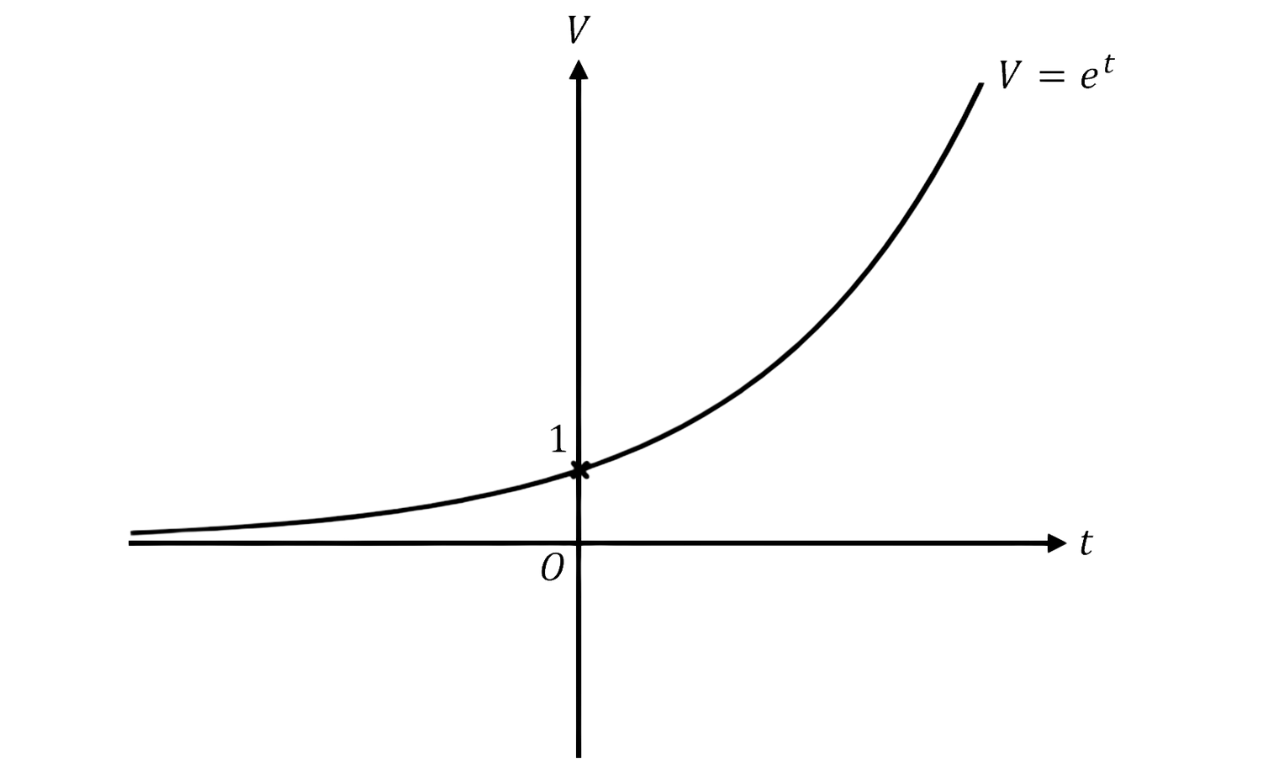
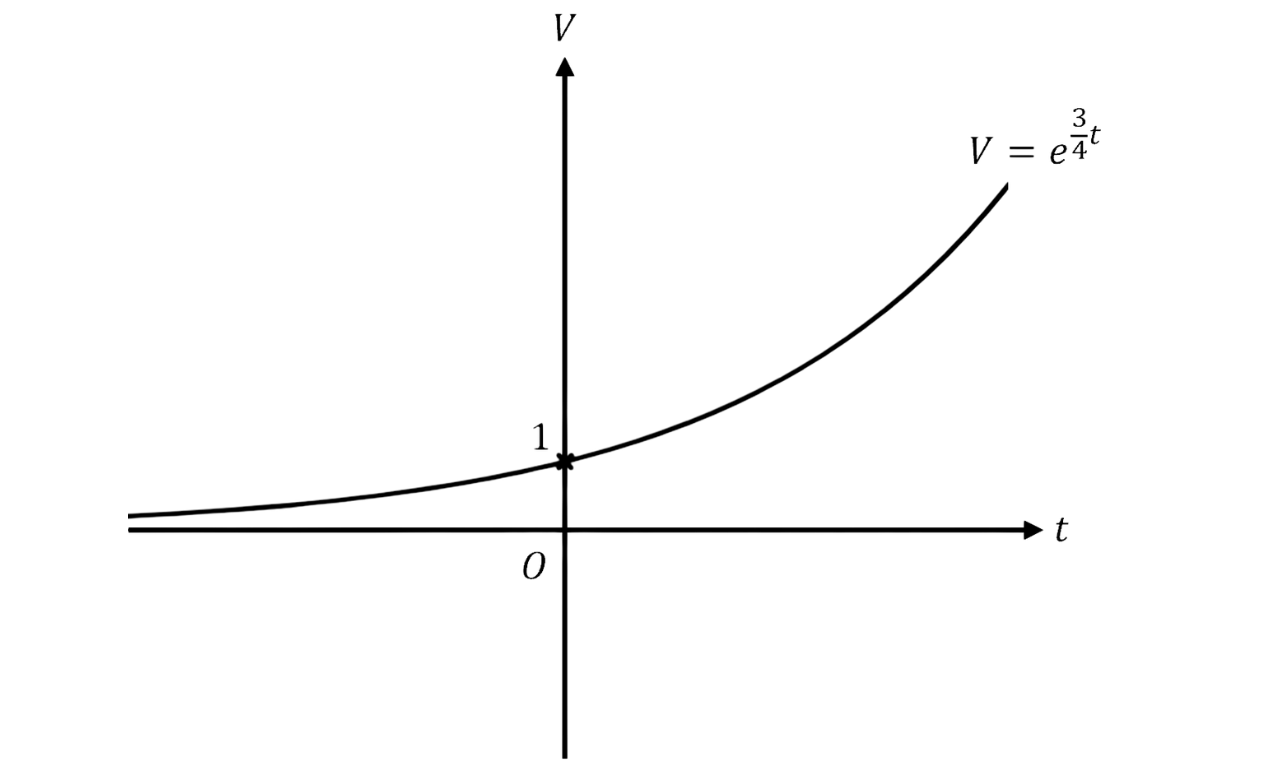
Then, we consider the graph of , which will look like the graph but with a shallower gradient.
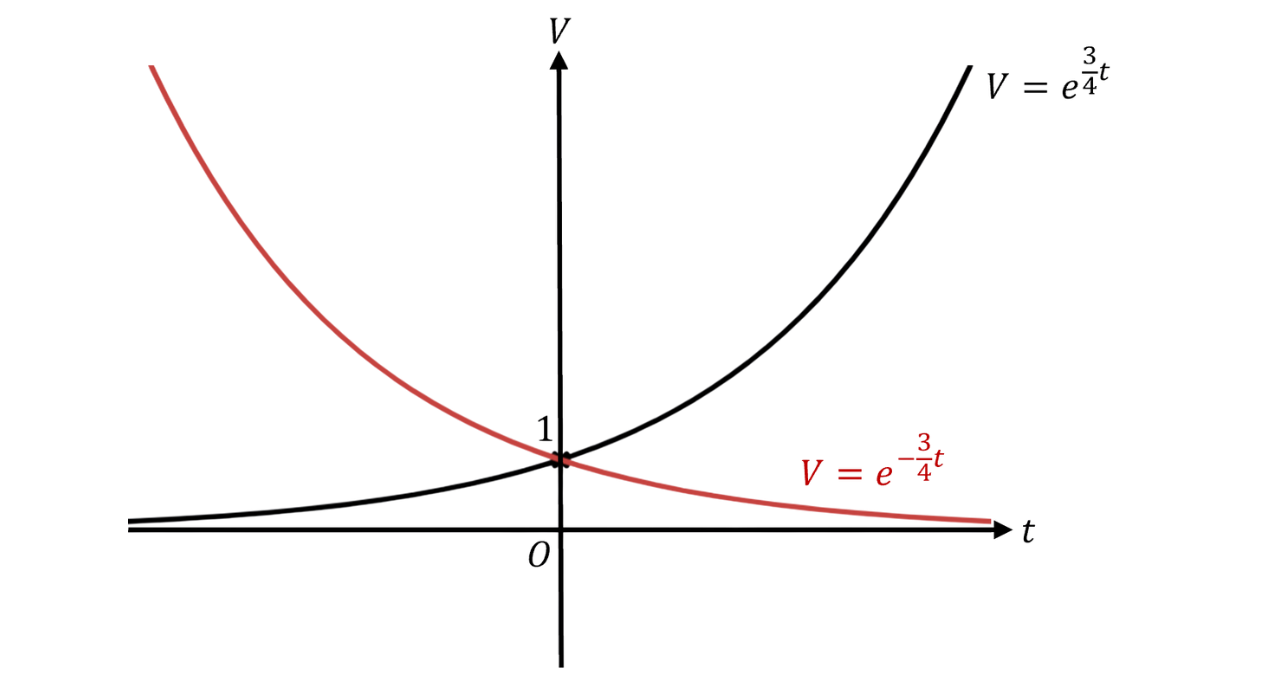
Then, we consider the graph of , which we get from reflecting the graph of about the axis.
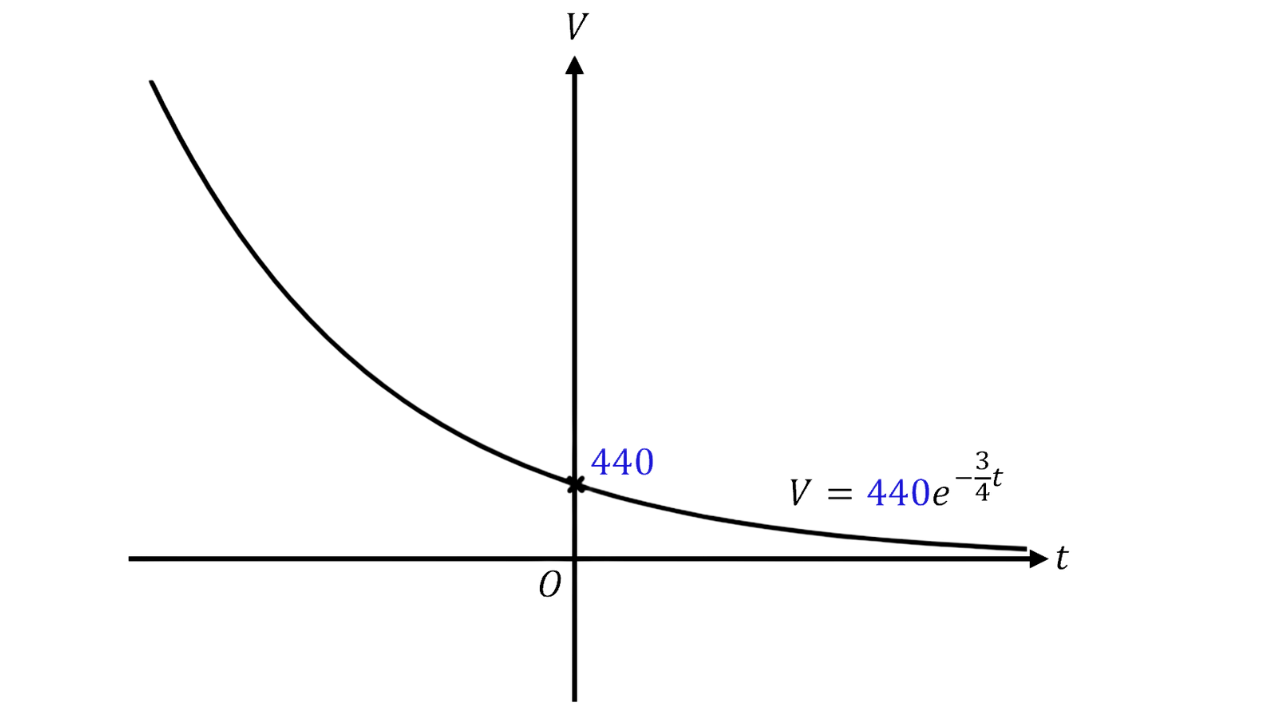
Then, we consider the graph of . We enlarge the graph of by a scale factor of parallel to the axis.
For the graph of . We reflect the graph of about the axis.
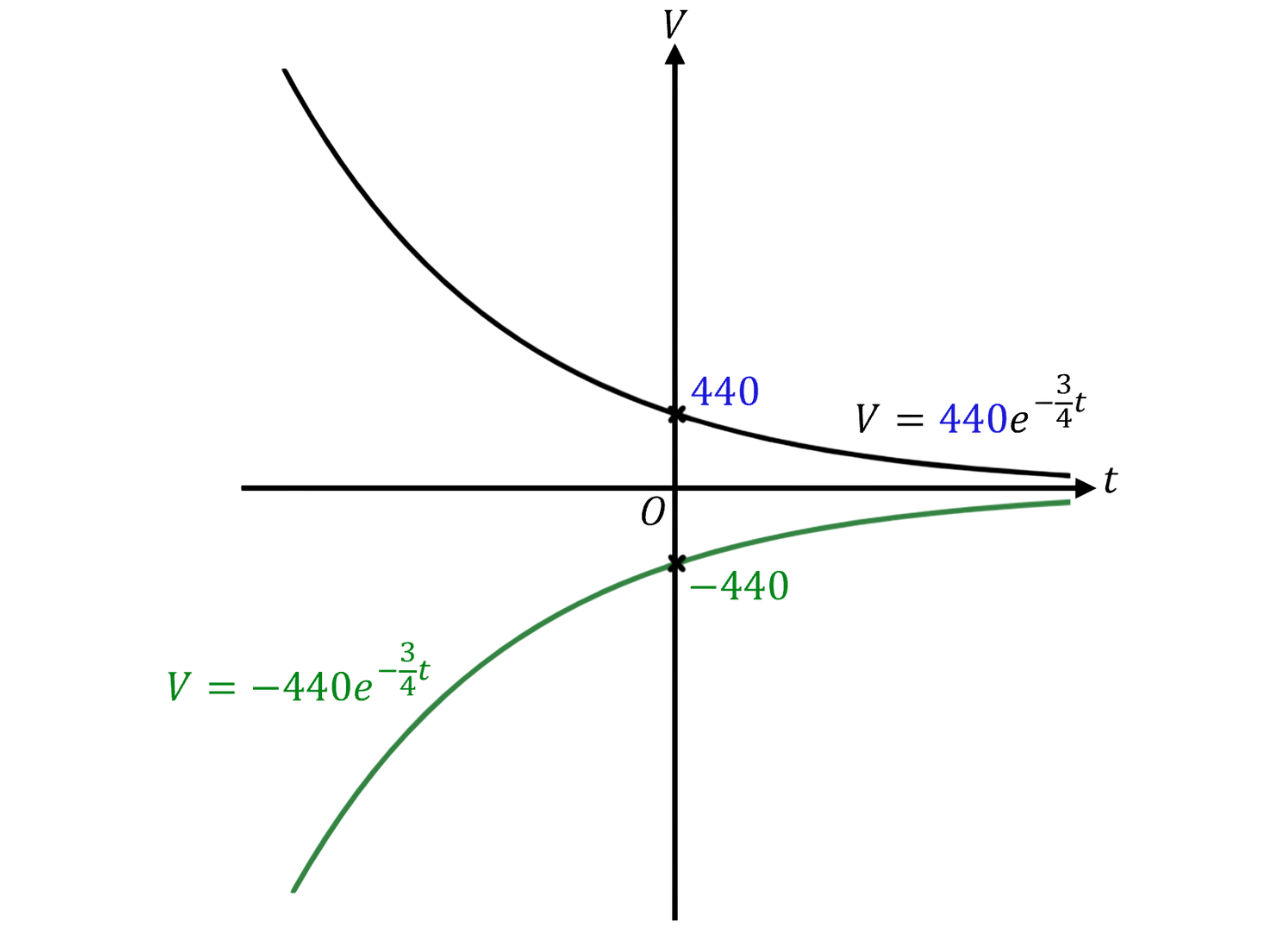
Finally, for the graph of . We translate the graph of by a vector of . To note, we’ve removed the part of the graph where because , being time, is non-negative.
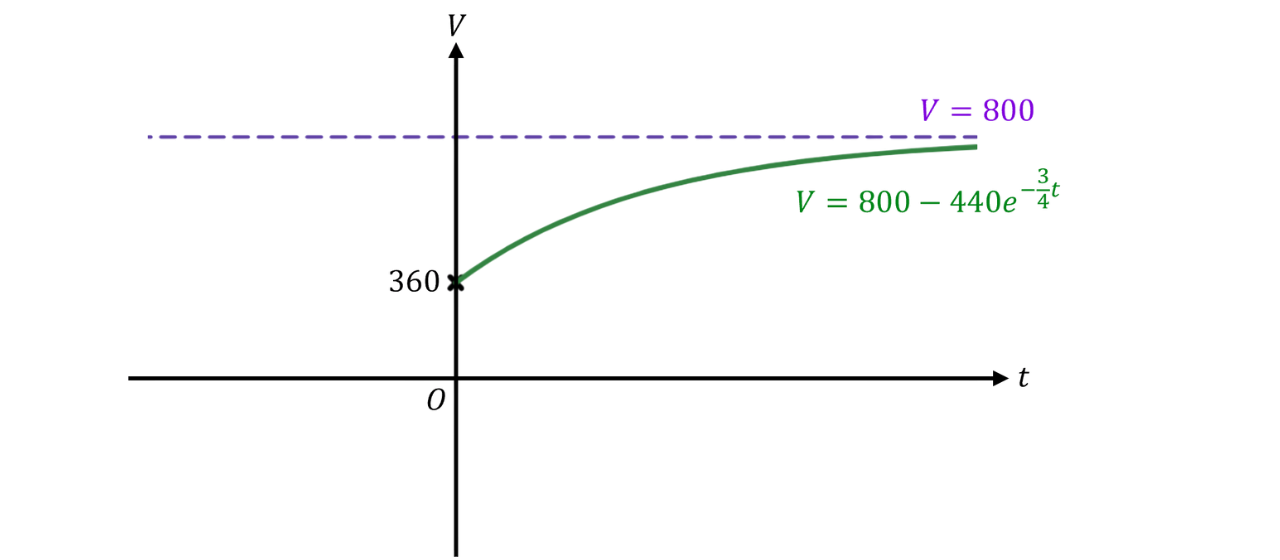
We can observe from the graph that as increases, the graph increases and tends towards .
To note once again, the graphs are to illustrate how is changing over time. In the real exam.
To conclude (and the following is all you’d need to state in the exam),
As , . Therefore, cm and so the maximum volume that the water in the container will ever attain is cm.
Note: We know that setting our independent variable to tend to infinity finds the horizontal asymptote just like when we sketch reciprocal graphs.
No answer provided.
Challenging Questions