Newton-Raphson Method
Neil Trivedi
Teacher

Newton-Raphson Method
The Newton-Raphson method uses the tangent of a function to approximate the root through iteration. Generally, this gets to the root much quicker than other numerical methods such as
fixed-point iteration.
Here’s how it works and we will derive a formula for the Newton-Raphson method.
1) First, let’s start with a curve where we are trying to approximate its root .
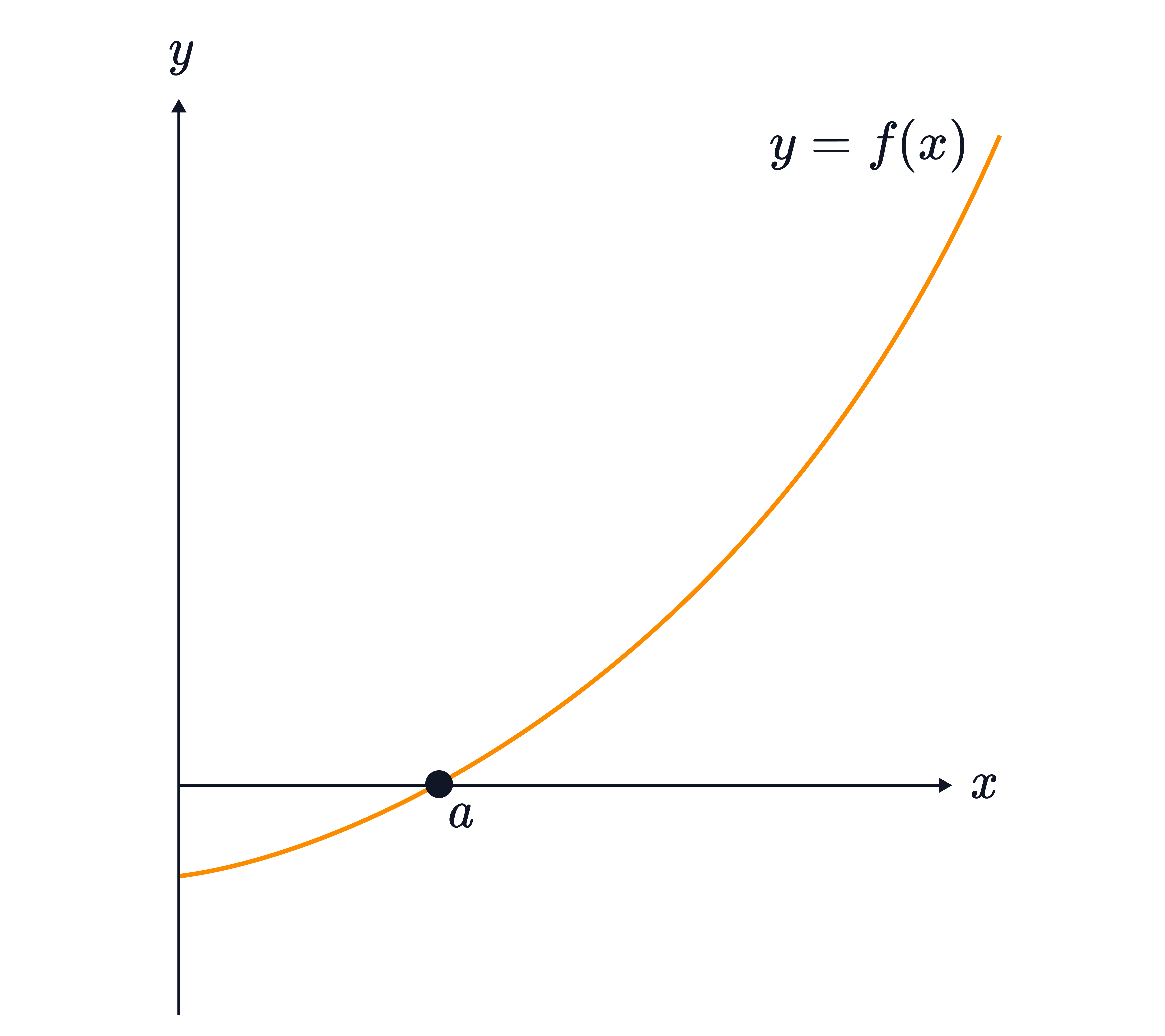
2) We are using tangents to approximate the root through iteration. Add a tangent to the graph at an arbitrary point . The tangent meets the axis at , which is closer to than is. Then, we repeat the process.
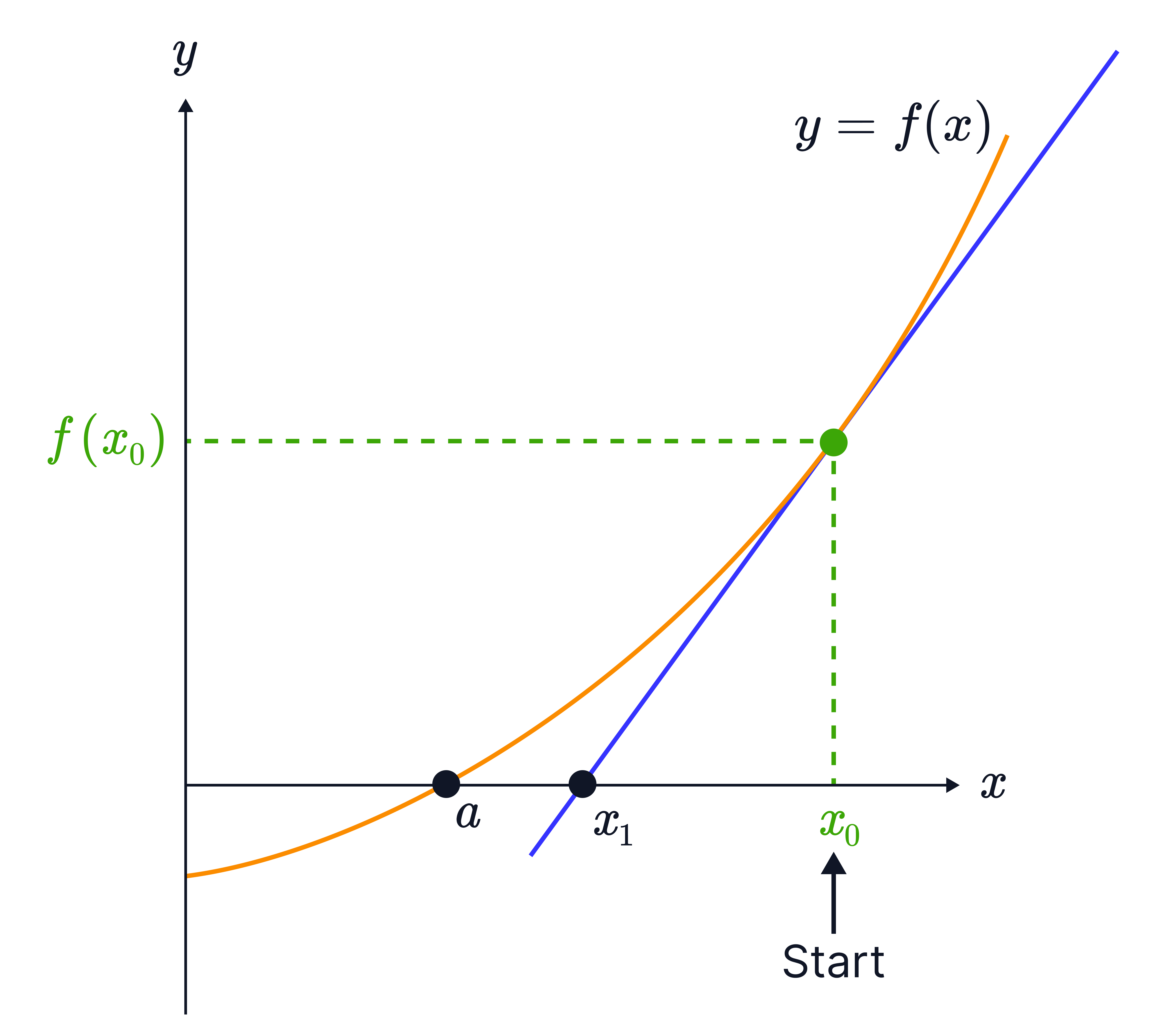
To derive the iterative formula using tangents, we must derive the tangent’s equation by first finding its gradient by differentiating the curve .
We must now find the gradient of the tangent specifically at the point .
We know the coordinates that lie on the tangent, .
We can now use with and to find the equation of our tangent.
As per point ), we are trying to find where the tangent crosses the axis, which is at , which we can then substitute into our tangent equation to form an equation for .
Dividing both sides by ,
Rearranging to isolate ,
We can generalise this by replacing with and with to obtain the formula for the
Newton-Raphson method.
Newton-Raphson Method
Steps:
1) Differentiate to find .
2) Rewrite the Newton-Raphson formula with our and .
3) Substitute the value of into the Newton-Raphson formula to get .
4) Repeat the process of substituting the result into the formula until we get two iterations whose results agree to the degree of accuracy specified in the question.
Example 1:
Use the Newton-Raphson method with and to find a root to correct to decimal places.
Step 1: Differentiate to find .
Step 2: Rewrite the Newton-Raphson formula with our and .
In this step, we substitute the expressions for and into the Newton-Raphson formula, replacing with .
This is known as the iterative formula and we find the next value, , by substituting the current value, , into the formula.
Step 3: Starting with , use the Newton-Raphson formula to find values of , repeating the iteration until we get two results that agree to decimal places.
and agree to decimal places.
Therefore, to decimal places.
Note: In your calculator, you can enter , press equals and it becomes the “answer”. Then, compute the Newton-Raphson formula and use the ANS button which represents and press equals to get . That’ll become your new answer, and you can just press equals straight away, with the formula intact, to get every value thereafter and you won’t have to compute each individual value every time.
No answer provided.
When Newton-Raphson Fails
The Newton-Raphson method fails very rarely. However, there is a particular instance where it does. Remember that we are looking at roots of tangents to a curve.
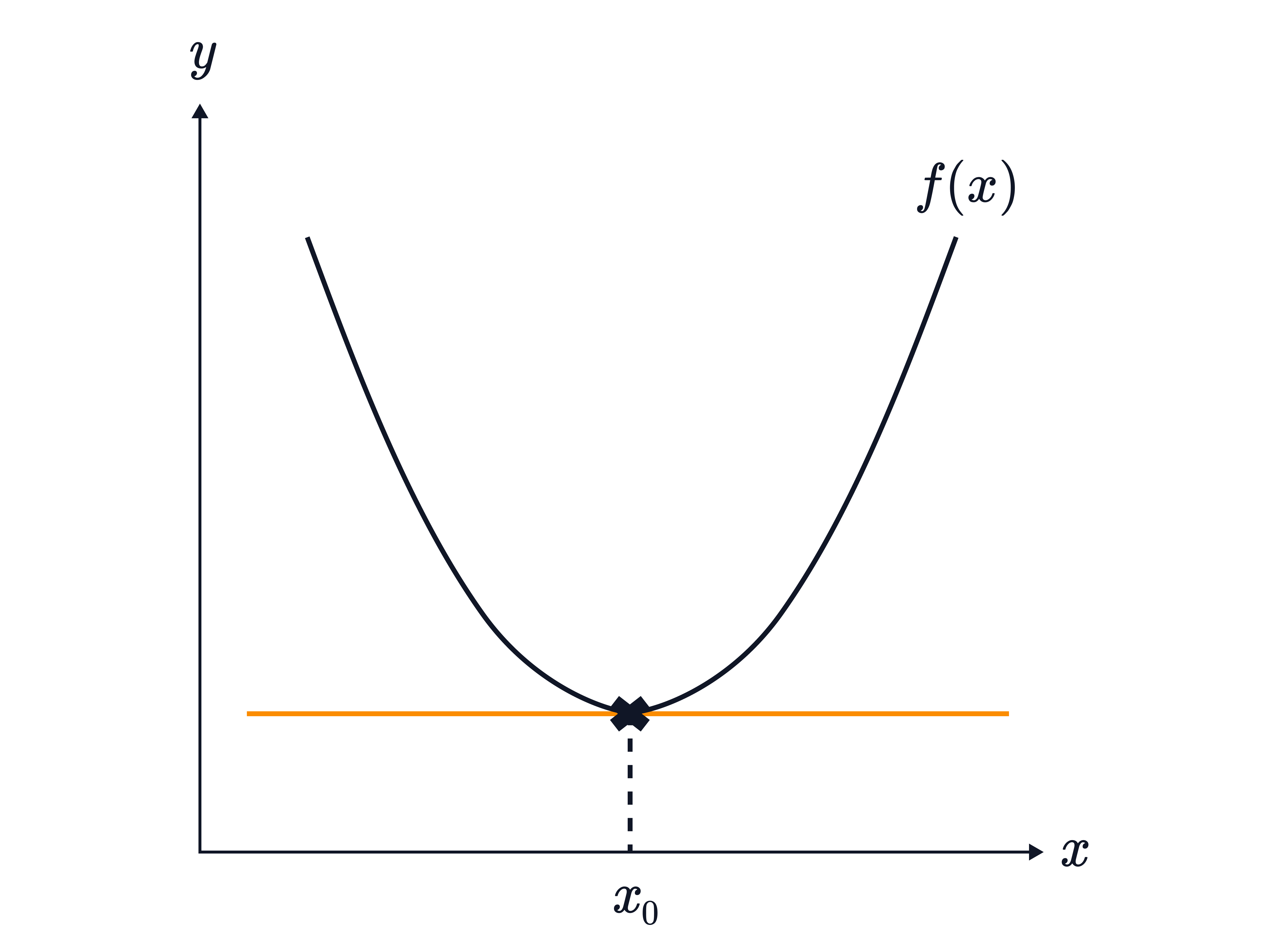
The Newton-Raphson method fails at this stationary point because the tangent to the curve will never meet the axis as the gradient is , or in other words, it’s a horizontal line. Therefore, the gradient of the curve at is and when we refer to our Newton-Raphson formula,
is in the denominator and we cannot divide by and so the Newton-Raphson method fails here.
Example 2:
a) Use the Newton-Raphson Method with and first approximation to obtain a second approximation, , to , where . Give correct to significant figures.
Step 1: Differentiate to find .
We differentiate using the chain rule for an exponential function. The angle is what’s in the power, which in this case is . This differentiates to . Then, in differentiation, the function of stays the same as well as its power.
Angle stays the same
Differentiated angle
differentiates to . So, combining the terms, we get
Step 2: Rewrite the Newton-Raphson formula with our and .
This is our iterative formula.
Step 3: Substitute into the Newton-Raphson formula to get .
Therefore, to significant figures.
b) Explain why the Newton-Raphson method fails if .
The Newton-Raphson method will fail if the denominator, namely , equals to at any moment because we can’t divide by .
Single Step: Substitute into and check.
Using the rule a ,
The function of is the inverse of the function of , so they cancel out. The will come down as a result.
Since , there is a stationary point so, the tangent does not cross the axis. Therefore, can’t be found and hence, the Newton-Raphson method fails.
No answer provided.
Challenging Question