SUVAT in Two Dimensions
Neil Trivedi
Teacher

SUVAT in Two Dimensions
In one-dimensional motion, we use the five SUVAT equations to describe the relationship between displacement , initial velocity , final velocity , acceleration , and time . We apply these in situations where there’s constant acceleration.
However, motion in the real world often occurs in at least two dimensions, such as a particle moving diagonally or a projectile travelling through the air.
We can represent displacement, velocity, and acceleration as vectors, not just scalars. Time remains a scalar quantity, as does mass when we use .
The vectors can be written in the form or as a column vector, . To note, we may prefer to use the column vector form as it is clearer and easier to work with. Examiners allow you to use either unless the question explicitly details which form they want their final answer in. However, for the body of working, the vectors can be in any form.
This means that instead of working separately with the and axes (denoted by and ), we can write most of the SUVAT equations in vector form to describe motion in both directions at once.
Scalar Form | Vector Form |
|
|
|
|
| N/A Note: We cannot simply square a vector in maths. To use this formula when working with vectors would require us to find the scalar forms of the vector first. |
|
|
|
|
We can use the equation to describe a particle’s motion. This equation tells us that “to find the final velocity, we need to know the initial velocity and the particle’s acceleration over time”.
Similarly, we can write an expression for a particle’s position after a given time, provided it is travelling at a constant velocity:
where is the general position vector, is the initial position vector, is the velocity vector, and is the time elapsed.
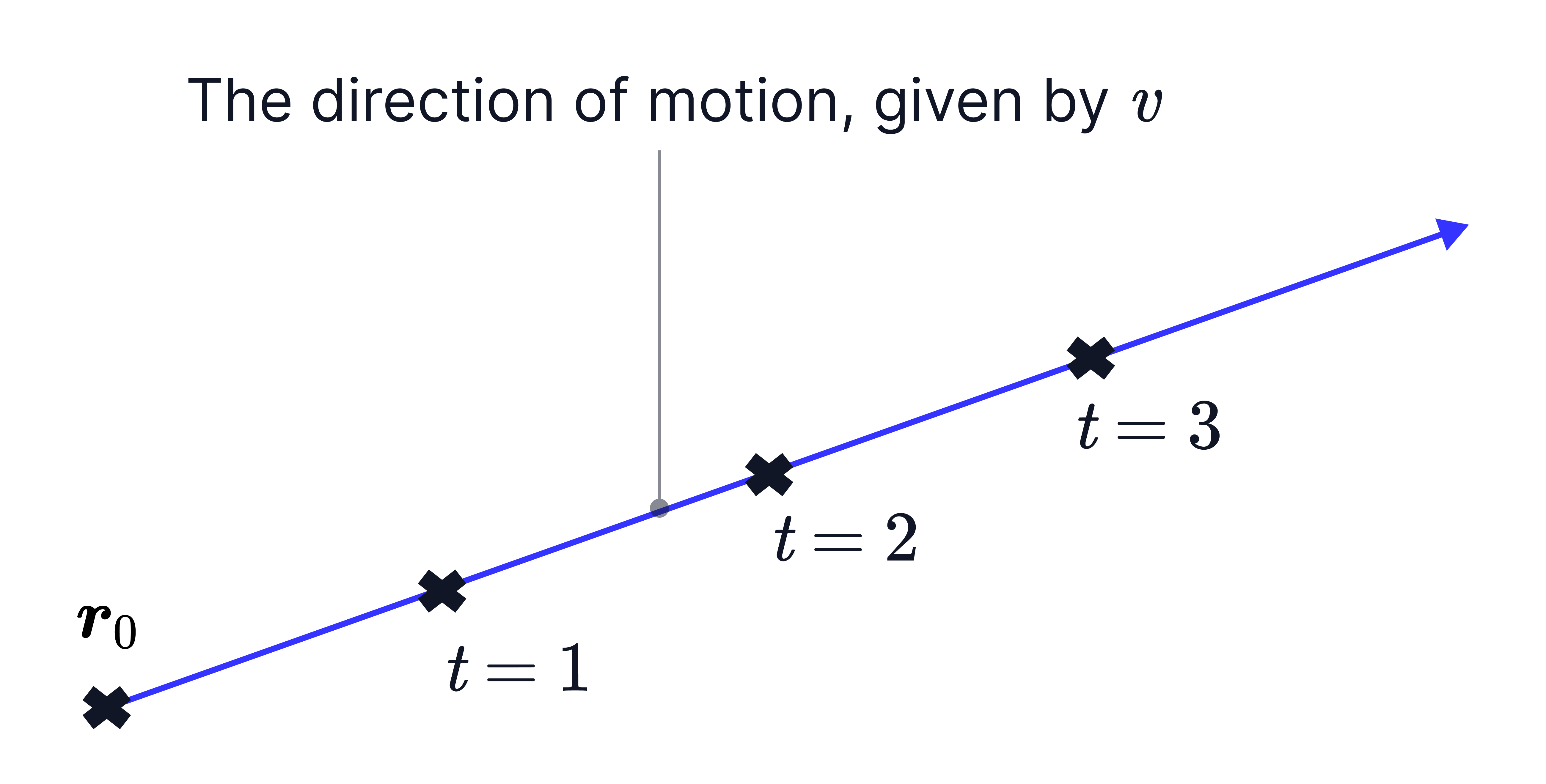
This formula essentially states that the final position can be found given the initial position plus the displacement over a period of time, where displacement is velocity time. The following diagram illustrates this.
Example 1:
A particle starts from the position vector m and moves with constant velocity
ms.
a) Find the position vector of the particle seconds later.
Single Step: Use the derived position formula given constant velocity to find the position vector.
m
b) Find the time at which the particle is due west of the origin.
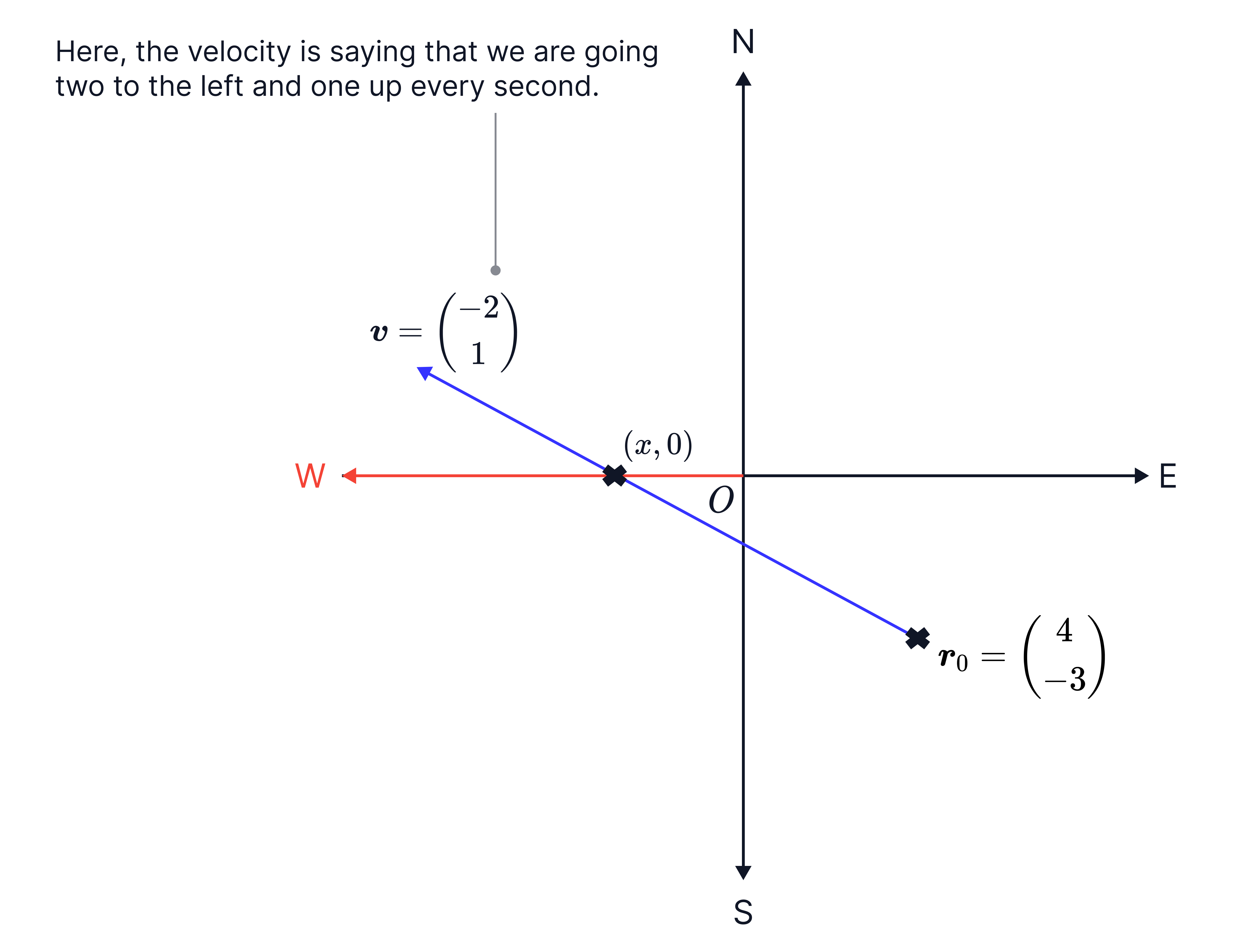
Firstly, here’s a diagram to visualise the motion of the particle. Being due west of the origin means the particle lies on the negative axis, represented by the coordinates on the diagram. Therefore, the component of the position vector must be .
Step 1: Find in terms of .
Step 2: Solve for by making the component equal .
Note: This is the same as making on a standard coordinate axis.
No answer provided.
Example 2:
A particle has initial velocity ms. The particle moves with constant acceleration ms.
a) Find the initial speed of the particle.
Single Step: Use Pythagoras’ Theorem to find the initial speed (the magnitude of the initial velocity).
ms
b) Find the bearing on which it is travelling at time seconds.
Step 1: Use to find the velocity when seconds.
ms
Step 2: Find the direction of motion and express it as a bearing.
Firstly, here is a diagram to help visualise the motion of the particle at seconds. The velocity vector points southeast and it makes the angle with the east axis.
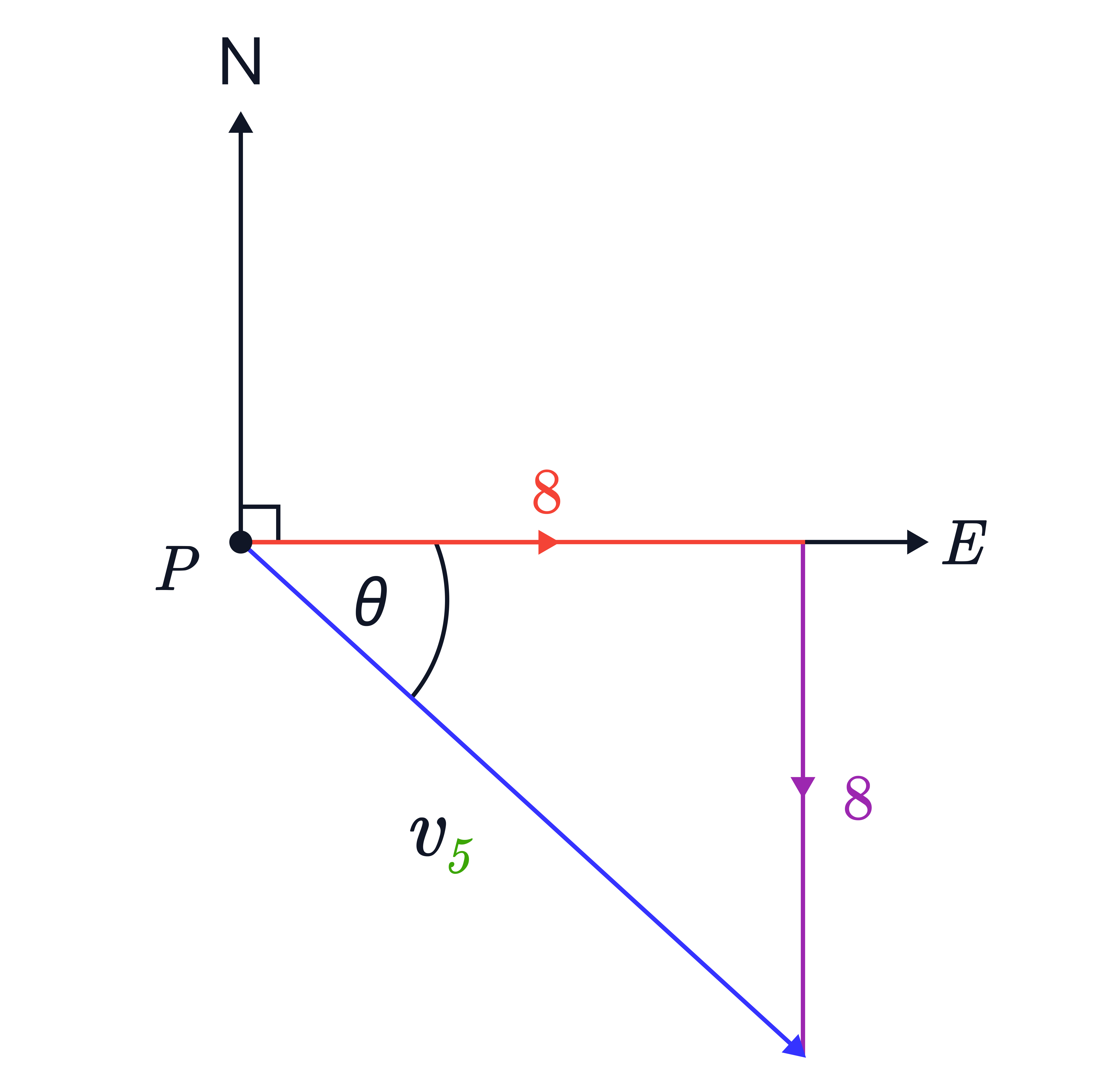
Therefore, the bearing (measured clockwise from the north line) is .
No answer provided.
Example 3:
A particle of mass kg moves in a D plane under the action of a single force newtons. At time seconds, the velocity of is ms.
When , ms, and when , ms.
a) Find the acceleration of .
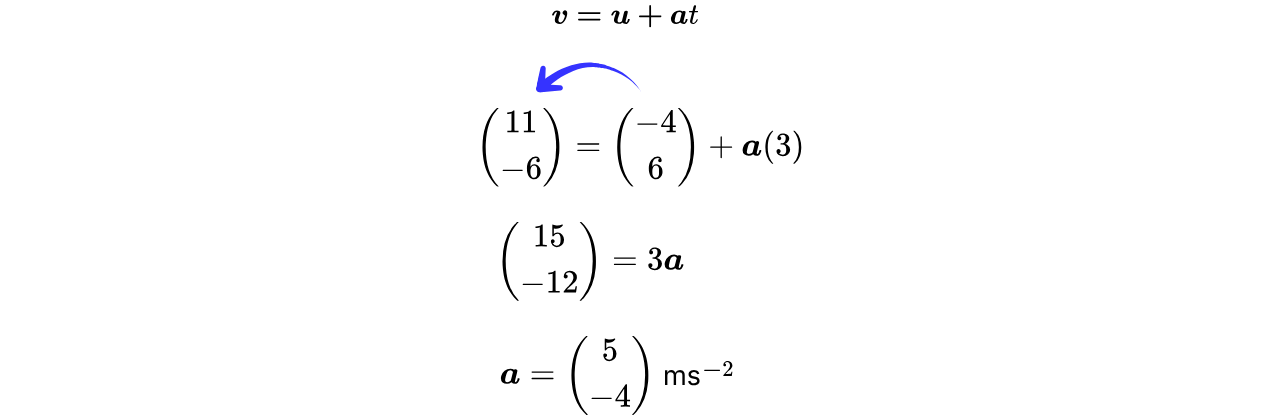
Single Step: Use to find the acceleration.
b) Find the magnitude of .
Step 1: Use the vector form of Newton’s Second Law to find .
N
Step 2: Use Pythagoras’ Theorem to find the magnitude.
N
c) Find, in terms of , the velocity of .
Single Step: Use to find in terms of .
ms
d) Find the time at which is moving parallel to the vector .
Firstly, here’s a diagram to visualise the motion of the particle when it’s moving parallel to the vector . Parallel means it can be any multiple of . We will use to represent the unknown multiple. We can see that the horizontal and vertical components are equal or that if we were using Cartesian coordinates.
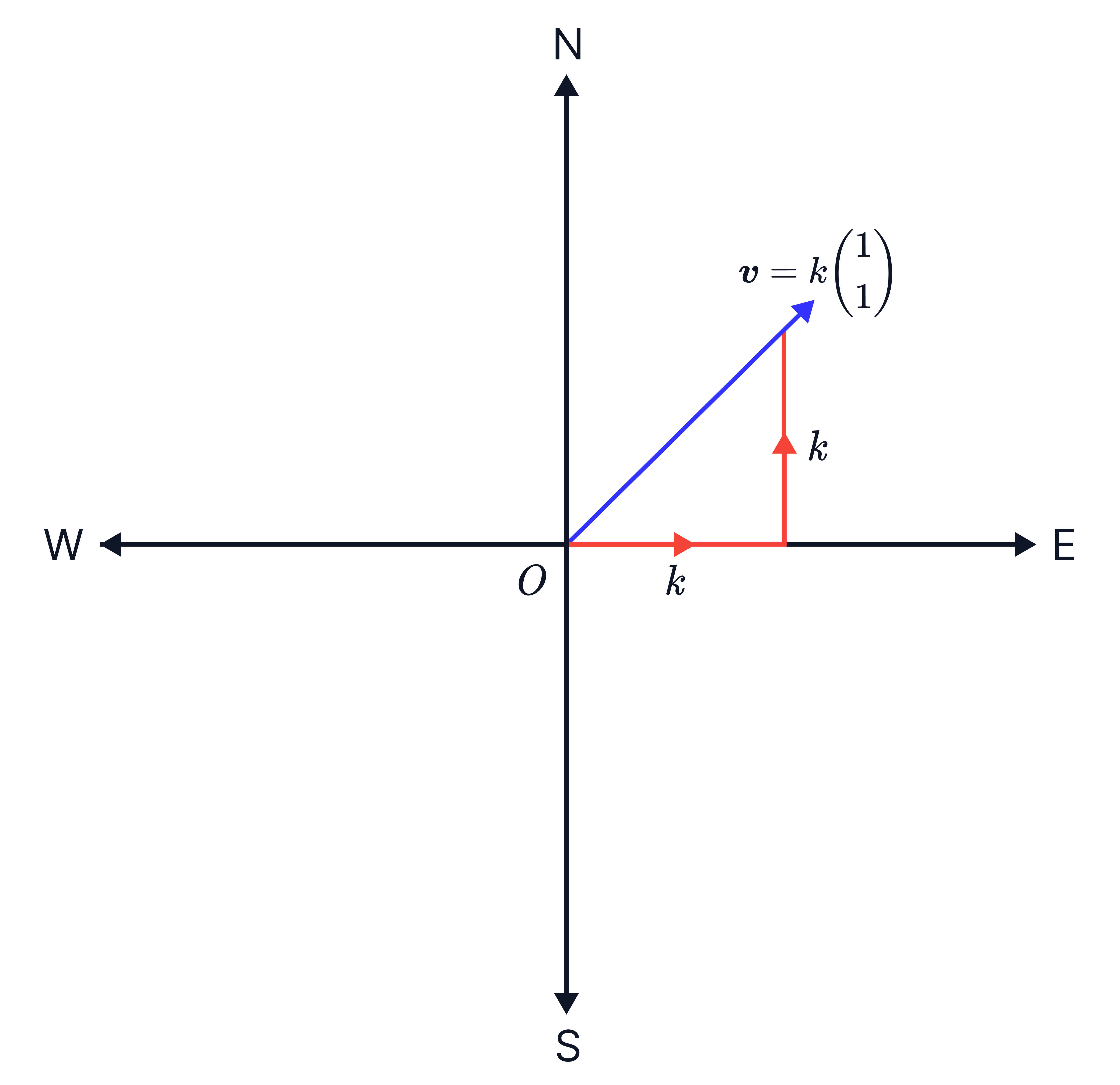
Single Step: Set the velocity vector equal to a scalar multiple of and solve for .
Then equating the horizontal components since they both equal we have:
seconds
No answer provided.
Challenging Question