Trapezium Rule
Neil Trivedi
Teacher

Trapezium Rule
Sometimes, we are given a function, , where we cannot calculate the area between two limits and the axis by integration. In these situations, we use numerical methods to estimate the area. The trapezium rule is one of one of these numerical methods.
By forming trapezia of equal width , we can derive a formula for the approximate area enclosed by the curve , the axis and the limits and . In this derivation, we are splitting the area into equal strips, , , , and .
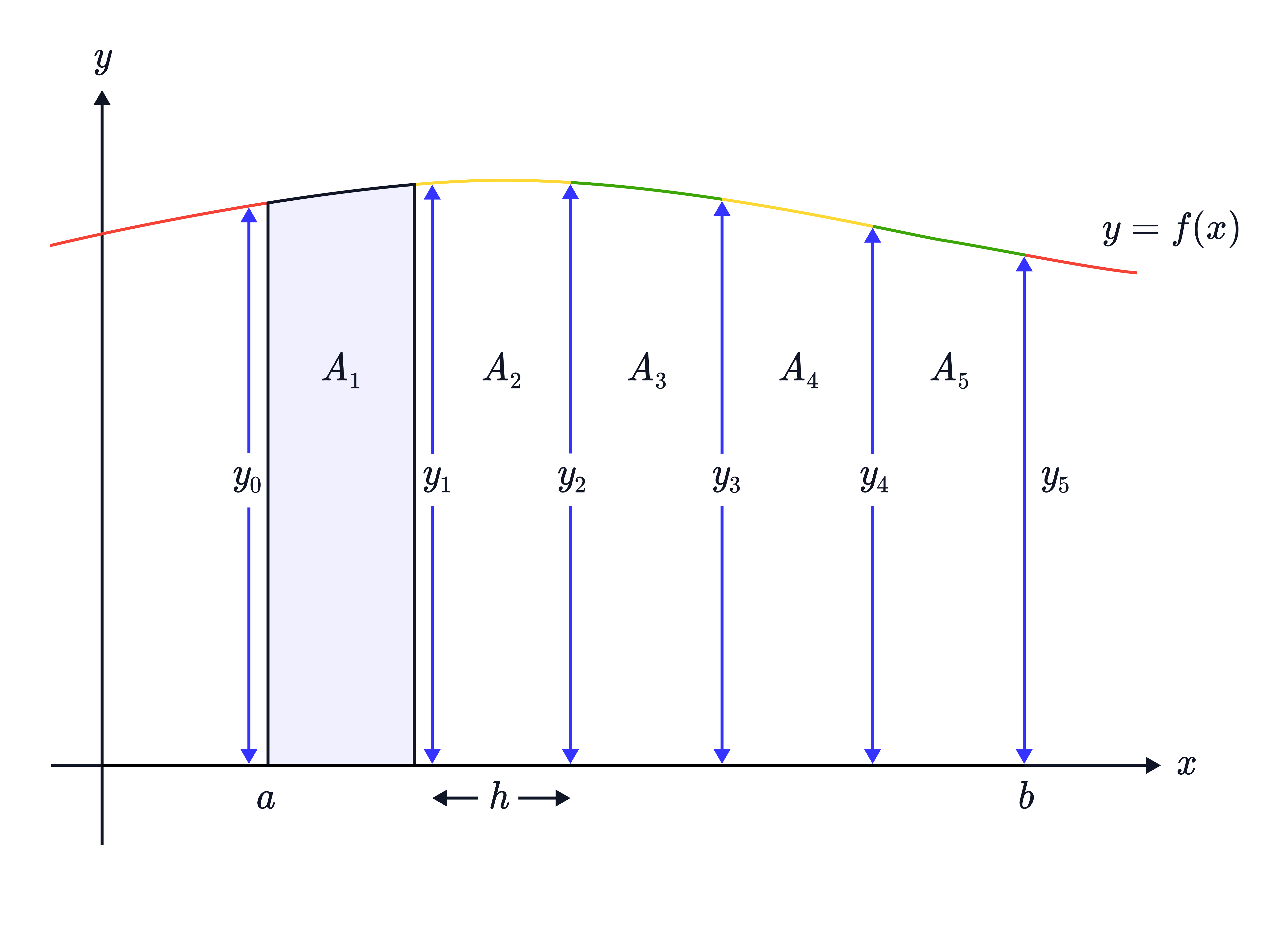
Firstly, recall that the area of a trapezium is , where and are the lengths of the parallel sides and is the height or the distance between the parallel sides.
Consider the trapezium . The parallel sides are and , and the height is . Therefore, the area of is . We then find the area of the other trapezia in the same way.
Adding all these areas together gives:
Factorising out the common factor ,
Therefore, the area under the curve between and is approximated by
This can also be written as
We can clearly see that in the bracket, we add the first and last values once, and then add twice the sum of all the middle values.
first last sum of middle values
General Formula for the Trapezium Rule
Where and is the number of strips.
Underestimate or Overestimate?
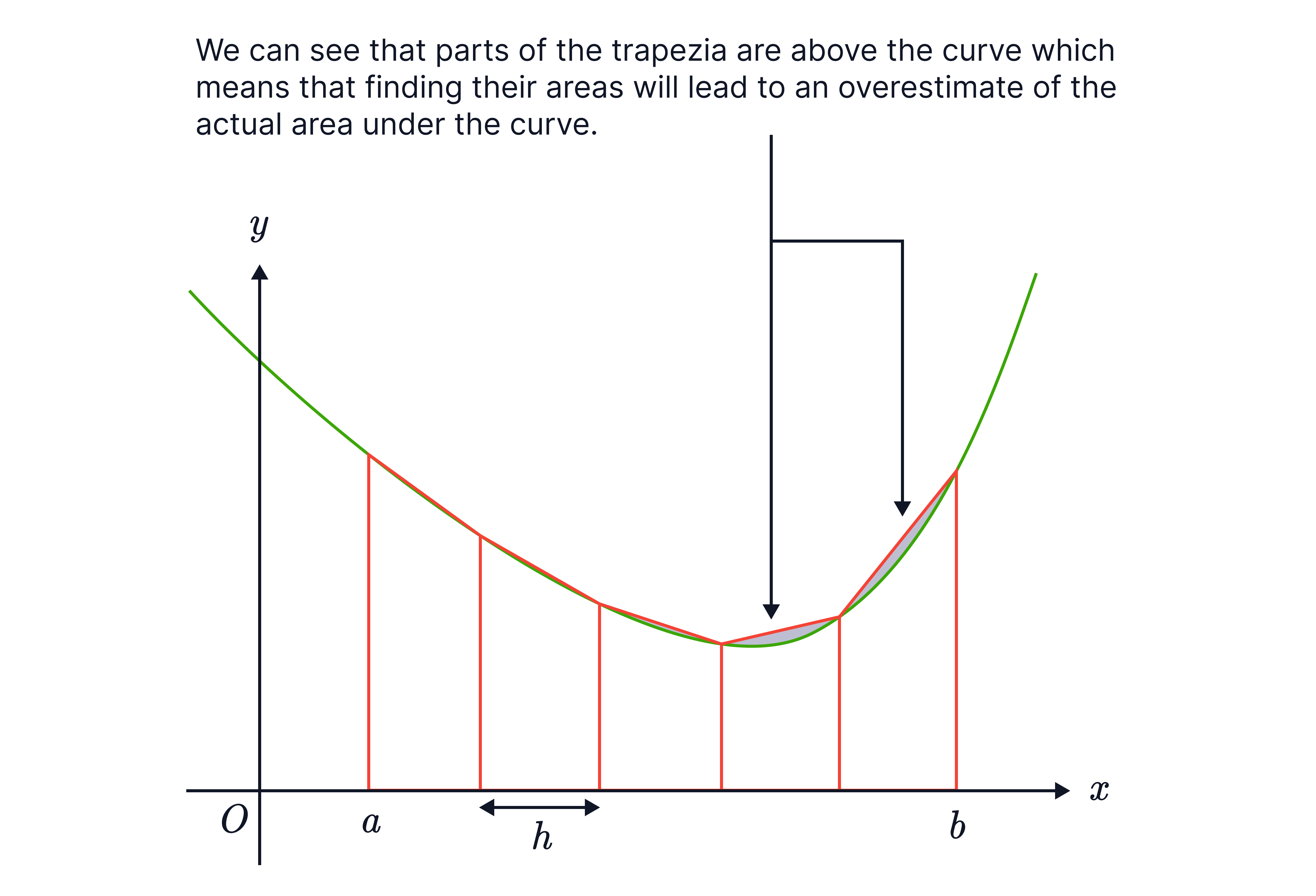
The trapezium rule may give an overestimate or underestimate depending on the shape of the curve. If the curve is convex, parts of the trapezia will lie above the curve, so we get an overestimate.
If the curve is concave, some area under the curve will not be included in the trapezia, so we get an underestimate.
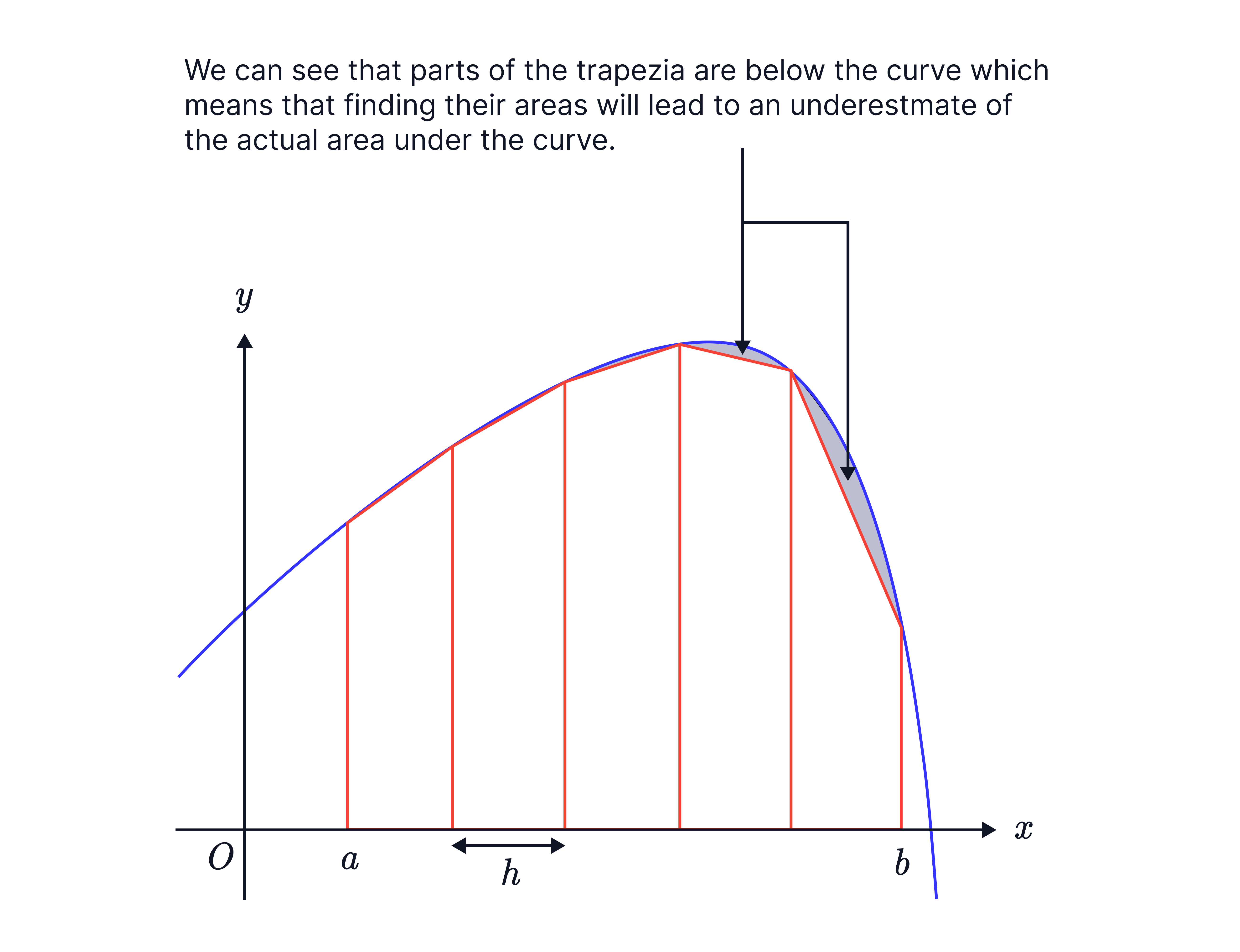
When determining whether our approximation is an overestimate or underestimate, we observe the graph where if it’s convex, then it will be an overestimate, and if it’s concave, then it will be an underestimate. If there is a point of inflection within the limits in which we are finding the area, then we cannot determine if it is an overestimate or underestimate.
Example 1:
Use the trapezium rule with equal strips to approximate the value of:
Give your answer to decimal places.
Step 1: Calculate the height, , of each strip.
where and are the limits in our integral, which are and respectively and is the number of strips which is . So, we have
Step 2: Calculate the values of the function at equal spacings from to .
We substitute values of in increments of from up until into our function
. The following table shows the results.
Note: The number of values we calculate is always more than the number of strips.
|
|
|
|
|
|
|
To maintain accuracy throughout, we store our values in the calculator.
Step 3: Substitute the values obtained into the trapezium rule equation to get the approximate area.
Note: We can obtain the true value from the integration function in the calculator which will give us an indication of an error if we are way off.
Therefore, we have estimated the value to be approximately to decimal places.
No answer provided.
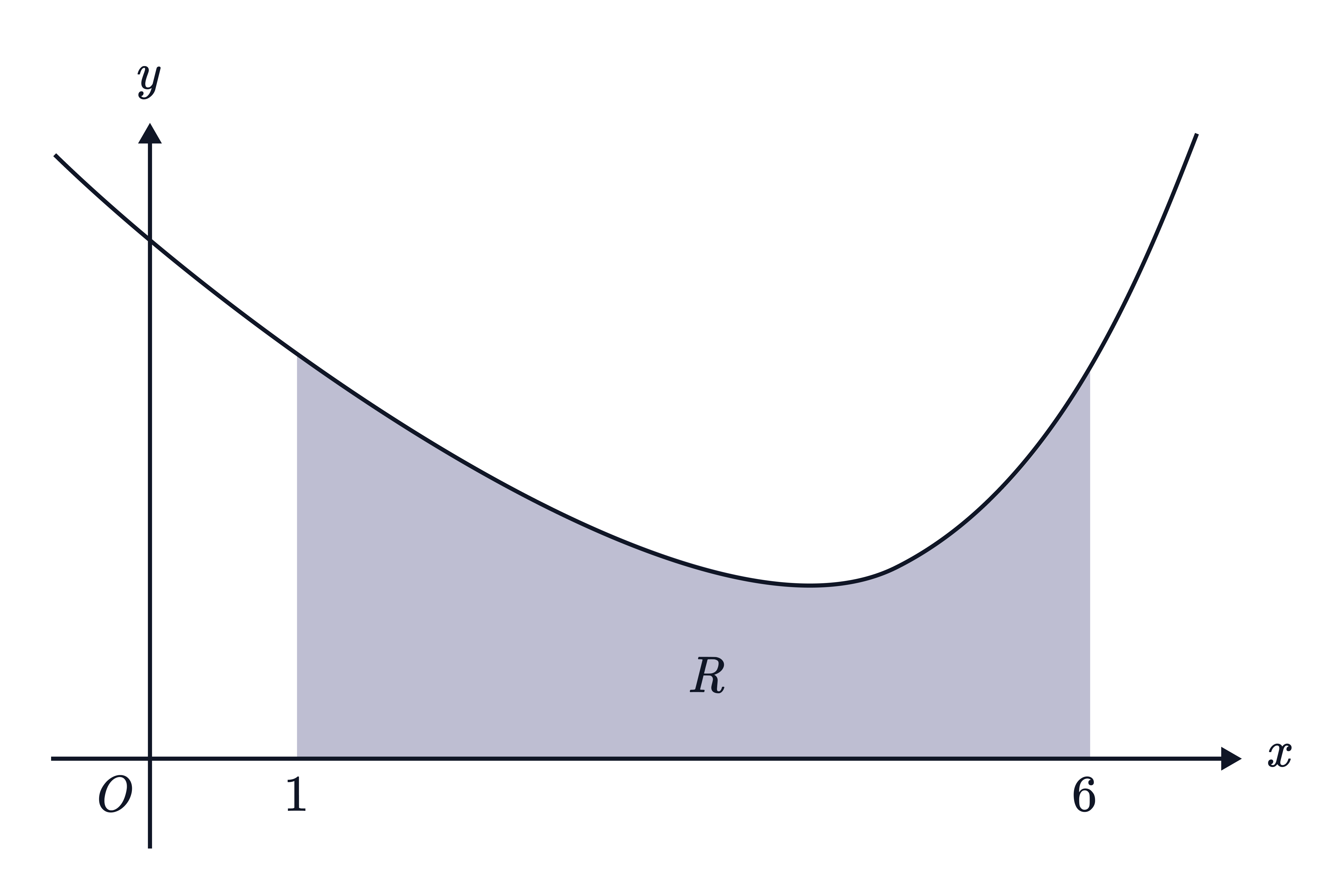
The figure shows part of the curve
The region is bounded by the curve, the axis, and the lines with equations
and .
a) Use the trapezium rule with strips to obtain an estimate the area of to decimal places.
Here’s the diagram with the region split into equal strips, which all have a height of .
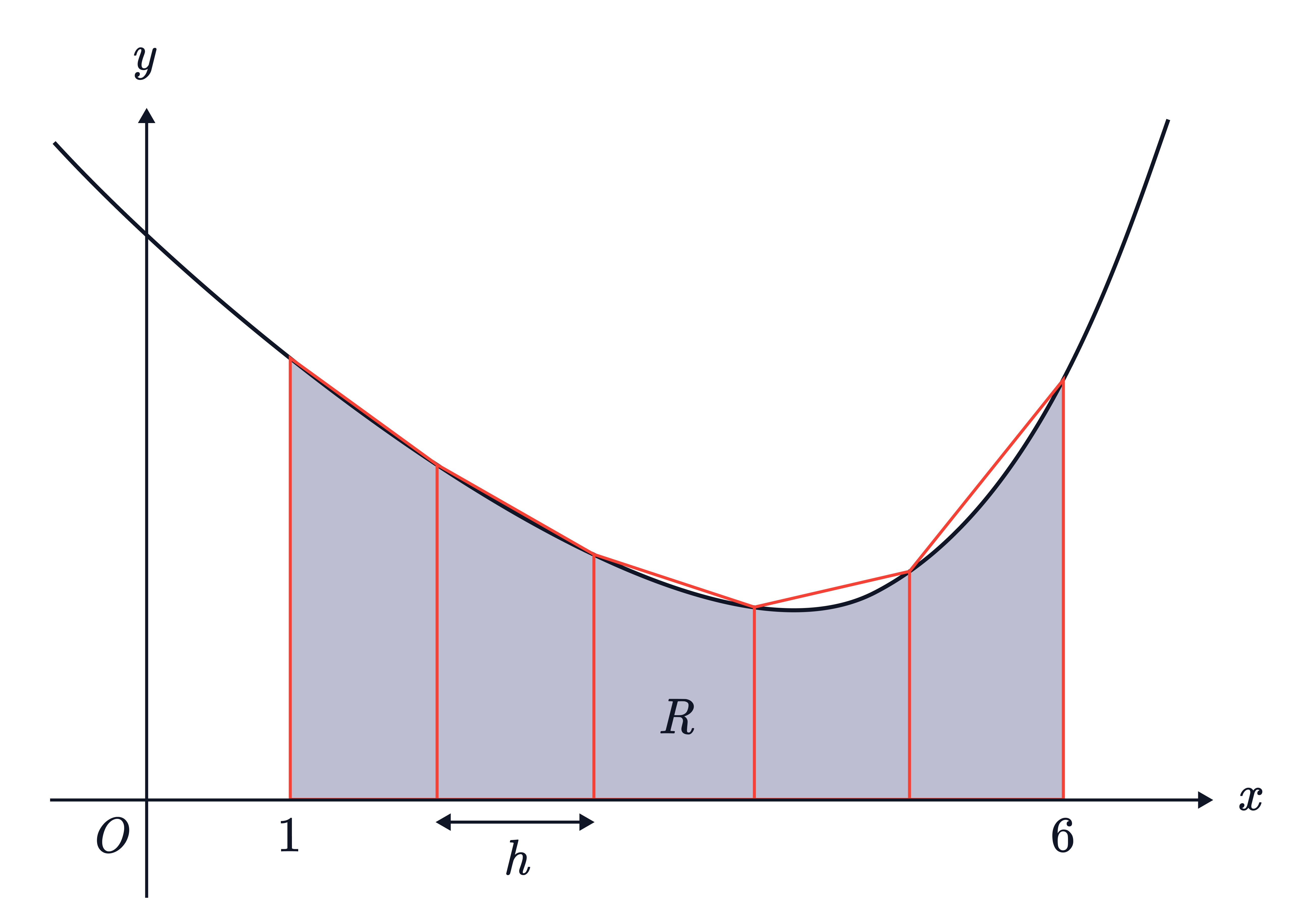
Step 1: Calculate the height, , of each strip.
where and are the limits, which are and respectively and is the number of strips which is . So, we have
Step 2: Calculate the values of the function at equal spacings from to .
We substitute in values of in increments of from up until into our function
. The following table shows the results.
|
|
|
|
|
|
|
|
To maintain accuracy throughout, we store our values in the calculator.
Step 3: Substitute the values obtained into the trapezium rule equation to estimate the area, , of :
Therefore, the approximate area of is to decimal places.
b) Use calculus to find the exact area of and hence, calculate the percentage error to decimal places.
We are evaluating
We know that will integrate to give and will integrate to give . To integrate , we use integration by recognition.
Step 1: Make a guess as to what may differentiate to give .
We will be integrating an exponential function, where the angle is what’s in the power. Here, the angle is .
We will guess . We know that the function of stays the same in differentiation as well as its power. We ignore the as that's a multiplier.
Step 2: Differentiate the guess using the chain rule.
Our angle is , which differentiates to , Then, the function of stays the same as well as its power.
Angle stays the same
Differentiated angle
Step 3: Adjust our guess.
Our guess differentiates to give , but we wanted . So, we multiply both sides by the constant we want over the constant we have, which will be .
Therefore, collecting all our integrated terms together, we get
Step 4: Evaluate the integral with the limits.
We now substitute and into the integrated function and subtract:
Step 5: Find the percentage error between the approximate area we got in part (a) and the exact area of .
The exact value above is , which we will store in the calculator to use below.
Percentage Change
Therefore, the percentage error is approximately to decimal places.
Note: Since the exact value is less than our approximation , we can conclude that the trapezium rule has given an overestimate. This also matches the shape of the graph at the start of the question where the curve is convex, meaning parts of the trapezia lie above the curve, which leads to an overestimate. This observation reinforces the conclusion we obtained from comparing the exact and approximate values.
No answer provided.
Challenging Question