Moles (HT only)
Lajoy Tucker
Teacher

Understanding Moles
Chemical amounts are measured in moles (mol).
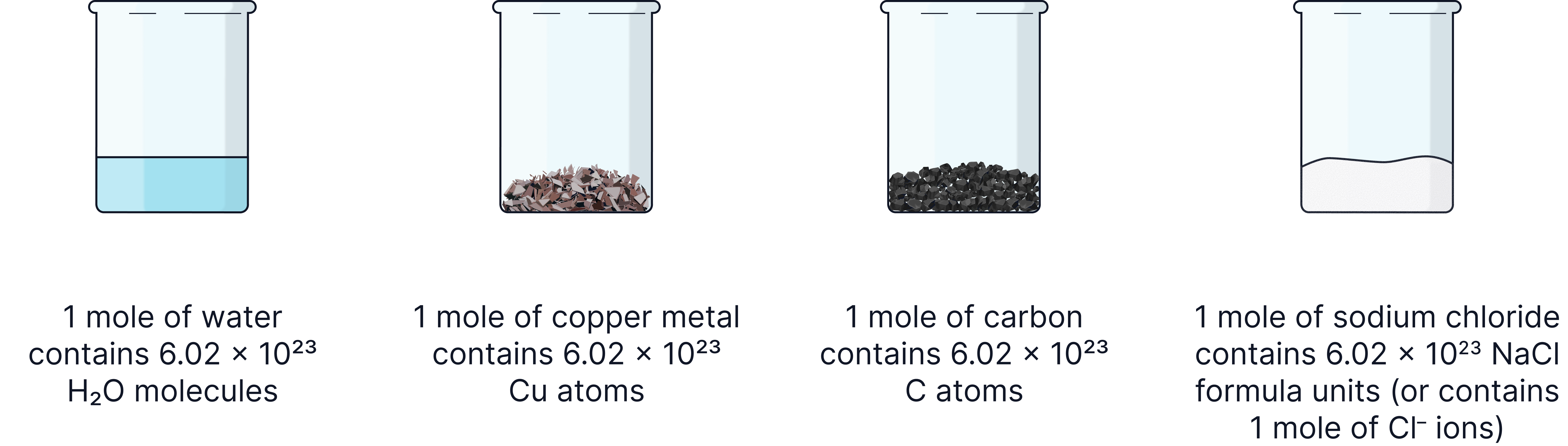
One mole represents a fixed number of particles – atoms, molecules, or ions – in a substance.
The concept of the mole allows chemists to compare amounts of different substances using numbers of particles instead of just masses.
The Avogadro Constant
One mole of any substance contains particles (Avogadro’s number).
This number is called the Avogadro constant and is written as: per mole
These particles can be atoms, molecules, ions, or formula units, depending on the substance.
Number of particles
Examples:
Substance | Type of Particle Counted | Particles in 1 mole |
Carbon (C) | Atoms | 6.02 × 10²³ atoms |
Carbon dioxide (CO₂) | Molecules | 6.02 × 10²³ molecules |
Sodium chloride (NaCl) | Formula units | 6.02 × 10²³ formula units |
Electrons | Subatomic particles | 6.02 × 10²³ electrons |
Worked Example
How many molecules are in 2 moles of oxygen gas ()?
Answer:
Number of molecules = molecules
Relative Formula Mass and Moles
The mass of one mole of a substance (in grams) is numerically equal to its relative formula mass
For example:
Carbon (C):
Carbon dioxide () =
This leads to the key formulae:
Moles (mol) | ||
Mass (g) |
Worked example:
What is the mass of of carbon dioxide ()?
Answer:
Check for Understanding
Recall
a. What is the value of Avogadro’s number?
Answer:
a) 6.02 × 10²³ particles per mole
b. What volume does 1 mole of any gas occupy at RTP?
Answer:
b) 24 dm³
c. What is the formula used to calculate moles from mass?
Answer:
c) moles = mass ÷ Mr
Application
d) What is the mass of of magnesium ()? (Relative atomic mass of ).
Answer:
d)
e) Calculate the number of moles of oxygen atoms in
Answer:
e)
Two O atoms per
Moles of O atoms =
Challenge
f) Calculate the number of water molecules in 3.60 g of H₂O.
(Mr H₂O = 18.0)
Answer:
Moles = 3.60/18.0 = 0.20
Molecules = 0.20 × (6.022×10 23) = 1.204 × 10²³
Summary
• Moles (mol) measure amounts of substances.
• 1 mole of any substance contains 6.02 × 10²³ particles (the Avogadro constant).
• The mass of 1 mole (in g) equals the relative formula mass ().
• Use and related equations for calculations.
• The mole concept links mass, particle numbers, and chemical equations, helping predict quantities of reactants and products.
No answer provided.