Nanoparticles (Triple Only)
Emmanuel Opoku
Teacher

Contents
What Are Nanoparticles?
Definition:
Nanoparticles are materials that contain structures with sizes between 1 – 100 nanometres (nm) - roughly a few hundred atoms in size.
They sit between atomic and bulk (larger) materials in scale.
Comparing Particle Sizes
Type of Particle | Approx. Diameter | Example | Common Name |
|---|---|---|---|
Nanoparticles | 1 – 100 nm | Silver nanoparticles | — |
Fine particles (PM2.5) | 100 – 2500 nm (1 × 10⁻⁷–2.5 × 10⁻⁶ m) | Dust, smoke | Fine dust |
Coarse particles (PM10) | 2500 – 10 000 nm (2.5 × 10⁻⁶–1 × 10⁻⁵ m) | Sand, pollen | “Dust” |
Nanoparticles are smaller than fine particles, which are smaller than coarse particles.
Surface Area to Volume Ratio (SA : V)
As the size of particles decreases, the surface area to volume ratio increases dramatically.
Take a cube for example…
Formulas for volume and surface area of a cube
1.
2.
3.
Example Calculations (HT ONLY)
Cube side (nm) | Surface Area (nm²) | Volume (nm³) | SA : V Ratio |
|---|---|---|---|
100 nm | 6 × 100² = 60 000 nm² | 100³ = 1 000 000 nm³ | 0.06 |
10 nm | 6 × 10² = 600 nm² | 10³ = 1 000 nm³ | 0.6 |
1 nm | 6 × 1² = 6 nm² | 1³ = 1 nm³ | 6 |
Comparison:
When the side decreases by ×10, the SA : V ratio increases by ×10.
Small particles expose more surface area per unit volume, so reactions happen faster and less material is needed.
Why It Matters
Higher SA : V leads to faster reactions (important for catalysts).
Small amounts can be very effective (useful in medicine or coatings).
Nanoparticles often have different properties compared to bulk materials.
No answer provided.
Uses of Nanoparticles
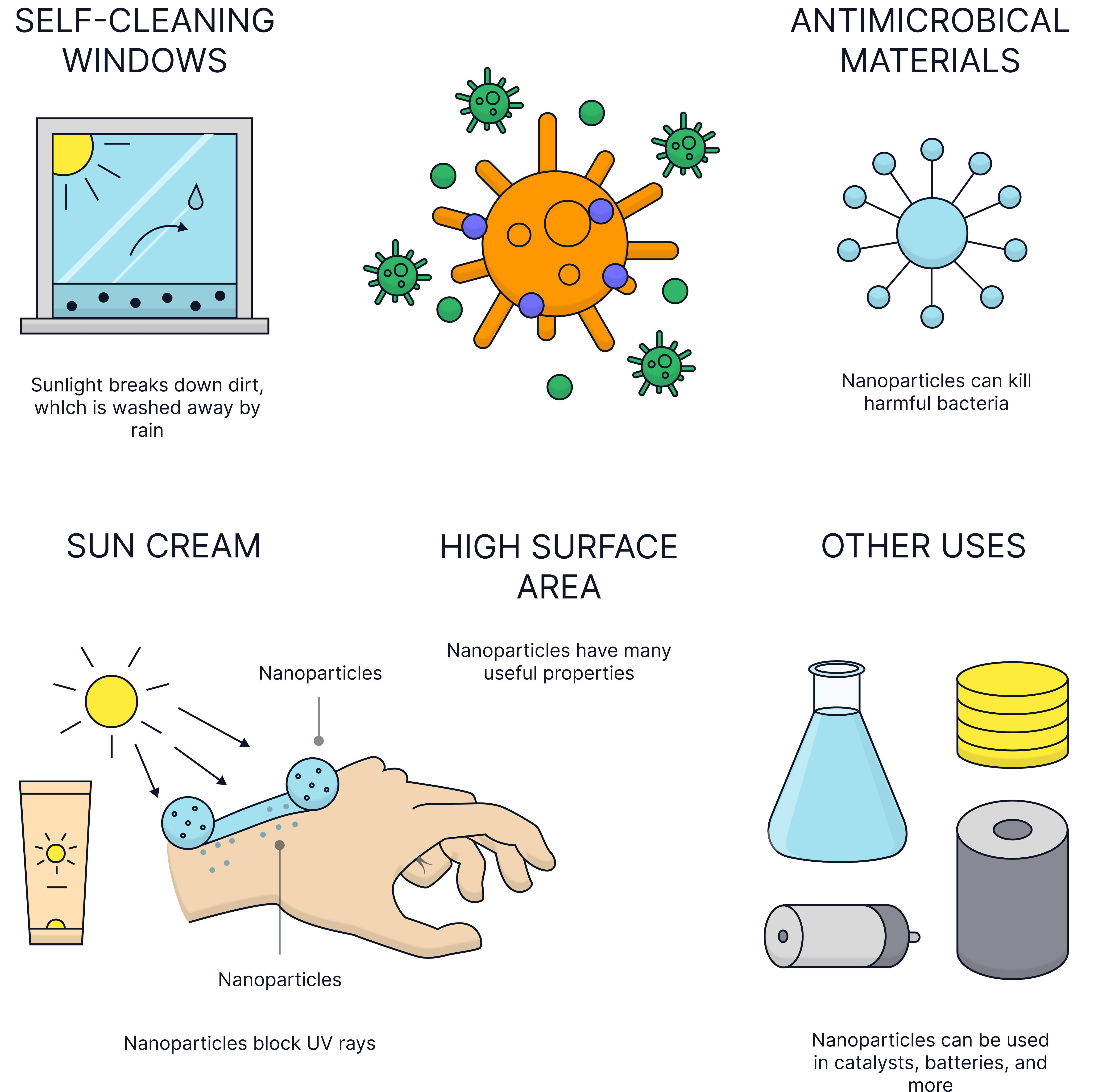
Evaluating Nanoparticles
Advantages | Disadvantages / Risks |
|---|---|
Require only small amounts (cost-effective) | May enter the body through skin/lungs |
High reactivity (efficient use) | Possible toxic or unknown effects |
Enable new technologies (electronics, medicine) | May accumulate in environment (TRIPLE ONLY) |
Reduce material waste | Further testing and regulation needed |
Comparing Bulk and Nano Materials
Property | Bulk Material | Nanoparticle Form |
Surface area volume | Small | Very large |
Reactivity | Lower | Higher |
Quantity needed | Large | Small |
Uses | Conventional | Medical, Catalylic, Electronic |
Check for Understanding
Recall
a) What size range defines nanoparticles?
Answer:
a) 1–100 nm.
b) Write the formula for calculating surface area and volume of a cube.
Answer:
SA :
c) What happens to surface area : volume ratio as particle size decreases?
Answer:
The ratio increases as particle size decreases.
d) Give one medical and one industrial use of nanoparticles.
Answer:
Medicine: drug delivery; Industry: catalysts.
e) State one possible risk of using nanoparticles.
Answer:
Unknown long-term health and environmental effects.
Apply (HT)
f) Calculate the SA : V ratio for a cube of side = 2 nm.
Answer:
SA :
g) Explain why nanoparticles make good catalysts.
Answer:
Larger SA : V means more surface available for reactions.
h) Evaluate the use of nanoparticles in sun creams.
Answer:
Advantage: Blocks UV more effectively. Disadvantage: Potential cell and environmental damage.
i) Suggest why smaller particles are more reactive.
Answer:
More atoms are exposed at the surface to react.
Summary — Foundation vs Higher Tier
Concept | Foundation Tier | Higher Tier (HT Only) |
|---|---|---|
Size range | 1–100 nm | Expressed as 1 × 10⁻⁹– 1 × 10⁻⁷ m |
Surface area : volume | Understanding link (smaller particle size = higher SA : V) | Quantitative using cube example |
Properties | Different from bulk | Explained by more accessible surface for reactions to take place |
Risks | Unknown | Toxicity and environmental evaluation |
No answer provided.