Properties Of Transition Metals (Triple Only)
Lajoy Tucker
Teacher

Contents
Introduction
-
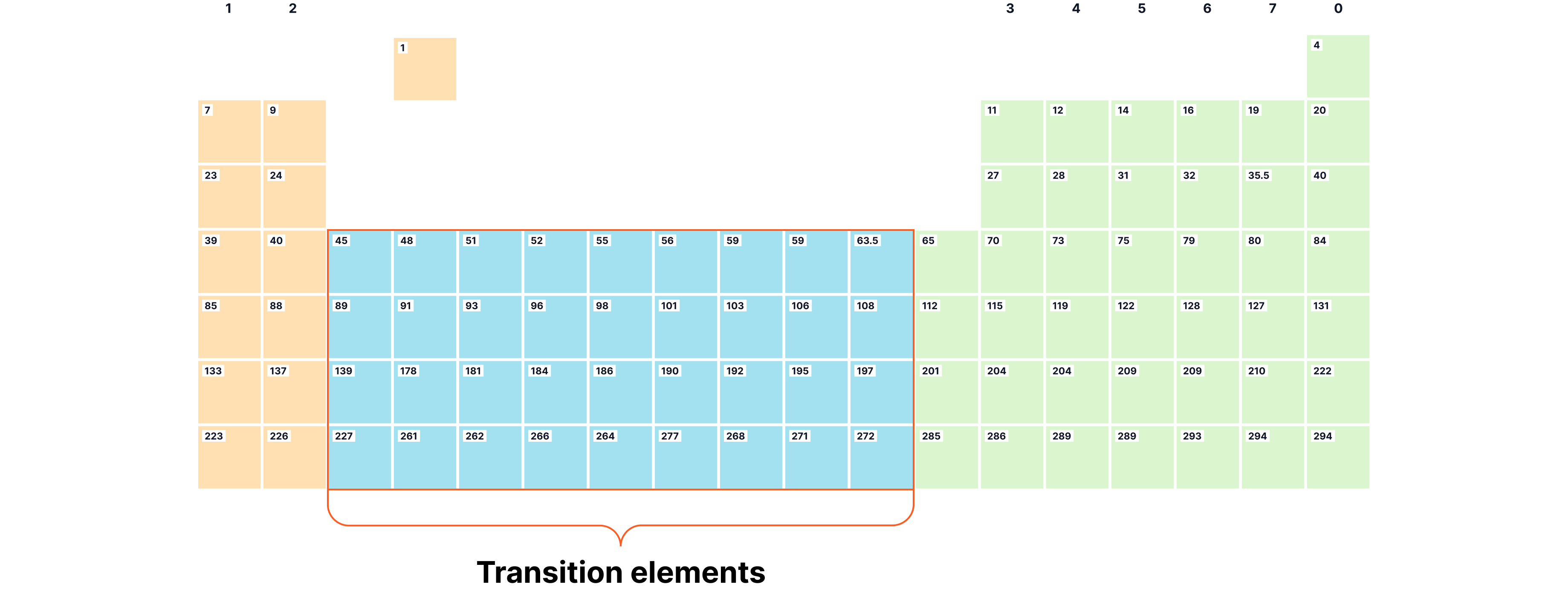
The transition elements are the metals in the centre block of the periodic table, between Groups 2 and 3.
-
Examples include chromium (Cr), manganese (Mn), iron (Fe), cobalt (Co), nickel (Ni) and copper (Cu).
-
They are all metals and share similar physical and chemical properties that differ from the metals in Group 1 (the alkali metals).
General Properties of Transition Metals
General Properties of Transition Metals
Transition metals have several special properties that make them distinct and useful:
|
Property |
Description / Example |
|
Form ions with different charges |
Transition metals can form more than one type of ion, e.g. Fe²⁺ and Fe³⁺, Cu⁺ and Cu²⁺. |
|
Form coloured compounds |
Transition metal compounds are often brightly coloured: |
|
Act as catalysts |
Many transition metals and their compounds speed up chemical reactions: |
Comparison Between Transition Metals and Group 1 Metals
Physical properties
Chemical properties
|
Properties |
Property |
Transition Metals (e.g. Fe, Cu, Ni) |
Group 1 Metals (e.g. Li, Na, K) |
|
Physical |
Melting points |
High |
Low |
|
Physical |
Density |
High |
Low |
|
Physical |
Hardness |
Hard |
Soft (can be cut with a knife) |
|
Physical |
Strength |
Strong |
Soft |
|
Physical |
Compound colours |
Coloured |
White solids and colourless solutions |
|
Chemical |
Ions formed |
Multiple charges |
+1 only |
|
Chemical |
Reactivity with oxygen |
React slowly (often form protective oxide layers) |
React rapidly (form oxides easily) |
|
Chemical |
Reactivity with water |
React slowly or not at all |
React vigorously |
|
Chemical |
Reactivity with halogens |
Less reactive |
Very reactive |
Check Your Understanding
Recall
State two physical differences between transition metals and Group 1 metals.
Answer:
Transition metals:
Have higher melting points
Are denser
Are harder than Group 1 metals
Describe three differences in chemical behaviour between Group 1 and transition metals.
Answer:
Transition metals are less reactive with oxygen and water than Group 1 metals
Transition metals form ions with different charges whereas Group 1 metals form only +1 ions
Transition metals form coloured compounds, whereas Group 1 metals form only white compounds
Summary
Transition metals are found in the centre of the periodic table and include Cr, Mn, Fe, Co, Ni, and Cu.
They have high melting points, densities, strength and hardness, unlike soft, reactive Group 1 metals.
Chemically, they are less reactive and can form multiple ions, coloured compounds, and act as catalysts.
These properties make transition metals essential for industrial processes, construction, and everyday materials.
No answer provided.
More Practice
Try to answer the practice question from the TikTok video on your own, then watch the video to see how well you did!