Introduction to Surds
Neil Trivedi
Teacher

Introduction to Surds
A surd is a root (this can be a square root or another root but, in this note, we will focus on square roots) that cannot be simplified to give a whole number.
Examples of surds include and .
However, and are not surds because they can be simplified to give whole numbers.
Surds are irrational numbers, meaning they cannot be written in the form where and are integers, and cannot equal .
We can use our index rules to work with surds. Recall that
Now, consider the expression . We can derive the result using index rules.
First, we rewrite each square root in index form
Next, we use the index rule which states that , and we get
Therefore,
This result is used when simplifying expressions involving repeated surds such as .
Important note: the root function is always positive.
For example:
The value appears only when solving equations such as , but not when simplifying surds.
Example 1:
Find:
a)
Single Step: Use the result to simplify the expression.
b)
Here, we have a coefficient in front of the . All this means is that we are doing and after we multiply the surds, we just multiply the result by .
Single Step: Use the result to simplify the expression and multiply the result by the coefficient.
Since ,
c)
Single Step: Multiply the coefficients and use the result to simplify the expression.
Here, the coefficients are and . We multiply those together and then multiply the surds.
Since and ,
Sometimes, we are asked to simplify a surd by factorising out a square number. A surd can be simplified if the number inside the root can be written as a product of two factors where one factor is a square number other than .
Using the index rule for products,
and the fact that , we have
This means that
We will use this rule to split the root. If is a square number, then will be a whole number, which helps us simplify the surd.
For example, consider .
First, we write as a product of two factors where one of them is the largest square number that’s a factor of .
Recall that the square numbers are
To note, we do not use as a square factor when simplifying surds as it does not change the expression. For example, if we rewrite as , and then split the root to give us , it would just give us and we’d be back at the beginning.
The largest square number factor of is . So, we write as
So,
Splitting the root,
Since ,
Example 2:
Simplify the following surds:
a)
Single Step: Write the number inside the root as a product of two factors where one factor is the largest square number factor and then simplify.
The largest square number factor of is , so we write as . So,
Splitting the root,
Since ,
b)
Single Step: Write the number inside the root as a product of two factors where one factor is the largest square number factor and then simplify.
The largest square number factor of is , so we write as . So,
Splitting the root,
Since ,
c)
Step 1: For both terms, write the number inside the root as a product of two factors where one factor is the largest square number factor and then simplify.
The largest square number factor of is , so we write as . So,
Splitting the root,
Since ,
The largest square number factor of is , so we write as . So,
Splitting the root,
Since ,
Step 2: Collect like terms.
Both terms are in terms of so we can collect like terms by adding the coefficients.
In the next example, we will be multiplying different surds. In comparison to example 1, where the surds were the same and could be simplified to a whole number, the surds here will not simplify in that way. We use the following rule
This means we combine the numbers inside the roots by multiplying them together. We can think of this as working backwards from splitting a surd like we did in example 2.
As always, if there are any coefficients, we multiply those separately from the surds.
Example 3:
Simplify the following surds:
a)
Single Step: Multiply the coefficients and the numbers inside the roots and then simplify.
b)
Single Step: Multiply the coefficients and the numbers inside the roots and then simplify.
We can simplify because , which is a square number, is a factor of and is the largest square number factor. So, we write as .
Since ,
Hence, .
c)
Single Step: Multiply the coefficients and the numbers inside the roots and then simplify.
We can simplify because , which is a square number, is a factor of and is the largest square number factor. So, we write as .
Since ,
Hence, .
Expanding Brackets with Surds
The following example involves expanding brackets with surds. This works exactly the same way as expanding algebraic expressions such as or .
Example 4:
Expand and simplify:
a)
Single Step: Expand the brackets and simplify the expression.

b)
Single Step: Expand the brackets using FOIL and simplify the expression.
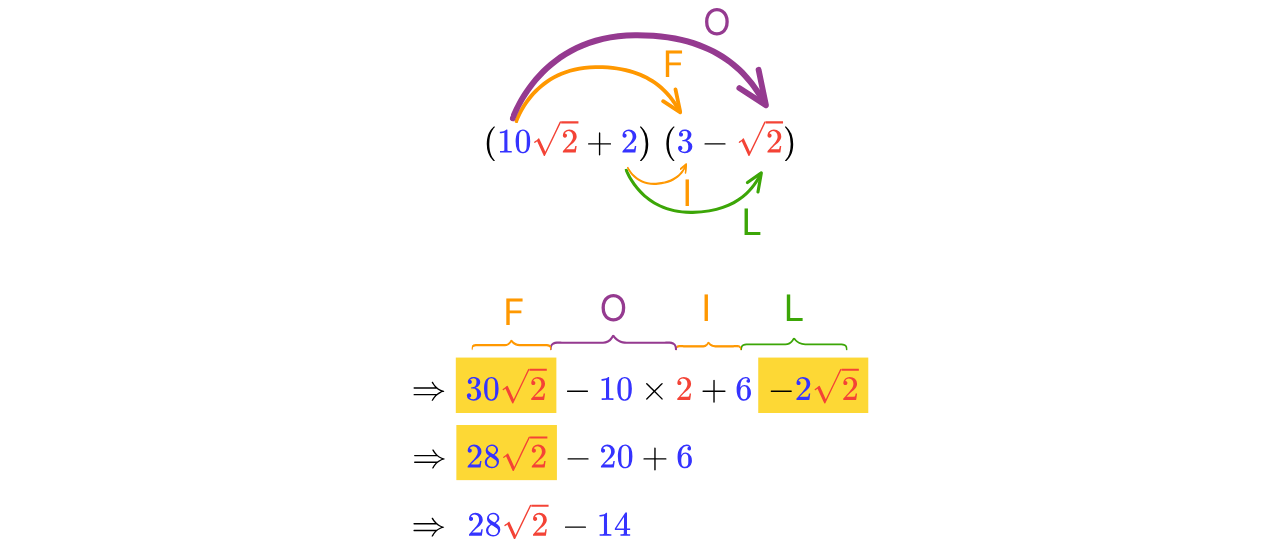
c)
Single Step: Expand the brackets using FOIL and simplify the expression.
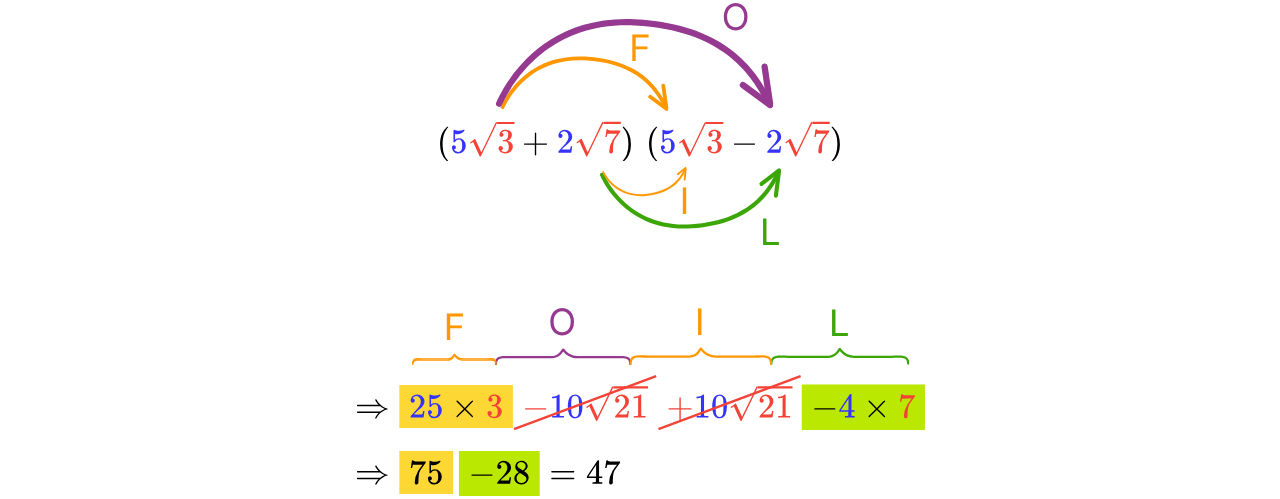
Notice that this question is an example of the difference of two squares principle
for which when we expand the brackets, the middle terms cancel out.
Practice Questions