Magnets
Brook Edgar & Hannah Shuter
Teachers


Explainer Video
Poles of a Magnet
Magnets have two poles:
North Pole
South Pole
When the North pole of one magnet faces the South pole of another magnet, they feel a force of attraction, trying to pull the two magnets together.

If the North pole of one magnet faces the North pole of another magnet, they feel a force of repulsion, trying to push the magnets away from each other.

This magnetic force is a non-contact force as it does not require the two objects to be touching for the force to act.
Rule -> Opposites Attract, Likes Repel
The closer the magnets are, the stronger the force between them. Below we can see that as the magnets are closer together, there will be a larger force between them trying to push them apart.

Magnets with fixed poles that do not change are called permanent magnets. These magnets are made of steel.
Iron, however, is an induced magnet. This means that it does not keep its magnetism. If we have a bag of iron nails, they are not all stuck together inside the bag as they are not magnetic; however, if a permanent magnet were brought near them, they would all become magnetic, but they would all lose their magnetism when the permanent magnet was taken away.
-> When an induced magnet is placed in a magnetic field, it becomes magnetic and is ALWAYS attracted. They do so by forming a pole at the end of the induced magnet, opposite to that of the permanent magnet, to ensure it is attracted. Iron, cobalt and nickel are induced magnets; they become magnetic when placed in a magnetic field but lose their magnetism when the magnetic field is removed.
For example, the figure below shows two iron nails brought near a permanent magnet.

Iron is an induced magnet; when placed near a permanent magnet, it becomes magnetic and is attracted. The nails are attracted to the magnet. As the left side of the permanent magnet is a North pole, the left iron nail needs to form a South pole at its top end to get attracted -> opposites attract. The right side of the permanent magnet is an S pole, so the iron nail needs to form an N pole at its top end to be attracted. The opposite ends of the nails form the opposite poles.

When the permanent magnet is removed, the iron nails will lose their magnetism and thus will no longer be magnetic and have magnetic poles.
Unmagnetised steel becomes magnetic when placed in a magnetic field, like iron, cobalt, and nickel, but unlike the others, it does not lose its magnetism when the magnetic field is removed -> its poles are fixed, and it is now a permanent magnet.
Worked Example:
The image shows two iron nails hanging from a bar magnet; they were initially unmagnetised and are now magnetised.

State what type of magnets they are.
Label the north and south poles on the iron nails.
Answer:
Iron is an induced magnet.
Induced magnets are always attracted, so as the top of the first nail is touching a S pole, it must form a N pole there to be attracted. The other end of the nail then becomes the opposite pole. As the two nails are stuck together, the opposite poles form at the top ends of the two nails. Rule -> opposites attract.

Magnetic Field Lines
Magnetic field lines show us the region of space around a magnet where another magnet will experience a force.
Magnetic field lines are always drawn coming out of the North pole and going into the South pole.

We know the shape of the magnetic field lines around permanent magnets from using iron filings (iron powder).
Iron is an induced magnet, so when sprinkled around a permanent magnet:
they become temporarily magnetised
line up along the magnetic field lines, making the field pattern visible
gather most around the poles of the magnet
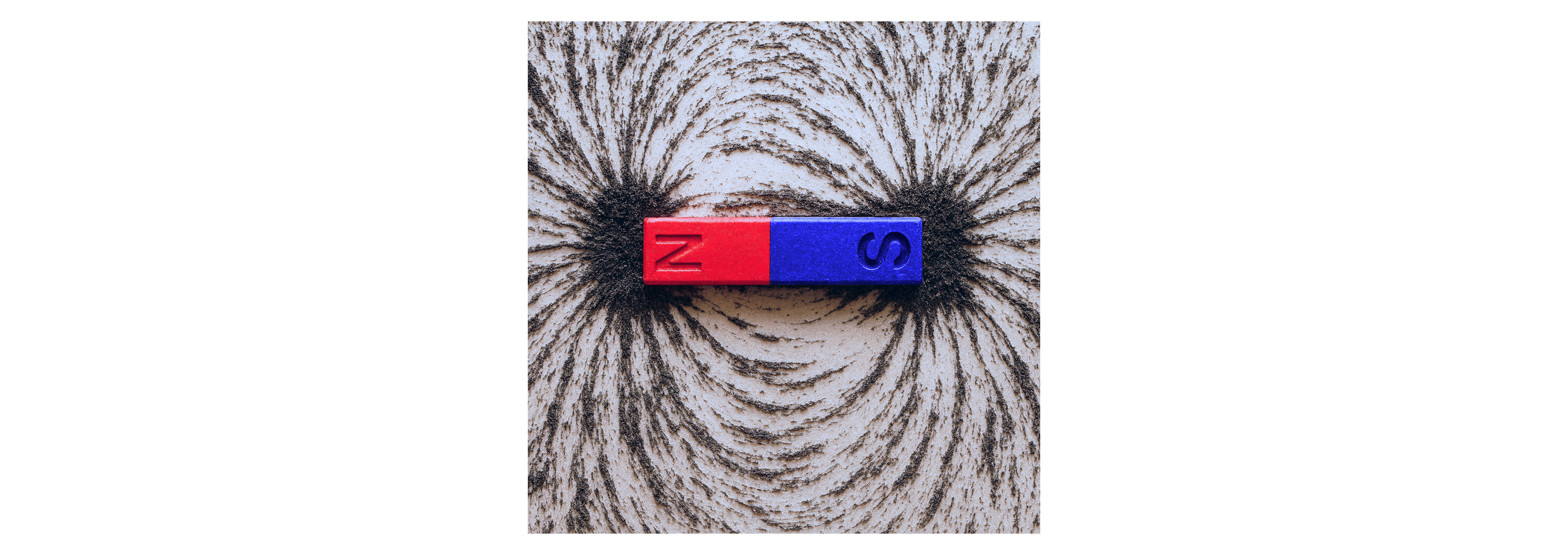
As the iron filings cluster most around the magnet's poles, this indicates that the magnetic field is strongest at the poles. We represent this in images by drawing more magnetic field lines that are closer together at the poles, as seen in the images above. The more dense the field lines, the stronger the force.
We can also use plotting compasses to show us the direction of magnetic field lines. They are tiny compasses with the arrow showing the direction of the magnetic field line.

In the image above, we can see that as all the arrows on the plotting compasses are pointing out of the right, this end of the bar magnet must be the North pole, and as they are pointing towards and into the left, this end of the magnet must be the South pole.
Remember: Santa Claus lives in the North Pole, so he must leave it to deliver his presents -> magnetic field lines always come out of the North Pole. He then has to travel around the World to deliver his presents -> magnetic field lines come out of the N pole and curve around the magnet to the S pole.
Worked Example:
Which is the correct drawing for the direction of magnetic field below?

Answer:
A. As magnetic field lines always come out of the North pole.
Worked Example:
Looking at the image of the Earth below, what can you conclude?

Answer:
The plotting compasses show us that the magnetic field lines are coming out of the bottom of the Earth and travelling around to the top. The bottom of the Earth is then the North magnetic pole, and the top of the Earth is then the South magnetic pole.
Note: This can be confusing, as the top of the Earth is correctly called the North geographic pole in geography and in everyday life, but it is actually the South magnetic pole; this is why all compasses appear to point due 'North'.
Practice Questions
A student investigates the interaction between two metal bars. One magnet is a permanent magnet and the other is made of iron.
The student places the south pole of the permanent magnet close to one end of the iron bar. Describe and explain what happens.
The student now replaces the iron bar with a second permanent bar magnet. Describe how the forces might differ when the same ends are brought together, and explain why.
-> Check out Hannah's video explanation for more help.
Answer:
The iron bar is attracted to the permanent magnet as the magnetic field of the permanent magnet induces magnetism in the iron. Induced magnetism causes the near end of the iron to become a temporary north pole in order to be attracted to the south pole of the permanent magnet.
The magnets may attract or repel depending on the pole orientation. Permanent magnets have fixed poles, so like poles repel and unlike poles attract. If the south pole of the second permanent magnet is brought close, it will be repelled, and if the north pole of the second permanent magnet is brought close, it will be repelled.
A teacher places three objects on a bench: a steel paperclip, a brass rod and a steel permanent magnet. The teacher brings the north pole of another permanent magnet close to each object one at a time.
State which objects will experience a force and what type of force it is.
Explain the difference between a permanent magnet and an induced magnet.
-> Check out Hannah's video explanation for more help.
Answer:
The permanent magnet will experience a force: attraction or repulsion, depending on the pole facing the permanent magnet. The steel paperclip will experience a force of attraction only (induced magnetism). The brass rod will not experience a force.
A permanent magnet produces its own magnetic field and keeps its magnetism and its fixed poles. An induced magnet becomes magnetic only when in a magnetic field and loses magnetism when removed.