Transformers
(Triple Only)
Brook Edgar & Hannah Shuter
Teachers


Explainer Video
Transformers
Transformers are devices that we can use to change the current and potential difference of an alternating current. We do this to reduce the current in transmission cables used in the national grid to reduce power loss (remember: ), and to reduce the potential difference going into people's homes for safety.
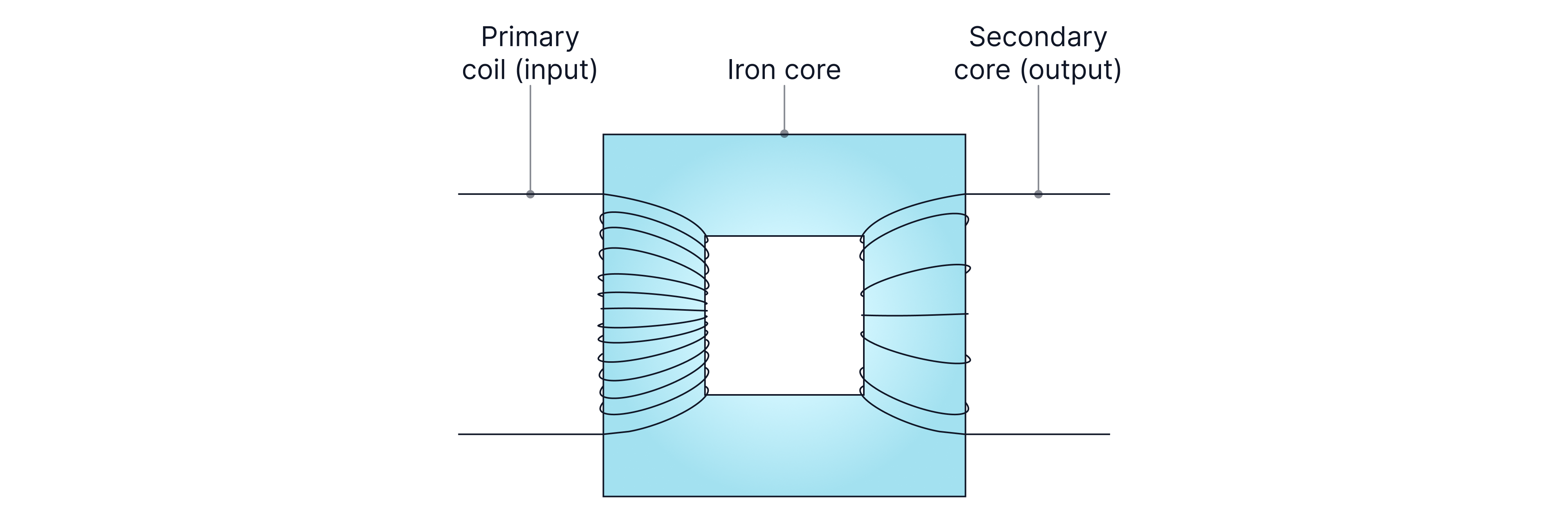
Transformers consist of two coils of wire wrapped around an iron core. Iron is used because it is quick to magnetise and demagnetise. The coil that the current flows through first is called the primary coil, and the other coil is called the secondary coil. The number of turns on each coil determines how the current and potential difference change. If the transformer has more coils on the secondary coil than on the primary coil, the potential difference will increase, so it is called a step-up transformer, as shown below. These are used to increase the pd and thus decrease the current in the cables used to transmit electricity across the national grid to reduce power losses due to heating in the cables.
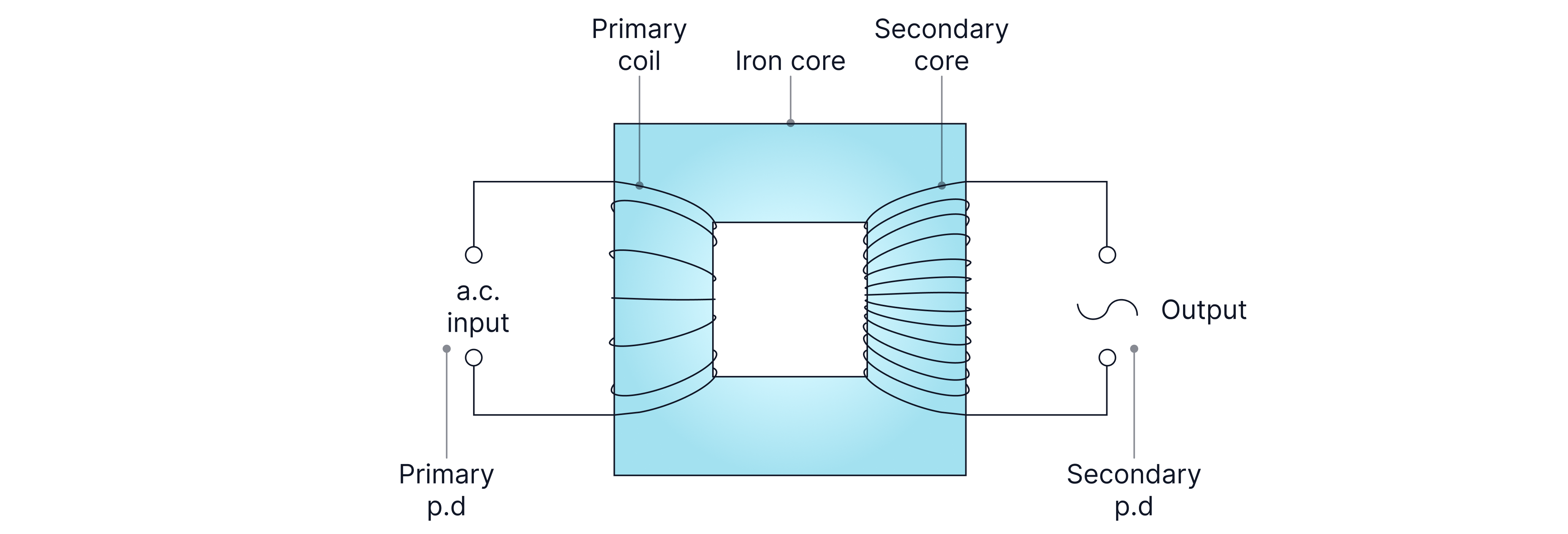
If the transformer has more coils on the primary coil than the secondary coil, the potential difference will decrease, so it is called a step-down transformer, as shown below. These are used to drop the pd to in all UK homes to prevent electrocution from high potential differences.
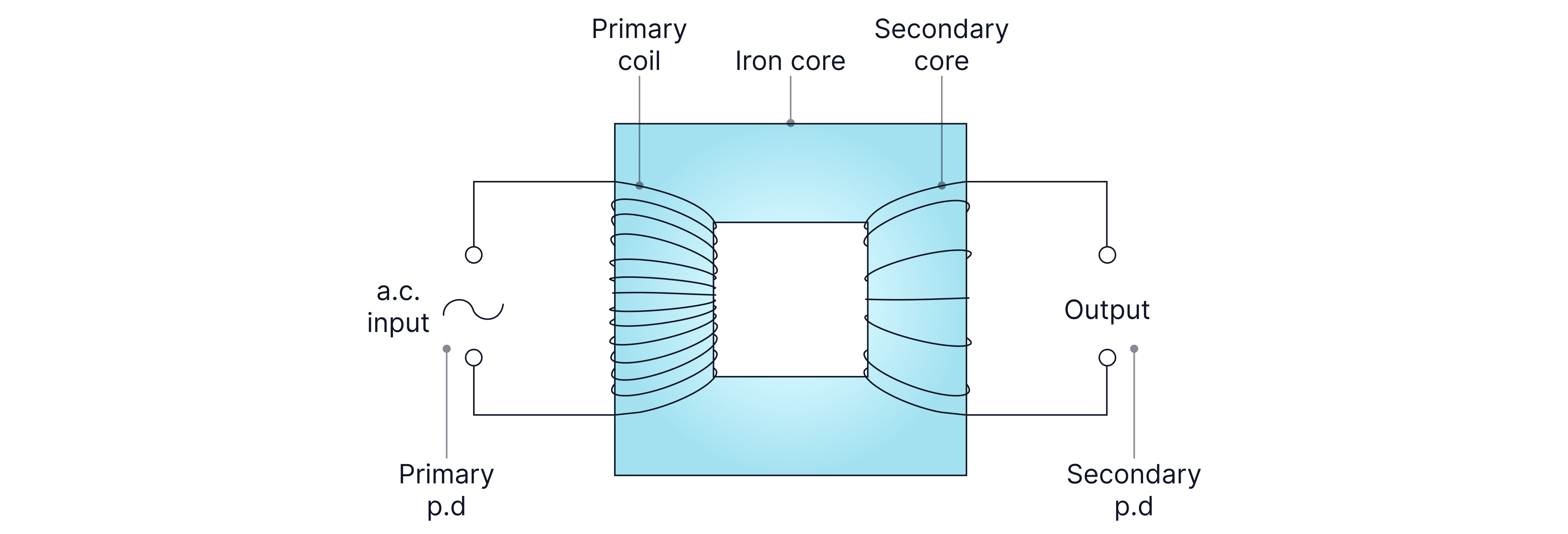
Transformers work using the generator effect. An alternating current flows through the primary coil of the transformer. This alternating current produces a changing magnetic field around the primary coil. The magnetic field is carried through the iron core, as iron is an induced magnet. This changing magnetic field in the core cuts across the secondary coil, inducing an alternating potential difference across it.
If the secondary circuit is complete, this alternating potential difference causes an alternating current to flow in the secondary coil.
The ratio of the induced potential difference in the secondary coil and the primary potential difference is proportional to the ratio of the number of turns on each coil.
Formula:
Example: I have a transformer with turns on the primary coil and turns on the secondary coil. If this transformer is plugged into the mains, the potential difference across the primary coil will be , so I can calculate the potential difference across the secondary coil:
Worked Example:
A transformer has turns on the primary coil and turns on the secondary coil. The primary is connected to a a.c. supply.
Explain how the transformer works.
Calculate the potential difference across the secondary coil.
Answer:
An alternating current in the primary coil produces a changing magnetic field around it. The iron core carries this changing magnetic field to the secondary coil. The changing magnetic field cuts through the secondary coil, inducing an alternating potential difference across it.
Worked Example:
A transformer is used to increase the potential difference. The transformer is connected to a a.c. supply. The potential difference across the secondary coil is . The primary coil has turns.
Explain why the transformer must be supplied with an alternating current.
Calculate the number of turns on the secondary coil.
Answer:
A transformer needs an alternating current to produce a changing magnetic field in the iron core. A changing magnetic field is needed to induce a potential difference in the secondary coil. If the magnetic field were not changing, if a d.c current were used, a pd would get induced in the secondary coil temporarily, but then disappear as the magnetic field is not changing. The magnetic field has to be constantly changing and cutting the wire to keep inducing an alternating pd.
Power in Transformers
Power is given by the equation . In a transformer, the power in the primary coil is equal to the power in the secondary coil, assuming there are no energy losses to the surroundings. This means an increase in potential difference across the coils must be matched by a decrease in current, or a decrease in potential difference must be matched by an increase in current. We can compare the power of both coils directly using the formula below.
Formula:
Example: I want to find the current in the secondary coil in the transformer used in my laptop charger. The charger converts the a.c. potential difference from the mains to to charge my laptop battery. The current in the primary coil is , so I would use the above formula to calculate the secondary current - remembering that the mains potential difference is always in the UK:
Worked Example:
A transformer steps the potential difference up from to . The current in the primary coil is .
Assume the transformer is ideal (no energy losses).
Calculate the current in the secondary coil.
Answer:
Worked Example:
At a power station, a step-up transformer is used before electricity is transferred along transmission cables.
The transformer increases the potential difference from to .
The current in the primary coil is .
Calculate the current in the secondary coil. Assume the transformer is ideal.
Explain why using this transformer reduces energy losses in the transmission cables.
Answer:
Remember you need to convert kV -> V:
The step-up transformer increases the potential difference, which reduces the current in the transmission cables. Power is lost due to heating in the cables, as all cables have resistance, shown by the equation , so reducing the current greatly reduces the power lost in the cables. This makes electricity transmission more efficient.
Practice Questions
A transformer has turns on its primary coil and turns on its secondary coil. The primary potential difference is . Calculate the secondary potential difference and state whether this is a step-up or step-down transformer.
-> Check out Brook's video explanation for more help.
Answer:
The transformer is a step-up transformer as the secondary p.d. is greater than the primary p.d.
A transformer is used to supply power to a device. The secondary coil produces and delivers a current of . The primary potential difference is . Assuming efficiency, calculate:
the power output from the secondary coil
the current in the primary coil.
-> Check out Brook's video explanation for more help.
Answer: