The ultimate guide to the 11+ Exam: GL Assessment, CEM and how to prepare
The 11+ exam is a test of children's verbal ability, English comprehension, numerical reasoning, and their non-verbal reasoning and the results form part of the acceptance criteria used by grammar schools. Most children sit the 11+ exam in September, at the start of Year 6.
There are two main 11+ exam boards, the ‘GL Assessment’ and the ‘CEM’. There are differences between the two, so whe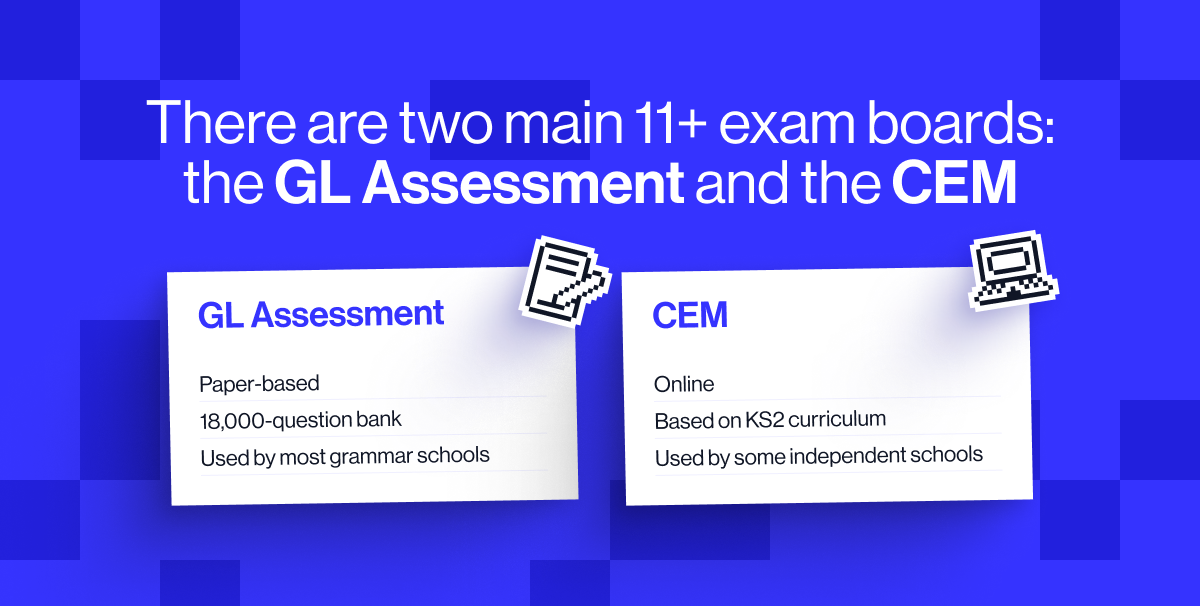 n preparing for the 11+, one of the key things to establish is which exam board’s exam your child will be sitting. UK grammar schools use the GL Assessment, whereas some Independent schools use CEM.
The main difference being that the GL Assessment 11+ exam pulls from 18,000 core questions. Meanwhile, the CEM exam papers draw upon topics covered by the Key Stage 2 (KS2) curriculum and changes each year. An additional difference is that since 2022 the CEM exam is taken online, whereas the GL Assessment remains paper-based.
How to prepare for the 11+ exam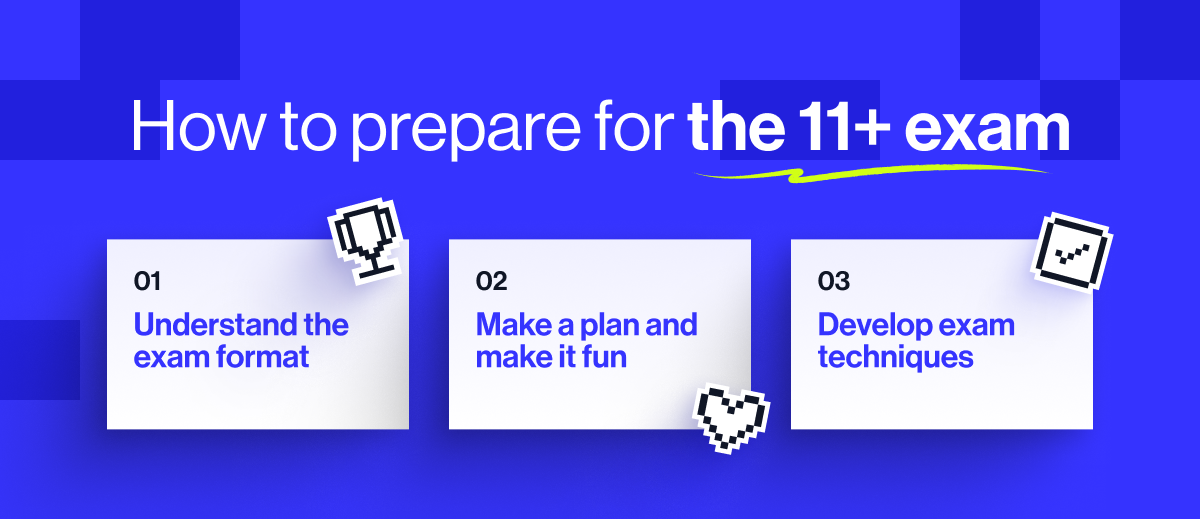
The 11+ is tough. Nationally only 30-35% pass. But, with the right preparation, you can give your child the best chance to beat those odds.
You can give your child 3-weeks specialist preparation and feel their confidence rise. Taught by expert teachers Louis Provis and Joe Sim, students get live, online-lessons, focussed on boosting confidence and results. 3 weeks. 1 goal. 0 pressure.
Plus, check out this guide covering everything you need to know about the 11+ exam.
Understand the 11+ exam format
Knowing what to expect in the type of 11+ exam you and your child choose is the first step towards success - especially if you have a particular grammar school in mind, as you will need to ensure your child takes their chosen test.
Once you’ve determined the type of test they’ll take, it’s important to familiarise your child with the exam.
As mentioned above, GL Assessment and the CEM test students in different ways, in particular when it comes to spatial reasoning and verbal reasoning skills. Not all GL 11+ exams cover non-verbal or spatial reasoning. Meanwhile, the CEM test doesn’t have an equivalent verbal reasoning assessment.
However, there are also lots of similarities between them. For example, the way the GL Assessment tests English and Maths is comparable to the CEM’s verbal skills and numerical reasoning assessments.
Make a plan and make it fun
Having fun makes learning memorable and enjoyable. Help your child enjoy learning by turning study sessions into interactive experiences.
For example, you can help them develop their reading by exploring books together and discussing new vocabulary. You can also use games to develop their Maths, non-verbal and spatial reasoning skills. Drawing and painting pictures also boosts spatial awareness skills.
When looking ahead towards the 11+ the volume and breadth of content to cover can feel intimidating. It is often useful to break down big subjects into smaller chunks and then - working backwards from the exam date - schedule some time on each chunk. We recommend dedicating more time to those areas your child is less strong, without forgetting to also reinforce the areas your child is more comfortable with.
To help you get started, we have created a free, downloadable, study plan template (PDF)
Finally, remember to include regular breaks in their study sessions. Techniques like the Pomodoro method, which suggests working for 25 minutes then taking a 5-minute break, helps maintain productivity and focus.
Develop exam techniques
Good exam preparation isn’t just about knowing the material, it’s also about developing the techniques required to demonstrate that knowledge in exam conditions.
Practice makes perfect. Introduce exam practice papers to familiarise your child with the exam format and timing and try to simulate test conditions at home to help them manage time and reduce exam-day nerves.
When looking at practice questions with your child, teach them how to read - and interpret - each question carefully. It’s also useful to dedicate some time to asking verbal, non-verbal and spatial reasoning questions, as these can initially be unfamiliar to students.
Prioritise wellbeing over pressure
While it’s natural to want your child to do well, too much pressure can harm their mental health and performance.
By keeping it fun and scheduling regular study breaks, while remaining calm and supportive helps them perform their best.
A guide to the GL 11+ exam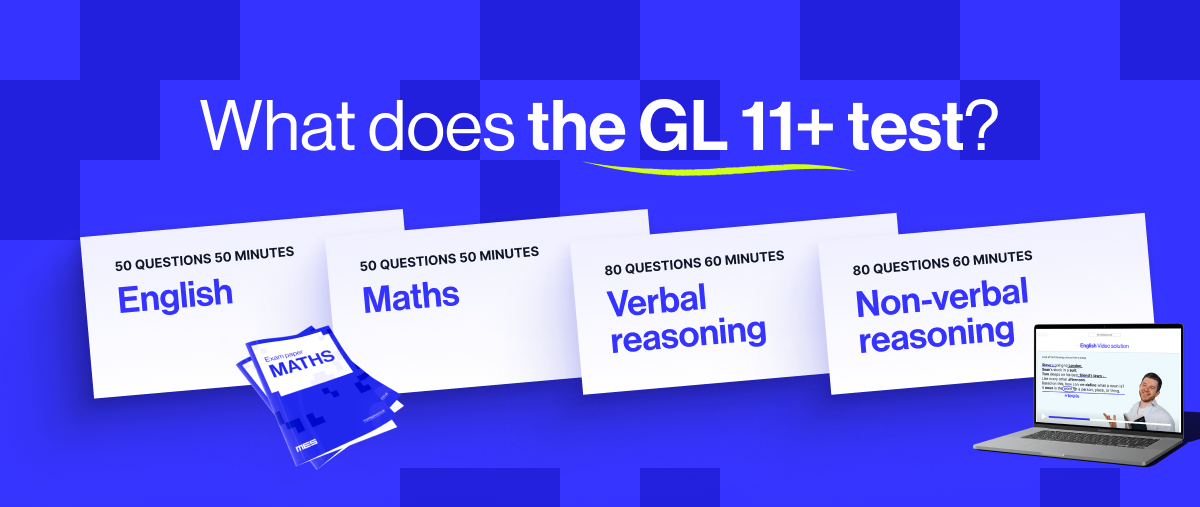
Most grammar schools use the Granada Learning (GL) 11+ exam for their acceptance criteria, so we’ll focus on that one here.
The GL 11+ exam tests a range of skills to identify whether your child is ready for grammar school. While the exact subjects may vary, depending on where you live, the exam typically covers English, maths, verbal reasoning, and non-verbal/spatial reasoning.
English
50 questions in 50 minutes
The English section of the GL 11+ exam tests your child’s reading, vocabulary, grammar, and writing skills, in order to assess how well they understand and use the English language.
The areas tested and types of questions your child will face include:
-
Reading comprehension: Your child will read a passage (about two pages long) and answer questions to show they understand the meaning, vocabulary, and ideas. The text could be fiction, non-fiction, or even poetry, from both modern and classic works. Questions are usually multiple-choice but may sometimes require written answers
-
Vocabulary and word meaning: A few questions will check how well your child understands the meanings of different words
-
Grammar: Basic grammar knowledge is tested, with questions on sentence structure and rules
-
Spelling and punctuation: Your child will spot errors in spelling, capital letters, or punctuation in simple sentences
-
Sentence completion: These questions ask your child to choose the best word to complete a sentence from a given list. For example, a question might ask the student to make connections between meanings of words like this:
-
Branch is to _____ as stem is to plant
-
3 is to 9 as 5 is to 25 and 4 is to ______
-
Stanza is to ______ as chapter is to novel
-
Son is to nephew and daughter is to ______
-
Rain is to ______ as wind is to tornado
Maths
50 questions in 50 minutes
The 11+ Maths section checks your child’s problem-solving and numerical skills and usually features multiple-choice questions, sometimes requiring written answers.
The areas tested and types of questions your child will face include:
-
Number fluency: addition, subtraction, multiplication, division, fractions, decimals, percentages, and working with factors and multiples
-
Measurement: understanding money, time, perimeter, area, volume, and distance-speed-time problems
-
Probability: basic questions on chance and likelihood
-
Geometry: angles, shapes, and symmetry
-
Algebra and pattern-recognition: solving equations and recognising patterns
-
Statistics: interpreting graphs, charts, and averages. For example, a student might be presented with a pie chart divided into 8 and told it represents chunks of time spent on different activities by somebody over the course of two hours, before asking them to establish how long was spent on the different activities
Quick problem-solving and confidence with numbers are essential to excel in this section, so make sure your child practices these areas thoroughly to be prepared.
Verbal Reasoning
80 questions in 60 minutes
The Verbal Reasoning section of the GL 11+ exam tests your child's ability to understand and work with words and verbal information.
The areas tested and types of questions your child will face include:
-
Vocabulary: tests their understanding of word meanings, synonyms, and antonyms
-
Problem-solving: involves puzzles, codes, and instructions using both words and numbers
-
Verbal information processing: assesses how well they can process and rearrange verbal information
For example, a question might ask the student to rearrange five sets of words (similar to the below) into grammatically sensible sentences:
-
and lay behind sea clouds nothing them but
-
window train back flashed something a of the near the from
-
difficult this exam feeling confident I am this is
-
friendly aggressive cats but be can usually are
-
walk energetic the his dog in forest the beautiful enjoyed
Non-Verbal Reasoning
80 questions in 60 minutes
The Non-Verbal Reasoning section focuses on solving problems using pictures, patterns, and shapes. It’s great for building logic skills that are useful in Maths and Science.
The areas tested and types of questions your child will face include:
-
Odd one out: Spotting the shape that doesn’t belong
-
Sequences: Finding the next shape in a pattern
-
Cube nets: Understanding how flat shapes fold into 3D cubes
-
Mirror images and reflections: Working with symmetrical and reflected shapes
-
Identical shapes: Identifying matching shapes in a series
-
Rotations and symmetry: Recognising rotated or symmetrical shapes
-
Visual problem-solving: Solving puzzles with shapes and patterns. For example a child might be presented with two shapes, followed by a single shape and a series of similar shapes, before being asked to identify which of the shapes best matches the relationship between the first two shapes, when coupled with the proceeding shape. Students might also then be asked to identify how many things are changing between the related shapes
Non-verbal reasoning questions can be tricky and take time to solve. That’s why it’s essential to get your child comfortable with these types of questions as early as possible.
Note - not every area includes Non-Verbal Reasoning in their 11+ exam, so check what applies in your location.
Good luck
With the right resources and strategies, your child can approach the 11+ with confidence.
Whether through studying at home, working on practice questions, and / or taking advantage of our expert teachers here at MyEdSpace, you have a range of tools to support their success.
Remember, to be mindful of your child’s limits - consistent effort and encouragement go a long way in helping your child reach their full potential.