A comprehensive guide to the UK education system
The UK education system can feel like a maze of year groups, key stages, sets and exams, parents (and students) are expected to navigate without a map.
To help parents we’ve produced a free comprehensive guide which covers: what happens at each stage, what assessments happen when, what actually matters, what options are available, and - most importantly of all - what you can do to help.
Below is a snapshot, and you can download the full guide here.
How the UK education system is structured
Education in England is divided into five key stages, from primary right through to sixth form.
|
Student age |
Year groups |
Key Stage |
|
5 to 7 |
1 and 2 |
KS1 |
|
7 to 11 |
3 to 6 |
KS2 |
|
11 to 14 |
7 to 9 |
KS3 |
|
14 to 16 |
10 and 11 |
GCSE (KS4) |
|
16 to 18 |
12 and 13 |
A-level |
In the UK, education is compulsory until students have completed their GCSEs (Key Stage 4) at 16.
From there, students must stay in some form of education or training until 18 - but that doesn't have to mean studying for their A-levels and students have a range of post-16 education options.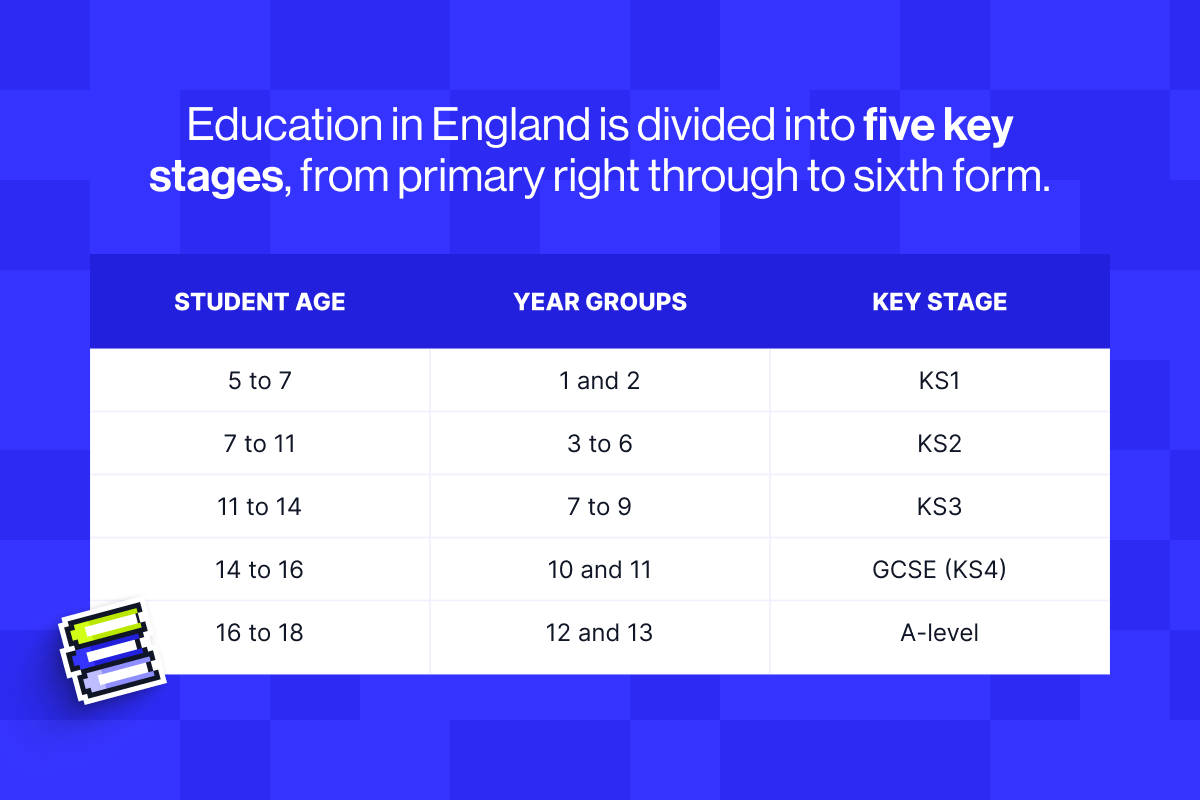
A brief overview of the key stages
Years 1, 2, 3 and 4 - Key stage 1
At this stage - sometimes called ‘primary education’, children are primarily learning through play, developing their social skills with some early reading and numeracy. Broader topics start to be introduced from Year 3.
The primary focus remains encouraging children to be curious and enjoy learning and there are no formal assessments undertaken at this stage.
Years 5 and 6 - Key stage 2
Years 5 and 6 are still considered primary education, and it is at this point that many families encounter anything that feels like a real exam for the first time - the 11+, and then SATs.
The 11+ is an optional exam for families applying to grammar schools. Students often start preparing for the 11+ in Year 5, before sitting in in September, at the start of Year 6.
The 11+ format is specific and unfamiliar, so preparation makes a real difference.
Then, at the culmination of Year 6, all students sit the SATs - a national test which assesses their reading, maths and grammar knowledge. Results are scored out of 120, with 100 considered the expected standard, and anything above 110 considered a higher level.
SATs don't determine your child's future, but many secondary schools use them to place students into ability groups in Year 7, and those groupings can follow a student for years.
Years 7, 8 and 9 - Key stage 3
With no formal exams, Years 7 to 9 often feel low-stakes and there’s a prevailing sense that they don’t really matter.
But, with no major exams and no big decisions to be made, Years 7, 8 and 9 build the foundation for everything that comes next.
In short, they matter.
Year 7 is one of the biggest transitions in a child's education, often meaning a new school, a different teacher for every subject, and homework across eight or more subjects from day one. The sets students are placed into here, usually based on SATs results, can shape their options all the way to GCSEs.
Year 8 is often called the "forgotten year” because Year 8 is the last full year before GCSE content begins. There's no assessment pressure, which means it's easy to coast - and that's a problem. Students who stay engaged arrive at Year 9 confident and prepared. Those who drift find the step up harder than it needs to be.
Year 9 is when students choose their GCSE subjects - usually 3 to 4 options on top of the compulsory core of English, Maths, and Science.
The choices and progress students make now can open - or close doors - later, particularly if they have any interest in specific A-level subjects or university courses, so it's worth looking at options together well before the deadline.
Years 10 and 11 - GCSEs (Key Stage 4)
With exams sat at the end of Year 11 after two years of studying, GCSEs are the first nationally recognised qualifications your child will earn. Year 10 builds the foundation, before Year 11 cements the understanding and hones exam technique.
One thing many parents don't realise is that Maths and Science GCSEs are tiered, which means if a student sits the foundation tier, the maximum grade they can achieve is a 5 - regardless of how well they do on the day. It's worth checking which tier your child is entered for.
Also, the Mock exams which students face early in Year 11 - usually between November and February - matter more than people realise too. Schools use mock results to set predicted grades, which feed into sixth form and college applications. They also show exactly where the gaps are while there's still time to close them.
Post-16 education and A-levels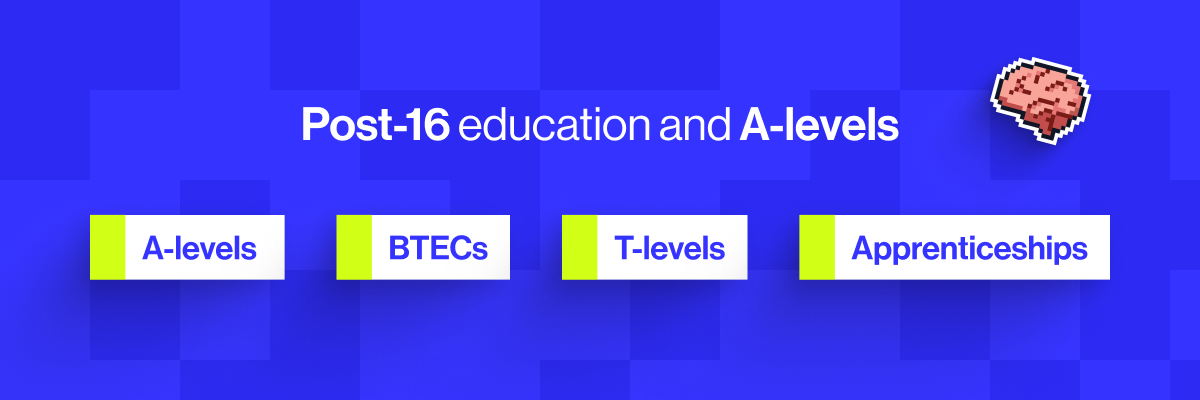
After GCSEs students are required to stay in some form of education or training. A-levels are one route - taken by roughly 45% of students - but there are plenty of options.
A-levels are a two-year course, typically covering three subjects. A-levels kick off in Year 12 and are examined at the end of Year 13. They're the most direct route to university, but they're not the only one.
BTECs focus on coursework and applied learning, making them ideally suited to students who prefer continuous assessment over high-stakes final exams, and provide another possible route to university
T-levels are two-year technical qualifications that include a 45-day industry placement and earn the same UCAS points as three A-levels.
Apprenticeships combine paid work with structured training. There are no tuition fees, and degree apprenticeships now exist across many industries.
Which path is the ‘right’ path depends on each individual.
Get your free guide to the UK education system
This article only scratches the surface.
From what the new Ofsted inspection framework actually means for school choice, to how to approach choosing GCSE subjects and understanding UCAS points, download the full guide and get a year-by-year breakdown of what happens, what to watch out for, and how to support your child at every stage.
Get ahead and stay ahead this year
Whether your child is getting started with Year 5, preparing for the 11+, heading towards their KS2 SATs in Year 6, or moving through KS3 in Year 7, Year 8, and Year 9, starting their GCSEs or their A-levels, now is the time to get ahead.
The secret to achieving academic success in the UK? Studying with top-quality teachers and former examiners, handpicked for their ability to make things click for their students and working hard. Do that and results follow. This year, it's your child's turn to get ahead and stay ahead.
And, it’s more affordable than you might think. With us, you can get a full year of expert teaching for less than a few classes with the average private tutor.