
A-level Biology: what to expect and how to prepare
If your child has chosen A-level Biology, they have picked one of the most rewarding subjects on offer, and one with a reputation for being a real step up.
You may already have heard that the jump from GCSE to A-level is bigger in the sciences than almost anywhere else, and in Biology that is certainly true. Students who comfortably achieved top grades at GCSE can find the first few weeks genuinely surprising.
The good news is that the leap is very manageable once you understand what is actually changing.
This article explains what A-level Biology asks, why it feels like such a jump, and how to make the transition from GCSE to A-level with confidence.
What changes from GCSE Biology to A-level Biology?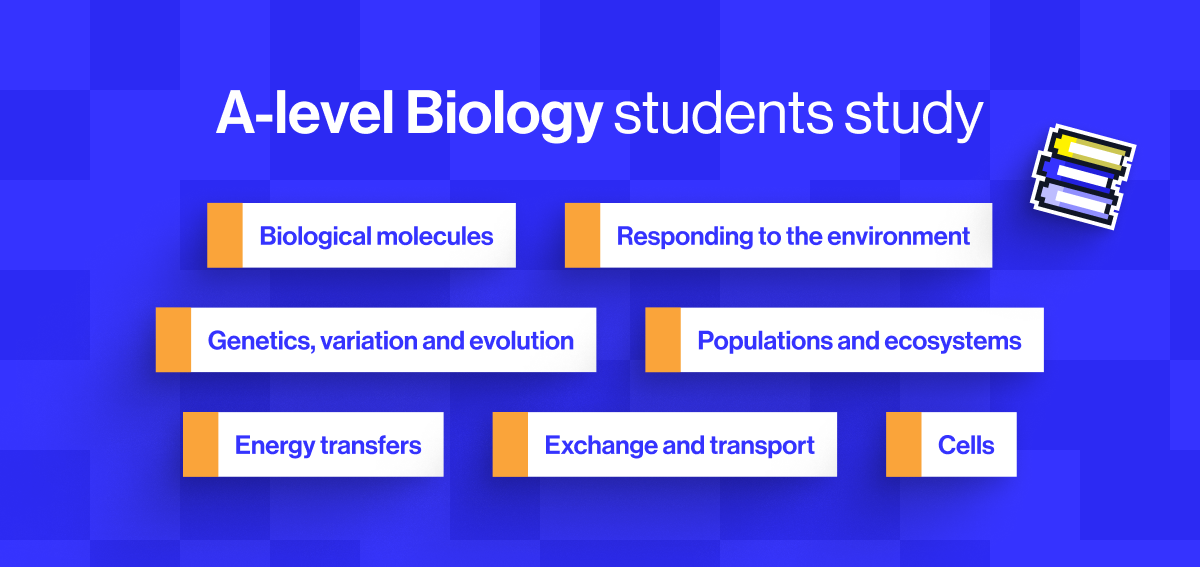
A-level Biology covers many of the same broad themes studied at GCSE, but in far greater depth and with far higher expectations.
Most courses (whether AQA, OCR or Edexcel) build on familiar foundations and then take them much further.
Over the two years, Biology A-level students typically study:
-
Biological molecules - the detailed chemistry of carbohydrates, lipids, proteins, enzymes and nucleic acids
-
Cells - cell structure in fine detail, transport across membranes, and how cells divide and how cells are studied
-
Exchange and transport - gas exchange, mass transport in animals and plants, and the systems that make them work
-
Genetics, variation and evolution - DNA, inheritance, gene technology and how populations change over time
-
Energy transfers - photosynthesis and respiration explored as multi-stage biochemical processes
-
Responding to the environment - nervous and hormonal coordination, homeostasis and control
-
Populations and ecosystems - how organisms interact, and how we measure and model the living world
The themes look familiar. What changes is the level at which they are studied.
Why the jump from GCSE feels so big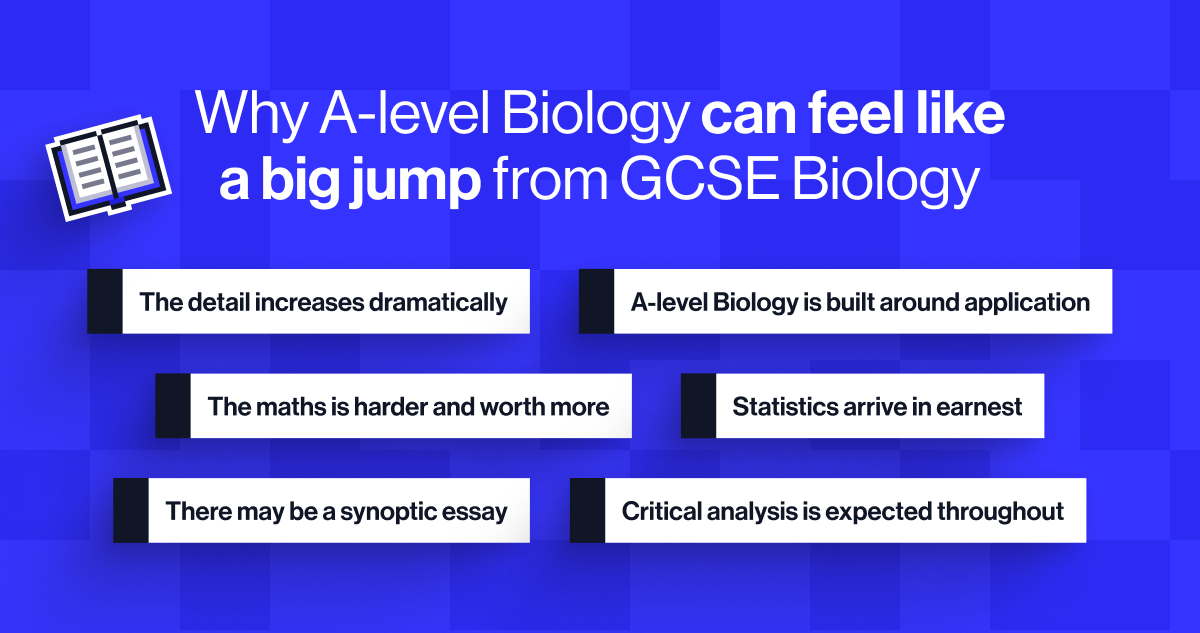
Almost every student adjusts well in the end, but it is worth being honest about why the early weeks can feel steep.
There are several reasons A-level Biology asks so much more than GCSE did.
The detail increases dramatically
Processes summarised in a sentence or two at GCSE are now studied stage by stage.
Respiration, for example, moves from glucose plus oxygen to four linked stages with named molecules, locations and electron carriers. Students are expected to hold a great deal of precise, complex knowledge.
A-level Biology is built around application, not recall
This is the single biggest shift. A-level exams rarely ask students simply to state what they know. Instead they present an unfamiliar experiment, organism or data set and ask students to apply their understanding to it.
Knowing the content is only the starting point; using it in a new context is where the marks are.
The maths is harder and worth more
At least 10% of the marks assess mathematical skills, and at A-level these go well beyond GCSE.
Students work with logarithms, rates of reaction, magnification and scale, standard form, and the handling of real experimental data. For many, the maths involved is one of the most unexpected challenges of studying Biology at A-level.
Critical analysis is expected throughout
Students are no longer just told how an experiment works; they are asked to evaluate it.
Were the variables properly controlled? Is the conclusion justified by the data? What are the limitations? This kind of careful, sceptical thinking runs through the whole qualification.
Statistics arrive in earnest
A-level Biology expects students to choose, carry out and interpret statistical tests, such as the chi-squared test, Student's t-test and correlation coefficients.
Deciding which test fits a given investigation, and explaining what the result actually means, is a skill that takes real practice.
There may be a synoptic essay
Students taking AQA A-level Biology face a 25-mark essay in their final paper.
They choose one title and must write a flowing, well-structured piece that draws together ideas from right across the two-year course. It rewards students who understand how the whole subject connects, rather than seeing each topic in isolation, and it is unlike anything most students will have attempted at GCSE.
A confident, well-prepared start matters so much more at A-level than it did at GCSE.
How you can help at home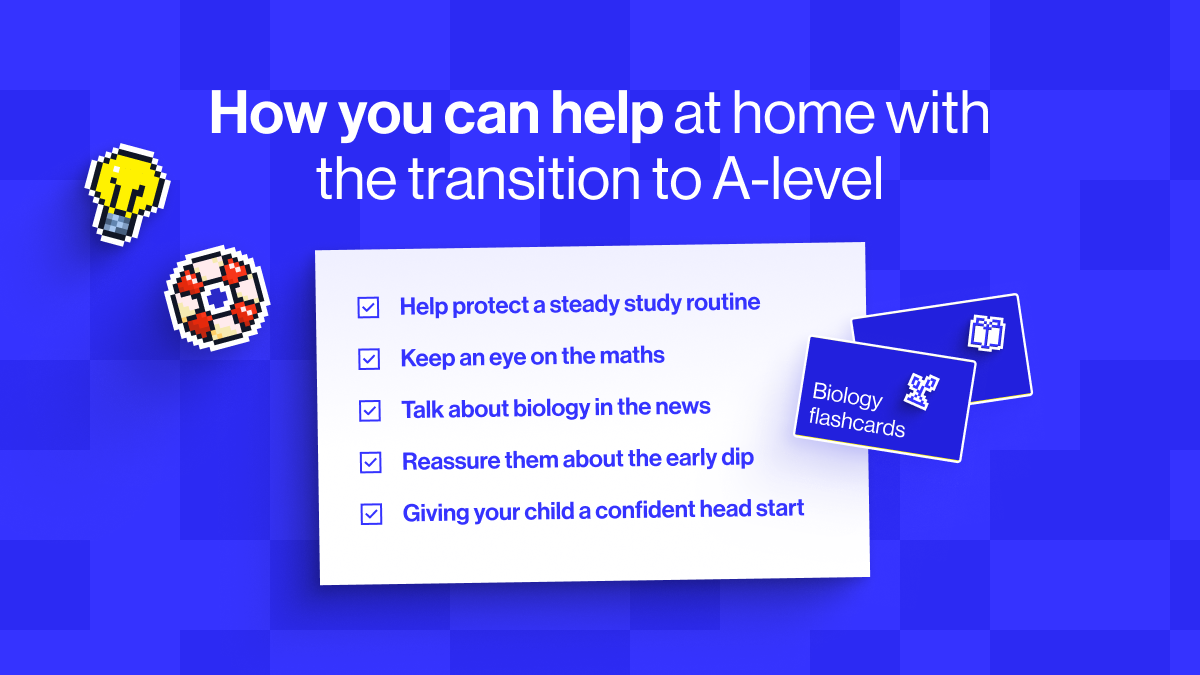
A-level students are more independent than they were at GCSE, so your role looks a little different, but it is no less valuable.
A few things genuinely help:
Help protect a steady study routine
A-level Biology rewards little and often. Short, regular sessions of consolidation beat last-minute cramming every time, and a calm, predictable place to work makes a real difference.
Keep an eye on the maths
Confidence with GCSE-level maths, especially rearranging equations, percentages, ratios and graphs, takes a lot of pressure off. A little brushing up over the summer pays off all year.
Talk about biology in the news
Discussing a new vaccine, a piece of health research or a conservation story is excellent informal practice at exactly the kind of application and analysis A-Level rewards.
Reassure them about the early dip
Many capable students find their first set of A-level marks lower than they are used to. This is normal and rarely lasts. Knowing it is coming makes it far less unsettling.
Get ahead and stay ahead this year
If you've just started your A-levels, now is the time to get ahead.
The secret to achieving academic success in the UK? Studying with elite teachers and former examiners, handpicked for their ability to make things click for their students and working hard. Do that and results follow. This year, it's your turn to get ahead and stay ahead.
And, it’s more affordable than you might think. With us, you can get a full year of expert teaching for less than a few classes with the average private tutor.
Check out our course catalogue to begin.