
A-level Further Maths: what’s involved and how to prepare
Few A-level subjects generate as much anticipation - and apprehension - as Further Maths. Long before lessons begin, students are often aware of its reputation for stretching even the strongest mathematicians.
The step up from GCSE Maths into A-level Further Maths is a substantial one. Students face unfamiliar topics, a more demanding workload, and a course that is frequently regarded as one of the toughest subjects available at A-level.
The good news is that Further Maths is far more rewarding than it is daunting, especially for students who enjoy the subject and make a confident start.
Here’s Maths teacher Nick Featherstone on what A-level Further Maths is, how the Edexcel course is structured, and what to expect from now until exam day.
The difference between A-level Further Maths and GCSE Maths
At GCSE, Maths is a single subject that every student takes. A-level Further Maths is different in two important ways.
-
It’s a separate, second qualification: students who take it study A-level Maths and A-level Further Maths side by side, so they are effectively doing two maths A-levels at once
-
It goes well beyond deepening GCSE topics and introduces genuinely new mathematics, from imaginary numbers to matrices and formal proof
Further Maths is a stretching but genuinely satisfying course, designed for students who enjoy maths and want to take it as far as school allows. For many, it is the most interesting subject on their timetable.
The Edexcel A-level (9FM0) is made up of four written papers, both lasting 90 minutes and each worth a quarter of the qualification.
What topics are covered in Further Maths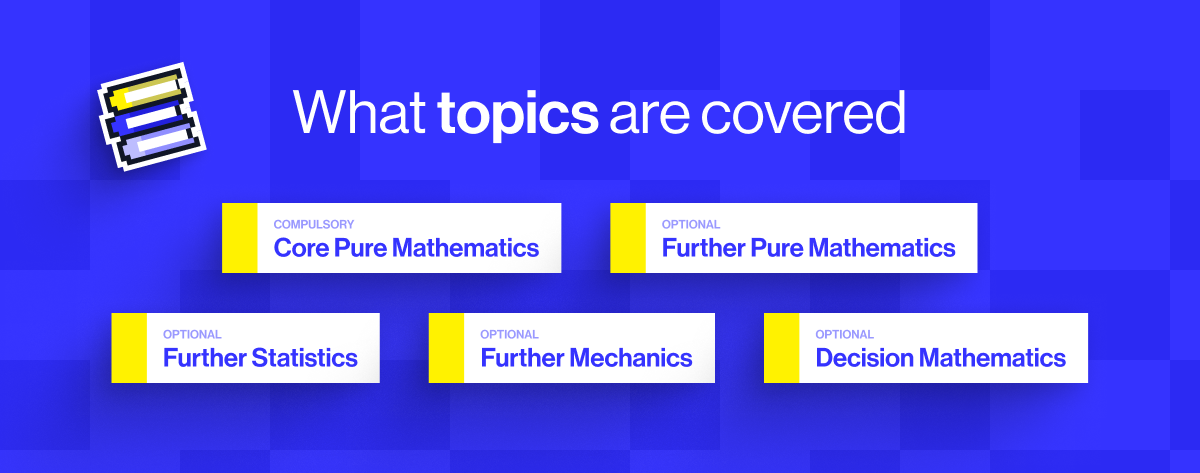
Every student takes the two Core Pure papers. For the remaining two papers, they choose a pair of options. Schools usually guide this choice, often steering it towards the degree a student is aiming for, so a budding engineer might take Mechanics while a future economist leans towards Statistics. Some students take the AS in Further Maths instead of the full A-level, which follows the same shape over fewer papers.
Core Pure Mathematics (compulsory)
Papers 1 and 2 are the heart of the course that every student sits. They cover complex numbers, matrices, proof, further calculus, polar coordinates, hyperbolic functions, differential equations and further vectors.
Further Pure Mathematics (optional)
Extends the pure ideas above into areas such as further series, more advanced calculus and additional coordinate systems.
Further Statistics (optional)
Builds on A-level statistics with more advanced probability distributions, hypothesis testing and data analysis, and suits economics, psychology and the sciences.
Further Mechanics (optional)
Applies Maths to the physical world, covering momentum, work and energy, and motion, and pairs naturally with physics and engineering.
Decision Mathematics (optional)
A more modern strand on algorithms, networks and optimisation, with strong links to computer science and logistics.
Why A-level Further Maths can feel like a big jump from GCSE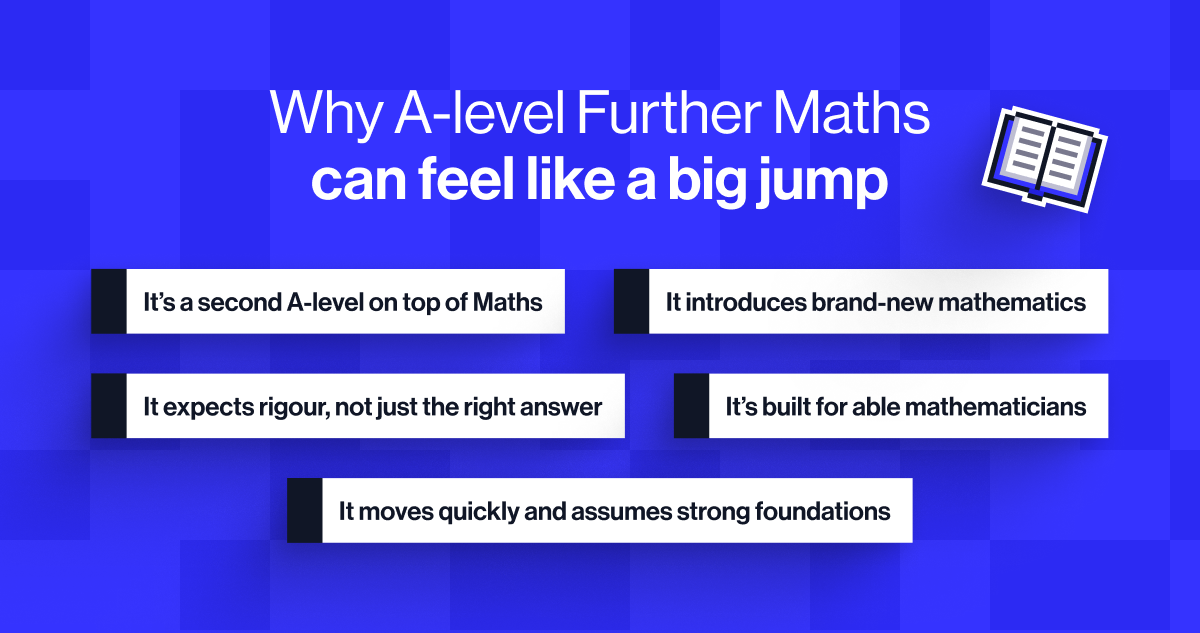
Students who choose Further Maths are usually strong, willing mathematicians, but it is fair to say the course asks a great deal of them, more than almost any other A-level.
There are a few reasons the step up from studying Maths at GCSE level can feel steep:
It’s a second A-level on top of Maths
Because Further Maths is studied alongside A-level Maths, students cover a large amount of mathematics every week. Managing that workload is part of the challenge, and one of the first things to get used to.
It introduces brand-new mathematics
Ideas like complex numbers, matrices and formal proof have no real equivalent at GCSE. Students are not just going deeper into familiar topics, they’re meeting entirely new ones - which is exciting but can also take time to absorb.
It expects rigour, not just the right answer
Further Maths places real weight on reasoning and proof, on showing clearly why something is true rather than simply that it works. This careful, logical style is one of the biggest differences from GCSE.
It moves quickly and assumes strong foundations
The pace is brisk and the course leans heavily on both GCSE fluency and the A-level Maths being studied at the same time. Small gaps in the basics tend to show up fast, which is why making a strong start is important.
It’s built for able mathematicians
Problems are longer, more multi-step and more open-ended than at GCSE, and they reward independent thinking. That’s demanding, but it is also exactly why students who enjoy Maths tend to find it so satisfying.
None of this is cause for alarm. Students who opt for Further Maths are well suited to it by definition, and a confident, well-prepared start makes all the difference. A little preparation over the summer can turn an intimidating first term into a settled one, and a settled student is far more willing to wrestle with a hard problem and enjoy it.
How to prepare for the step up from GCSE Maths to A-level Further Maths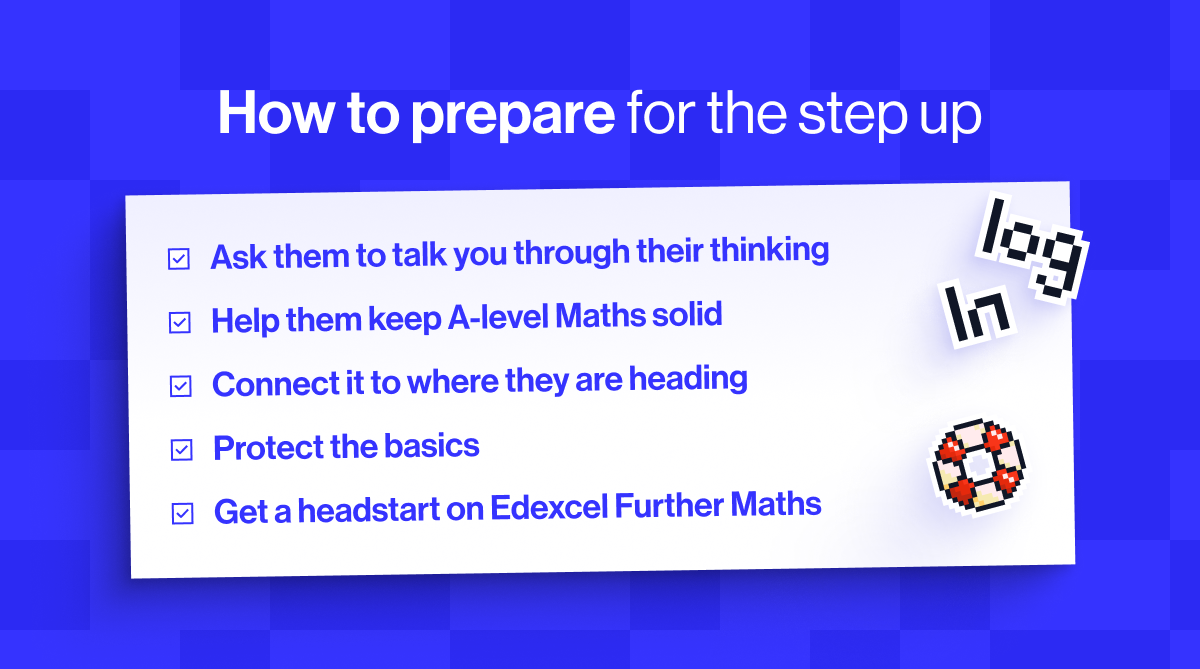
You do not need to understand complex numbers yourself to be useful and a few simple things go a long way:
Ask them to talk you through their thinking
Even if you can’t follow the mathematics yourself, having your child explain how a method works, out loud and in plain words, is one of the best ways to help them cement their own knowledge. If they get stuck explaining, they’ve just found something worth revisiting.
Help them keep A-level Maths solid
Further Maths rests on the main Maths A-level being studied at the same time, so the most useful thing is making sure neither is neglected. Steady, little-and-often practice beats last-minute cramming.
Connect it to where they are heading
Further Maths opens doors to mathematic-rich degrees and careers, from Engineering and Physics to Computer Science and Economics, and several competitive university courses value it highly. Linking the effort to those goals is a powerful motivator.
Protect the basics
Sleep, routine, a calm place to work and a sensible balance across two maths A-levels do more to support strong grades - across Further Maths and everything else - than most parents expect. It also helps to keep the tone positive, since Further Maths is meant to be a stretch and treating wobbles as normal rather than alarming keeps confidence intact.
Get ahead and stay ahead this year
If you've just started your A-levels, now is the time to get ahead.
The secret to achieving academic success in the UK? Studying with elite teachers and former examiners, handpicked for their ability to make things click for their students and working hard. Do that and results follow. This year, it's your turn to get ahead and stay ahead.
And, it’s more affordable than you might think. With us, you can get a full year of expert teaching for less than a few classes with the average private tutor.
Check out our course catalogue to begin.