Contribution to Parliamentary Education Committee inquiry into use AI of in education published
MyEdspace Biology teacher Joe Wolfensohn has had his evidence into how to use AI in education published by the UK Parliamentary Education Committee’s inquiry.
The committee collected evidence from schoolteachers and policymakers from across the UK.
Joe’s submission in full
“It has always felt fundamentally unfair to me that some students have access to exceptional teachers, experts who know how to engage and inspire, while others do not.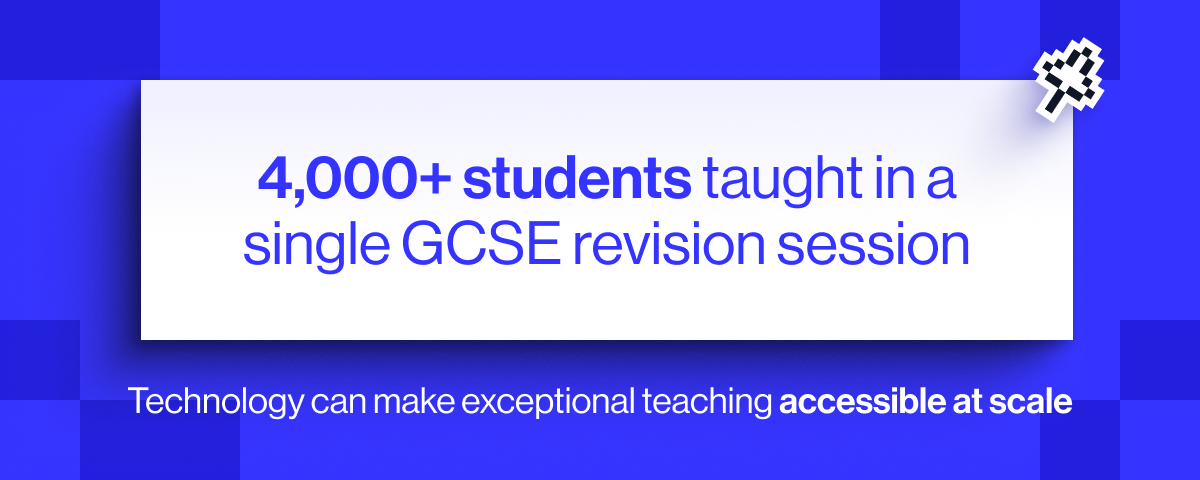
By using modern technology at MyEdSpace, we can give this opportunity to hundreds or even thousands of students at once. I taught over 4,000 students in a single GCSE revision session last year, more than I had taught in my entire career up to that point. It was both eye-opening and a clear demonstration of what is now possible.
This model allows us to deliver high-quality education at scale while keeping costs low, with lessons starting from £5 an hour.
The outcomes reflect this: in 2025, 51% of our maths students achieved grades 7-9 at GCSE, compared to a national average of around 17%.
I'm submitting evidence because as someone who taught in state schools for over five years before moving to an ed-tech company, as all of my colleagues did as well, I have passionate opinions about how schools are failing to properly integrate technology.
Since joining MyEdSpace, I've been able to learn more about AI and have seen the power that alternative learning environments facilitated by tech can have on students.
I believe that the system can learn a lot from my experience from teaching in schools and now outside of schools.
Give teachers time to upskill in AI
When ChatGPT was first launched, I made a conscious effort to integrate it into my classroom practice.
One of the biggest challenges I encountered was simply finding the time to learn how to use it effectively. Although AI models have become more intuitive, they still require a particular skill set and a thoughtful approach to prompting and application. I felt it was a problem that my school did not create dedicated time for me to develop these skills, which made it much harder for me to implement it effectively.
I've been given the space to do this at MyEdSpace and I now use AI far more productively and analytically when preparing teaching resources. For example, I recently used AI to summarise and analyse past examiner reports, enabling me to identify recurring patterns and misconceptions that I may previously have overlooked.
Put teachers in control of implementing AI into schools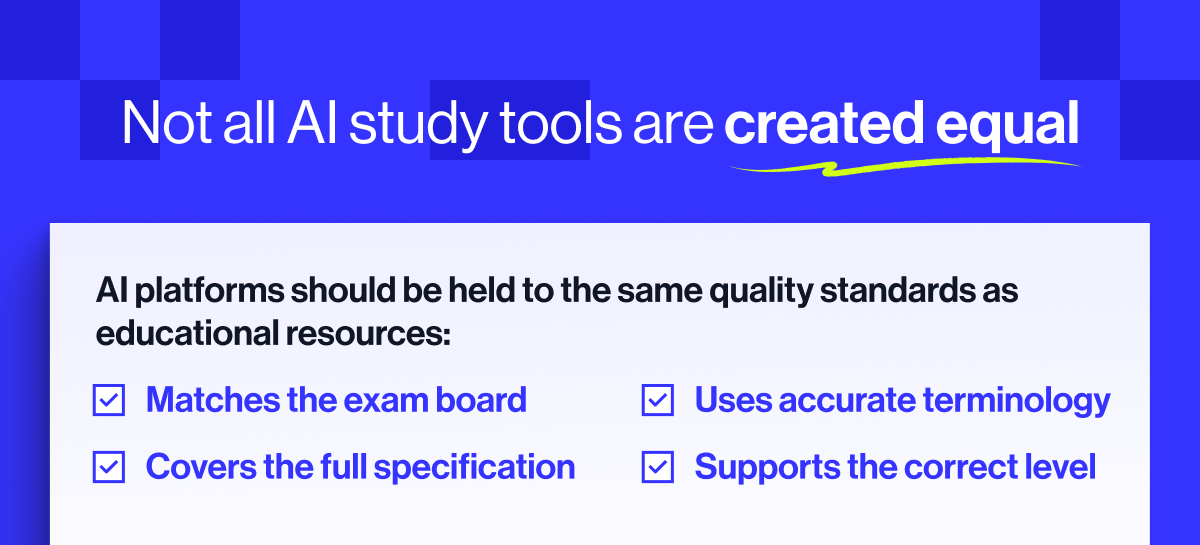
A second challenge relates to the quality and precision of the content produced by AI models.
Examination boards use highly specific language and nuanced phrasing that experienced teachers learn to recognise and explicitly teach to students in order to maximise exam performance. Current AI models do not always capture this nuance accurately and students are getting bad advice as a result.
To address this issue, AI systems need to be guided and refined by teachers so that the terminology and explanations align closely with exam board expectations. This is the approach we are taking at MyEdSpace when training our own models, ensuring that students receive support that is directly relevant to the assessments they will sit.
Introduce AI accreditation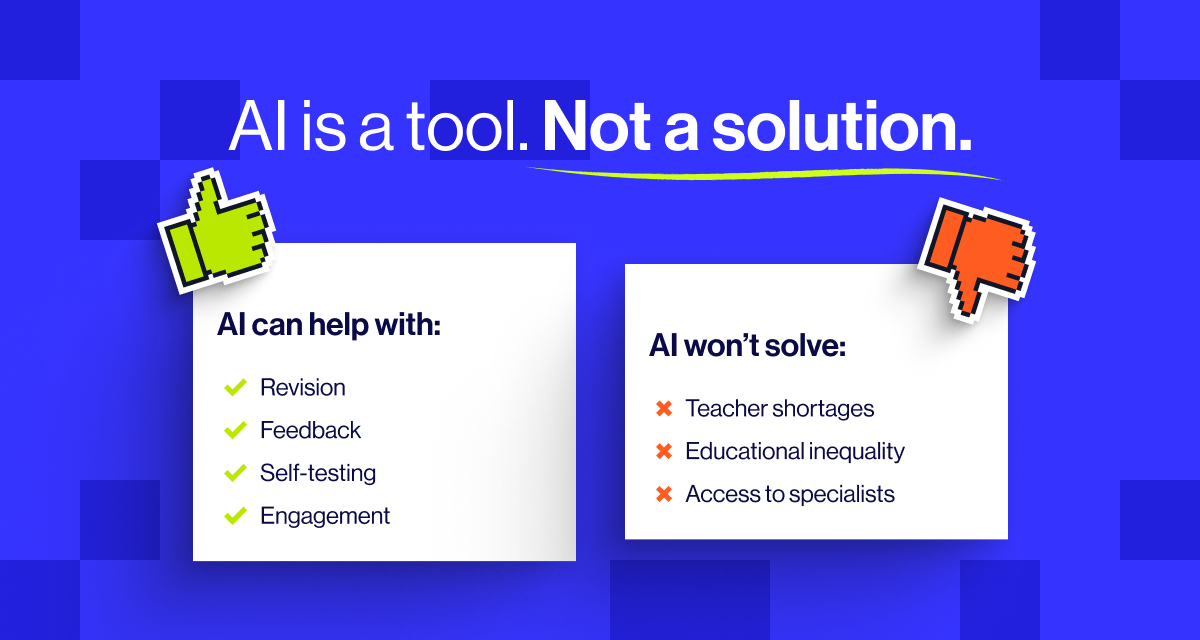
There is also a rapidly growing number of AI-based revision and self-testing tools available online.
However, when I have evaluated many of these platforms, they often encounter similar issues: they are not sufficiently tailored to a specific exam board or level (for example GCSE or A-level). In some cases they include material beyond the required specification, while in others they omit essential topics. For this reason, caution is needed when adopting such tools.
Just as textbooks can receive some level of accreditation from exam boards, it would be beneficial to see a similar form of quality assurance applied to AI-based learning platforms, comparable to the standards expected within the tutoring industry.
Make AI part of the curriculum
Finally, with regard to student use of AI, it seems clear that these technologies are here to stay. As educators, we therefore need to adapt and focus on teaching students how to use them responsibly and effectively.
Students have always found ways to avoid or shortcut homework and assessments; the design of these tasks must evolve with AI in mind. This also connects to a broader conversation about the nature of assessment within our education system.
At the same time, AI has significant potential benefits. Used appropriately, it can provide students with powerful opportunities for self-testing and revision in creative and engaging ways. It can also act as an intrinsic motivator, giving students greater agency and ownership over their learning.
Overall, rather than viewing AI purely as a threat, the key challenge for educators is to ensure that it is implemented thoughtfully, supported by teacher expertise, and aligned closely with curriculum and assessment requirements.
AI isn't the only answer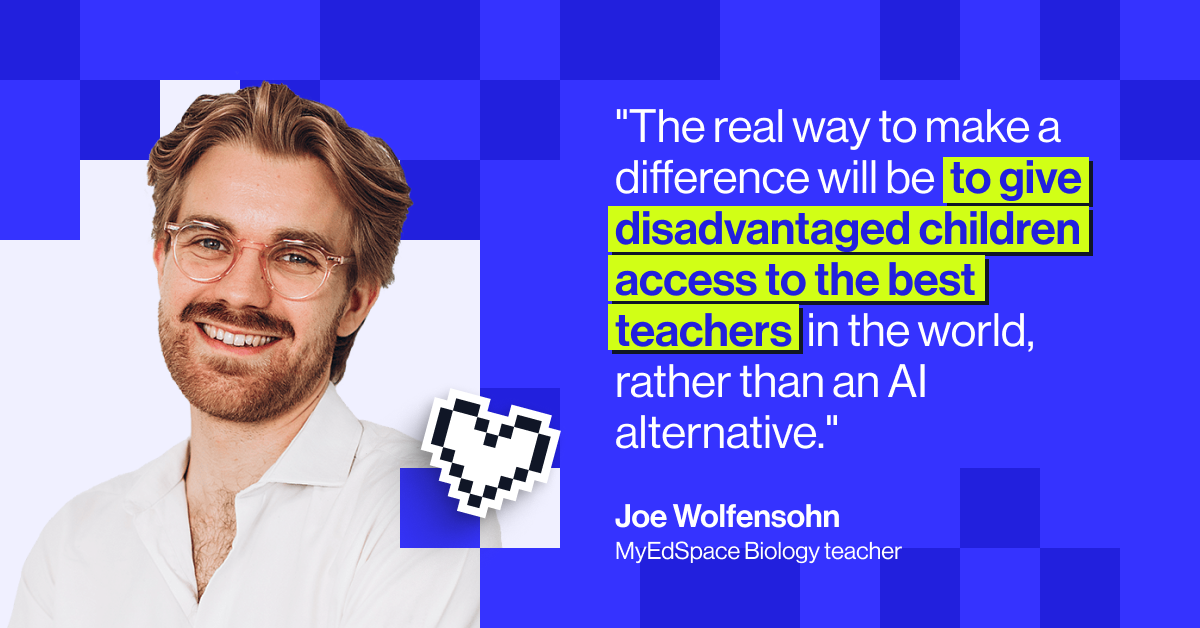
AI is a powerful tool, but it is not the answer to all our problems. For example, it will not solve issues between gaps in attainment between advantaged and disadvantaged children.
The problems in education are to do with teacher shortages, particularly in disadvantaged areas, where many students are taught by non-specialist teachers.
AI can be a powerful educational tool if used well, but the real way to make a difference will be to give disadvantaged children access to the best teachers in the world, rather than an AI alternative.
This is where live-streaming should come in. We should use this technology to get the best teachers teaching every child in the country and use AI to support this learning.
This environment can be very helpful for children who are struggling in mainstream education, particularly SEND children who need a quiet environment where they can learn at their own pace in and in their own time.
It's important to be careful about how this is introduced, as we've already seen strikes from teachers in areas such as Lancashire where remote teachers have been used to fill gaps. Care should be taken to make sure that livestreaming is presented as a way to support overworked teachers who are being asked to juggle admin, rather than as a cheap staffing fix.
Get ahead and stay ahead this year
Whether your child is getting started with Year 5, preparing for the 11+, heading towards their KS2 SATs in Year 6, or moving through KS3 in Year 7, Year 8, and Year 9, starting their GCSEs or their A-levels, now is the time to get ahead.
The secret to achieving academic success in the UK? Studying with top-quality teachers and former examiners, handpicked for their ability to make things click for their students and working hard. Do that and results follow. This year, it's your child's turn to get ahead and stay ahead.
And, it’s more affordable than you might think. With us, you can get a full year of expert teaching for less than a few classes with the average private tutor.