
Everything you need to know on A-level results day
A-level results day is nigh. If you’re burning with questions – or just sizzling with excitement – you’ve come to the right place.
As a former head of sixth form, with over a decade of involvement in the process, I know the sorts of queries and anxieties that arise as the midpoint of August looms. So, here’s everything I think you should know about the big day.
The UCAS Hub on results day
The UCAS “Hub” will open to applicants from 8am UK time on Thursday 13 August, and here’s our first surprise: it knows your grades before you do… but it’s not going to tell you what they are.
Schools and UCAS both receive your A-level results the night before, and often spend the night doggedly working on your next steps for you. This is why you might see a Conditional offer suddenly turn into an Unconditional offer the night before – because this university has decided (irrespective of your grades) that they definitely want you. Such outcomes get more common with every year, and are a mighty relief for many.
Then, at 8am on Thursday, the Hub will go live, and you’ll be able to see the final status of your ‘Firm’ and ‘Insurance’ choices. At that point, you’ll need to head to school for the grades themselves; UCAS do not disclose these to you directly.
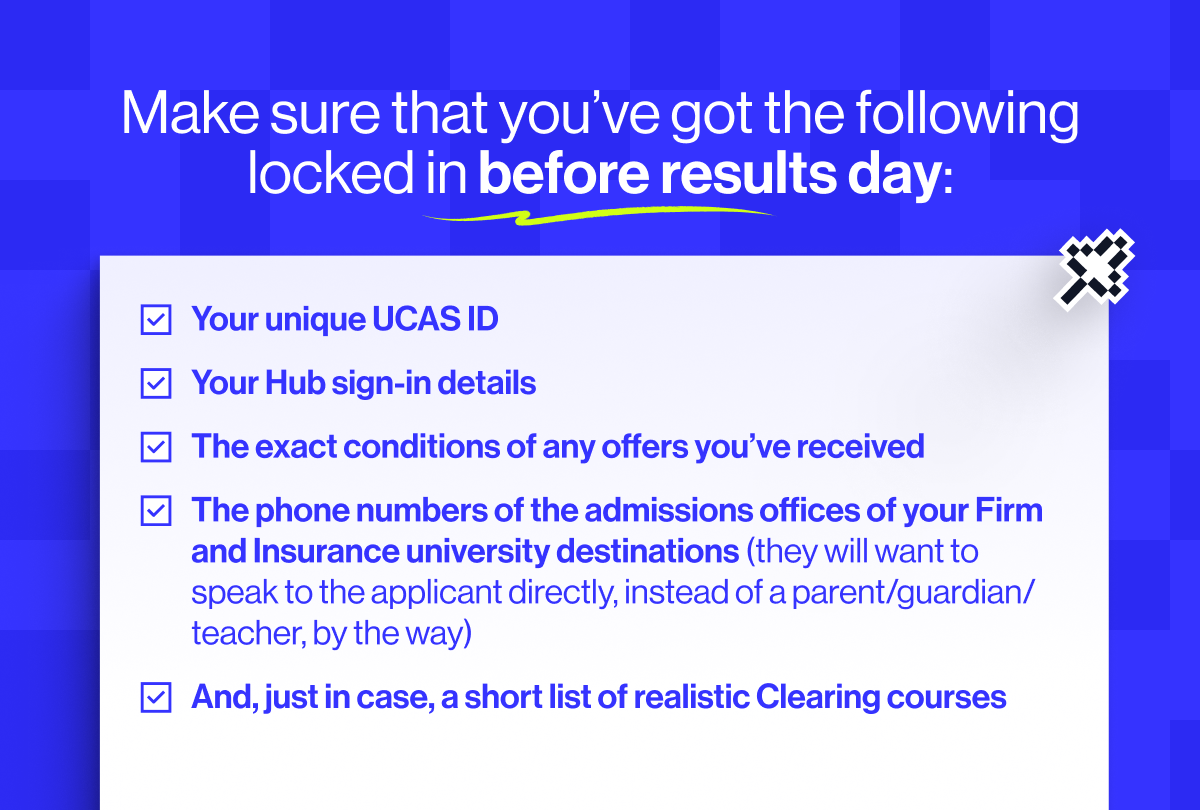
With this in mind, make sure that you’ve got the following locked in before results day:
-
Your unique UCAS ID
-
Your Hub sign-in details
-
The exact conditions of any offers you’ve received
-
The phone numbers of the admissions offices of your Firm and Insurance university destinations (they will want to speak to the applicant directly, instead of a parent/guardian/teacher, by the way)
-
And, just in case, a short list of realistic Clearing courses
Hub statuses: what do they mean?
There are five typical statuses students may find in the Hub from 8am on results day:
-
Firm CONFIRMED
-
Firm UNSUCCESSFUL, Insurance CONFIRMED
-
Firm UNSUCCESSFUL, Insurance UNSUCCESSFUL
-
PENDING
and -
REVISED offer
There are some other slight variants, but this is my list of most-common possible outcomes. The wording is not identical, but the five likely outcomes are clear. Let’s consider them in turn.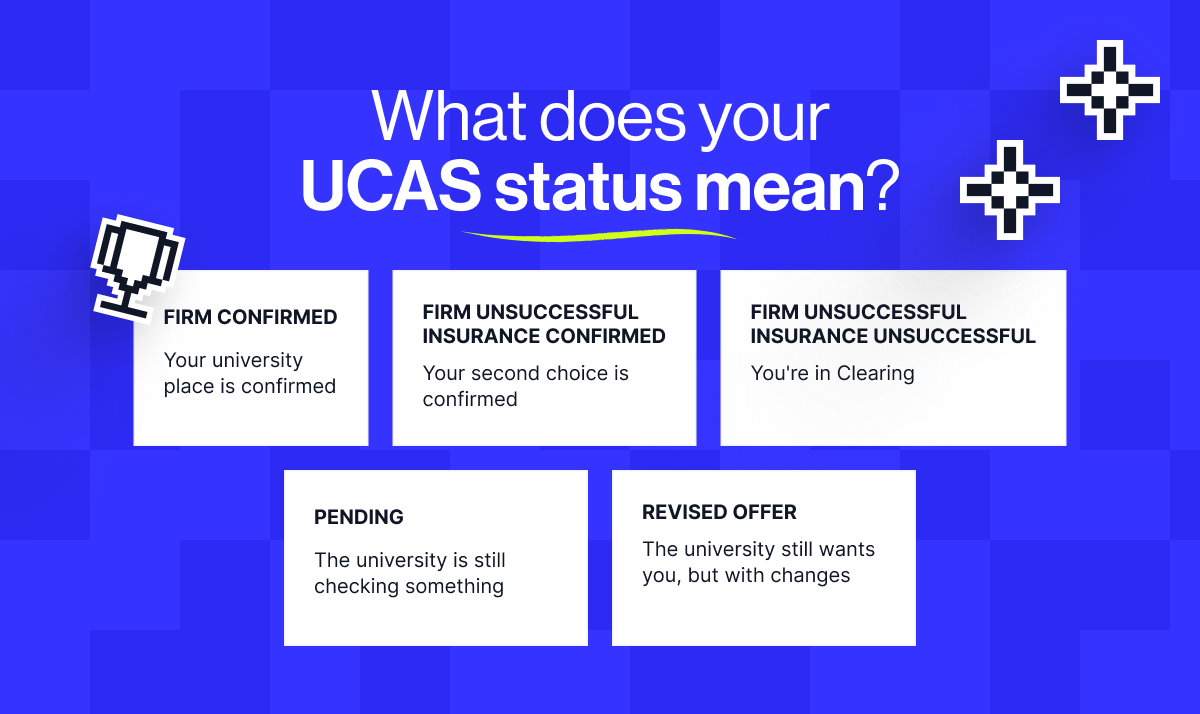
Firm CONFIRMED
This means that you have your place at your ideal university. Either it was an Unconditional offer, or you met the terms of your Conditional offer.
Jump for joy, high five your teachers, hug your friends, and then get online.
You don’t need to do anything further on UCAS; your university will be in touch. For you, instead, it’s time to finalise finances and to race against other successful applicants to your university for places in the best accommodation.
Firm UNSUCCESSFUL, Insurance CONFIRMED
This means you haven’t met the conditions of the offer for your preferred choice, but you have met the conditions for your second choice.
This is still a major win; you selected your Insurance choice because it was also somewhere you’d be happy to study.
That said, if you check Clearing (see the later section on Clearing) and find a genuinely more appealing alternative, you can still decline your Insurance offer at this stage.
Don’t do it prematurely! And, assuming you do want the Insurance place, you can – as above – jump, high five, hug, and get searching for accommodation once you’ve confirmed with Student Finance England.
Firm UNSUCCESSFUL, Insurance UNSUCCESSFUL
This means you haven’t met the conditions for either of your offers.
You will show as in Clearing, and you will gain a Clearing number (see the later section on Clearing), unless either university changes its mind – in which case the status will change to Firm SUCCESSFUL and/or Insurance UNSUCCESSFUL, but only after changing from Conditional to Unconditional at the offer stage (usually the night before).
It’s time to give some real thought to next steps, and then to pursue Clearing if appropriate.
PENDING
This means that the university may be waiting to hear from you or the providers of your qualifications.
I said the latter will typically inform UCAS of your grades – but some, non-A-level qualifications will need confirming manually, by you. You may need to provide a document. Contact the university admissions office to confirm why the status remains pending. Sometimes, there’s just a lag on the system – which won’t take more than 24 hours to resolve.
REVISED offer
This means, usually, that the university still wants you, but with a caveat.
That caveat may be that you can be enrolled on a different course (oftentimes Medicine, for example, will be substituted for Medicine with a Foundation Year, or Biomedical Science, etc.).
It may be an offer at a different campus for the same university. It may be an offer for the following academic year, in rare cases.
Whatever the named caveat, it is time to think deeply about what you really want – considering the changes in course content, location, accommodation, and associated costs, where relevant.
Grades not what you hoped for? Want a remark?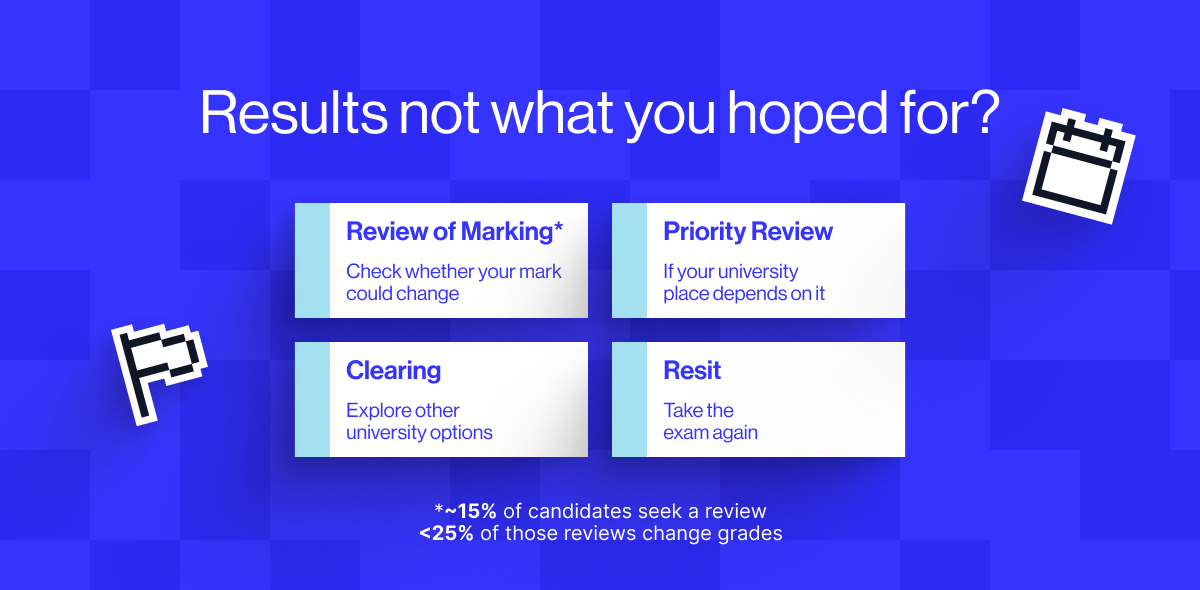
While “remark” as a term gets bandied about, it isn’t strictly speaking the official language. What you may want is a “Review of Marking”.
This review essentially involves an exam board official checking the marks of the examiner who assessed your paper(s). Sometimes something as simple as a clerical error in entering the numbers onto an electronic system may have impacted your outcome.
If you want a Review, you will need to discuss this with your school or college (unless you were a private candidate – in which case, go straight to the exam board). You’ll have to sign a form acknowledging that the mark and grade could go down as well as up – or stay the same.
It’s worth getting a copy of the marked script from the exam board first, to have a quick review of your own with your subject teacher, because this is a free service.
If you do then pursue a Review, it will cost you – though the fee is waived if the grade changes.
To break it down: access to the papers is, as mentioned, a free service; a clerical re-check of data entry is around a tenner; and a review of marking will be between £50-60. This varies by exam board, and year-on-year, so check with your exams officer. You should discuss with your subject teacher which service best suits your situation, based on the marked paper you get back, before proceeding.
If you apply for a Review, and your university place depends on it, then you may be wise to consider doing two things:
-
seeking a Priority Service 2 request from the exam board within a week of results day
-
Informing the university that a Review is being sought
The Priority Review, for an extra £10-15, is faster (resolved within about two weeks of the request), and informing the university might mean that they hold your place until it is resolved – though this is not guaranteed.
Because your place is not locked in, and because the Review may not resolve the shortfall in your grade, you should also be getting stuck into the Clearing vacancies (see next section) if you still want to head off to university in a few months.
It’s worth noting that about 15% of candidates in England typically seek a Review, and less than a quarter of these Reviews end up amounting to a change in grades – so align your expectations with the data.
If the mark doesn’t improve, you are then allowed to request an Appeal, and then later an Ofqual Review. These are costly (often ranging from £200-300 each), time-consuming, and rarely instrumental in securing a better grade outcome (about 0.07% of students end up with a grade changed through Appeals) – so you must be absolutely certain that a mistake (followed by several subsequent mistakes) was made in the handling of your paper(s) if you pursue this route.
Resitting is also an option, if your current education site allows.
You will need to discuss this with your school or college, and there will be plenty of experts on hand (your teachers, exam officers, school leadership, etc.) who can advise on this. You may be able to “drop” into the year below, or in special cases get additional support from subject teachers outside of lessons, if they have time – and then resit at the earliest opportunity (almost always the following summer).
This is rarely free; expect to pay about £100-150, course-and-exam-board-depending – unless your school covers some or all of the fee. It is crucial, if you do opt for a resit, that you consult with target universities. Some will refuse resit candidates; others will impose additional conditions for them; and others, still, will be as open to you as ever before.
Decisions, decisions!
What is Clearing?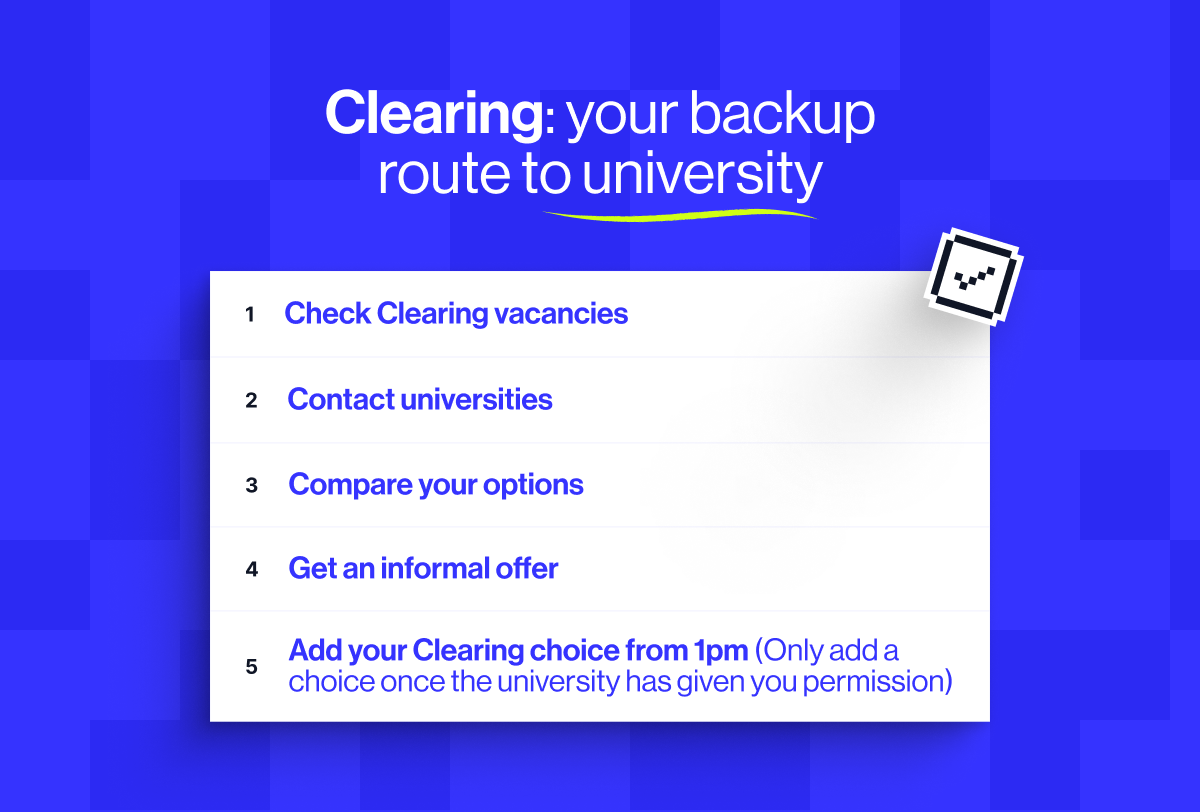
Clearing is the “back-up” option for securing a fruitful university place, and in 2026 runs from 2 July to 19 October.
The Clearing process is available to applicants who are not holding a university or college offer. This tends to include those who didn’t receive an offer in the first place, didn’t meet the conditions of their Firm or Insurance choices, applied initially after 30 June, or deliberately gave up a confirmed place.
An eligible applicant will see a Clearing number appear in their UCAS application, and a browse through Clearing’s course vacancy listings may commence.
On A-level results day, if this is you, you can start contacting universities during the morning, but you won’t be able to add a Clearing choice until 1pm UK time. This interval should be used to investigate courses and compare offers carefully.
You should search the official UCAS vacancy list and contact each university before adding a choice. You will need:
-
Your UCAS Personal ID
-
Clearing number
-
Results
-
Details of the course available
Universities may ask questions about the application, qualifications, and your reasons for choosing the course. During this conversation, they may make an informal offer to you – which you can enter as your Clearing choice once 1pm rolls around.
You may speak to several universities and receive more than one informal offer, but you’ll only be able to enter one at a time. Remember, an informal offer is not the final UCAS placement. Indeed, before deciding to enter your option, you ought to establish:
-
The exact course, campus, start date, modules, and assessment methods
-
Any placement, accreditation, or study-abroad arrangements
-
Tuition fees and additional course costs
-
The availability and cost of accommodation and student support
-
The deadline for adding the Clearing choice
A university place is a big commitment. Choosing it, through Clearing, in one morning, is quite the ask!
Practically speaking, only one Clearing choice can be entered in your UCAS application. You should add it only after the university has given permission – and only if you’re prepared to accept the place. If the university confirms the choice, then you are placed.
If it declines the application, then you can add another Clearing choice. In theory, you can keep going through this process until you get a place secured; in practice, there may be a limit – but I’ve never seen it maxed out before!
Students who change university or course through Clearing should then update their Student Finance account.
If that’s you, then you should also contact the new university’s accommodation service as soon as you can. A Clearing place doesn’t constitute an entitlement to university-owned accommodation, so availability and contractual terms must be checked directly.
What if you do better than expected?
Every year, I’m pleased to say, students come up to me beaming at their A*s after banking on Bs. Of course, I am beaming back before their mouths open because I already know – and have likely been researching their options all night.
Once upon a time (until 2021), a process called Adjustment allowed students to hold their Firm/Insurance place whilst seeking destinations with higher entry requirements. Nowadays, you have to use Clearing if you’re in this scenario.
Crucially, if this is you, then you must be aware that declining your Firm/Insurance place is usually permanent. So, you’ll need to be sure that there is a more appealing option actually available to you by searching Clearing vacancies and contacting other institutions.
If you find a course that looks good, and you get an informal offer from the university with the vacancy, based on your grades, then – and only then – you can decline your Firm/Insurance place, which gives you a Clearing number and allows you to select the new option.
Do not decline your offer until you are sure that Clearing gives you a better choice. Include consideration of scholarships, cost of living, accommodation options, and travel – alongside the course structure and university reputation – before deciding that choice is indeed “better”.
Perhaps university is not right for you at the moment
Among the beams of joy every year are long faces, too. It is always something of a lottery – and not everyone’s a winner. Fortunately, results day does not have to dictate your future. It doesn’t even mean you have to choose whether to go to university – this year or ever.
You should think about long-term plans – and think hard.
Start with your current intended career, if you have one in mind. Ask yourself (and your mentors, and Google), Does successful entry to this career require a degree, an accredited qualification, vocational training, or relevant experience? When you know the answers to these questions, then you can compare the routes available to you – by course content, duration, cost, assessment, and employment prospects. There are many ways to skin a cat.
-
An apprenticeship, for example, combines paid employment with study towards a qualification and may suit someone who prefers to learn through work
-
School-leaver programmes offer another direct route into employment – and may also include professional or academic qualifications
-
Higher Technical Qualifications provide job-focused higher education and are usually shorter than a standard undergraduate degree
-
Going directly into work can provide income and experience, particularly where an employer offers structured training
-
A gap year can allow time for employment, volunteering, travel or further study – though of course it should have defined aims, a realistic budget, and a plan for what follows
Deferring a place is usually something you do at the point of applying, not in August – but not always. Indeed, a student who wants to retain a university place while taking a year out can still ask the university to defer entry – there’s no harm in doing so.
Deferral is not an automatic right, however, and is up to the discretion of the university; they may require you to reapply next year, and you may decide that losing the place is too great a risk and acquiesce to their offer. Obtain the university’s decision before making commitments for the year ahead.
Parents and guardians might want to be involved. You can let them feel useful by asking for help with gathering information, comparing practical consequences, and preparing important questions. Where nominated access is in place on UCAS, a parent/guardian may also help with calls to universities and training providers. You, however, should remain at the fore in every decision – because the academic, financial, and contractual commitments will ultimately be yours.
I hope that this article has been helpful!
Below, I’ve included a short list of very common questions I get asked every year – with very brief answers – so that should cover everything.
Rapid-fire FAQs
Does UCAS Hub show the grades?
No. The Hub shows the application decision. You receive the grades from your school or college.
Can a university accept an applicant who narrowly missed the offer?
Yes. The university may confirm the place despite the lower result. You should rely on the decision shown in the Hub and any direct communication from the university.
Can Firm and Insurance choices be swapped after results are released?
No. If you now want the Insurance university, you must first ask them whether they can accept you through Clearing.
Can a student contact several universities during Clearing?
Yes. You may discuss courses and receive several informal offers. Only one Clearing choice can be entered in the UCAS application at a time, though.
Can a parent speak to UCAS or a university?
A parent can discuss the application only where the applicant has granted nominated access and the organisation accepts that authority. The student should remain available because universities generally expect to speak to the applicant.
What should I do if the Hub has not updated?
You should check whether the application identifies a missing result or document. If no explanation is shown, they should contact the university holding the offer and ask whether a decision is still pending.
Does a Review of marking preserve the university place?
No. The university must decide whether it can keep the place available. You as an applicant should notify it immediately and continue to consider Clearing courses.
Must an applicant use Clearing after losing both choices?
No. The applicant may decide to resit qualifications, apply in a later cycle, pursue an apprenticeship or job, take another qualification, or plan a gap year.
Get ahead and stay ahead this year
If you've just started your A-levels, or are heading in to Year 13, now is the time to get ahead.
The secret to achieving academic success in the UK is studying with elite teachers and former examiners, handpicked for their ability to make things click for their students and working hard. Do that and results follow. This year, it's your turn to get ahead and stay ahead.
And, it’s more affordable than you might think. With us, you can get a full year of expert teaching for less than a few classes with the average private tutor.