
GCSE Biology: what’s involved and how to prepare
If you or your child is about to begin their GCSEs, you’ve probably noticed how the word "GCSE" seems to carry a weight that "Year 9 Science" never did.
The step up from Key Stage 3 Science into GCSE Biology in particular can feel like a mystery: a long list of unfamiliar words, diagrams of things nobody can see, and the vague sense that it suddenly matters more.
The good news is that GCSE Biology is far more understandable than it first appears. In this article we explain what GCSE Biology is and what to expect from now until exam day.
What’s the difference between GCSE Biology and Key Stage 3?
At its heart, Biology is the study of living things and how they work, from the tiny machinery inside a single cell to the way whole ecosystems fit together. GCSE Biology takes the basics your child met in Key Stage 3 and builds them into a connected, more detailed picture.
It’s a rich, fascinating subject, and most students thrive in it once they have settled in and learned how it works.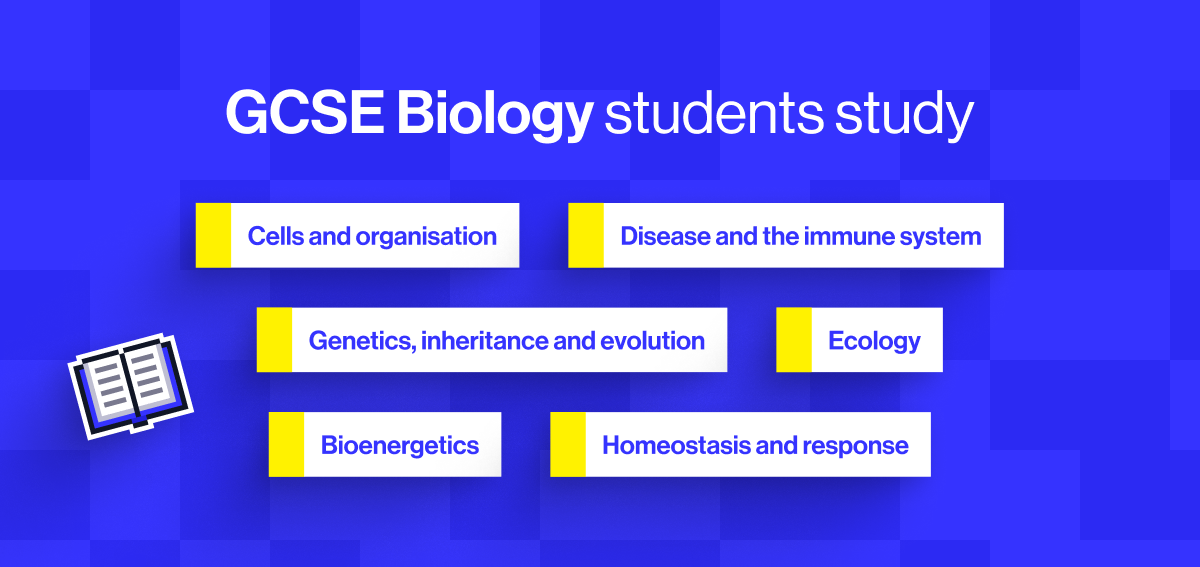
Over two years, GCSE Biology students typically study:
Cells and organisation
How living things are built from cells, and how cells group into tissues, organs and systems.
Disease and the immune system
What causes illness, how the body defends itself, and how vaccines and medicines work.
Bioenergetics
Photosynthesis and respiration, the two processes that power almost all life on Earth.
Homeostasis and response
How the body keeps itself stable, using nerves and hormones.
Genetics, inheritance and evolution
DNA, how genes pass from parent to child, and how species change over time.
Ecology
How organisms interact with each other and their environment, and why biodiversity matters.
Depending on the school, Biology is studied either as part of Combined Science (worth two GCSEs across Biology, Chemistry and Physics) or as a separate "Triple Science" GCSE. Either way, the core ideas above are the foundation.
Why GCSE Biology can feel like a big jump from Year 9 Science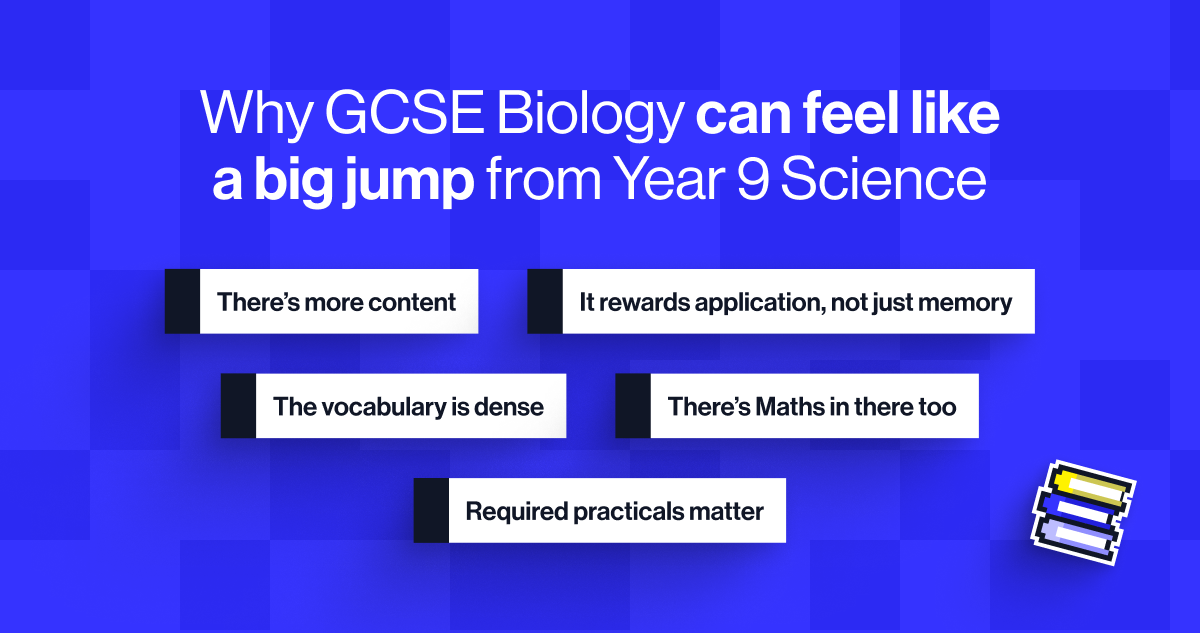
Most students cope perfectly well with GCSE Biology, but it is fair to say it asks more of them than Key Stage 3 did.
There are a few reasons the step up can feel steep:
There’s more content
Topics that were covered in a lesson or two at KS3 are now studied in real depth, with students having to learn many complex processes.
It rewards application, not just memory
Exam questions rarely say "list the parts of a cell." They are more likely to describe an unfamiliar scenario and ask your child to apply what they know. That is a different skill, and it takes practice.
The vocabulary is dense
Words like osmosis, mitochondria and homeostasis arrive quickly. Students who get comfortable with the language early tend to find everything else easier.
There’s Maths in there too
Around 10% of the marks involve Maths skills such as percentages, ratios, graphs and units. This catches some students by surprise.
Required practicals matter
Students carry out a set of core experiments and are then examined on the methods and results, so understanding why an experiment is done a certain way is just as important as the result.
None of this is cause for alarm. It simply explains why a confident, well-prepared start makes such a difference. A little preparation over the summer can turn an anxious start into a confident one, and a confident student is a curious one.
How parents can help the transition from KS3 to GCSE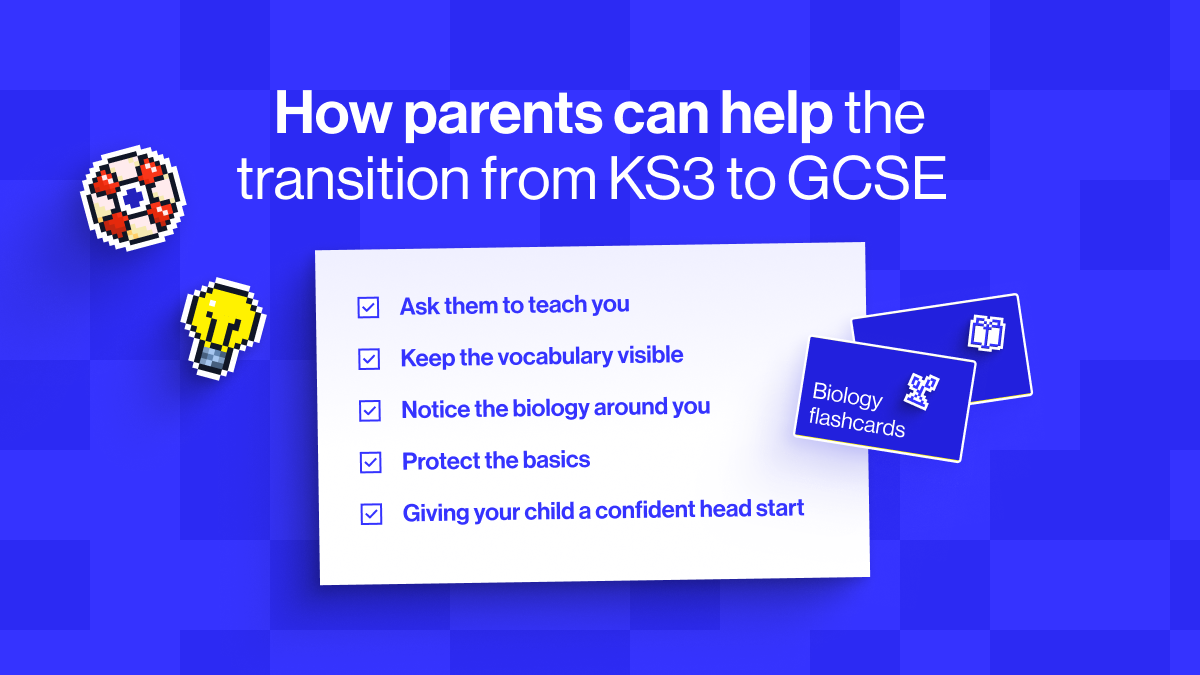
You do not need to remember your own school Biology to be useful, and a few simple things go a long way:
Ask them to teach you
If your child can explain photosynthesis to you over dinner, they understand it. If they get stuck, you have just found a topic worth revisiting.
Keep the vocabulary visible
A few key word definition lists or a flashcard pile turns scary terms into familiar ones.
Notice the biology around you
Why do plants grow towards the window? Why do we get a temperature when ill? Curiosity is the engine of this subject.
Protect the basics
Sleep, routine and a calm place to work do more to help students improve their science grades - and marks across the board - than most parents expect.
Get ahead and stay ahead this year
If you've just started your GCSEs, now is the time to get ahead.
For many students, the single biggest hurdle is not the difficulty of Biology itself, but the pace of those first few weeks.
September arrives, new terms land thick and fast, and it can take a term to find their feet. Children who have already met the foundations tend to spend that time consolidating and growing in confidence, rather than playing catch-up.
The secret to achieving GCSE Biology success? Studying with elite teachers and former examiners, handpicked for their ability to make things click for their students and working hard. Do that and results follow. This year, it's your turn to get ahead and stay ahead.
And, it’s more affordable than you might think. With us, you can get a full year of expert teaching for less than a few classes with the average private tutor.
Check out our course catalogue to begin.
And finally, MyResources is a free library of GCSE study notes and topic explainer videos.
The notes break each topic down into clear, exam-ready summaries, while the short videos talk students through the trickier ideas at their own pace. It is a simple, no-cost way to keep the key concepts fresh and build confidence.