GCSE Chemistry: what's involved and how to prepare
Chemistry is everything. Literally.
It is the study of matter, both seen and unseen, often referred to as a ‘central science’ as it connects Maths and Physics with Biology and Applied Sciences.
What’s covered in GCSE Chemistry?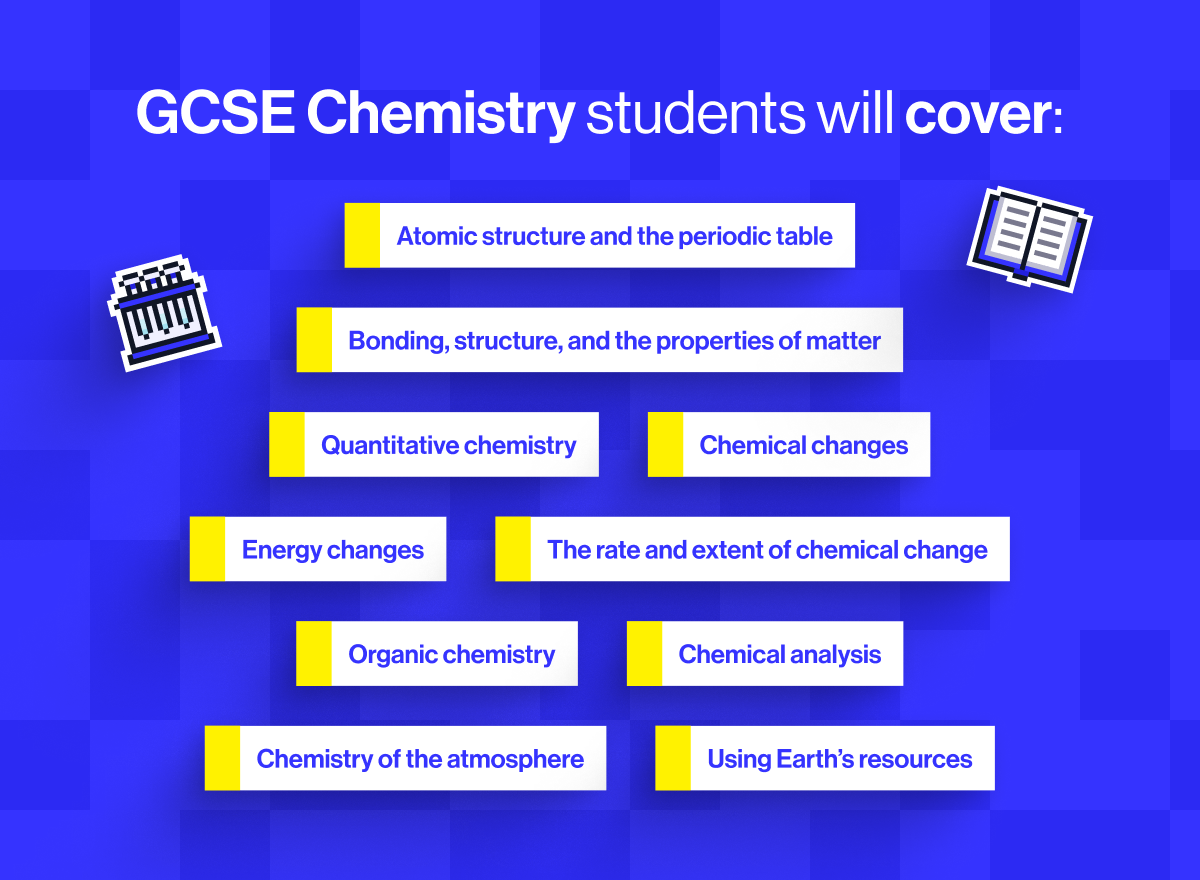
Students studying chemistry will not necessarily get a qualification that says ‘GCSE Chemistry’. Based on guidance from their teachers and future goals, they will typically choose between Combined Science (worth two GCSEs) or Separate Sciences (often referred to as ‘Triple Science’) where they’ll gain three separate qualifications in Biology, Chemistry, and Physics.
In both instances, students will study all three sciences and take a total of six science examinations, but the breadth, depth, examination length, and associated challenge is greater for Separate Sciences. The pathway chosen often depends on a number of factors, including aspirations to study a science to A-level, and attainment in science up to that point.
It is important to note, however, that taking Combined Science doesn’t stop students from taking an A-level in that subject and students that find it clicks a little later can still go on to further study and careers in STEM.
Over the two years, GCSE Chemistry students will cover:
Atomic structure and the periodic table
What are the building blocks of matter and how elements are categorised?
Bonding, structure, and the properties of matter
How do particles interact and how does that relate to their behaviour?
Quantitative chemistry
How much of the product can be made in this chemical reaction?
Chemical changes
How reactive are different substances and can we predict the products?
Energy changes
How is energy transferred during chemical reactions and how can this be investigated?
The rate and extent of chemical change
What affects how quickly a reaction happens and how far it goes?
Organic chemistry
Why is the chemistry of carbon so important?
Chemical analysis
What is this chemical and how pure is it?
Chemistry of the atmosphere
How has the Earth’s atmosphere evolved over billions of years and why does it continue to change?
Using Earth’s resources
How are natural resources used and how do we develop products more sustainably?
Also, embedded throughout the course are opportunities to apply practical skills through the study of 6-8 required practical activities. Bunsen burners and colourful chemicals will definitely feature, but most importantly, these help to make the theory learnt throughout the course more real, as well as develop a deep understanding of the scientific method.
Transition to GCSE Chemistry from Key Stage 3 (KS3) Science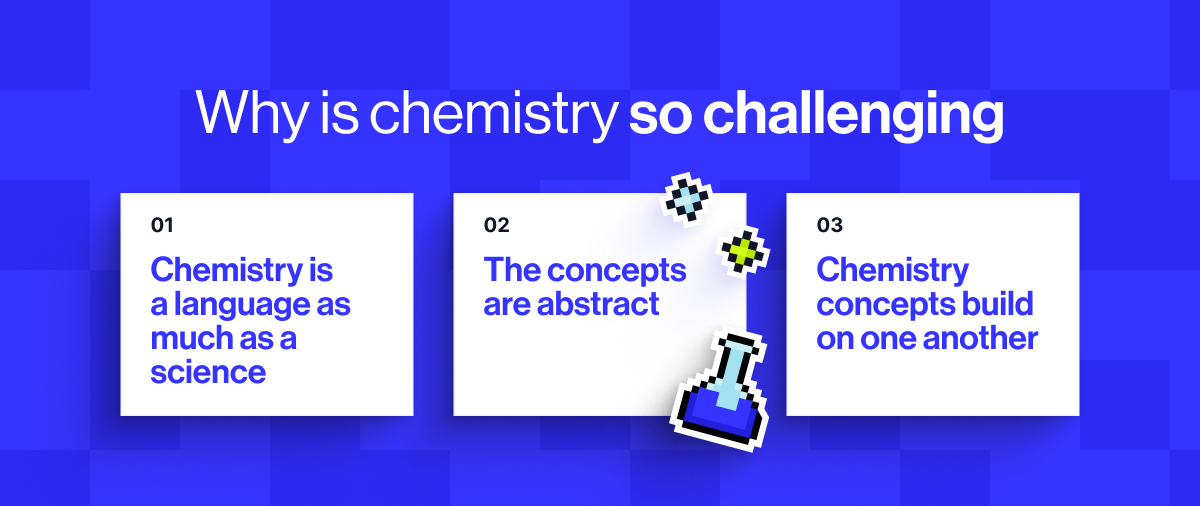
Unfortunately, the most common responses I get when telling adults I meet that I’m a Chemistry teacher are along the lines of “oh, I hated chemistry”, “I could just never get my head around it” or “I liked it until GCSE”.
So why is chemistry quite so challenging, and what makes the difference between these attitudes?
1. Chemistry is a language as much as a science
At GCSE level, the terminology becomes much more precise, and where in KS3 the word ‘molecule’ could get you pretty far, at GCSE we get more technical and the choice of words makes much more of a difference.
2. The concepts are abstract
GCSE chemistry introduces big ideas based on particles that are impossibly small.
Students are expected to grasp and fluently explain the behaviour of things that they cannot see. For example, how do clouds of negative charge relate to the table salt added to that pot of boiling water AND why does that make the water boil at a different temperature?
3. Chemistry concepts build on one another
At GCSE, concepts build one on the other and as a result, even small gaps in understanding can quickly become significant. An idea introduced in a lesson that was missed due to absence, or misunderstood without the opportunity to ask follow-up questions, can lead to
compounding confusion and misconceptions.
How to support the transition to GCSE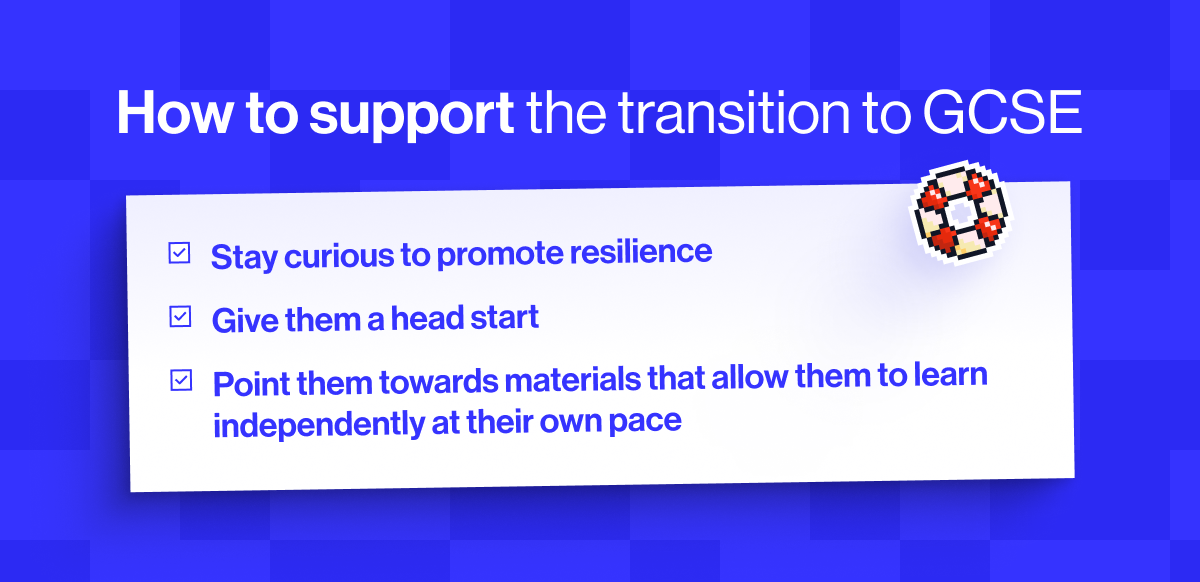
Stay curious to promote resilience
Many students switch off when they don’t get it, and as adults we can be guilty of using phrases like “I never got this at school” or “I was just never a Chemistry person”.
While some students may find the content harder to conceptualise at first, stay open to the idea that they can get this, and a challenge doesn’t mean the door is closed to them.
Give them a head start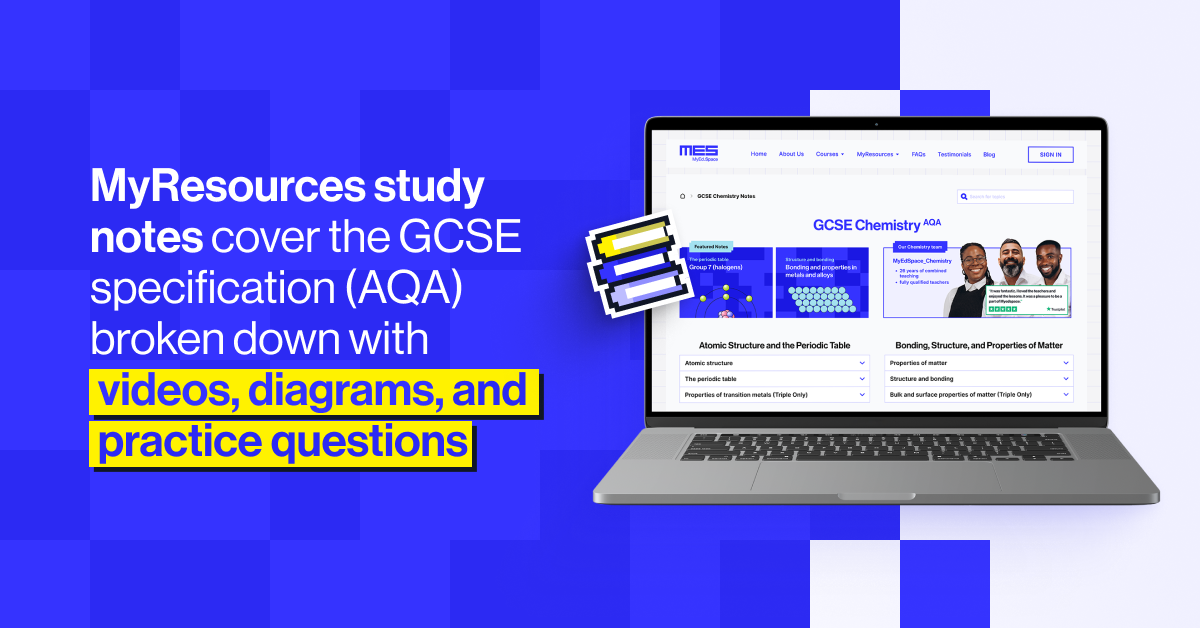
Get ahead and stay ahead this year
If you've just started your GCSEs, now is the time to get ahead.
The secret to achieving academic success in the UK? Studying with elite teachers and former examiners, handpicked for their ability to make things click for their students and working hard. Do that and results follow. This year, it's your turn to get ahead and stay ahead.
And, it’s more affordable than you might think. With us, you can get a full year of expert teaching for less than a few classes with the average private tutor.
Check out our course catalogue to begin.
Finally, MyResources GCSE Chemistry study notes cover the GCSE specification (AQA) broken down with videos, diagrams, and practice questions that can be used as pre-reading (or watching) to get ahead of upcoming topics, and as a tool to hold on to that understanding in the longer term.