GCSE English Language: What’s involved and how to prepare
A recent blog by my colleague Louis Provis went through everything that you need to know about GCSE English Literature. As he acknowledges in his opening, the entirety of GCSE English is indeed a complex beast. One subject, made up of two distinct qualifications, can be tricky for students and parents to get their heads around.
Now that he has made the Literature side of the course easy for you to understand, it’s my turn to take you through the details of English Language.
What is GCSE English Language?
If English Literature is your opportunity to explore the great texts that sit at the heart of the Literary Canon, English Language is your opportunity to showcase your skills with texts that you have most likely never seen before.
Without the ability to know what it is you will end up writing about for your exam, the bulk of your work will be practising the skills you need in order to succeed. Typically, these are:
-
The ability to read and comprehend texts, extracting meaning from them and understanding their intended purpose
-
Analyse the methods that writers use in order to achieve a certain effect on the reader
-
Respond to questions around a text's structure and the language within
-
Write both creatively and persuasively in relation to a given theme or idea
Number 4 on this list is really what separates GCSE English Language from GCSE English Literature.
As a student of Language, you’re given the opportunity to showcase your creative writing skills and your persuasive writing skills. In fact, these two questions on the exam papers are your biggest opportunity to secure the grades that you want - each is typically worth 40 marks, around 50% of your final grade.
As well as this, there is a small spoken language component, where students are assessed on their ability to speak publicly about a topic that is important to them. The Spoken Language Endorsement is one of the standout parts of this course and something that students at MyEdSpace really enjoy studying.
The English Language GCSE is often the main English GCSE that colleges and further education providers look for when students apply to study, and as such, it is one of the single most important exams that you will sit during your time at school.
What you’ll study in Year 10 GCSE English Language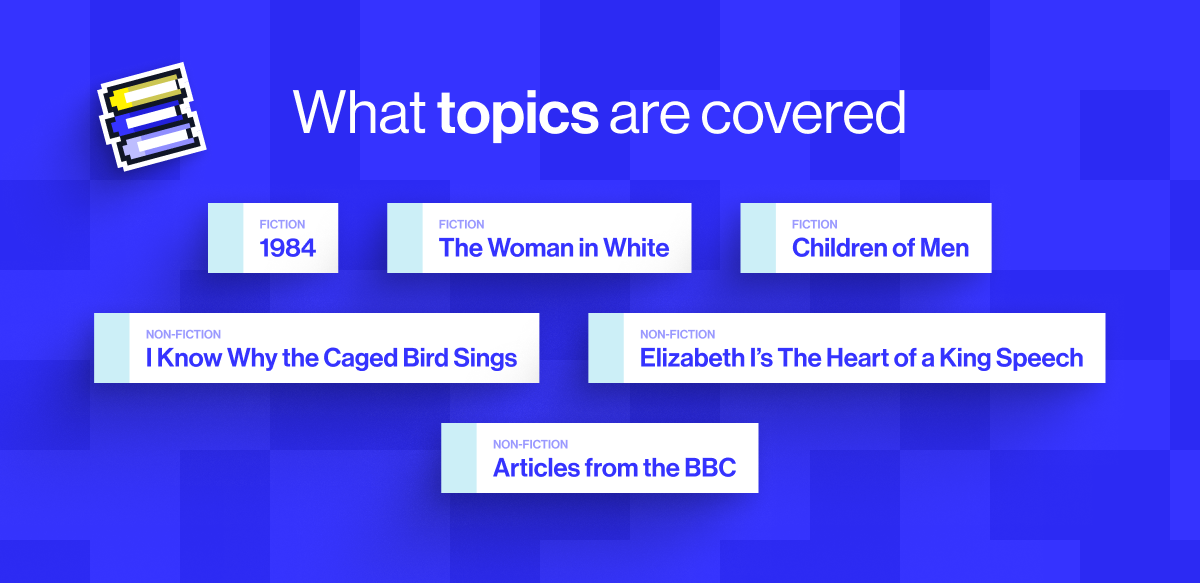
There are no set texts when it comes to GCSE English Language. Generally, each school in the country will pick a selection of fiction and non-fiction texts to teach students. These texts will act as the gateway into the skills you will need to practise over the course of two years.
As such, the following is just a few examples of the types of texts that we cover in Year 10 at MyEdSpace to help students prepare for their exams.
Fiction
When deciding how to teach unseen fiction to students across ability ranges, teachers tend to choose texts that are simple, engaging and full of great ideas. In the past, I’ve used extracts from texts such as:
1984
The classic Dystopian novel written by George Orwell, allowing students to explore ideas such as authoritarian control, alternate realities and the surveillance state.
The Woman in White
This famous 19th century Gothic mystery novel introduces students to the Gothic genre, a cornerstone of English writing and allows students to explore tension and suspense.
Children of Men
A modern apocalyptic novel allows students to imagine a world that has echoes of our own, while exploring creative narrative voices.
Non-fiction
While English Literature focuses entirely on fictional texts, the English Language GCSE allows students to study non-fiction texts.
The chosen non-fiction texts tend to focus on real events, described by those who were there, as well as accounts of important moments in history. With its basis in reality, students often find non-fiction texts highly engaging, allowing them a window into true human experience.
A few examples of non-fiction texts that we study at MyEdSpace are:
I Know Why the Caged Bird Sings
Maya Angelou’s memoir that takes students into her struggles with identity in America in the early parts of the twentieth century.
Elizabeth I’s The Heart of a King Speech
A window into Elizabethan England, with the country on the cusp of war and a woman proving herself in a largely male world.
Articles from the BBC
Covering a range of topics such as education, crime and poverty, allowing students to see how international news organisations report the key events of our time.
GCSE English Language exams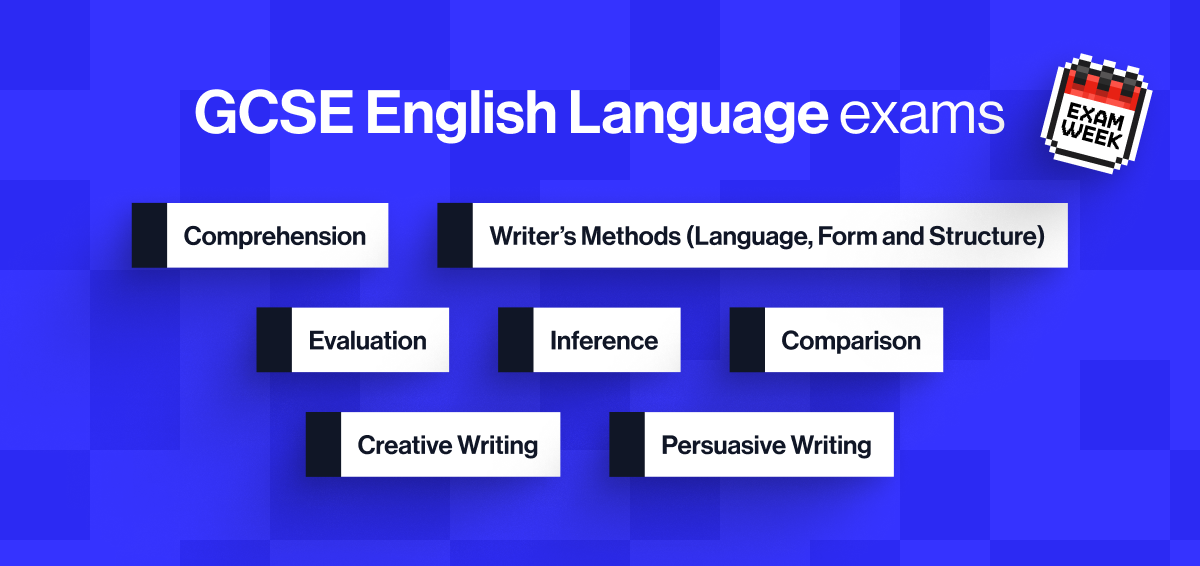
Regardless of which exam board you end up sitting for English Language, the skills you are assessed on are largely the same. What tends to differ is the wording and order of the questions themselves.
Comprehension
Your ability to read and extract information from the text, usually assessed through the form of multiple choice questions or the writing of one or two lines from a text to show you have understood the question.
Writer’s Methods (Language, Form and Structure)
Your ability to analyse the methods that writers use in order to achieve a certain effect. This could be picking out language methods such as hyperbole or metaphor, structural techniques such as the withholding of information or the form of the text, such as the personal nature of a letter.
Evaluation
Exploring how successfully a writer has achieved a certain effect, usually directed by a statement from a student on the text itself.
Inference
‘Reading between the lines’ of texts to extract subtle information not necessarily stated explicitly.
Comparison
Comparing the viewpoints and perspectives of two writers, usually informed by the time period in which they were written, as well as the writer’s relationship to the topic itself.
Creative Writing
Your ability to write creatively at length, describing characters and settings, usually hitched to a narrative that you have come up with yourself.
Persuasive Writing
Your ability to write persuasively at length, to argue your point of view on an often controversial topic and to present your ideas in a clear way.
Tips for how to make the step up from KS3 English, to GCSE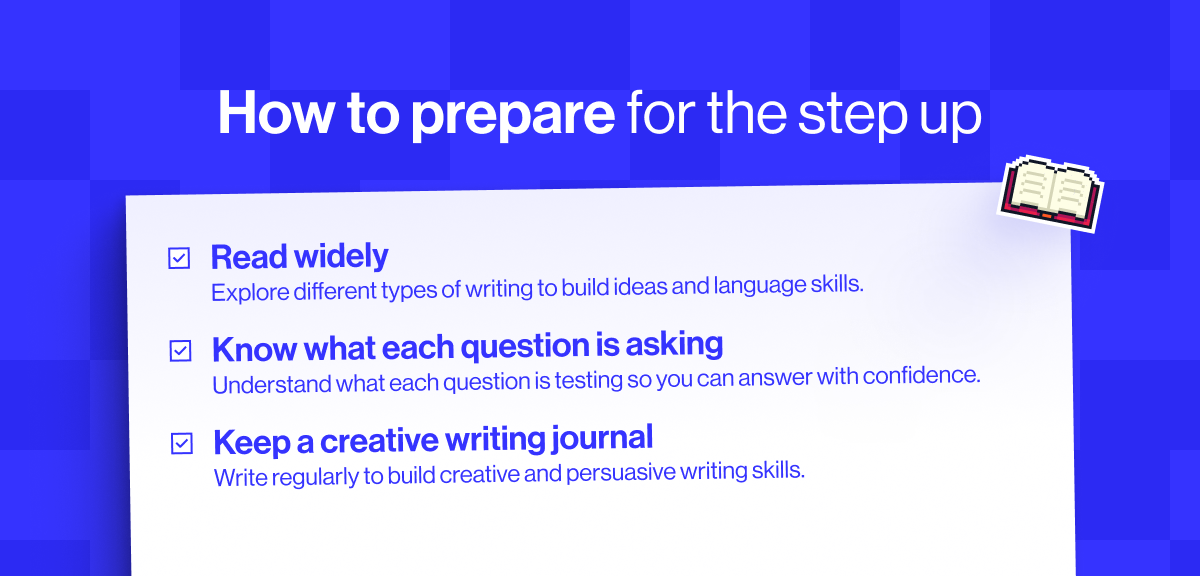
As an experienced teacher and examiner, I have three top tips for students to help you hit the ground running in September.
-
Read widely
In my experience, the students who tend to do the best in English Language are those who have read a variety of text types over the course of their time at school.
While predominantly this means reading novels, students should also push themselves to read opinion pieces on topics that interest them, autobiographies of famous individuals speaking about their important achievements and even articles from magazines about the important conversations of our time.
Reading is not one set thing - it’s about engaging with words upon the page and using them to inform and influence your own ideas. Remember: those who read, lead!
-
Build confidence about what each question asks of you
Writing about Language is different from writing Creatively. Writing Persuasively is different from writing about structure.
Each question on your exam paper is linked to a specific assessment objective. Knowing which question asks what is a vital part of success in GCSE English Language.
Taking the time to explore past papers, to engage with our MyResources GCSE English content for examples of great answers and speaking to your teachers about the papers will ensure that you go into the exam with confidence.
-
Keep a creative writing journal
Ray Bradbury, one of Britain’s most celebrated authors, set his students a task to ‘Read one poem, one short story, and one essay every day to feed your Muse’.
My challenge to students preparing to sit English Language is to write one each of these per week and to keep a record of this.
You don’t have to show anyone (though I’m sure your English teachers would love to read them) but by doing this, you can demystify the process of writing creatively and persuasively and build confidence over time, as opposed to trying to cram it all into the last minute!
Get ahead and stay ahead this year
If you've just started your GCSEs, now is the time to get ahead.
The secret to achieving academic success in the UK? Studying with top-quality teachers and former examiners, handpicked for their ability to make things click for their students and working hard. Do that and results follow. This year, it's your turn to get ahead and stay ahead.
And, it’s more affordable than you might think. With us, you can get a full year of expert teaching for less than a few classes with the average private tutor.