GCSE English Literature: what’s involved and how to prepare
We asked English teacher Louis Provis what students can expect from studying GCSE English Literature and how to prepare for the step up from Key Stage 3 English. Over to you Louis...
GCSE English is a slightly complex beast. I’ve been a teacher of English for over a decade, and an examiner for nearly my entire career, so I see every day how confusing this all is… and I want to make it simpler.
The main reason things get complicated for English is because there are two separate GCSEs that stand alongside each other – English Literature and English Language – and they’re often taught by the same teacher, sometimes within the same weekly timetable.
Let’s begin by outlining the difference, before focusing on English Literature. Of course, English Language will also be worth talking through – but in another article.
First, let’s break down the core information, so everything is clear.
What’s the difference between GCSE English Literature and English Language
Two GCSEs, both called English: what’s the big idea? The main difference is that English Literature has a lot more “content” – whereas English Language has slightly more “skills”.
“Content” means pre-learned material. “Skills” are techniques involved in analysing and writing. So, for English Literature, you’ll be studying at least four texts (books, plays, collections of poems) in detail before the exam, ready to answer questions on them. For English Language, you’ll practise your skills on a ton of (shorter) texts, but you won’t see the same texts in the exam.
Another way to look at it is to say that English Literature will focus on Literature (fiction texts that stand the test of time), while English Language will focus on Language (how it works in everyday contexts, not just stories). The GCSE English Literature assessment is entirely about essays, while GCSE English Language also contains an assessment of your speaking and listening skills.
Students tend to perform better in English Literature, but English Language is necessary for the next steps in life: college, apprenticeships, or entry-level jobs.
What you’ll study in Year 10, GCSE English Literature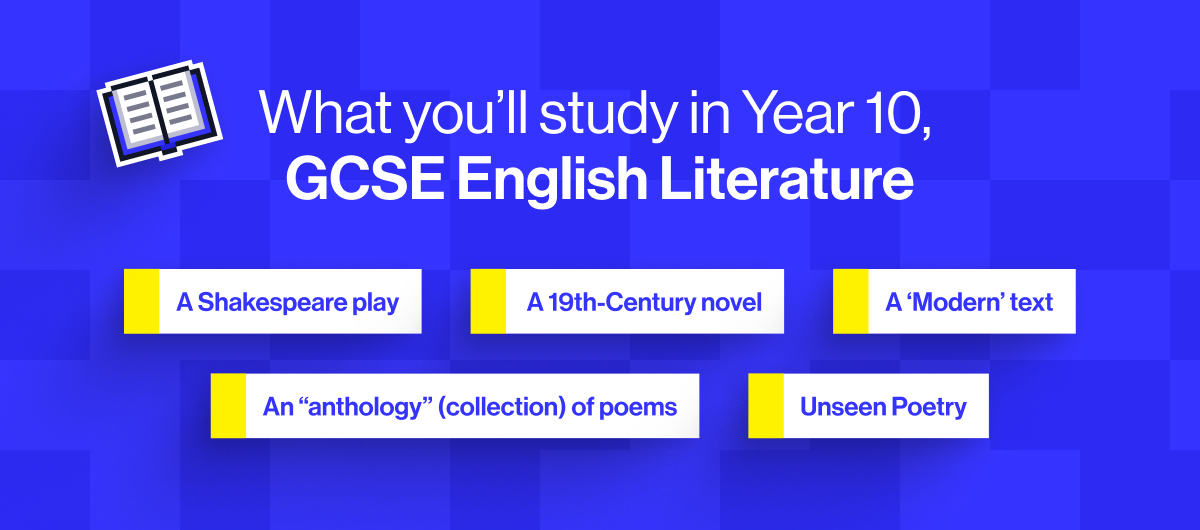
Regardless of your exam board, your GCSE in English Literature will almost certainly cover the following five areas:
1 - A Shakespeare play
Different schools can pick different plays, but the most common play studied the country over is the Scottish tragedy, Macbeth. In this play, the title character (no first name, just Macbeth) follows the prophecy of three witches, encouraged by his wife, and murders the current king, taking his position on the throne.
You’ll study the hard Shakespearean language (“a tale [...] full of sound and fury [...] signifying nothing”) and get to grips with the characters and themes, as well as the early-17th-Century context. The next-most-studied play is also a tragedy: Romeo and Juliet.
2 - A 19th-Century novel
The 19th-Century novel comes next, historically speaking. Once again, schools can choose their own preference from a list provided by the exam board, but the most commonly-studied novel in this category is Charles Dickens’ A Christmas Carol, written in 1843. The “novella” (our fancy name for a short book) involves the grumpy Christmas-hater, Ebenezer Scrooge, being haunted by three Christmas ghosts, who intend to teach him the value of Christmas and the error of his ways.
You’ll study the (slightly easier) Victorian language (“I am as merry as a schoolboy [...] I am as giddy as a drunken man"), encounter the cast of characters, explore the themes, and wrap your head around the 1800s as a time period. The next-most-studied novel, here, is R. L. Stevenson’s gothic Curious Case of Dr Jekyll and Mr Hyde.
3 - A ‘Modern’ text
Next up, the Modern Text, which is not necessarily even that modern, involves the study of a text written after 1914. Why that specific date? Well, that’s the year in which World War 1 broke out, and that was a war that changed everything about the country in which these books were written.
Most students study J. B. Priestley’s classic 1946 play, An Inspector Calls – but, as before, schools can opt for another option from their exam board’s list (for example, the slightly more recent Blood Brothers, written by Willy Russell in 1981).
Once again, the text’s characters, themes, language, and contexts will all likely be studied, in anticipation of a question in the exam that tests the depth of your understanding.
4 - An “anthology” (collection) of poems
The final “text” or book that you’ll study will be an “anthology cluster”. To break that down: an “anthology” is a collection of poems from different authors; and within that anthology there will be several “clusters”, which are smaller collections of poems, grouped around a theme.
Students will study about 15 poems, usually covering poets from the 18th Century onwards – with particular attention given to the so-called Romantic poets (who wrote more about nature and politics than romantic love, by the way). The most commonly-studied set of poems, nationally, is AQA’s Power and Conflict cluster, featuring some absolute classics like Agard’s Checking Out Me History and Shelley’s Ozymandias.
As before, the focus of study is on the language (and form and structure) of these poems, as well as the contexts in which they were written. There are no characters or “plots” to compete with, and the poems are usually only about a page long, if that. The exam question usually asks you to compare two of these poems.
5 - Unseen Poetry
The final element of GCSE English Literature is Unseen Poetry. This is the one that makes students panic, because there is no pre-study. You don’t get to know which poem or poems you’ll be analysing until you open the exam paper on exam day. As such, you will spend a good deal of time throughout your GCSE English Literature course practising the skills associated with analysing unseen poetry.
Here at MyEdSpace, we use a hack known as “FIRST”, to ensure that every student will have at least five things to say about every poem that could ever come up. It’s hard, but I am something of a weirdo, so I think this is the best part of GCSE English Literature full stop.
GCSE English Literature exams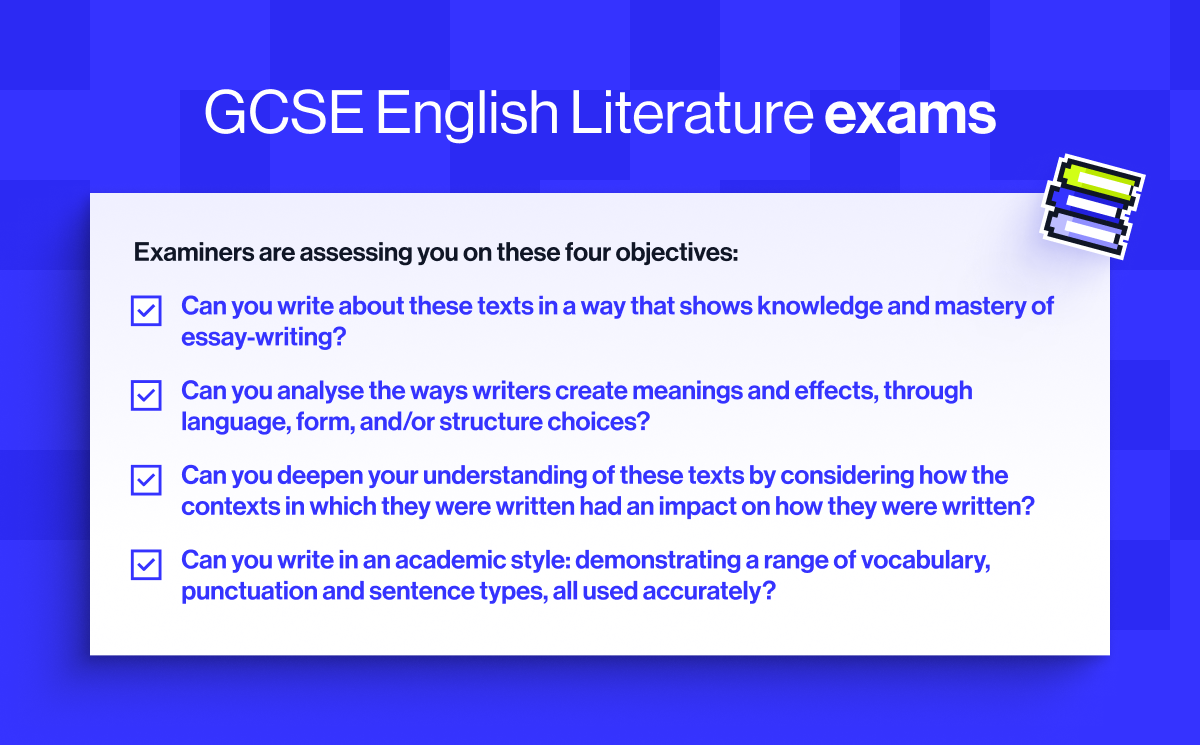
Typically, you’ll have two GCSE English Literature exams, and these five elements will be spread across them. This differs from exam board to exam board, with the most popular (AQA) having: Paper 1 (Shakespeare and the 19th-Century Novel); and Paper 2 (Modern Texts and Poetry).
The next question, inevitably, should be: how is it marked? Can you just “blag it” because there are “no right answers in English”? Sadly not. The GCSE English Literature exam is marked with all the same rigour as a GCSE Maths exam, using a clear mark scheme and assessment objectives. Let’s look at those, shall we?
The skills GCSE English Literature assesses
As with all GCSEs, there are Assessment Objectives (AOs) to work towards. The JCQ (Joint Council for Qualifications), the body that oversees the main exam boards – the parent figure to AQA, OCR, Edexcel, Eduqas/WJEC, etc. – has said that all exam boards must assess the same four things for English Literature.
So, taking them in order, examiners are assessing you on these four objectives:
-
Can you write about these texts in a way that shows knowledge and mastery of essay-writing?
-
Can you analyse the ways writers create meanings and effects, through language, form, and/or structure choices?
-
Can you deepen your understanding of these texts by considering how the contexts in which they were written had an impact on how they were written?
-
Can you write in an academic style: demonstrating a range of vocabulary, punctuation and sentence types, all used accurately?
In essence, if an examiner (or a team of examiners – as I’ll explain) can say “Yes” to all of these questions when marking your exams, you’ll succeed. Different exam boards assess those skills in different places across the exams, meaning it is not enough simply to know about the AOs.
Using AQA as an example again, I can tell you that AO3 will be about 20% of the marks on all questions except Unseen Poetry, and AO4 is only assessed on two of the five sections of the exams… so it pays to know exactly how and where marks are awarded across the papers if you want to excel.
To that end, I think it’s worth mentioning briefly how grades are awarded for GCSE English Literature – because there’s a lot of myth-making out there. Spoiler: grade boundaries aren’t decided until months after you sit your exams.
How GCSE English Literature awards grades and sets grade boundaries
The journey that your papers take from the exam hall in May or June to the brown envelope containing your grade in mid-August is long and winding.
First, your paper is sent securely to the exam board to be scanned onto the system.
Then, examiners are sent out a batch of answers from this bank, all anonymised, for the question or questions they’re marking this year. (One year, I spent basically an entire summer just marking GCSE essays on Romeo and Juliet… it was quite the summer!) Having been trained and tested on their allotted question, these examiners all around the country use a mark scheme to award marks for each relevant assessment objective on each answer, to give a total mark (out of 34, for example).
Then, moderation happens. Teams of examiners meet and compare marking to ensure reliability (something already being checked by senior examiners, who put pre-marked “dummy” papers in examiners’ cohort to check the marking is fair and consistent), and then a phone call is made to the top, confirming that marking is accurate.
At that point, there’s an official meeting of senior examiners and other stakeholders, during which a random assortment of papers representing practically every mark (from 0 to, say, 34/34) to determine what a “Grade 4”, or “Grade 7”, etc. looks like this year. From this, a numerical range for each grade is given (perhaps a Grade 4 is 12-15 marks out of 34, based on this sample). The process is then repeated for every question.
From here, some magic mathematics happens, during which statisticians take all the insights from the examiners and create grade boundaries.
First, they combine the notional grade conversions from all questions across both papers to get a grade estimate for the total marks across both papers, concluding with something like: “A representative Grade-7 range should be between 100 and 120 marks out of 160.” From this score, a draft grade can be attached to your combined score across the papers.
Once grades have been prospectively allocated to all papers, a final sense-check is done, ensuring that the grade “distribution” is reasonable – essentially about the same proportion of students are getting each grade as previous years. Any adjustments of grade boundaries are then made, and consequent adjustments of student grades follow.
Finally, your marks and grade are finalised and recorded on the system, and this information is sent to your school or exam centre to give to you on results day in August.
Tips for how to make the step up from Key Stage 3 English
As an experienced teacher and examiner, I have three top tips for students seeking an edge at this early stage.
1 - Read the texts at home
Curriculum time is extremely limited. Teachers are always complaining about how there aren’t enough hours in the week to cover everything properly. Until school days are extended to 5pm (don’t worry – this won’t happen), you can give yourself the text of reading the texts you’re going to study.
If you don’t have your hard copies from school yet, you can find most of them online. As most of the texts are “old”, their authors have been dead for more than 70 years, meaning they are no longer under copyright – so you can find them free online without breaking the law! There are also some excellent resources out there to help you self-study the texts, like the (totally free) MyResources, written by me and my team at MyEdSpace. 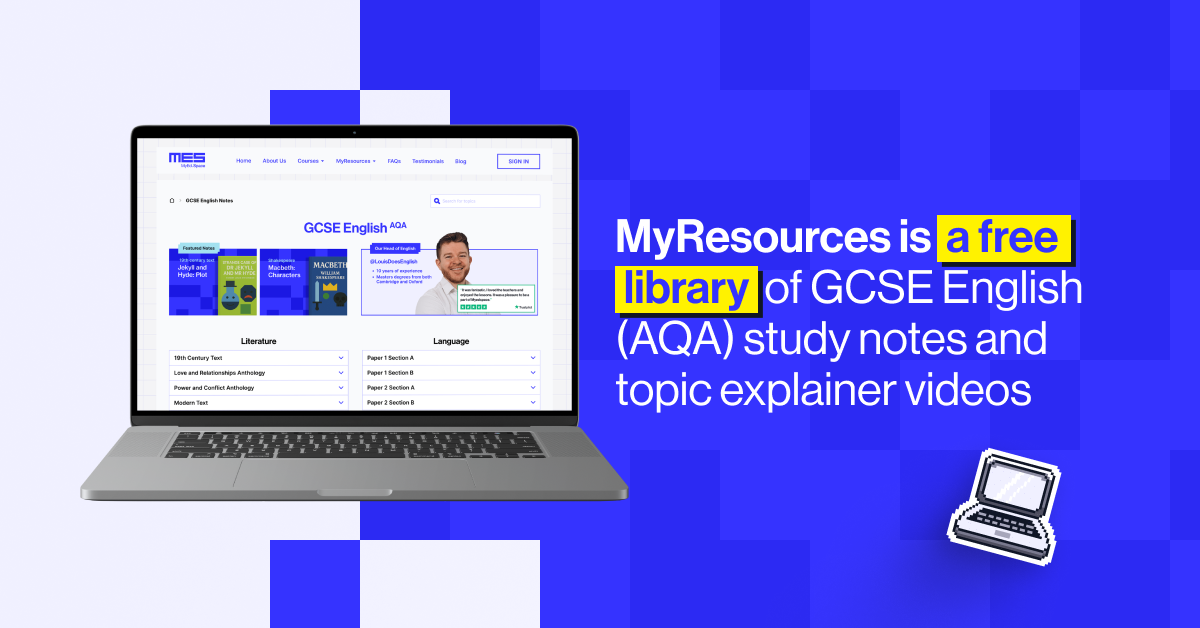
2 - Write a weekly essay
English Literature is an essay subject, more than perhaps any other. As such, getting into the habit of writing essays can be an absolute game-changer if you want to get a top grade.
You don’t have to get it assigned or even marked by your teacher; simply write about what you have covered that week in lessons: plot progression, character development, quotes that stood out, contextual details. As time goes by, you can start to gear these essays toward exam-style demands, but for now, just establish the habit.
The beauty of this is that you are not only practising essay-writing, but also beginning your revision early in a low-stakes environment. Nobody has to mark what you write; you’re consolidating your learning and committing it to long-term memory more securely than every other student who has just decided to “let the learning happen to them”. Get ahead of the curve.
3 - Get guidance and support from the experts
Most people who want to be their best recognise that the lack of hours in the school day I mentioned before – as well as the distractions of a class of 30-plus teenagers – cannot be good for true mastery of any subject.
For many students, the single biggest hurdle when stepping up into Year 10 is not the difficulty of the English topics they’re studying, but the intensity of those first few weeks.
In some Asian countries, like Singapore, Japan, and South Korea, extra tuition outside of school hours is the norm (between 60-80% of students), and these same countries rank 1st, 2nd and 4th in the world, respectively, for reading performance by age 15. This is no surprise. More hours, fewer distractions, and buy-in from families are all going to add up to better progress in English.
The problem, of course, arises when we take stock of the fact that extra tuition is something of a “wild west” – lawless and full of mystique – when all you really want is an expert and a community.
That’s exactly why we run our GCSE English Summer School - three weeks across August designed to give students starting their GCSEs a genuine head start.
Lessons are taught by experienced English teachers - specialists in creating effective, supportive and friendly groups. Each lesson includes plenty of confidence-boosting activities so everything feels logical rather than intimidating.
By the time term begins, students arrive on the first day already familiar with the methods, the language and the way of thinking that GCSE English Literature asks for. For a lot of children, that early confidence is what sets the tone for the whole course.
The results our students go on to achieve show the strength of this approach. For example, in 2025 three times more MyEdSpace GCSE students achieved Grade 9 than the national average.
Get ahead and stay ahead this year
If you've just started your GCSEs now is the time to get ahead.
The secret to achieving academic success in the UK? Studying with elite teachers and former examiners, handpicked for their ability to make things click for their students and working hard. Do that and results follow. This year, it's your turn to get ahead and stay ahead.
And, it’s more affordable than you might think. With us, you can get a full year of expert teaching for less than a few classes with the average private tutor.
Check out our course catalogue to begin.
And, finally, MyResources is a free library of GCSE English (AQA) study notes and topic explainer videos.