
GCSE grade boundaries and how they work
If you have spent any time on social media as a Year 10 or Year 11 student, you will probably have come across a creator claiming that “grade boundaries this year will be…” – with some even claiming they have insider knowledge from a parent working at the exam board. I’m here to tell you why that is nonsense, and hopefully a lot more.
Between the June completion of GCSE examinations and the mid-August results day, there is an enormous amount happening behind the scenes. In this article, I will use my experience as a former examiner for all major exam boards to explain how your completed exam scripts turn into a grade.
The first thing to know, to put your mind at ease, is that grade boundaries are not decided before you sit the exams, but after they’ve been marked. Let’s break it down, step-by-step.
On GCSE exam day
When you’re in the exam hall, you’ll need to remember two things (well, two things on top of all your knowledge and skills for that exam): your candidate number, and the marginalia rule.
Your candidate number connects your answer booklet to you as an individual, so it’s an important part of the admin. Don’t worry, though – there are sophisticated checks that happen at the exam board’s headquarters to match you with your script if you copied it out incorrectly.
The second part, marginalia, refers to anything you write outside of the allocated boxes in your booklet. These do not get marked. They don’t get marked because they don’t get seen; your papers are sliced so that just your lines are visible, before scanning onto a computer.
What this means is that you are free to scribble notes in the margins (I recommend this quite often, to reduce cognitive load), but anything you scribble will be lost – so don’t put any of your answer there. If you’re running out of space, ask an invigilator for more paper.
At the exam board
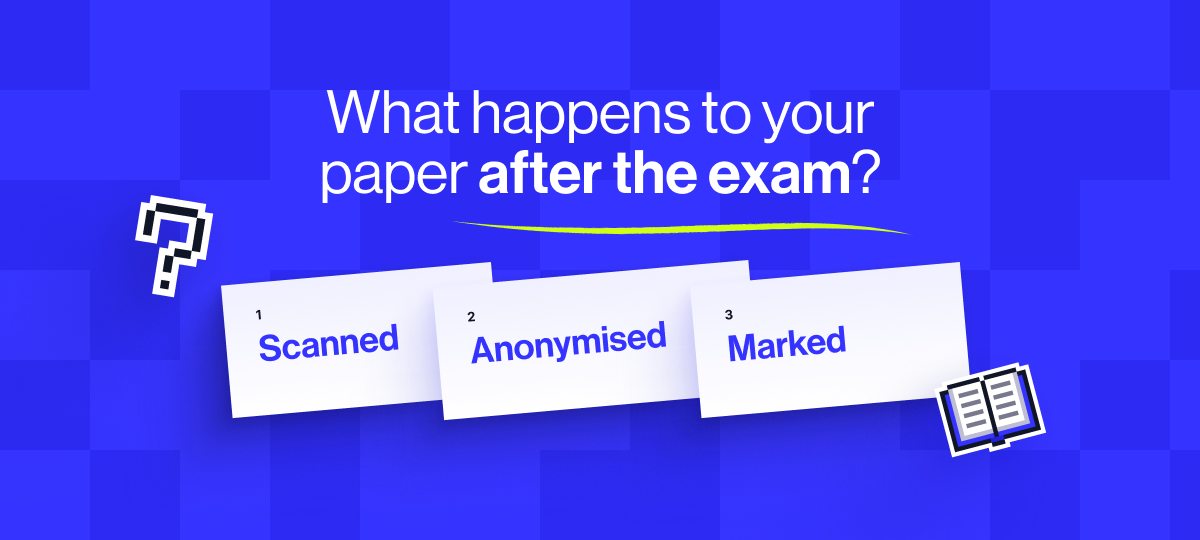
Once your invigilators and exams officers have collected, packaged and sent your scripts to the exam board, they’re ready to be marked. As noted above, they will slice off the margins and upload each page to a computer, so they can be sent to examiners (like me) who are based all round the country.
(Some remain on paper, for various reasons, but this doesn’t affect you.)
They are sliced for three main reasons:
-
To make them accessible to examiners, wherever they’re based
-
To separate one component from another (in English, for example, an examiner will typically just mark one question number for the whole summer, like the Macbeth question)
-
To anonymise responses (your teacher might be an examiner, and if randomly allocated your paper, might want to award you higher marks than your response has earned)
Once the answers are on the computerised system, the exam board sends them to the examiners to mark. But wait – how do we know we can trust the examiners to mark fairly?
GCSE examiner training
Examiners are almost always experienced qualified teachers, so the barrier for entry is reassuringly high – but not high enough for full confidence, so exam boards don’t leave it at that.
As such, examiners are required to complete a lengthy and rigorous period of training before they can mark GCSE papers. They receive guidance from the chief examiner, and devolved troubleshooting from a team leader, in a process called “standardisation”, where they improve their understanding and application of the mark scheme. Throughout the process, they receive a sample of student scripts, pre-judged by the senior examiners, and are assessed on how closely they mark to the agreed-upon standard from the very top.
If an examiner is found to be an inaccurate marker, they will work with their team leader to improve their approach. Then, later on, if they’re found to be inaccurate again, they’ll lose the privilege of marking for that year. Random dummy scripts are thrown into their batch of papers by the senior examiners (a process called “seeding”) so examiner reliability can be checked, not just before but also during the process of marking.
For English, and other essay questions, sometimes “moderation” is used instead of “seeding” whereby questions are double-marked – and inter-rater reliability is assessed. As long as both examiners have awarded a similar mark, within a few marks (called “tolerance”), the examiners are considered competent.
An individual GCSE examiner might mark 500 scripts in the 12-week marking window. After the first 10, they will be checked for accuracy. When they get to around 250 (the halfway point), they’ll be checked again. (This is true for on-paper marking; a slightly different sampling approach is used for the online majority, but with the same rigour and the same outcomes.)
In short, your scripts are in safe hands. The system is fair.
Allocating marks
Examiners, now highly-trained and ultra-confident, will proceed to annotate and allocate. Annotating is noting how and where a candidate has gained marks, and allocating is deciding how many marks in total should be awarded for the question – as per the detailed instructions in the mark scheme and rubric.
Once a question or exam section has been given a mark, these marks go into a tracking system – like a giant spreadsheet. They are added to the marks from other examiners for other questions, and then the marks from other papers (and coursework if applicable) to give a total “raw mark”. For example, an examiner might give 22 out of 34 marks for an essay on Macbeth for English Literature, which is then added to the mark that student was awarded for their essay on A Christmas Carol – and then both are added to the total marks acquired on the Modern Texts and Poetry sections of their other paper.

At this point, an individual student for English Literature may have acquired 100 out of 160 marks. This amounts to about 63%, which in previous years may have been around a grade 6 – but at this point, it doesn’t link to a grade.
Turning GCSE marks, into GCSE grades
Once all the individual papers have been marked (AQA claims to mark about 7 million a year), a very special meeting takes place – involving chief examiners, statisticians, and a range of other experts and stakeholders. This takes place for each component (usually a paper or paper section) and the meeting’s purpose is to decide ‘what a grade 1, a grade 4, and a grade 7 look like this year’... and then all the other grades.

For tiered examinations (where there is both Foundation and Higher), grade 4 is judged on both papers: Foundation grade 4 and Higher grade 4.
The process for determining grade boundaries is (basically) as follows:
-
For each of the benchmark grades (typically 1, 4, and 7), a selection of scripts are brought into the meeting that represent each mark within a grade as per the previous year’s grade boundary (so if a student had been awarded a 21 for their Macbeth essay, a mark that would’ve looked like a grade 6 the previous year, the question would be: ‘does this essay still look like a 6’?)
-
These candidate responses are compared with previous years to assess whether the old grade boundary should still stand (adjustments are usually made, increasing the threshold if the paper provided less challenge this year, and decreasing it if it were “easier” than last year’s)
-
Once any suggested adjustments have been made to the grade boundaries, calculations are made to determine the other grade boundaries by finding suitable midpoints (for example, if a grade 7 fit best with about 70%, and grade 4 looked to be about 45%, then grade 5 might be 54%, and grade 6 around 63% – though the maths they do is a little more complex)
-
Next, the distribution of grade boundaries is mapped against that year’s cohort of candidates and further adjustments are made, if necessary, based on achieving consistency with the previous year’s distribution of grades and this cohort’s estimated outcomes
-
Finally, the grade boundaries can be considered set, and each individual student’s final mark can be turned into a final grade
That is a somewhat simplified version of events, but covers the key details – and demonstrates how nobody can know grade boundaries until this point (usually early-August).
GCSE results day
When results day rolls around, in August, you will turn up at school to receive an envelope with a summary of your grades, component scores, and raw marks. Your school will have received this information the day before, and you can talk to your teachers about whether you wish to get any of your papers remarked (this isn’t free, and not always worth it).
Remember, retakes are also possible if remarks seem untenable, and in the case of Maths and English Language, these resits can come as soon as November. Indeed, a grade of 4 or above is generally required in both of these subjects for progression to the next life stage. Employers typically also require a 4 or above in these subjects.
As for college or sixth form, many will set specific entry requirements. When I was Head of Sixth Form, I required 4s in all subjects, as well as 6s and 7s for certain subjects that are extremely difficult at A-level.
Later on, if you choose to pursue university or a degree apprenticeship, most entry criteria will be based on A-level outcomes, but some courses – such as Medicine – will expect you to have achieved 6s at GCSE, too.
In short, speak to your teachers, to your careers advisor, to the admissions staff at your next step, and make sure your future is in your hands.
And that, my friends, is the whole GCSE grade boundary process.
Get ahead and stay ahead this year

If you've just started your GCSEs or A-levels, now is the time to get ahead.
The secret to achieving academic success in the UK? Studying with elite teachers and former examiners, handpicked for their ability to make things click for their students and working hard. Do that and results follow. This year, it's your turn to get ahead and stay ahead.
And, it’s more affordable than you might think. With us, you can get a full year of expert teaching for less than a few classes with the average private tutor.