
GCSE Maths: what’s involved and how to prepare
If you or your child is about to start studying GCSE Maths, you’ve probably noticed how the word “GCSE” seems to carry a weight that “Year 9 Maths” never did.
The step up from Year 9 and Key Stage 3 Maths into GCSE Maths in particular can feel daunting - there’s more topics to cover, more abstract ideas, and the nagging sense that Maths is the subject people keep telling you really matters.
The good news is that GCSE Maths is far more manageable than it first appears, especially with a confident start.
To help you prepare, here’s expert Maths teacher Neil Trivedi (@NeilDoesMaths) covering what GCSE Maths is and what to expect from now, all the way through to exam day.
The difference between GCSE Maths and Key Stage 3 Maths
At its heart, mathematics is the study of patterns, quantities and shapes, and of the rules that connect them.
GCSE Maths takes the mathematical foundations covered in Key Stage 3 and builds them into a connected, more detailed picture, where ideas from one topic are used to unlock the next.
It is a logical and satisfying subject, and most students grow in confidence once they have settled in and seen how the pieces fit together.
What’s covered in GCSE Maths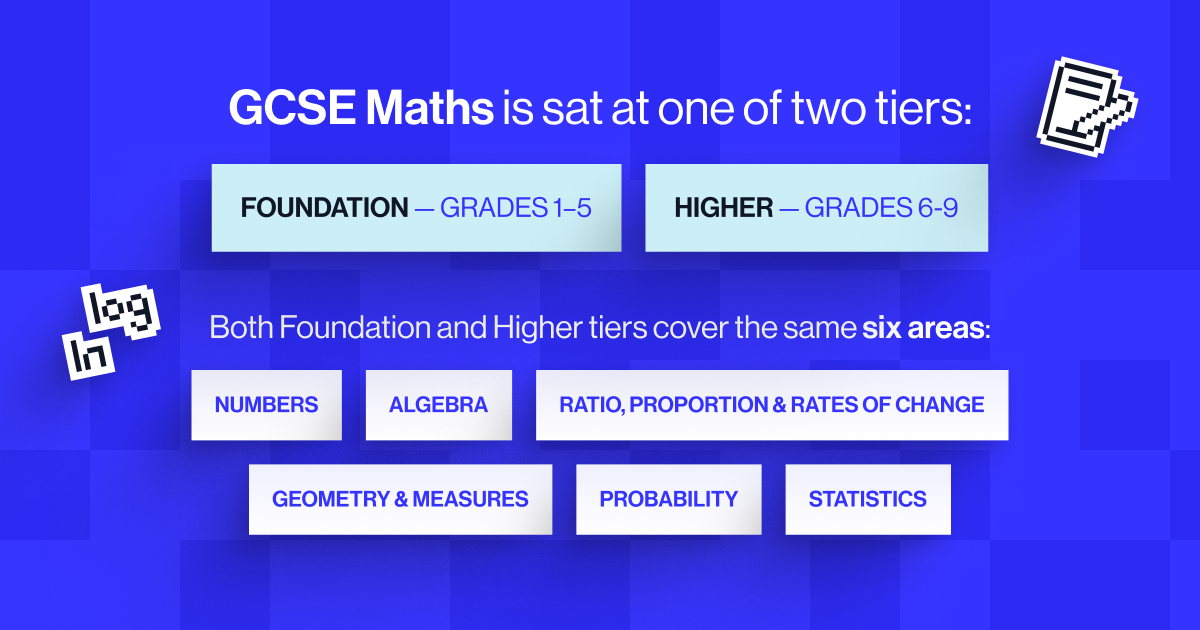
Unlike many subjects, GCSE Maths is sat at one of two tiers - ‘Foundation’ (covering GCSE grades 1-5) and ‘Higher’ (covering Grades 4-9).
Schools decide which tier best suits each student, and that decision is not set in stone early on. Whichever tier your child sits, these six areas will be covered:
Numbers
Working confidently with fractions, decimals, percentages, ratio and standard form, and knowing when an answer looks sensible.
Algebra
Using letters and symbols to describe relationships, solve equations, and work with sequences, graphs and formulae.
Ratio, proportion and rates of change
Comparing quantities and scaling them up or down, from recipes and maps to interest, speed and density.
Geometry and measures
Angles, shapes, area and volume, transformations, and the rules of Pythagoras and trigonometry.
Probability
Working out how likely events are, and using diagrams to make sense of more complicated situations.
Statistics
Collecting, presenting and interpreting data, and drawing fair conclusions from graphs and averages.
Why Year 10 and GCSE Maths can feel like a big jump from Year 9 Maths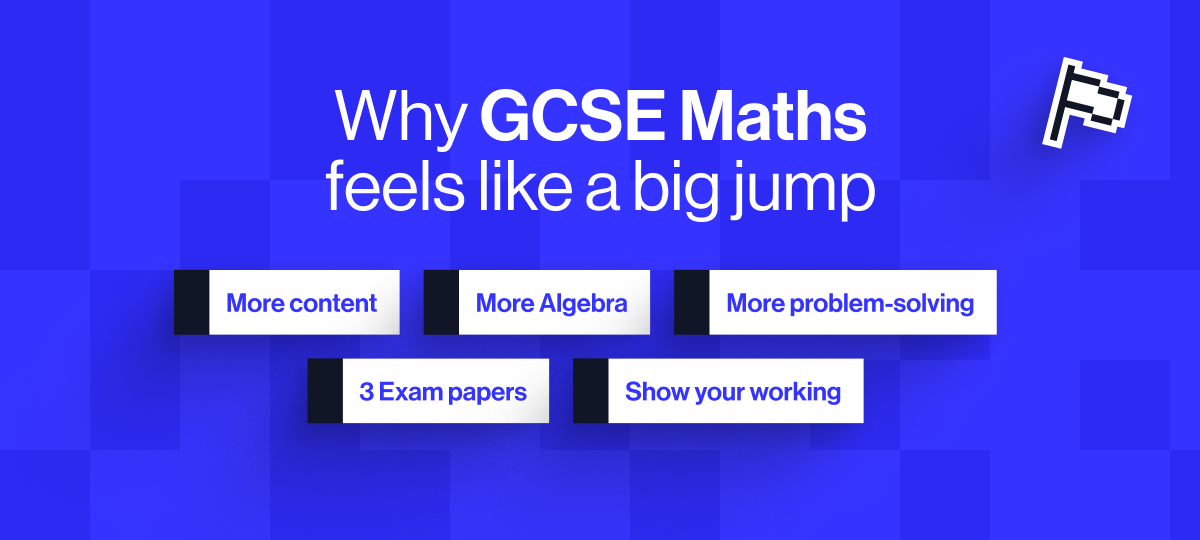
Most students cope perfectly well with GCSE Maths, but it is fair to say it asks more of them than Year 9 and Key Stage 3 Maths did.
There are a few reasons the step up can feel steep:
There’s more content, and it builds on itself
GCSE Maths covers a lot of ground, and unlike many subjects each topic rests on the ones before it. A shaky grasp of fractions or early algebra has a habit of resurfacing later, which is why a secure start matters so much.
It rewards problem-solving, not just method
Exam questions rarely say “solve this equation” in so many words. They are more likely to describe an unfamiliar situation and leave your child to work out which method to use. That is a different skill from following steps, and it takes practice.
The algebra steps up
Algebra grows from a gentle introduction at KS3 into a central tool used right across the subject. Students who get comfortable rearranging expressions and equations early tend to find everything else easier.
There are three papers and one is without a calculator
GCSE Maths is examined through three papers, one of which must be done without a calculator. Confident mental and written methods therefore count for just as much as knowing how to use a calculator well.
Both methods of working and accuracy count
Marks are given for clear working methods, not only the final answer. A student who shows their method can pick up marks even when the final figure is wrong - while a correct answer without any of the working shown can still lose them.
None of this is cause for alarm. It simply explains why a confident, well-prepared start makes such a difference.
A little preparation over the summer can turn an anxious start into a settled one, and a settled student is far more willing to have a go.
How parents can help the transition from Key Stage 3 to GCSE
You do not need to remember your own school Maths to be useful, and a few simple things go a long way:
Ask children to talk you through a problem
If your child can explain how they reached an answer, and not just what the answer is, they truly understand it. If they get stuck explaining, you have just found a topic worth revisiting.
Keep mathematical foundations ticking over
A few minutes of times tables, fractions or percentages, little and often, turns shaky basics into automatic ones and frees up energy for the harder ideas.
Notice the maths around you
Splitting a bill, working out a discount, scaling a recipe or reading a graph in the news are all real maths. Spotting it in everyday life makes the subject feel useful rather than abstract.
Protect the basics
Sleep, routine and a calm place to work do more to help students improve their Maths grades - and marks across the board - than most parents expect. It also helps to keep the tone around Maths positive, since remarks like “I was never any good at Maths” are easily picked up, and a calm, can-do attitude at home goes a long way.
Get ahead and stay ahead this year
If you've just started your GCSEs now is the time to get ahead.
The secret to achieving academic success in the UK? Studying with elite teachers and former examiners, handpicked for their ability to make things click for their students and working hard. Do that and results follow. This year, it's your turn to get ahead and stay ahead.
And, it’s more affordable than you might think. With us, you can get a full year of expert teaching for less than a few classes with the average private tutor.
Check out our course catalogue to begin.
And finally, MyResources is a free library of GCSE Maths study notes and topic explainer videos.