How to register for the 11+ exam
The 11+ exam can open the door to a grammar school place - but only if your child sits (and passes) it.
Every year, families spend months preparing their child, only to discover they missed the registration deadline. There is no late entry. There is no appeal. That year's opportunity is gone.
Registration deadlines typically fall between April and July - months before the September exam - and they are enforced. This guide explains exactly how the registration process works, when to act, and what to do once your child is registered.
Registering for the 11+ and applying for a school are two different things
This is the most important distinction to understand before you do anything else.
The two steps have different deadlines, different forms, and are handled by different organisations and completing your exam registration does not automatically submit your school place application. Both must be completed separately and both deadlines are non-negotiable.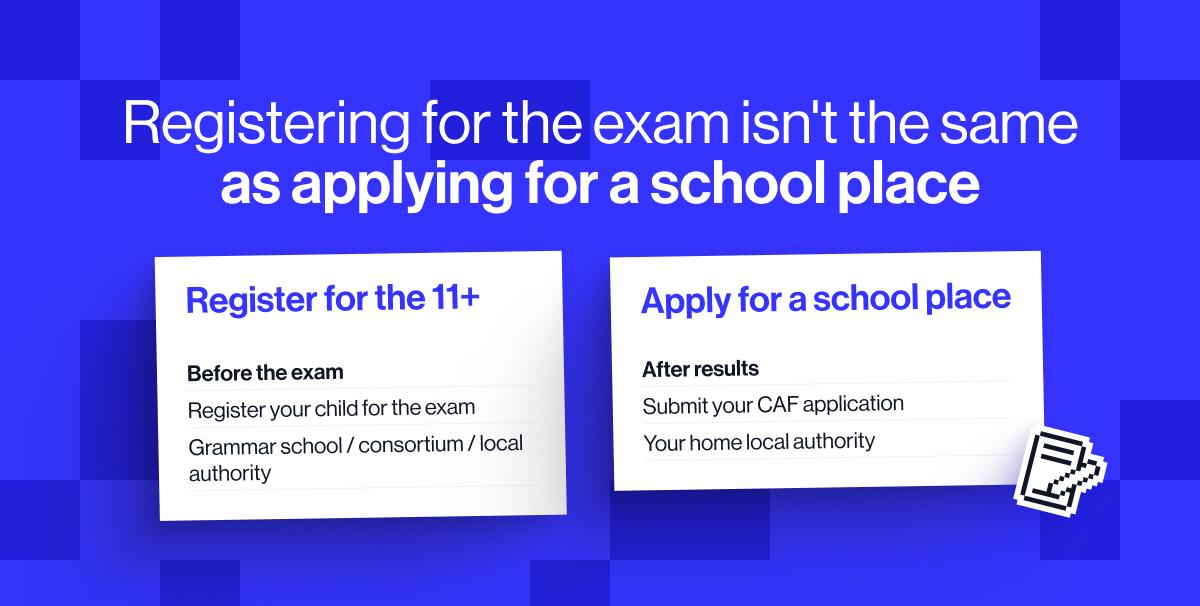
Registering for the 11+
This is signing your child up to sit the exam itself. Depending on your region, this is done directly with the grammar school, the regional consortium, or your local authority.
Applying for a school place
This is a separate process, completed through your home local authority's Common Application Form (CAF).
11+ exam registration key dates
Registration typically opens in the spring or early summer of Year 5. For most regions, that means somewhere between April and June, with deadlines closing in July.
Most exams take place in early September of Year 6, with results usually arriving in mid-October. You can find out more on the GL Assessment website.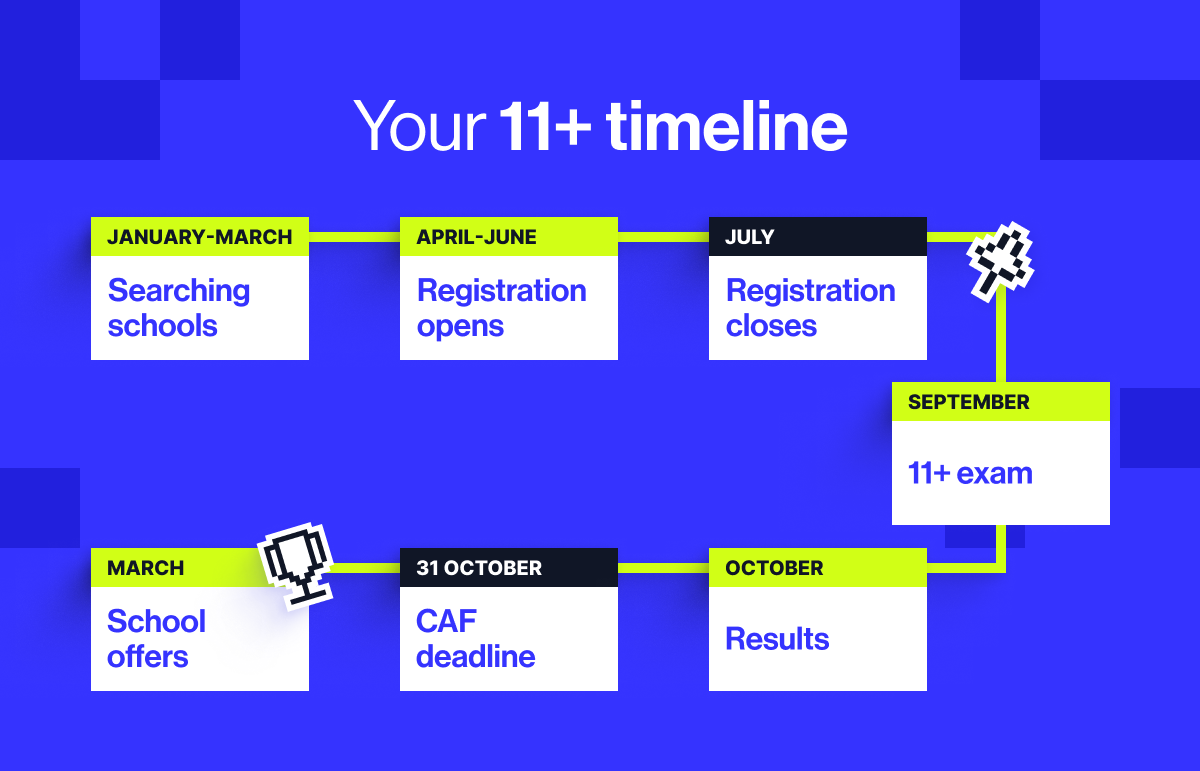
A rough timeline looks like this:
-
January - March, Year 5 - Research target schools and confirm which exam they use
-
April - June, Year 5 - Registration window opens; submit your registration
-
July, Year 5 - Most registration deadlines close
-
September, Year 6 - Exam day (typically the first or second Saturday of the month)
-
October, Year 6 - Results arrive
-
31 October 2026, Year 6 - National CAF deadline for school place applications
-
March, Year 7 - School place offers
How to register - depends on where you live
There is no single national registration system for the 11+. Each region - and in some cases each individual school - manages its own registration process.
Here is how it typically works across the main grammar school areas:
Local authority registration
In areas including Kent, Buckinghamshire, and Gloucestershire, registration is coordinated by the county council. Registration is via the county council website, usually opening in June. Check your local authority's admissions pages for the exact form and deadline.
School or consortium registration
In Sutton, Trafford, and parts of Birmingham, registration is handled directly by the grammar school or a consortium of schools. Some areas have automatic registration if you live in the catchment area, while others require a manual application. Out-of-area applicants usually follow the same process but should check specific deadlines.
Individual school registration
Some schools, particularly in London, run their own independent processes with their own timetables. Schools like Queen Elizabeth's Boys' School and Henrietta Barnett School sit outside the typical GL Assessment framework entirely and use their own papers and registration systems.
We recommend going directly to the admissions page of every school your child might apply to and noting each deadline individually.
The information you'll need to register for the 11+ exam
While the exact form varies by region, most registration processes ask for:
-
Your child's full name and date of birth
-
Your home address and postcode
-
Your child's current school
-
Your contact details
-
Which grammar school(s) you are applying to
Some regions ask you to specify your school preferences at the point of registration. Others keep registration and preferences as separate steps. Just as we tell students before exams - always read the instructions carefully.
What happens if you miss the deadline?
There is no appeal process for a missed 11+ registration deadline and there is no late entry. In rare circumstances, some individual schools may show flexibility if places remain unfilled, but this is the exception and not something you can rely on.
If you realise you have missed a deadline, you can contact the school or local authority directly to explain the situation and ask if there are any options - but be prepared for the answer to be no.
What to do after registering
Registration is the starting line, not the finish. Once your child is registered, the priority shifts to structured preparation.
A few things worth doing immediately after registering:
Confirm the exam format your child will sit
Check whether your target school uses GL Assessment, CEM, a local consortium paper, or its own bespoke test. The format affects how you prepare, particularly for verbal and non-verbal reasoning. The GL Assessment is the most widely used.
Build a preparation plan and enlist expert support
Work backwards from the exam date and map out what needs to be covered and when.
We know that finding and vetting tutors, driving to tutoring centres or working through worksheets each evening costs time and money - and adds extra pressure nobody needs. Release the pressure - and their potential - with our specialist 11+ preparation course, featuring 28-hours of live, online, lessons they can join at home, or on holiday.
If working through practice papers or exercises at home, focus more time on areas where your child is less confident, while continuing to reinforce their strengths.
Also, timed practice under exam-like conditions is one of the most effective ways to build both accuracy and confidence.
Build core English and Maths skills
If your child is in Year 5 or 6 and starting to prepare our Year 5 Maths, Year 5 English, Year 6 Maths and Year 6 English courses - taught live by specialist teachers - build core skills your child will need for the 11+, their Year 6 SATs, and beyond.
The earlier your child starts building these skills, the better equipped and more confident they'll feel walking into the exam room.