What YOU need to know about the latest English Language Paper 1 Examiner Report
As a former examiner of many years, I love examiner reports.
That might sound weird, but it’s true—I get giddy about the opportunity to take the examiners’ distilled commentary and apply it in my lessons immediately.
These reports are often quite dry reading, though. So, let me take you through the key information that you need to know ahead of the next raft of GCSEs, question-by-question, for GCSE English Language Paper 1: Explorations in Creative Reading and Writing (AQA).
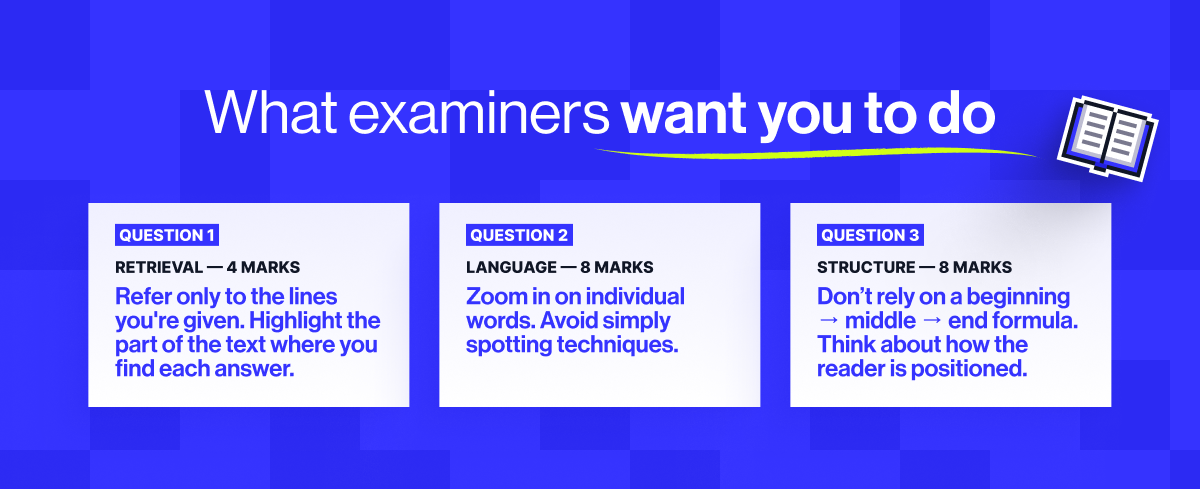 Question 1: retrieving information [4 marks]
The advice from the 2025 examiner report does not apply to the new question-style, which is now multiple choice.
We must still remember to refer only to the given lines, and my advice as a teacher is to highlight in the text where the answers are going to come from. Beyond that, we need to wait for the 2026 examiner report.
Question 2: analysing language [8 marks]
This question remains unchanged for the new GCSE format, so the advice is relevant.
My top advice, before we get to the examiner report, is to annotate on the reproduced section of the text. That way, you won’t accidentally refer to language from outside of the given lines, and you’ll have nice white space to put Question-2-specific insights on.
What does the report tell us?
-
Analyse how language does x. The question is never as simple and generic as ‘analyse language’, so refer to the given focus. In 2025, it was ‘How does the writer use language here to describe the early morning?’ If you refer to the place more generally, rather than its early-morning presentation, you will miss out on marks
-
Comment on the effect of language. That doesn’t mean ‘it makes the reader want to read on’; the examiner report calls that a “Level 1 comment”. It means ‘the [language feature] depicts the town as…’—meaning we as readers feel something—and this can be tied to the methods already identified (by…). ‘As’ and ‘by’ are useful, when used precisely
-
Zoom in at the word level. If you’ve picked out a great metaphor, you can provide a general inference, but it’s often more valuable to dive into the specific word choices that make it so striking or effective. Relying on longer quotations can leave you scratching your head and may waste your time
-
We still hate feature-spotting. If you name a ‘semantic field’ but neglect its effect, it is pointless. Examiners agree that saying ‘the word choice of… creates the effect of…’ is miles better than ‘this is an example of pathetic fallacy’
-
Your opinion is not relevant here. You’re being marked for analysis, not evaluation. Don’t tell us that ‘the bus driver should be fired’; tell us how the language depicted her bad behaviour
Question 3: analysing structure [8 marks]
This question has always irritated me. There is no sense in artificially separating language from structure in your analysis, but oh well.
As we can’t change it, what can we do about it? Well, the first thing is to be wary of the beginning–midddle–end formula… it comes with risks!
-
Consider why something occurs where it does. If you want the comfort of beginning–middle–end, you need to be asking: why start with this image, why delay a key detail until the middle, why end with this impression? Recounting the order of events is not structural analysis
-
Think about the reader’s positioning. Essentially, what changes in your understanding or experience as the text progresses? Do we gain knowledge at a certain point, are held in suspense, do we change our views on someone? The placement of these shifts is key
-
Structural terminology can help, but not always. The effect is built-in with some devices (foreshadowing connects present reading to later expectations; cliffhangers leave you with unresolved questions; juxtaposition creates contrast and draws attention), but others are much more vague—telling us about a ‘short sentence’ or a ‘long paragraph’ really only tells us you have eyes. What is it doing there?
-
Avoid language analysis. I disagree with this in all contexts except this question; you need to isolate structural features, so while you can observe repetition of a specific word, you must focus on its importance rather than its meanings, connotations, phonology, etc., so be careful. If in doubt, stick to named, known structural features.
Question 4: evaluating the statement [20 marks]
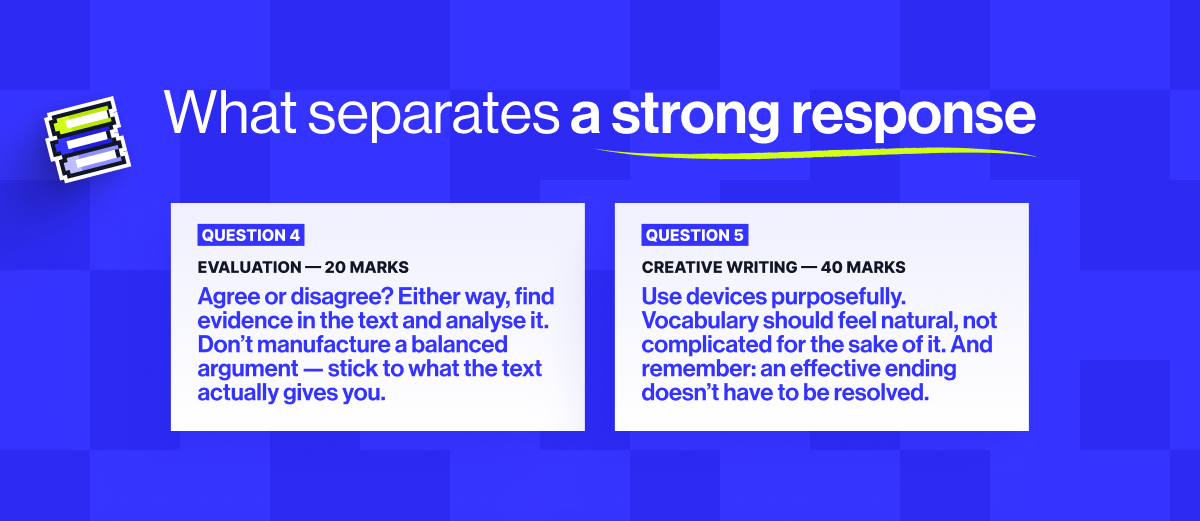 The kind of evaluation that AQA rewards is not really evaluation at all; it’s analysis, with a different orientation. Essentially, ‘I agree with the statement, and now I shall analyse how the effect was created’.
Some students like to use evaluative language throughout, like ‘The writer effectively achieves this by…’; others like to embed themselves in the response, saying ‘I am made to feel this because the writer…’; both are fine, but the words immediately following will be the same analysis skill they use for Questions 2 and 3!
The examiner report has a few points of note on this.
-
Provide evidence for your judgement. If you agree, find evidence to analyse; if you disagree, find evidence to analyse. Bring your attention quickly to the text, and focus less on dissecting the nuance of the given statement
-
Stick to the given lines, except when you don’t. The report from 2022 was even more direct about this; you may refer outside of the lines if you are linking to something inside them. For example, if the full text noted at the start that the narrator “hates the telephone”, then a telephone ringing in the given lines will contribute to the effect of discomfort
-
Don’t manufacture disagreement or a ‘balanced view’. The statement is historically defensible, and higher marks aren’t awarded for being contrarian. If in doubt, agree with the statement, and then your job becomes as simple as finding evidence to analyse in its creation of the named effect. If the statement is obviously flawed, then write about a different or opposing effect—don’t talk about the absence of effect, as your paragraph will lose steam fast
-
Stick to the text. The reports of 2022, 2024, and this one all agree: providing broader social commentary that leaves the text behind is not going to gain you marks. Write about the narrator’s views on the conflict in the text; don’t bring your own political views to bear on it
Question 5: describing or narrating [40 marks]
The new GCSE only amends this question slightly, so I have preserved most of the advice from the report. I will refer to the description and narrative options separately, and then talk about AO6 (technical accuracy and range).
-
Description: the image is a helpful stimulus, but you’re not describing it. The picture can help to give ideas, but it is not a comprehensive view of everything you might describe—apart from anything else, it is purely visual (so the other senses aren’t accounted for) and static (so no movement can be known in advance). My advice on this is (if you use the image at all) to use it as ekphrasis: imagine stepping into the image’s world, allowing you to see past horizons, note the passing of the clouds, imagine the histories of the rockface, etc
-
Description: use details to strike up and hold onto an atmosphere. The tone of your piece should be coherent; if you start with distant sounds and fear, then build on this. A declarative overview of all that can be seen and heard in a place is going to fall flat, so home in on juicy details and ignore what detracts
-
Narrative: depth is usually more valuable to you than breadth. In short, say a lot about a little; a more successful story would narrate one penalty than an entire football tournament. Think at least about having one episode narrated at length, even if it is bookended with other details. Control over pace and detail matter more than the sheer number of events
-
Narrative: the end should be effective, not necessarily resolved. The new version of the paper makes clear that you’re writing part of a story (probably the beginning), rather than a whole hero’s journey epic, so you don’t need to tie up all loose ends. That said, ending mid-sentence, or confusingly, is not the same as an effective cliffhanger; demonstrate control using things like motifs and cyclical structures, rather than simply ramping up to a fizzled stop
-
General: use devices purposefully. Examiners reported that excessive personification, pathetic fallacy, disconnected lists, and unexplained changes from idyllic to miserable settings weakened coherence.
-
General: write material that is original and relevant. Don’t pre-write a story; don’t copy from the reading extract; don’t lift lines from your Literature set texts; and ensure that you’re responding to the actual prompt, not just writing what you want to write.
-
AO6 (vocabulary): needlessly complex words, especially in lists, are not generously rewarded—and words that clash tonally (e.g. obsidian and discombobulated) are actively discouraged historically
-
AO6 (sentences): fragments/minor sentences are a risk (they’re okay, if serving a clear purpose), as are Dickensian-length epic ones (they can be great, but run the risk of a loss of control—one of the most fundamental things you’re graded on)
-
AO6 (punctuation): the mark scheme calls for a wide range of punctuation used accurately—and the former is limited by the latter. Misusing semicolons is worse than not using them. In my experience, too, full stops and commas are the most common; students should create opportunities for sparing and accurate use of colons, parentheses, dashes, and the very occasional ellipsis if applicable… you shouldn’t shoehorn them into every sentence
-
AO6 (handwriting): you’re not actually marked on this, but it can still cost you marks. The examiner report notes, as in previous years, that some candidates’ handwriting proved difficult to read, and that some students could benefit from access arrangements. If your handwriting is difficult to read, you should be speaking to your teachers and exams officer or SEND coordinator as early as possible—in case word processing could be useful
And there we have it. Check out the English Language Paper 2 examiner report rundown, coming soon—as well as the English Literature Paper 1 and Paper 2 rundowns.
Try online English courses with specialist teachers
If you’re studying GCSE English and think you might benefit from some expert support from specialist teachers like Louis, you can now try MyEdSpace for 10-days for just £10.
There’s no-obligation, no auto-enrolment and no contract. Simply, your chance to see if this would help you boost your grades.