Applications of Parametric Equations
Neil Trivedi
Teacher

Applications of Parametric Equations
Parametric equations describe curves by expressing both and in terms of a third variable, often time. This method is useful when the relationship between and is complex or cannot be easily written as a single equation.
Parametric equations are commonly used to track motion over time (in physics or engineering), model real-world paths such as orbits or trajectories, and find points of intersection, tangents, or areas under curves.
Example 1:
A curve has parametric equations
Find the coordinates of the points where the curve crosses the axes.
Step 1: Let’s start by finding the points of intersection with the axis. We find the values of such that .
Step 2: Substitute these values of into the equation to find the corresponding
coordinates.
So, the points of intersection with the axis are and .
Step 3: Now, let’s find the points of intersection with the axis. We find the values of such that .
Step 4: Substitute the value of t into the equation to find the corresponding coordinate.
When
Therefore, the point of intersection with the axis is .
No answer provided.
Example 2:
The motion of a toy racing car, relative to a fixed origin, , at time minutes is modelled using the parametric equations.
where and are measured in metres.
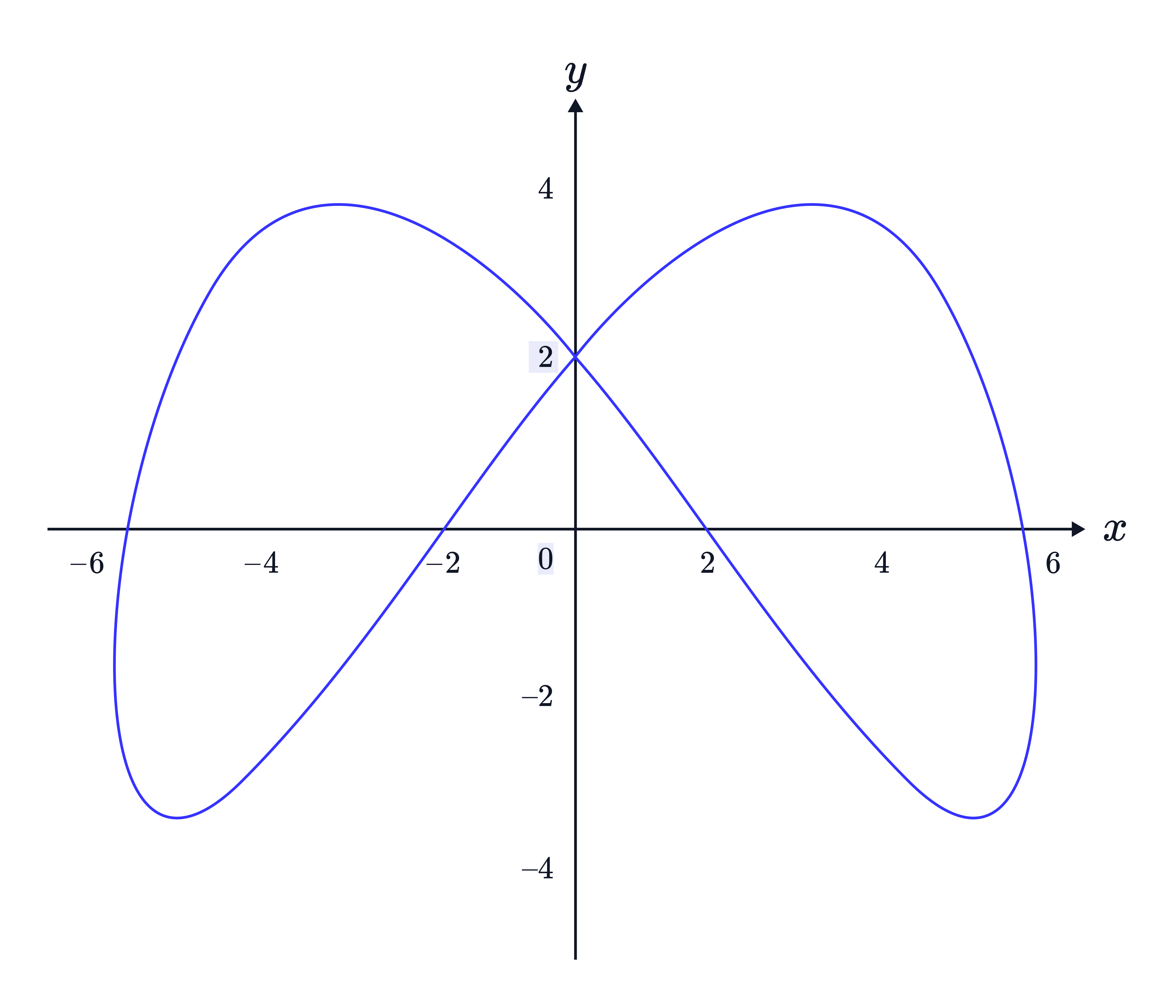
a) Find the coordinates of the car at the beginning of its motion.
Single Step: Substitute into the and equations to get the coordinates. Remember that is in radians when we’re working with trigonometric equations unless the question explicity uses degrees.
When
So, the initial coordinates are .
b) Find the coordinates of the points where the path of the car crosses the axis.
Step 1: Find the values of such that (where the curve intersects the axis).
Find the PV.
(PV)
Trigonometric Functions | Finding the SV |
| PV |
| PV |
| PV |
Find the SV by working out PV.
PV (SV)
Take the PV and SV and add to both to find two other values (we can see from the diagram that there are four points of intersection).
So, we have:
Step 2: Substitute the values of we found into the equation to find the corresponding coordinates.
Therefore, the coordinates of intersection with the axis are
and .
c) Find the time taken for the car to complete one figure-of-eight motion.
To answer this, we need to know the period of a graph. The period is the time it takes to complete one full cycle of the graph. For sine and cosine graphs, the period is , while for tangent graphs, it is (as shown in the graphs below where the dotted lines represent the start/end of a cycle).
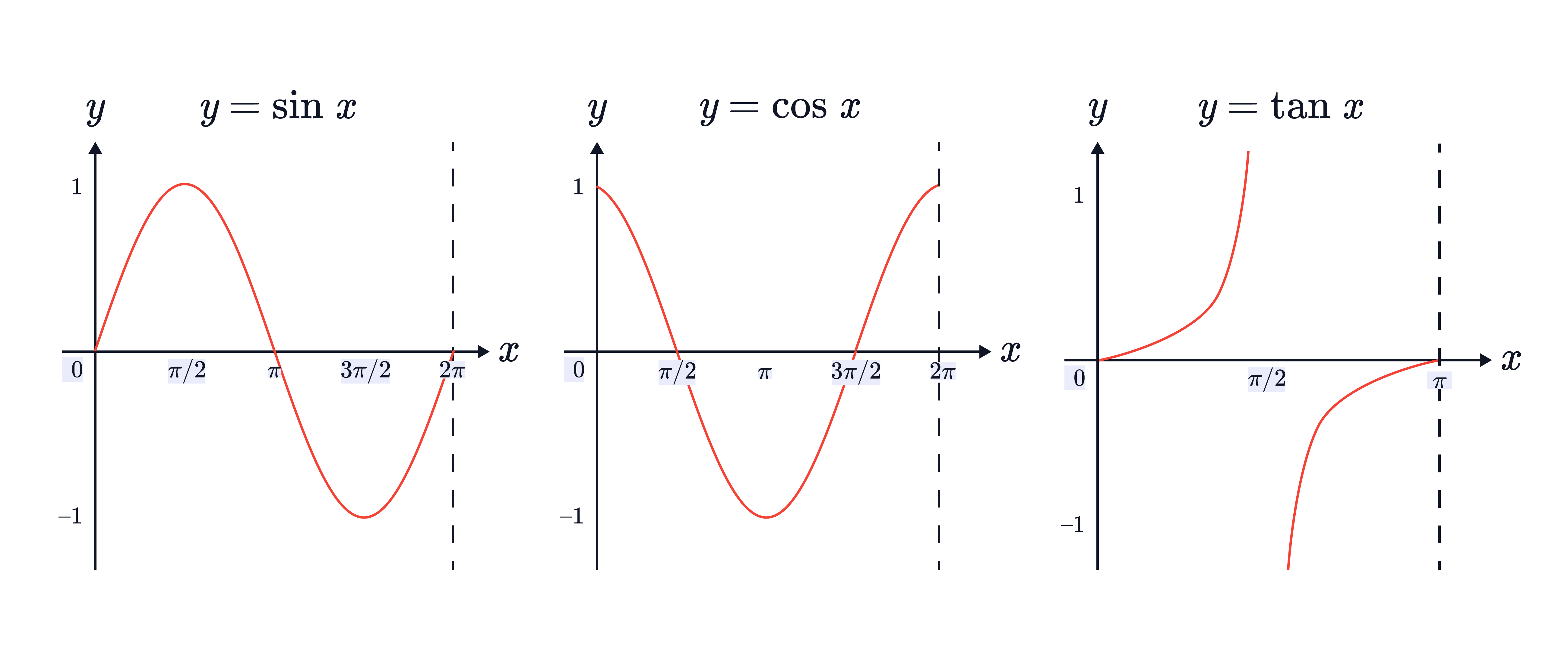
The period of a trigonometric function is only affected by enlargements parallel to the axis, not by horizontal shifts. For instance, If a function is written in the form , the term doesn’t change the period, but the coefficient does by a scale factor of .
In our function , the coefficient of is , so the period will enlarge by a scale factor of . The period of a cosine graph is , which after enlargement becomes So, the car takes minutes to complete one figure-of-eight motion.
No answer provided.
Challenging Questions