Introduction to Parametric Equations
Neil Trivedi
Teacher

Contents
Introduction to Parametric Equations
Parametric equations define a set of coordinates using a third variable, usually denoted as (often time), called a parameter. Instead of expressing in terms of , we express both and in terms of .
The cool thing about parametric equations is that the third variable is defined along the curve unlike Cartesian coordinates, which are measured by a point’s horizontal and vertical distance from the origin. In science, this is particularly useful because we can track where something we are measuring (such as the number of infected subjects of a disease) is at different times.
Converting from Parametric to Cartesian Form (excluding trigonometry)
Graphs expressed using only and are said to be in Cartesian form. Here are the general steps to follow when converting from parametric to Cartesian form:
1. Rearrange one of the equations to make the subject.
2. Substitute the rearranged equation into the other equation to eliminate and get our Cartesian equation, which will now be in terms of and .
Example 1:
Convert the following parametric equations into Cartesian form:
a)
Step 1: Rearrange one of the equations to make the subject. We’ll rearrange the
equation.
Step 2: Substitute this into the equation to eliminate and get our Cartesian equation.
b)
Step 1: Rearrange one of the equations to make the subject. We’ll rearrange the
equation.
Note: We do not always have to rearrange for in the equation. It is much easier to rearrange for in the equation that has roots and fractional powers.
Step 2: Substitute this into the equation to eliminate and get our Cartesian equation.
c)
Step 1: Rearrange one of the equations to make the subject. We’ll rearrange the
equation.
Step 2: Substitute this into the equation to eliminate and get our Cartesian equation.
No answer provided.
Example 2:
By first converting to Cartesian form, draw the curve , for .
Step 1: Rearrange one of the equations to make the subject. We’ll use the equation .
Step 2: Substitute this into the equation to eliminate and get our Cartesian equation.
Step 3: Determine the domain and range of the curve using the given parameter interval .
For the domain, we use and sketch against to observe the maximum and minimum values of .
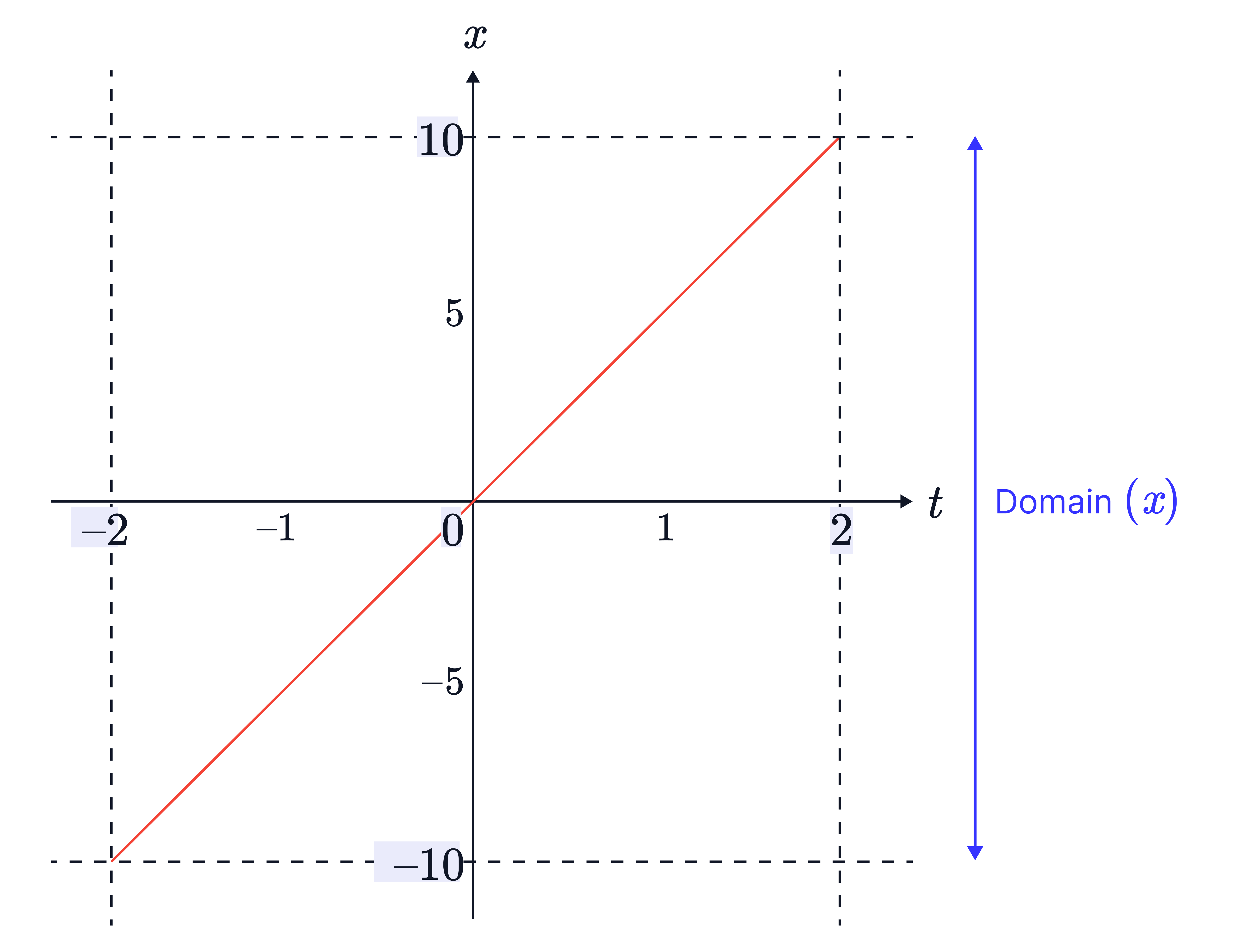
From the graph, we can see that the minimum value of is , and the maximum is .
Therefore, the domain of the curve is .
For the range, we use and sketch against to observe the maximum and minimum values of .
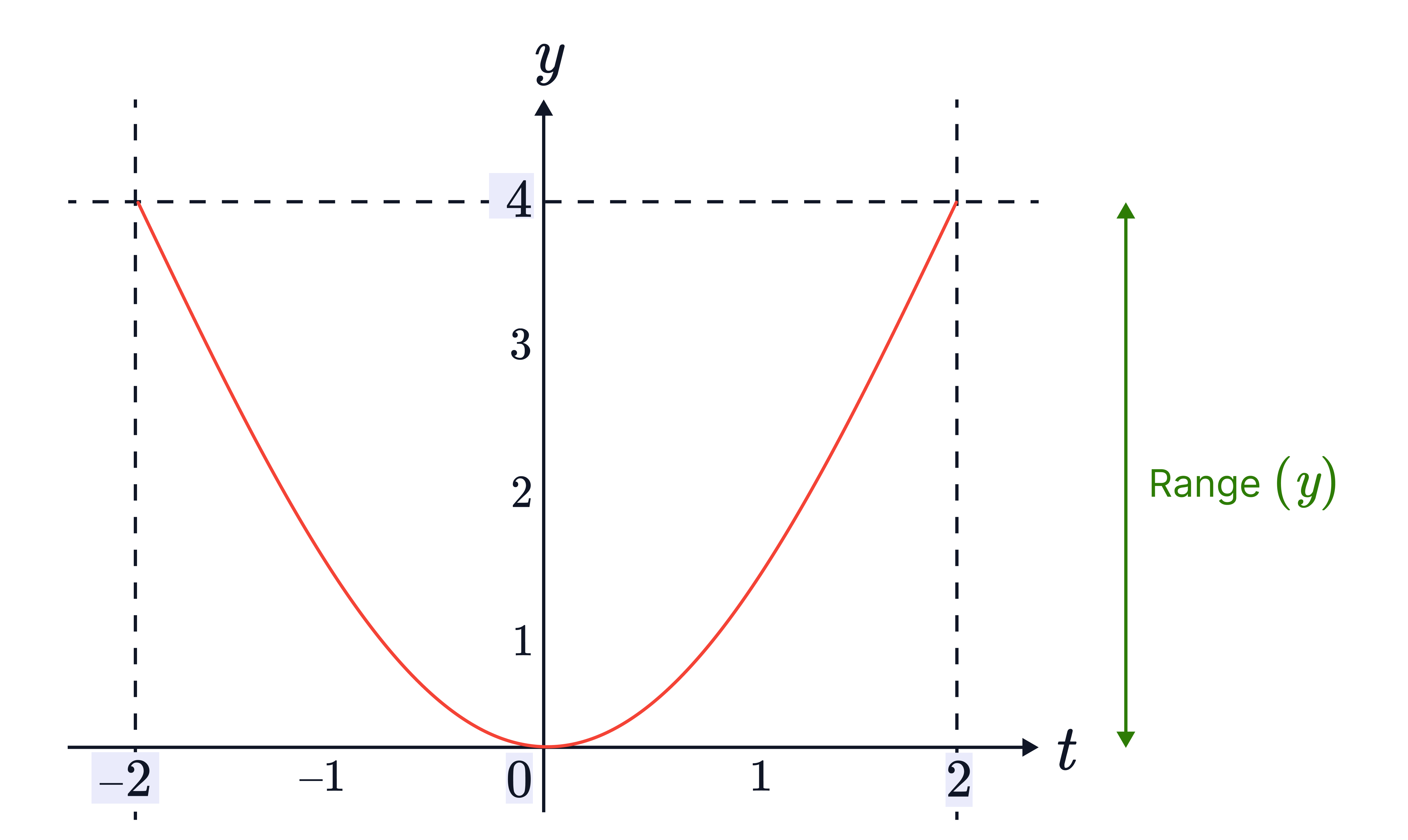
From the graph, we can see that the minimum value of is , and the maximum is .
Therefore, the range of the curve is .
Step 4: Sketch the curve of . We must take into account the restrictions in our domain and range that we found.
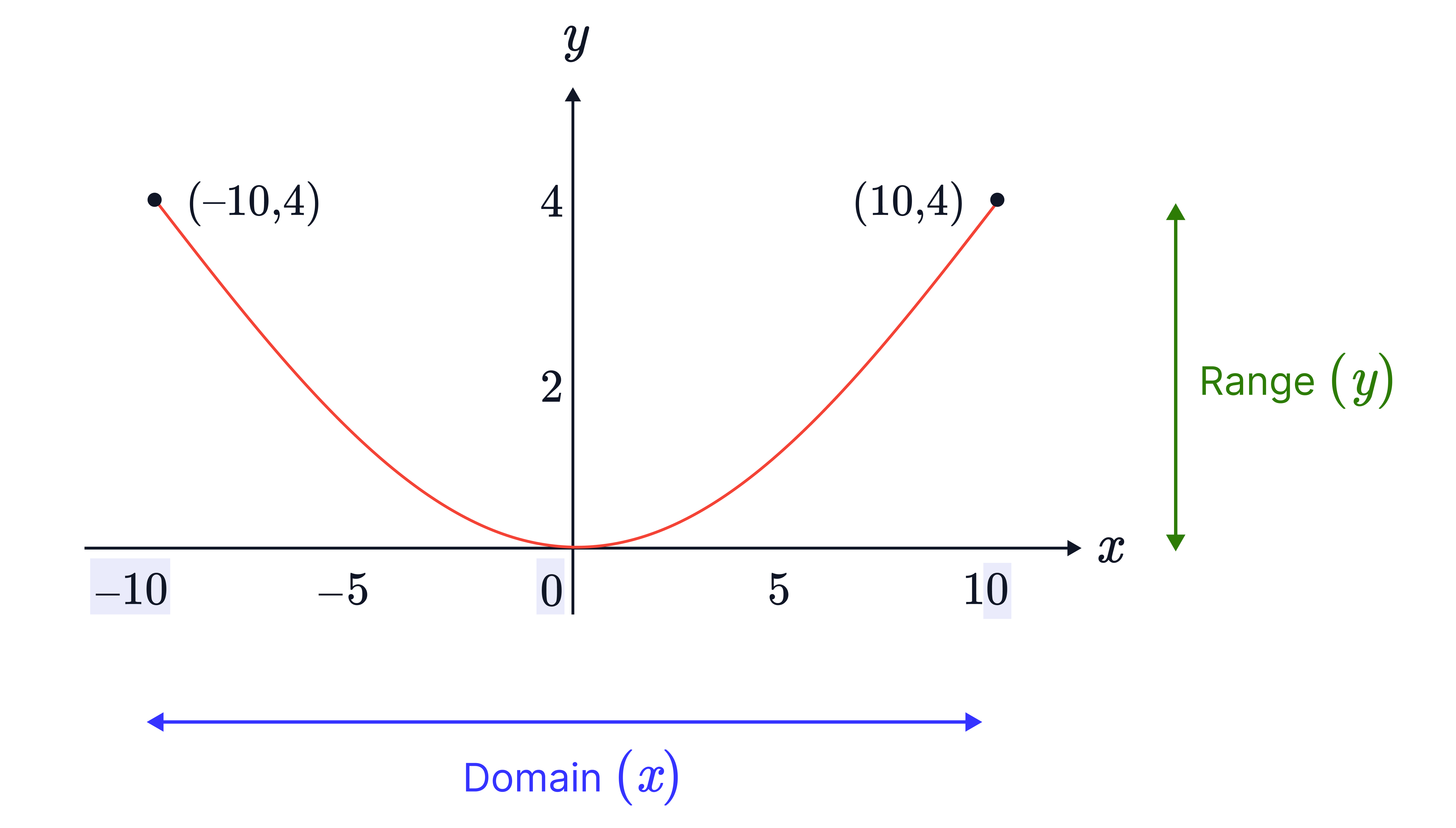
No answer provided.
Parametric Equations with Trigonometric Functions
When converting trigonometric parametric equations into Cartesian form, we take a different approach.
For example, given
If we rearrange to make the subject, we get
This form is not very useful. Instead, we use a trigonometric identity:
So, our Cartesian equation would be .
Example 3:
Find the Cartesian equation of the following parametric curves:
a)
Step 1: Rearrange to make and the subjects of their respective equations.
Step 2: Substitute the rearranged equations into the identity .
Using the same skill that we developed when doing the binomial expansion, we can rewrite with positive by factoring out .
We obtain the following Cartesian equation.
b)
Step 1: Use the addition formula for cosine to expand the equation.
Step 2: Use the identity to eliminate .
To note, since and have the same power, we can combine them under one root.
No answer provided.
Challenging Questions