Differentiating Inverse Trigonometric Functions
Neil Trivedi
Teacher

Differentiating Inverse Trigonometric Functions
To differentiate inverse trigonometric functions, the key is to rewrite the inverse function as a standard trigonometric function and then differentiate either with respect to , or implicitly. This is unlike Further Mathematics where these are all just standard results.
Example 1:
Show that if , then .
Step 1: Rewrite the inverse fraction.
We take on both sides.
Step 2: Differentiate the new equation with respect to .
Reciprocating,
Step 3: Using the identity , express the derivative in terms of by rearranging for , then rewrite the result in terms of .
So,
No answer provided.
Similarly, for our other inverse trigonometric functions:
Example 2:
Given that .
Note: These are traditionally how they express inverse trigonometric functions in A-Level Mathematics, with the equation already rearranged for instead of .
a) Find in terms of .
Step 1: Identify the type of function.
Although this looks like a trigonometric function, where there are powers, that becomes
the primary function. This is a power function, and we need to rewrite the function as
.
Step 2: Identify the angle and apply the chain rule process to a power function.
The angle of a power function is what is inside the bracket. Here, that is , which differentiates to . Then, for the power function, we bring down the power, knock off the power, and then keep the angle the same.
Angle stays the same
Differentiated angle Differentiated power function
b) Hence, show that .
Step 1: We already notice that , so we can replace that immediately. We now must convert in terms of , so we can rewrite our derivative in terms of . We will use the identity .
Step 2: Find by first reciprocating and then replacing with .
Reciprocating,
No answer provided.
Example 3:
Given that , find in terms of .
Step 1: Differentiate the equation with respect to using the chain rule for the sin function.
The angle is , which differentiates to , then differentiates to , then the angle stays the same. The is a multiplier so we write that at the front.
Multiplier Angle stays the same
Differentiated angle
Reciprocating,
Step 2: Find using SOHCAHTOA.
Note: We can still use the identity . However, when there is a coefficient, which is in this case, it is much easier to use a right-angled triangle to avoid fractions within roots. Notice in the previous examples that there were no coefficients, so it was simple to use the standard Pythagorean identities.

Using Pythagoras’ Theorem, we can find that the adjacent side has length .
Using this information, we can construct a triangle:
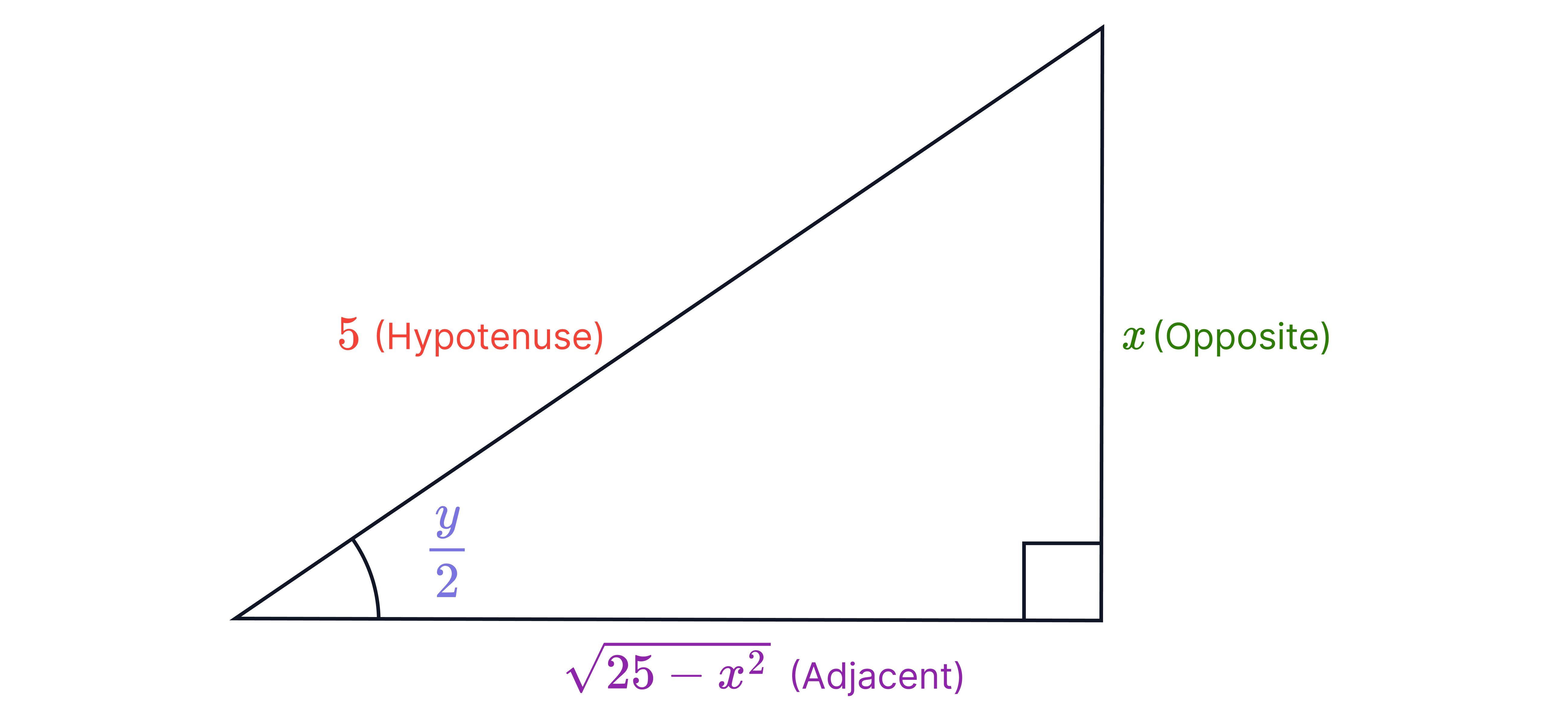
Using SOHCAHTOA, we find

Therefore,
No answer provided.
Challenging Questions