Parametric Differentiation
Neil Trivedi
Teacher

Contents
Parametric Differentiation
When we are given parametric equations:
We can find by following these steps:
1. Differentiate and with respect to , obtaining and .
2. Divide by to find .
Example 1:
A curve is given by the parametric equations:
a) Write down expressions for and .
Single Step: Differentiate and with respect to separately.
b) Hence, show that .
Single Step: Divide by .
No answer provided.
Example 2:
A curve is given by the parametric equations:
.
a) Find an equation for the tangent to the curve at the point where .
Step 1: Differentiate and with respect to separately.
Step 2: Find the gradient at .
Step 3: Find the Cartesian coordinates at .
Step 4: Find the equation of the tangent using , where , , and .
b) Show that the tangent to the curve at does not meet the curve again.
When we see the key words “meet” or “intercept”, we immediately think of simultaneous equations, regardless of whether they meet of not. It is very important in these questions that you work in terms of and do not convert everything to Cartesian form.
Single Step: Show that is the only solution to the intersection of the tangent and the curve.
Here are our two sets of equations:
Multiplying through by ,
Moving all terms to the right,
Dividing all terms by ,
is the only solution. Therefore, the tangent intersects with the curve at only.
Note: Notice how we have a double root of . This is because a tangent meets a curve once but is classified as a double root as the discriminant is .
c) Show that the Cartesian equation of the curve can be written in the form , where is a constant to be found.
Single Step: The question has given us the Cartesian form, so we just need to substitute our and to find what is.
Therefore,
No answer provided.
Where Tangents are Parallel to the Axes
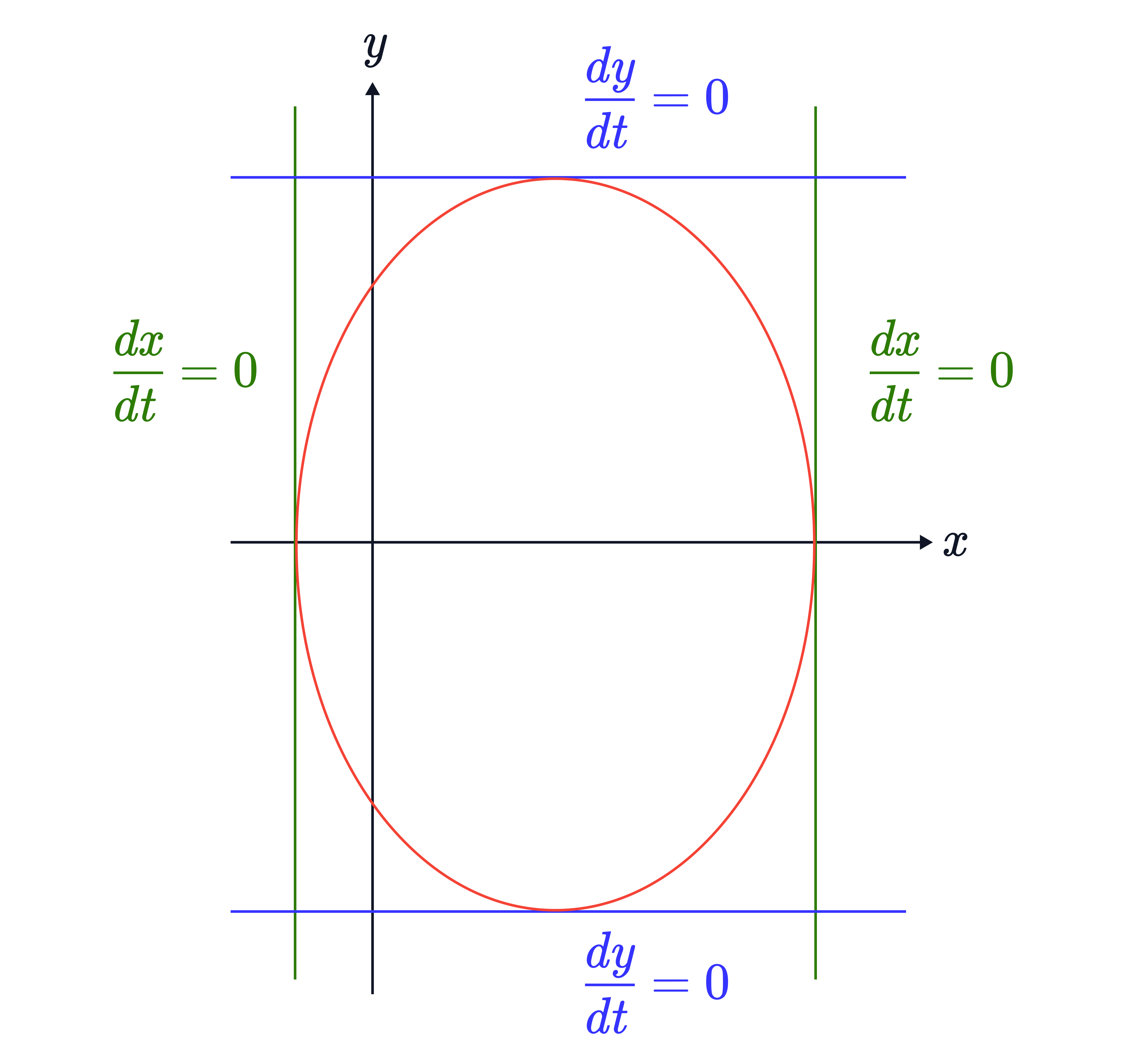
When a tangent is parallel to the axis, it means that the values are not changing, hence why the tangents are horizontal. We usually know this to be , but when working with parametric equations, we can take a step back and say that “as varies, does not change”, which leaves us with the result:
for tangents parallel to the axis
Similarly, when a tangent is parallel to the axis, it means that the values are not changing, hence why the tangents are vertical. When working with parametric equations, we can say that
“as varies, does not change”, which leaves us with the result:
for tangents parallel to the axis
• Points on a curve whereby the tangent is parallel to the axis satisfy or
• Points on a curve whereby the tangent is parallel to the axis satisfy
Example 3:
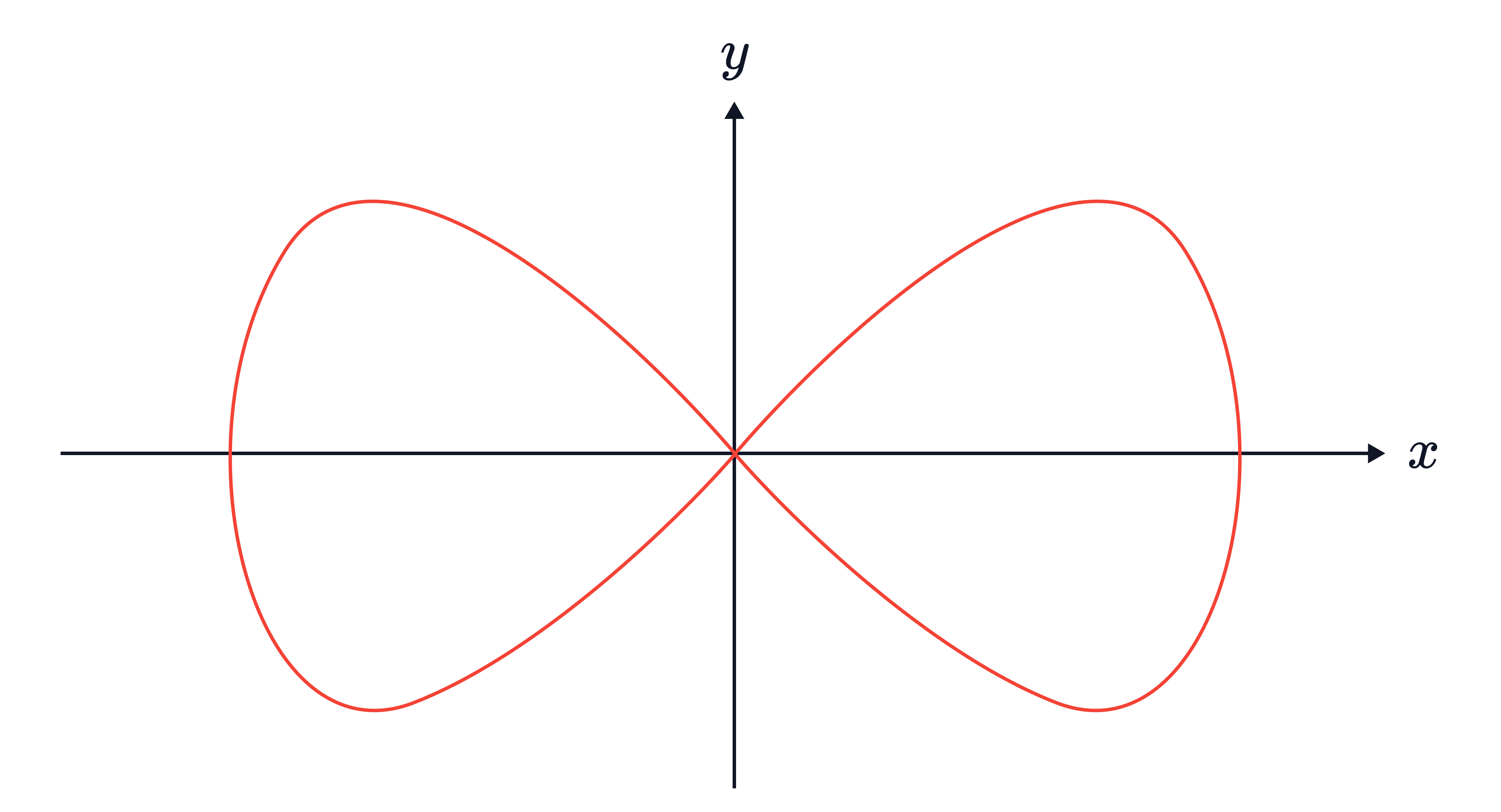
The diagram shows the curve with parametric equations
Find the coordinates of the points where the tangent to the curve is
a) Parallel to the axis,
Step 1: Parallel to the axis means the values are not changing, hence .
We find using the chain rule for the sine function. Firstly, the is a multiplier so we write that out in front. The angle is , which differentiates to , differentiates to , and then the angle inside is kept the same.
Multiplier Angle stays the same
Differentiated angle
Hence,
Step 2: Solve for .
Modifying the range to read ,
Find the PV.
(PV)
Find the SV by working out PV.
Trigonometric Functions | Finding the SV |
| PV |
| PV |
| PV |
PV (SV)
Both the PV and SV are in the modified range. Take the PV and SV and add to both to find the rest of the values in the modified range. We can also observe from the diagram that we are looking for four values as the tangents are horizontal at four points.
PV
SV
These values are also in the modified range. We can stop here as if we keep adding , we’d find values that lie outside the modified range. Hence,
Unmodifying the range by dividing all values by ,
Step 2: Find the corresponding coordinates for each value of .
Therefore, the required coordinates are
and .
Note: Since this is a figure of , we could have also used symmetry given one of the coordinates to find the others.
b) Parallel to the axis,
Step 1: Parallel to the axis means the values are not changing, hence .
We find using the chain rule for the sine function. Firstly, the is a multiplier so we write that out in front. The angle is , which differentiates to , differentiates to , and then the angle inside is kept the same.
Multiplier Angle stays the same
Differentiated angle
Hence,
Step 2: Solve for .
Modifying the range to read ,
Find the PV.
(PV)
Find the SV by working out PV.
Trigonometric Functions | Finding the SV |
| PV |
| PV |
| PV |
PV (SV)
Both the PV and SV are in the range. If we add to both, we’d get values outside the range, so we stop here. We can also observe from the diagram that we are looking for only two points as the tangents are vertical at two points.
Unmodifying the range by dividing all values by ,
Step 2: Find the corresponding coordinates for each value of .
Therefore, the required coordinates are and .
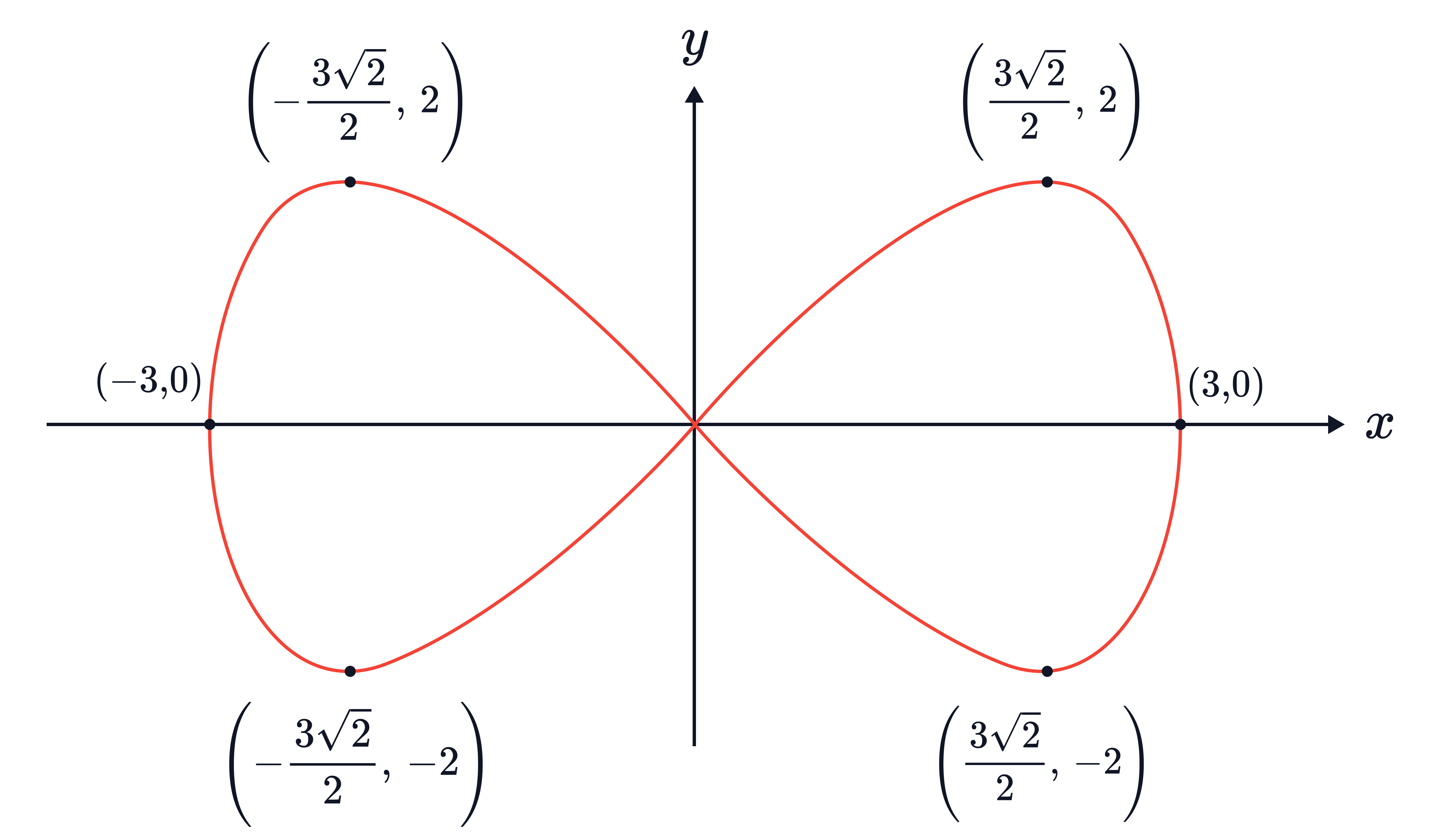
Here is the diagram with all the points we’ve found. To note, this is for illustrative purposes and in the exam, you wouldn’t have to do this.
No answer provided.
Challenging Question