Domain and Range
Neil Trivedi
Teacher

Contents
Domain and Range
Definitions:
The set of possible numbers that we can input into a function is called the domain.
The set of possible outputs that we obtain because of our domain is called the range.
How to determine restrictions within the domain:
Identify values of that make the function undefined, such as where the denominator is equal to , the expression inside a square root is negative, or the argument of a logarithm is non-positive.
Determine where the function may have vertical asymptotes or discontinuities.
Sketch the graph of the function to help confirm which values the function is defined for.
The domain is the set of all possible values.
How to determine the range:
Sketch the graph of the function to identify all possible values.
Consider any turning points, horizontal asymptotes and the highest or lowest values within the domain.
Analyse the behaviour of the function as to determine any limits on .
The range is the set of all possible values for the given domain.
Example 1:
Find the range of , domain .
Step 1: Find the roots and turning point of the quadratic.
For the roots, we solve , which will give us . So, the turning point occurs at , giving the minimum value:
The maximum value is the same at both the endpoints of the given domain and .
Step 2: Sketch the graph of , considering the domain restriction , and observe the range.
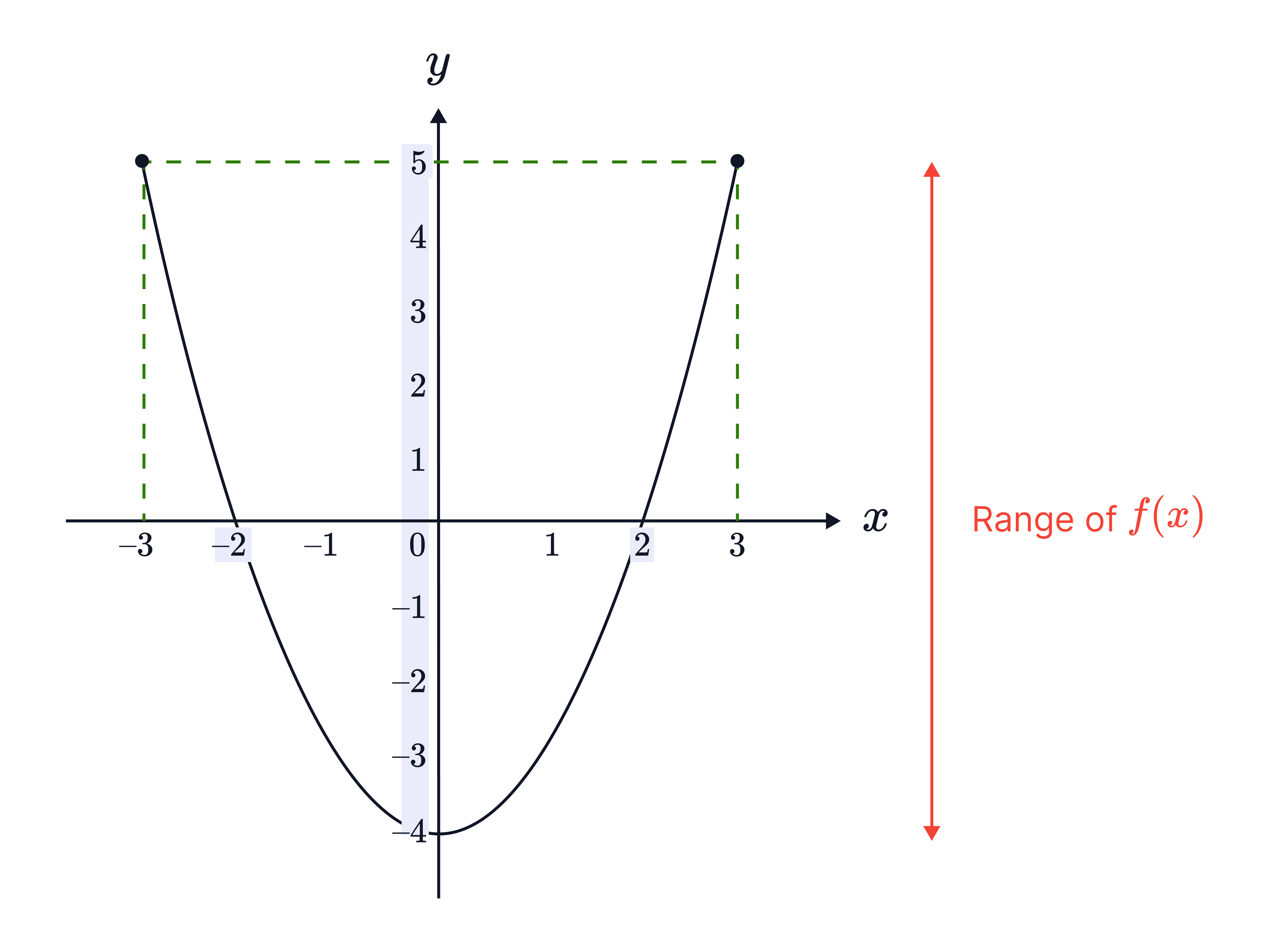
Thus, the range of the function is .
No answer provided.
Example 2:
Determine the range of , given that .
Step 1: To sketch the graph of , we must first identify asymptotes and sketch the graph of .
To find the vertical asymptote, we must find the values of , where the function is undefined. That will be where the denominator is equal to .
Thus, the vertical asymptote is .
Next, we find the horizontal asymptote by determining how the function behaves as
. As , the constant and become negligible in comparison
to and and can be ignored as part of the division.
As .
Therefore, the equation of the horizontal asymptote is
Finally, we find the points where the graph intersects the and axes, as these help determine which quadrants the reciprocal graph occupies.
To find the intercept, we let and solve for .
Multiplying through by the denominator, we have
Thus, the intercept is .
To find the intercept, we substitute into the function.
Thus, the intercept is .
Using these asymptotes and intercepts, we sketch the graph of .
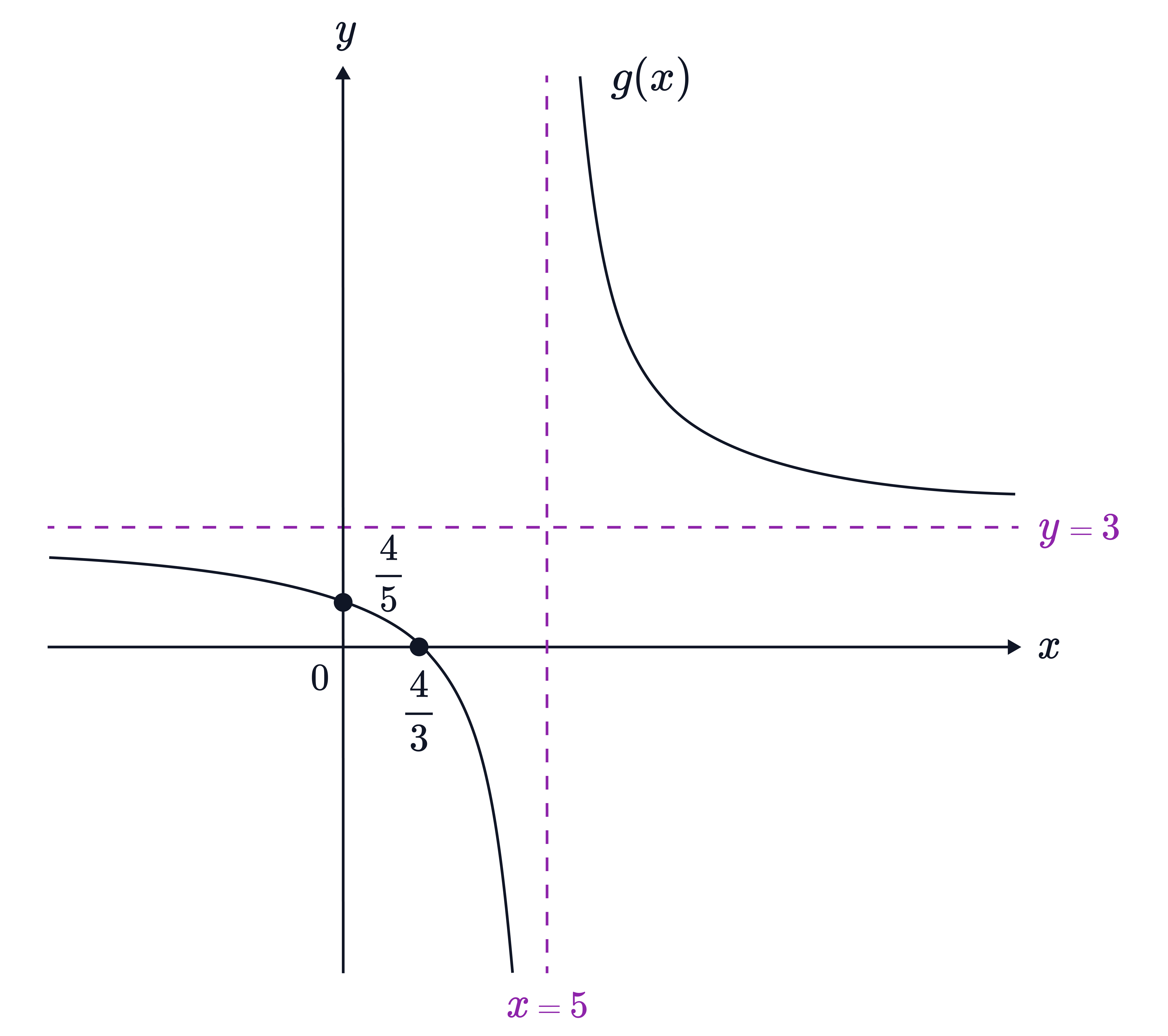
Step 2: Determine the range using the graph and the domain restriction.
Our domain is restricted to which means we will only consider the region of the graph when . We need to find the value of when .
Here is an annotated graph to illustrate this information. To note, the red region of the graph is the part we’re concerned about.
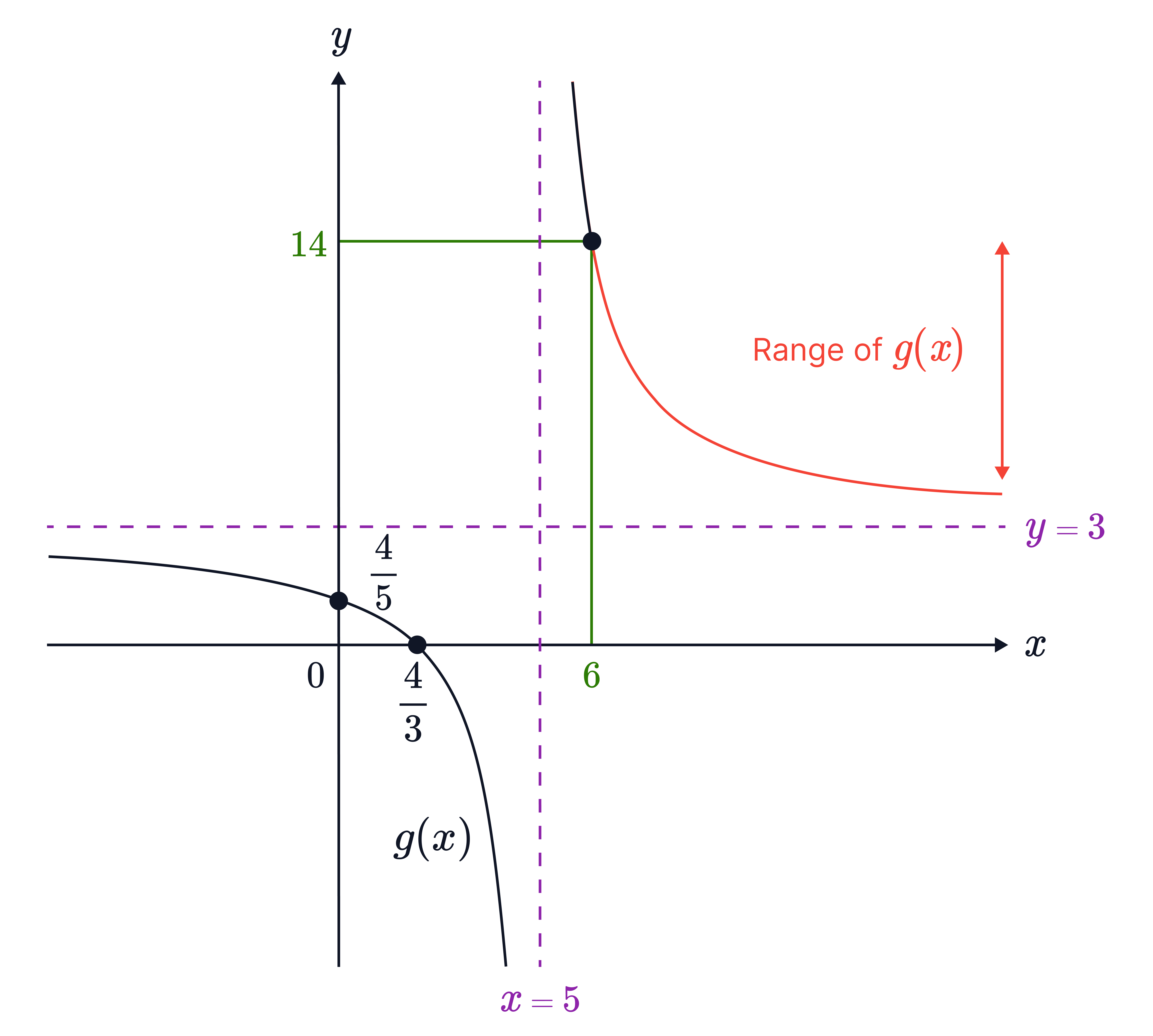
Therefore, by observation, the range is .
Note that is not included in the range as it corresponds to an asymptote, but is included because the value lies within our restricted domain, and hence its corresponding
value is also included.
No answer provided.
Example 3:
Sketch and state the range.
Step 1: Sketch the graph of .
For the function follows the linear equation This is a straight line, approaching , but with a hollow circle because is not included.
For the function follows the quadratic equation . This is a parabola, starting at with a filled circle because is included.
Using these, we sketch the graph of
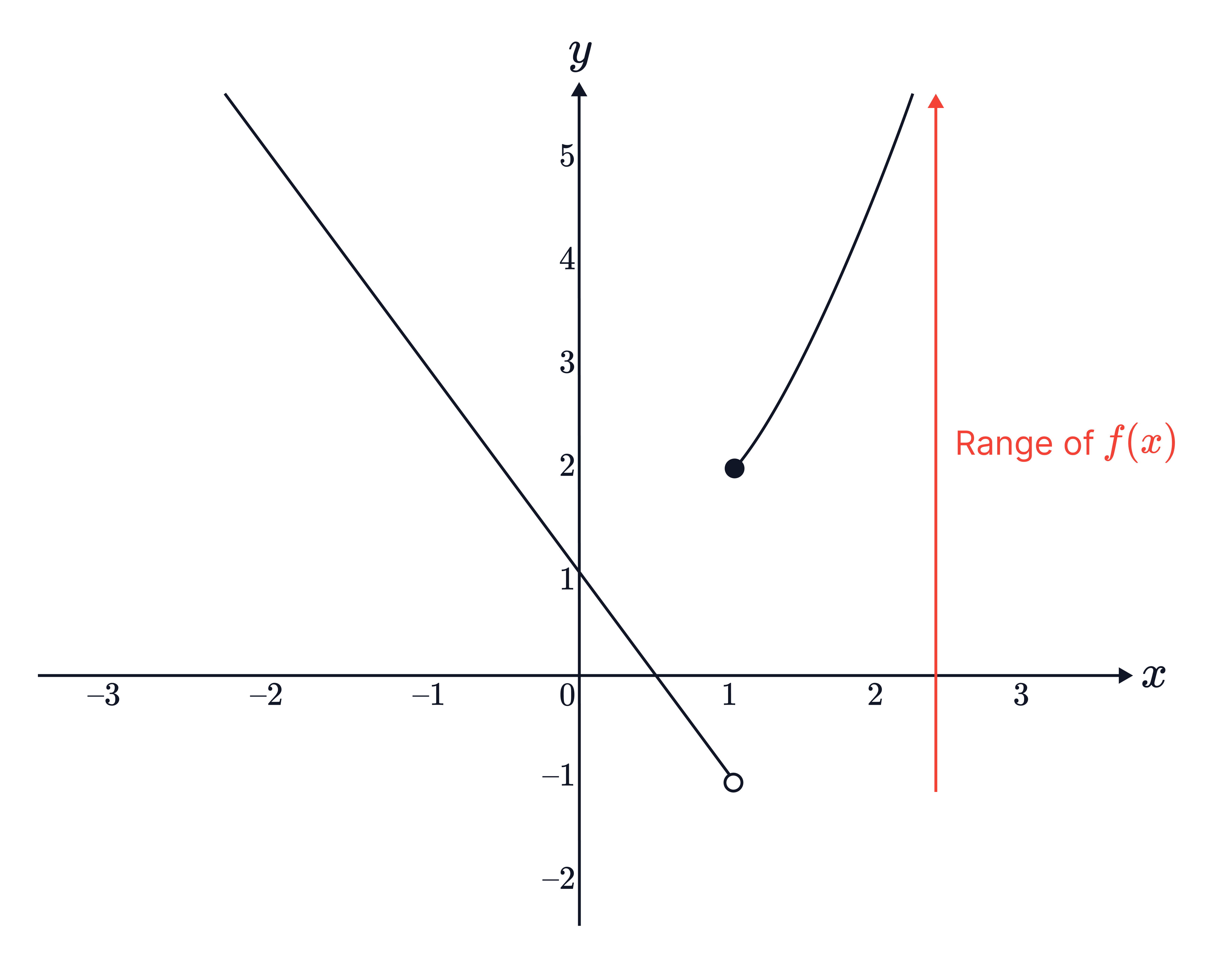
Step 2: Determine the range.
The linear part of the function approaches as (approaching the point from the left side) but never reaches it. The quadratic part starts at and increases indefinitely. Since includes all values greater than but never equals , the range is .
No answer provided.
Practice Question