Composite and Inverse Functions
Neil Trivedi
Teacher

Composite Functions
Composite functions involve applying successive functions to an input. For example, means , for which is applied first and then . This example is illustrated by the diagram below.

Example 1:
The functions , , and are defined by
Find:
a)
Single Step: means , so we apply first, and then .
b)
Single Step: means , so we apply first, and then .
c)
Single Step: means , so we apply first, then , and then .
d)
Single Step: means , so we apply first, and then apply again.
No answer provided.
Inverse Function
An inverse function, denoted as , performs the opposite of what the original function does. If maps an input to an output , then the inverse function , maps back to An example is shown below.
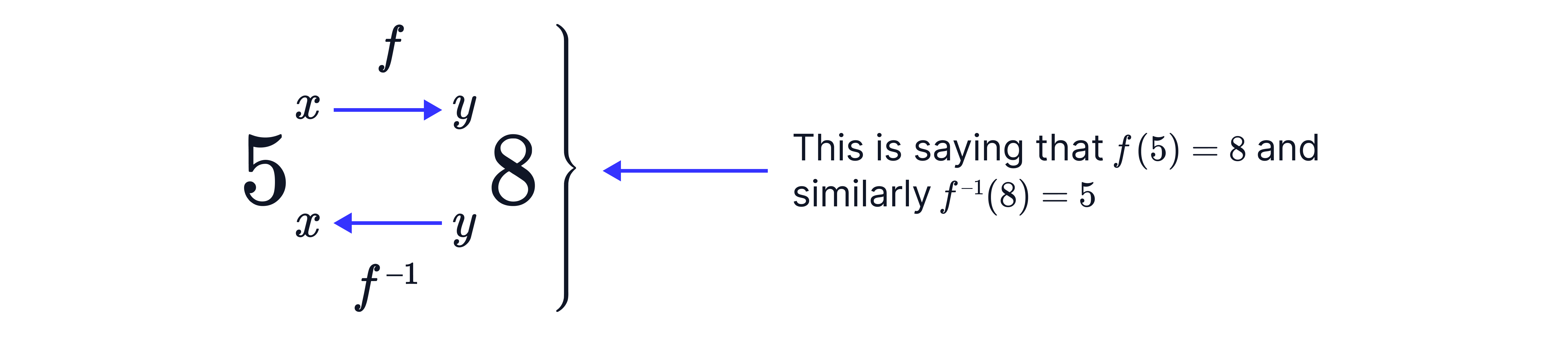
To find the inverse function , swap and in the equation for , then rearrange the equation to make the subject.
To note, an inverse can only exist for a one-to-one function.
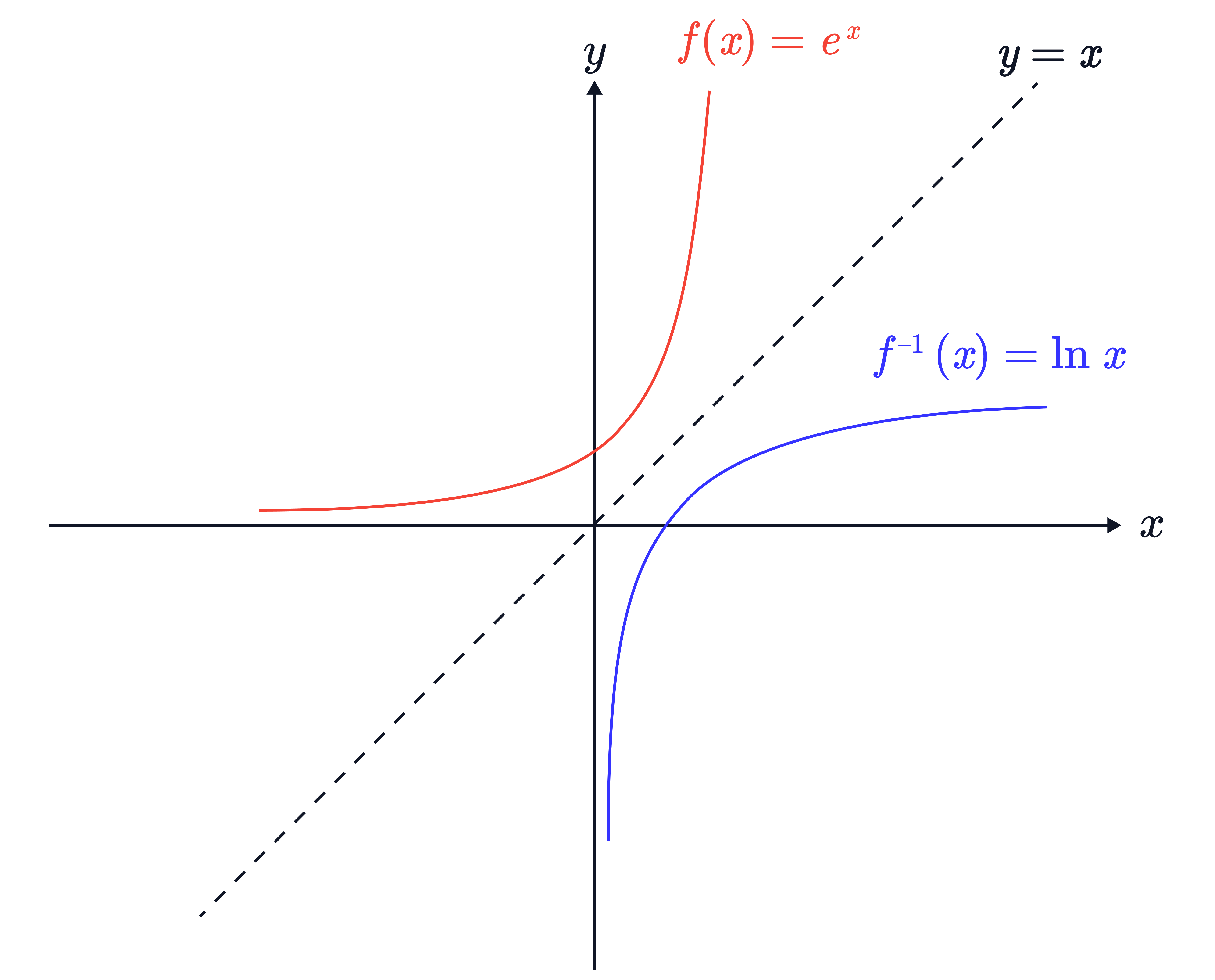
Also, the graph of the inverse function is a reflection of the original function in the line . For example, below, we can see the graph of (represented by the red curve.) We can work out the inverse function to be (represented by the blue curve.) We can see that has been reflected in the line (shown dotted) to give .
Example 2:
Given
a) Find .
Step 1: Here, we have . Swap and .
Step 2: Rearrange the equation to make the subject.
Multiply both sides by .
Add to both sides.
Apply the natural logarithm to both sides.
Therefore,
b) Solve .
Single Step: Use the logarithm power rule, , to rewrite the right-hand side, then exponentiate both sides using base to eliminate the natural logarithm and solve for .
No answer provided.
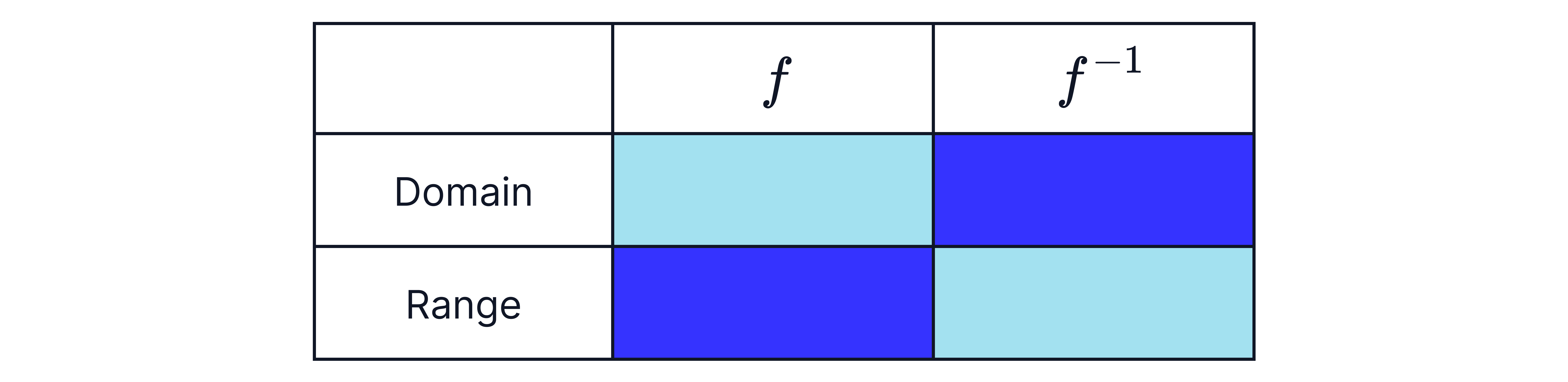
The domain of is equal to the range of , and the domain of is equal to the range of . This is because we are switching the inputs and outputs.
Example 3:
Given
a) Find an expression for .
Step 1: Here, we have . Swap and .
Step 2: Rearrange the equation to make the subject.
Therefore, .
b) Determine the domain and range of .
Step 1: Sketch the graph of .
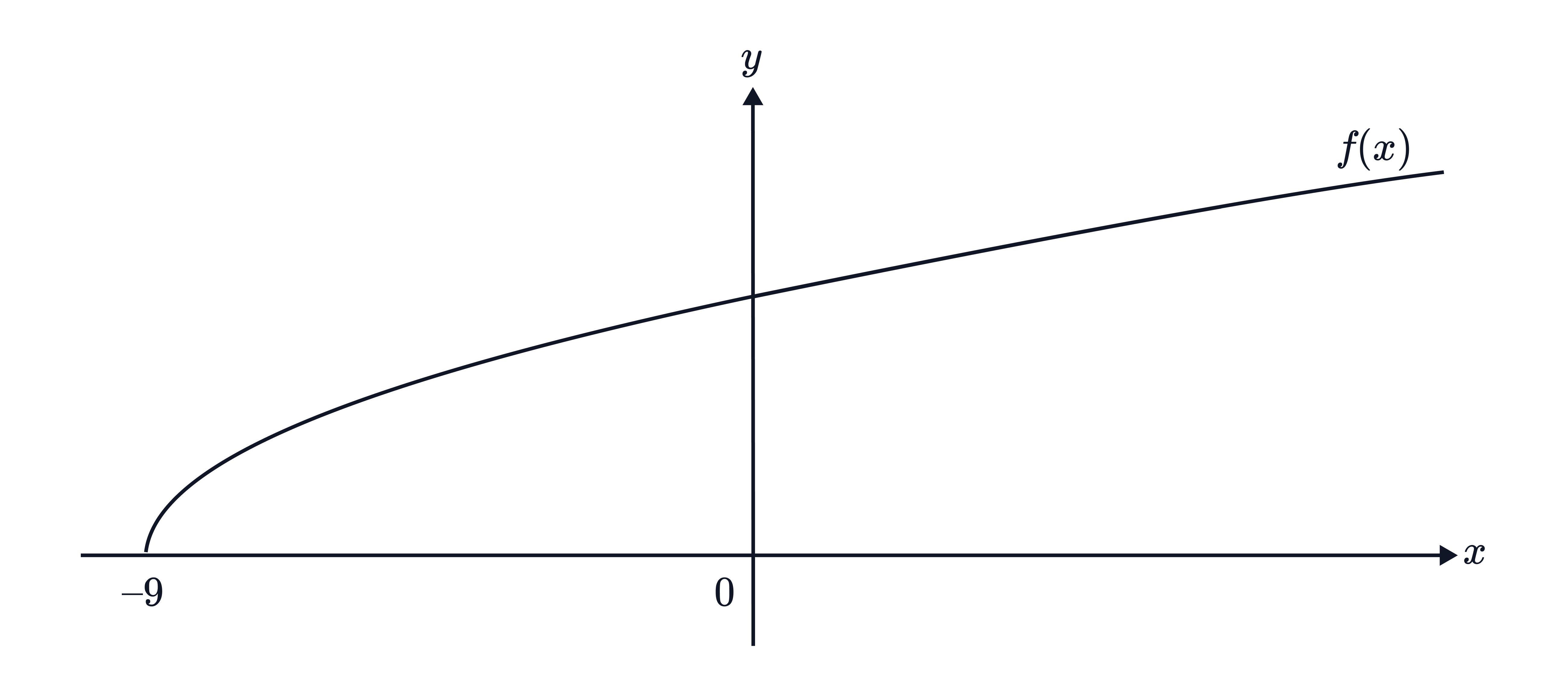
Step 2: Identify the domain and range of .
The range of is equal to the domain of . Thus, the range is .
To find the domain of , we need to find the range of . The domain of is restricted to , which means we will only consider the region of the graph where
. We need to find the values of when and .
When :
When :
Here is an annotated graph to illustrate this information. To note, the red region of the graph is the part we’re concerned about. Note that is included in the restricted domain, whereas isn't, so will be included in the range, but not .
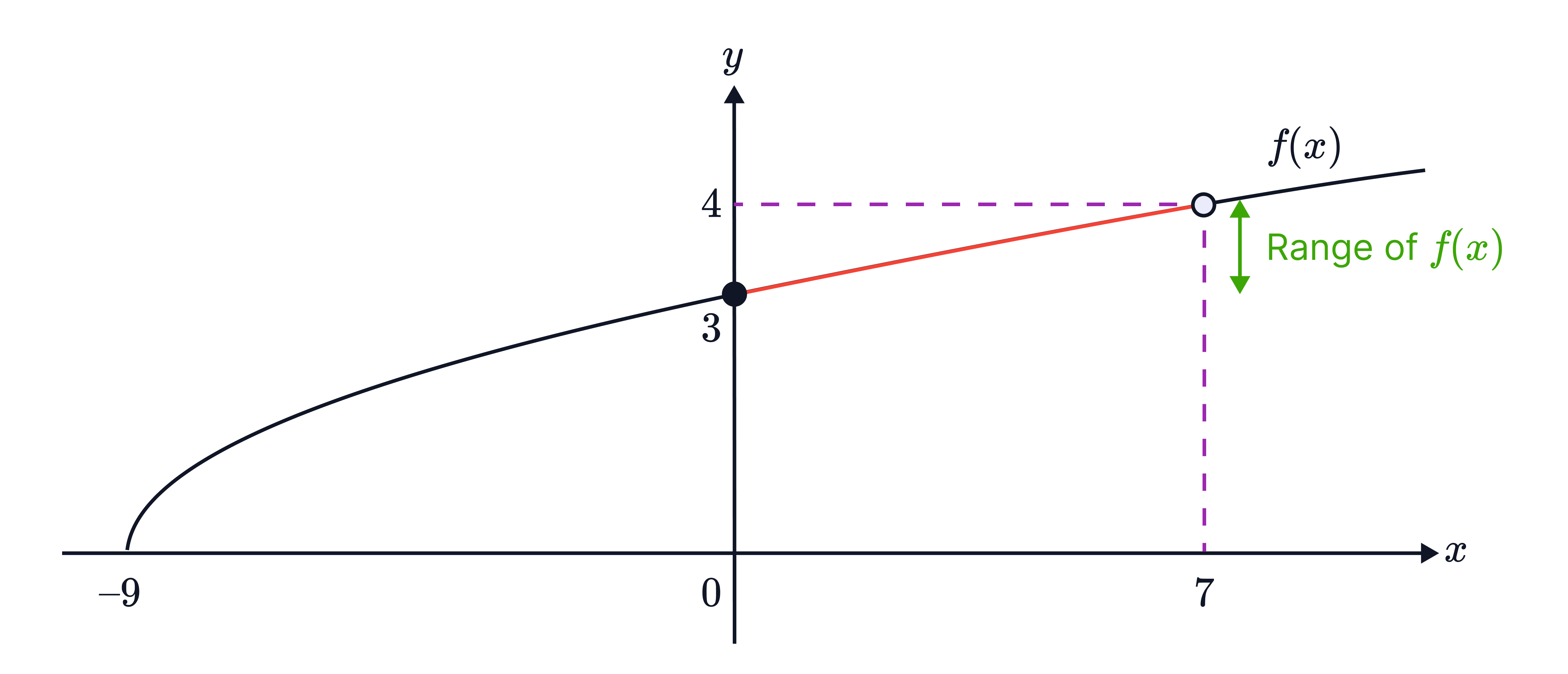
The range of , considering the restriction in the domain, is . Hence, the domain of is .
No answer provided.
Practice Question