Double Angle Formulae
Neil Trivedi
Teacher

Double Angle Formulae
Double Angle Formulae
The double angle formulae are derived from the addition formulae but are specific to cases where the two angles are the same. For example, can be rewritten as . Here are the derivations for each double angle formula.
Let .
Let .
Let .
The other two expressions can be found by using and rearranging the identity .
Substituting into , we get
Substituting into , we get
Example 1:
Use the double-angle formulae to write each of the following as a single trigonometric ratio.
a)
Single Step: Apply the formula with .
b)
Single Step: Apply the formula with .
Note that both the angle and the function are doubled once.
No answer provided.
Example 2:
Prove
Step 1: Express the reciprocal trigonometric functions in terms of sin and cos.
Step 2: Apply the formula .
No answer provided.
Example 3:
a) Prove that
Step 1: Apply the addition formula for tan on the left side.
Step 2: Apply the double angle formula on .
Step 3: Scale the fraction so we don't have fractions in fractions. This involves multiplying the numerator and denominator by . Then multiply in the .
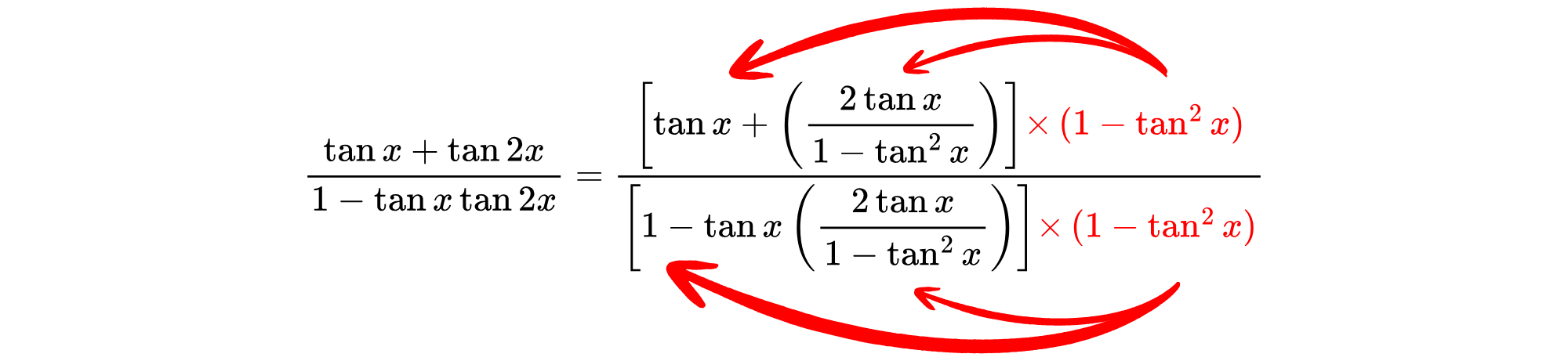
Step 4: Expand all brackets and simplify,

b) Hence, solve the equation
Giving your answers in terms of .
Step 1: Recognising the left side is similar to the left side in part (a), rewrite the equation.
Step 2: Solve the equation within the modified range.
Modified range:
Find the PV.
(PV)
Trigonometric Functions | Finding the SV |
| PV |
| PV |
| PV |
Find the SV by working out PV.
PV (SV)
Both the PV and SV are in the modified range. Take the PV and SV and add to both to find the rest of the values in the modified range.
PV
SV
To note, and we can find more values that lie in the modified range by adding to each value again.
If we continue adding , we will find values larger than and will therefore be out of the modified range. So, we can stop here.
Step 3: Un-modify the range to find . Do this by dividing every value by 3.
No answer provided.
Challenging Question