R-Transformations
Neil Trivedi
Teacher

R-Transformations
Because of the way the addition rule works, if our function is of the form:
a) then our R-Transformed form MUST be .
b) then our R-Transformed form MUST be .
A couple of notes:
• the first term determines the form. If the first term is then the form will be and if the first term is then the form will be .
• the addition rule for sine keeps the sign the same whereas for cosine, the sign changes.
Once you have clarified the form (the exam paper usually gives it to you but not always) then we can summarise and using:
Note: Notice how the sign in front of makes no difference since we factored that in when we decided the form of our R-transformation.
Example 1:
By choosing an appropriate R-transformation, re-write each of the following, giving in radians to decimal places where necessary.
a)
Step 1: Recognise the form we transform to and the values of and .
Since the function is in the form of , our R-form is , and we have and . The sign changes from negative to positive due to the addition rule for cosine.
Step 2: Find and then put everything together to get our R-form.
Therefore,
b)
Step 1: Recognise the form we transformed to and the values of and .
Since the function is in the form of , our R-form is , and we have and . The signs stay the same due to the addition rule for sine.
Therefore,
Note that it is rather than and that this process is independent of the variable changing.
No answer provided.
Example 2:
a) Express in the form , where and . Give to significant figures.
Single Step: The R-form matches the first term in . Then we recognise the values of and to find and .
We have and .
Therefore, .
b) Solve for ,
Give your answers to significant figures.
Step 1: Substitute in the R-form and rearrange.
Step 2: Solve the equation with the modified range.
Modified range:
(PV)
Trigonometric Functions | Finding the SV |
| PV |
| PV |
| PV |
Find the SV by working out PV.
PV (SV)
Both the PV and SV are in the modified range. If we add or subtract from the PV and SV, we’d get values that lie outside the range, so we’ll stop here.
Step 3: Un-modify the range to find . Do this by adding to every value.
c) Deduce the maximum value of , and the smallest positive value for , to significant figures, at which it occurs.
Step 1: Express in the R-form.
Step 2: Apply our knowledge on the sine function to deduce the required values.
The maximum value sine is . The enlarges the graph by a scale factor of parallel to the
axis so the maximum value can be is .
The sine function is at the maximum at . We can confirm this by observing the graph.
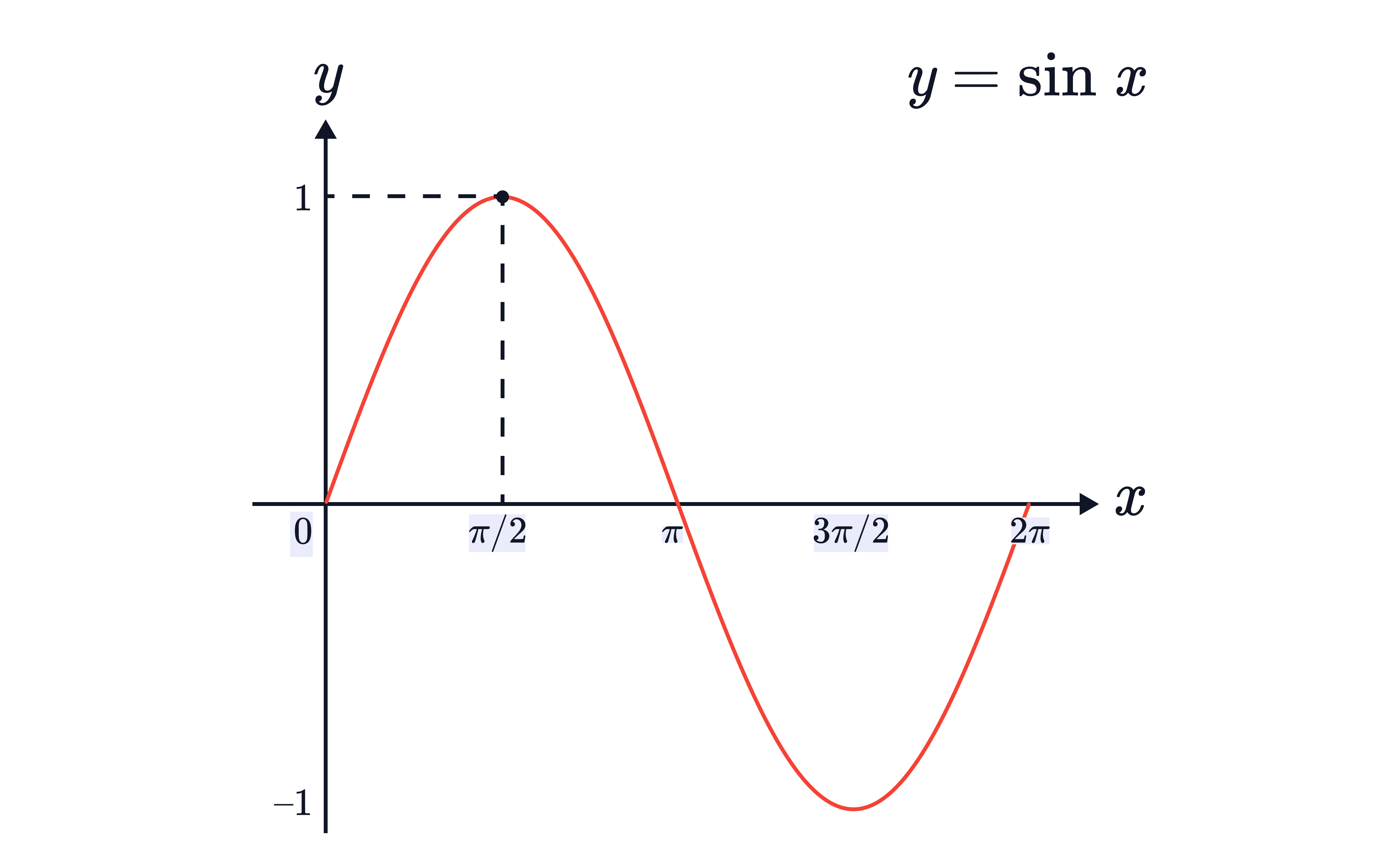
So, we equate our angle to .
No answer provided.
Challenging Question