Modelling with Trigonometry
Neil Trivedi
Teacher

Neil Trivedi
Head of Mathematics
Modelling with Trigonometry
Example 1:
James rows across a lake of constant width m to capture a photograph of a speedboat racer, Emma, who is approaching at ms. James is m ahead of Emma when he starts to row across the lake from a fixed point . Emma passes him as he reaches the other side of the lake at a variable point . James rows at a speed of ms, moving in a straight line at an angle , where , relative to the shoreline.
You may assume that is given by the formula:
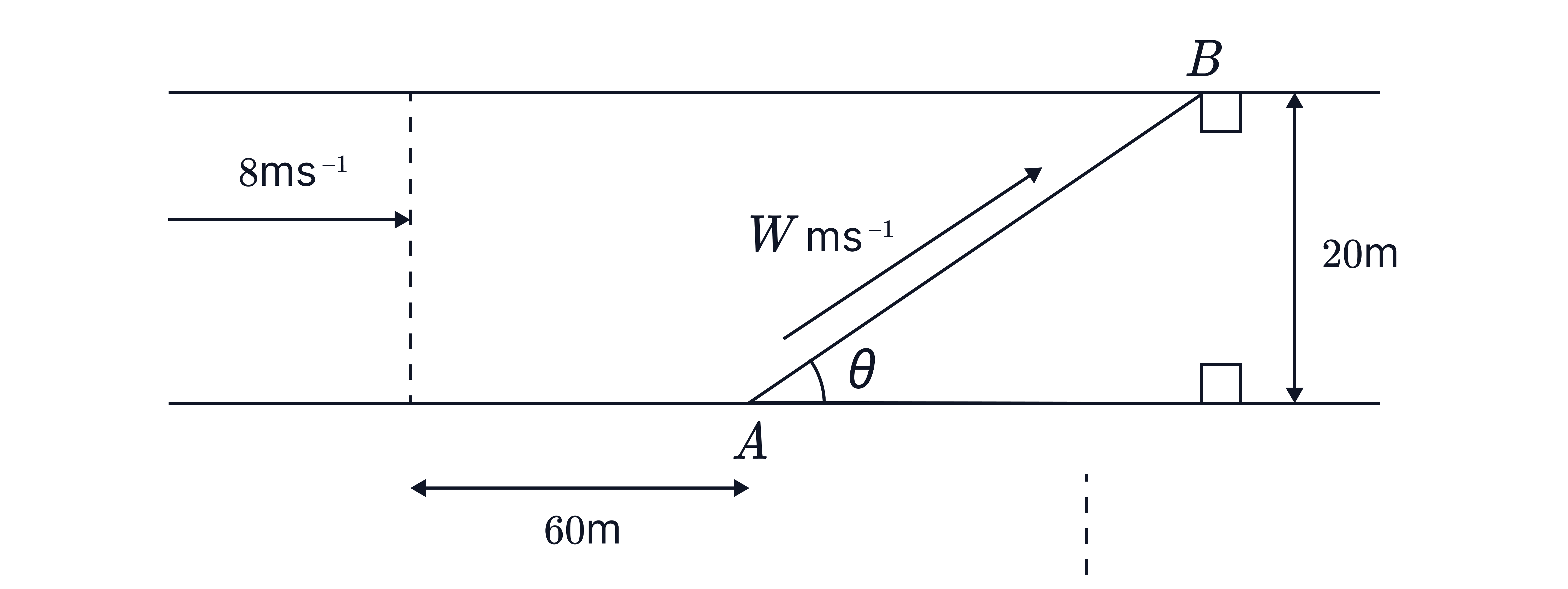
a) Express in the form , where and are constants and and , giving the value of to decimal places.
Step 1: Recognising the value of and that corresponds to the required R-transformed form.
Since we are required to transform to , we need our original expression to be in the form of . We can write as , giving
Step 2: Find and and write them in the required form.
Therefore, .
b) Given that varies, find the minimum value of .
Single Step: Rewrite so that its denominator is in R-form. Since is a fraction, and the numerator is constant, to minimise , we need to maximise the denominator which is when the cosine function is .
To minimise , we want the largest value of , which is . So,
(sf)
c) Given that James' speed is the value found in the part (b), find the distance .
Single Step: Deduce the value of to find the distance using SOHCAHTOA.
To obtain the distance , we need the angle . We know that . So,
is the hypotenuse. So, by SOHCAHTOA,
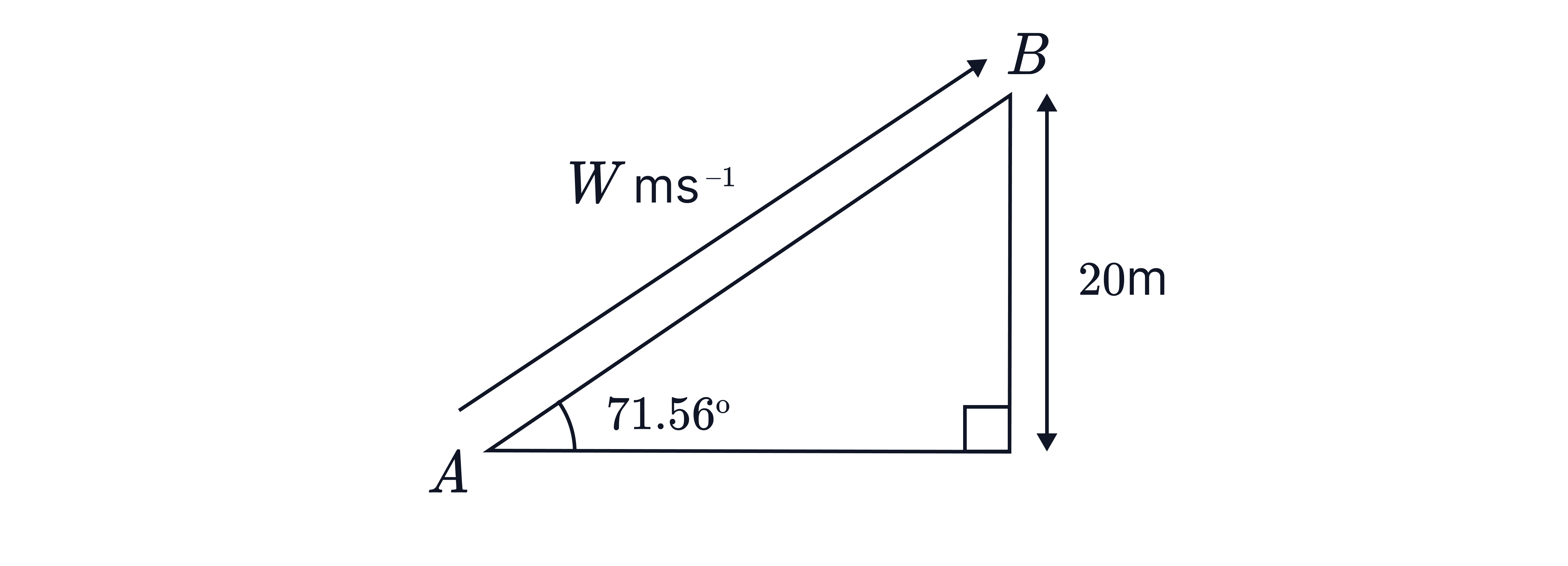
(sf)
Therefore, the distance is approximately m to significant figures.
d) Given instead that James' speed is ms, find the value of the angle , given that
.
Single Step: Substitute the new in the given formula in R-form to find .
Multiply through by and divide by :
(2dp)
Note: The modified range here would have been , which is why we did not find the SV and stuck with just the PV.
No answer provided.
Example 2:
a) Express in the form , where and are constants and and , giving the value of to significant figures.
Single Step: Recognise the values for and to find and .
(sf)
Therefore, .
b) State the maximum value of and the value of at which it occurs for
.
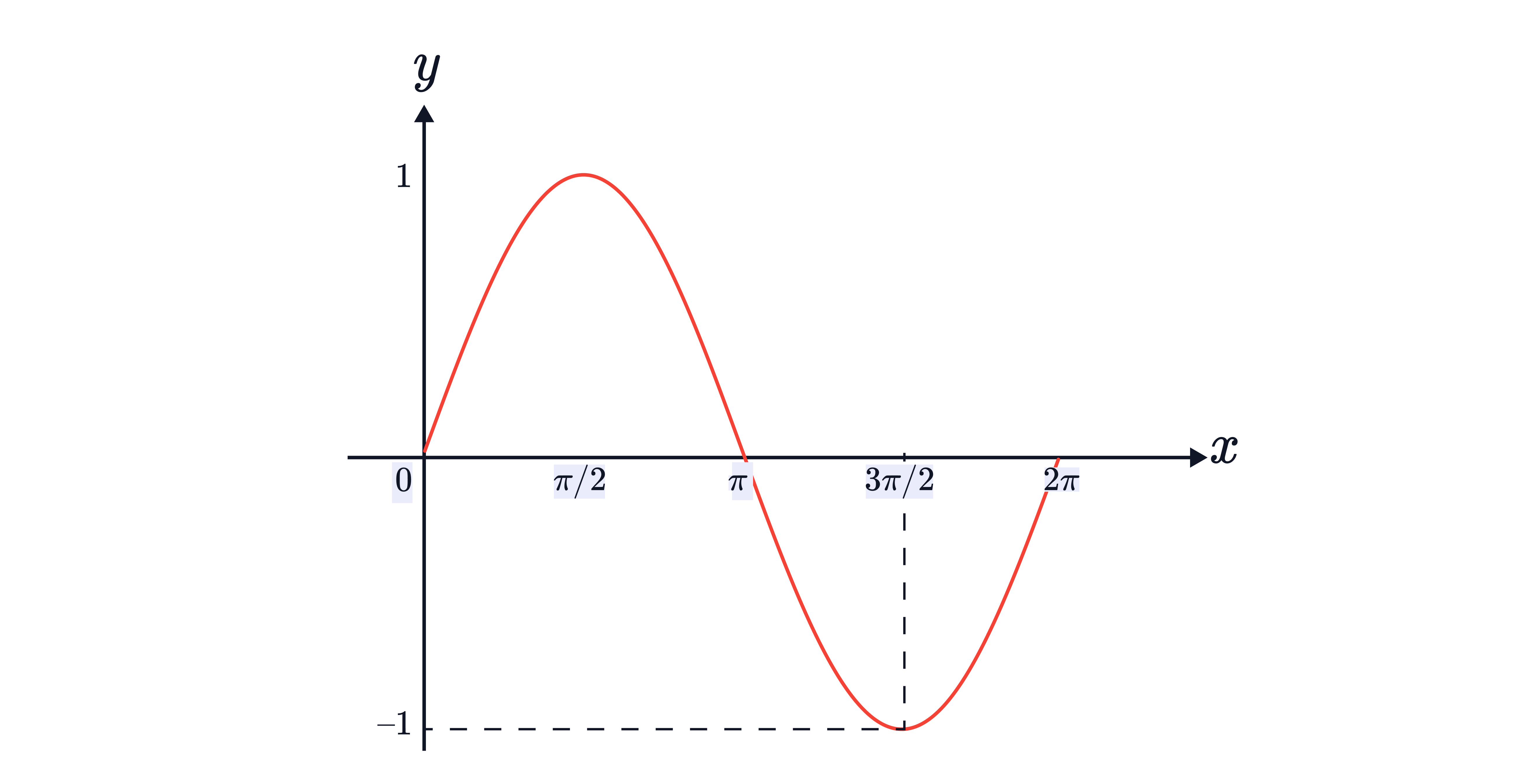
Single Step: The sine function has a maximum value of when its angle is . The following graph of the sine function illustrates this.
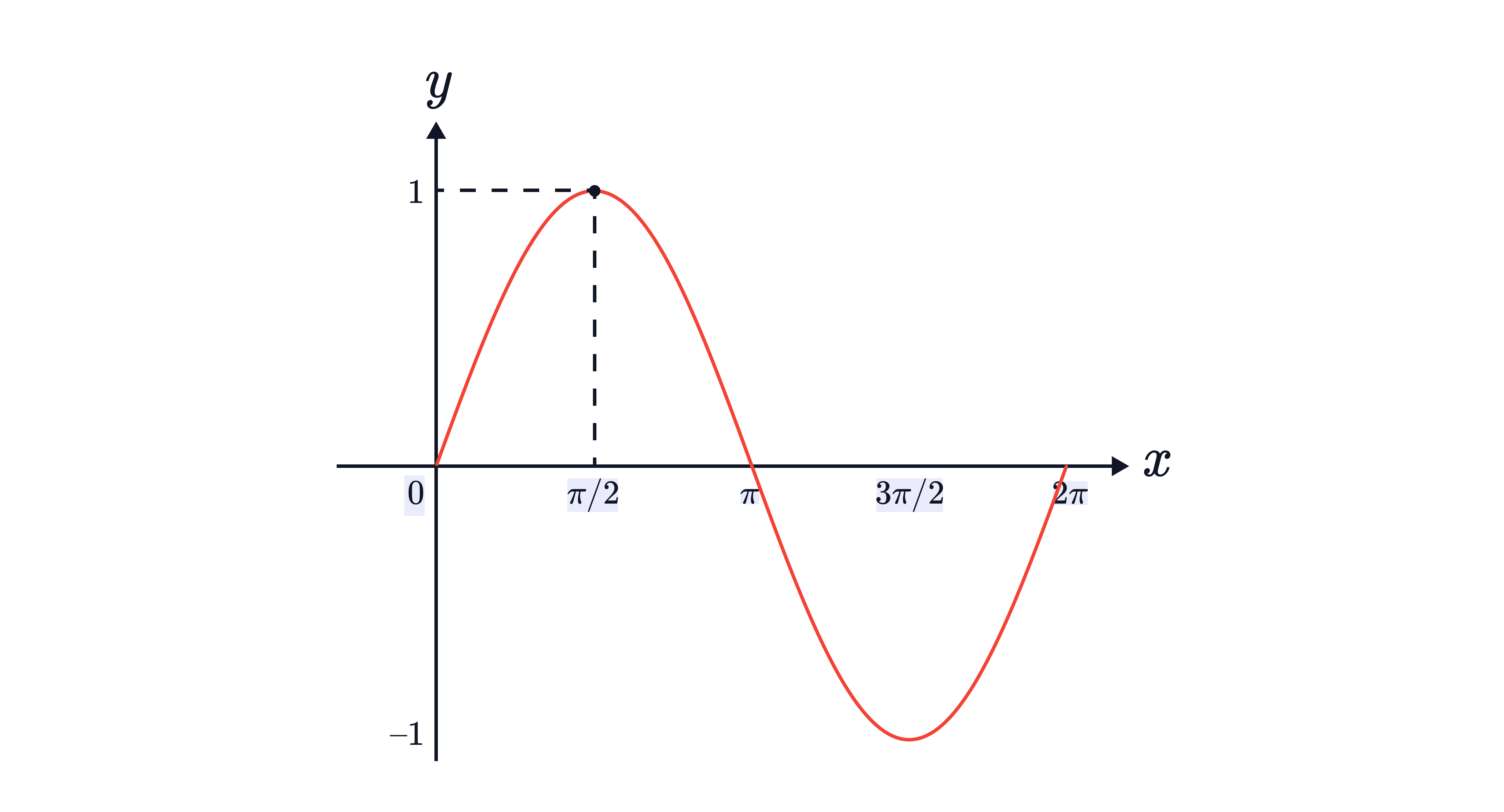
The stretches the graph by scale factor so the maximum value of
is
To find , we set to equal the angle at the maximum point, , and solve.
No answer provided.
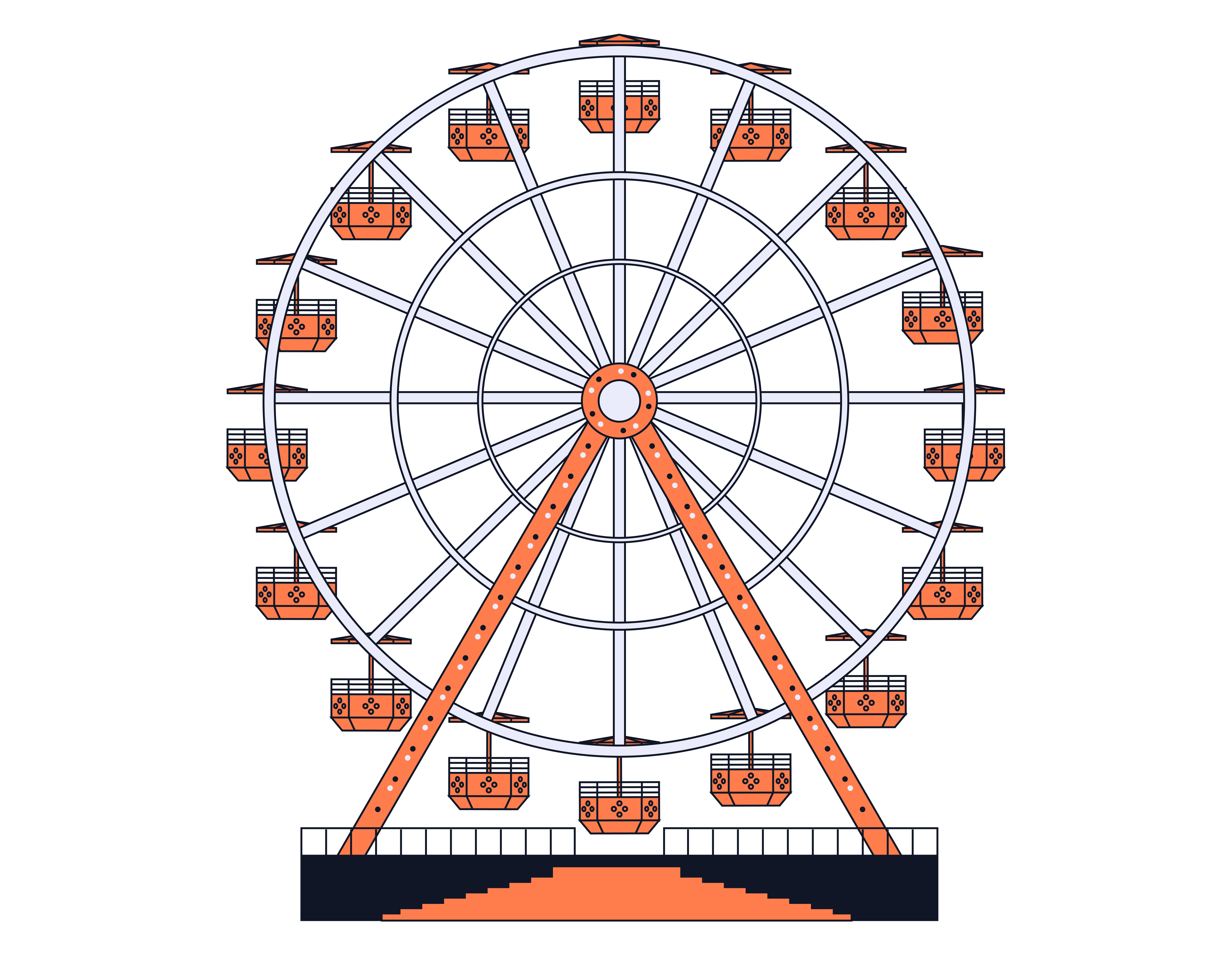
Sophia models the height above the ground of a passenger on a Ferris Wheel by the equation
Where is measured in metres and is the time in minutes after the wheel starts turning.
c) Calculate the maximum value of and the value of at which this maximum occurs. Give your answers correct to decimal places.
Step 1: Express in R-form.
The form of is the same as part (a), but now equals and the function is negative.
Step 2: Apply our knowledge on the sine function, deduce the required values.
Minimising gives the largest value of . The smallest value sine can be is . So,
(2dp)
Sine is at its minimum at . The following graph of the sine function illustrates this.
So,
(dp)
d) Determine the time for the Ferris Wheel to complete three revolutions.
Step 1: Find the time for the Ferris Wheel to complete a single revolution.
To answer this, we need to know what the period of the graph is. The period is the time it takes to complete one full cycle of the graph. For sine and cosine, it is and for tan it is (as shown in the graphs below where the dotted lines represent the start/end of a cycle).
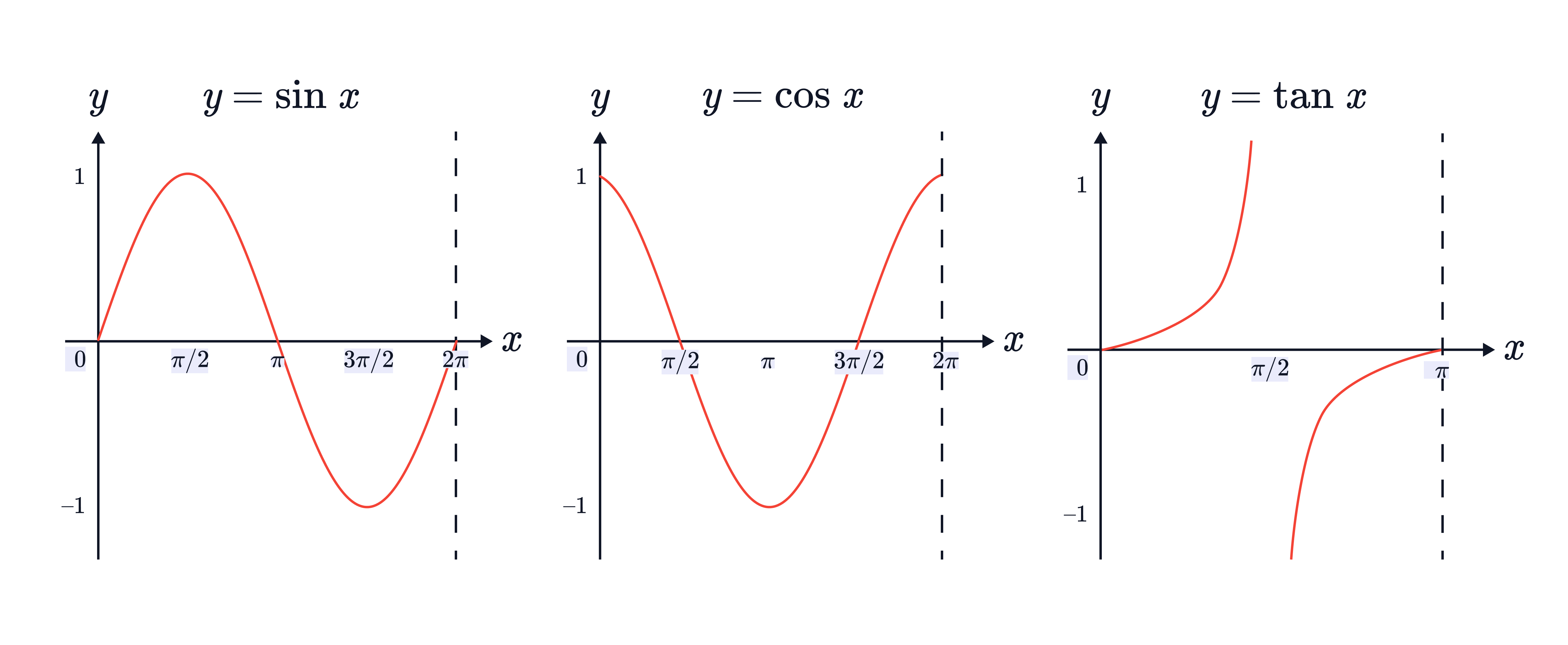
The period of a trigonometric function is only affected by enlargements parallel to the -axis, not by horizontal shifts. For instance, if you have a function written in the form , the term doesn't change the period, but the coefficient does by a scale factor of .
In our function , the coefficient of is , so the period will enlarge by a scale factor of . The period of the sine graph is , which after enlargement becomes . So, is the time it takes to complete one full revolution.
Step 2: Scale up to get the time for three revolutions.
One revolution takes minutes to complete and so, it takes minutes to complete three revolutions.
No answer provided.
Challenging Question