Further Variable Acceleration
Neil Trivedi
Teacher

Further Variable Acceleration
Variable acceleration refers to motion where the acceleration of a particle is not constant but instead varies with time. Unlike constant acceleration (SUVAT), we solve variable acceleration problems using calculus.
Key Definitions:
• Displacement/Position – It is the relative position of a particle to its starting point as a function of time and is denoted by .
• Velocity – It is the rate of change of displacement and is denoted by or .
• Acceleration – It is the rate of change of velocity and is denoted by or .
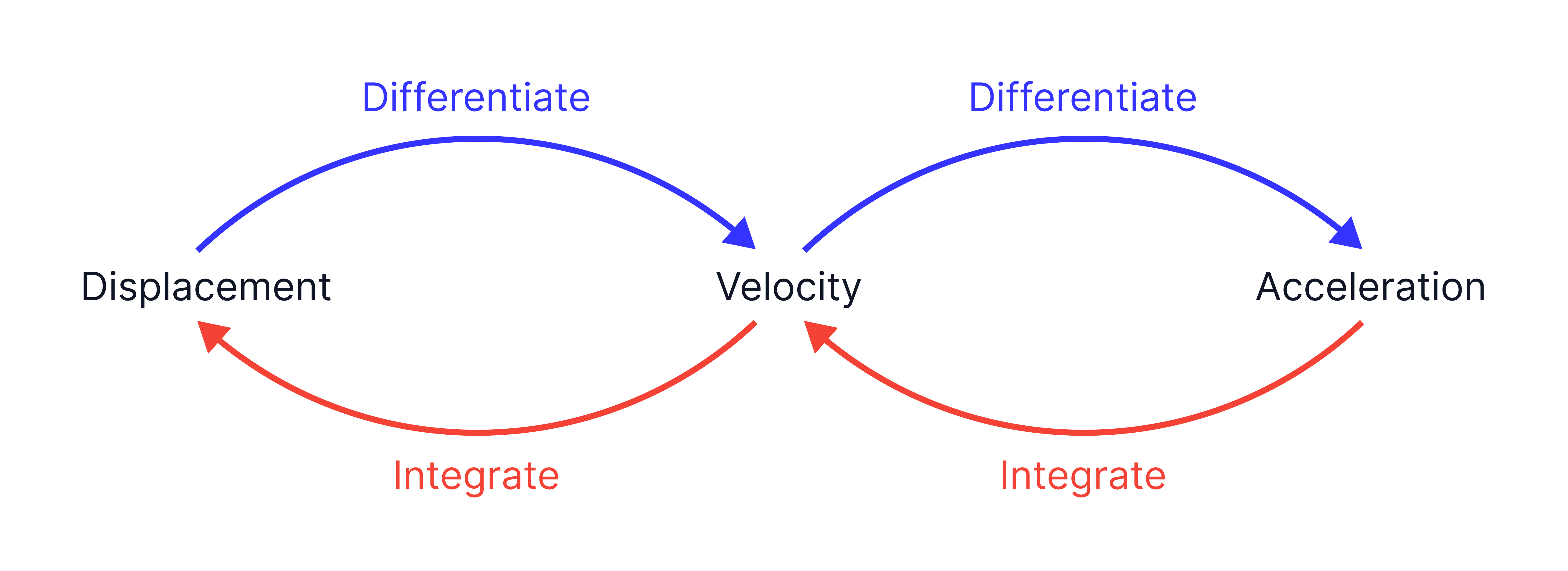
Example 1:
A particle is moving in a straight line with acceleration, at time seconds, given by
ms
The velocity of the particle at time is ms.
a) Find an expression for the velocity at time seconds.
Step 1: To find the velocity, we need to integrate the expression for the acceleration.
Step 2: Use integration by recognition to make a guess as to what may differentiate to get .
We will guess . The angle is , which differentiates to , differentiates to , and then the angle inside stays the same.
Angle stays the same
Differentiated angle
Our guess differentiates to give , but we wanted . So, we multiply both sides the constant we want over the constant we have, which will be .
Step 3: Find using the initial conditions when given in the question.
ms
b) Find the maximum and minimum speed.
Single Step: The maximum value of occurs when and the minimum occurs when .
ms
ms
c) Find the distance travelled in the first seconds.
Step 1: To find the distance, we need to integrate the velocity between and seconds.
First, we need to ensure that the velocity is positive within that domain. From part b), the minimum value of is , which is greater than , so is always positive.
Take out of the integral to leave us with an easier expression to integrate
Step 2: Use integration by recognition to make a guess as to what may differentiate to get .
We will guess . The angle is , which differentiates to , differentiates to , and then the angle inside stays the same. We know that integrates to .
Angle stays the same
Differentiated angle
Our guess differentiates to , but we wanted . So, we multiply both sides by the constant we want over the constant we have, which will be . So, we have:
Step 3: Substitute the limits and to find the distance travelled.
m
No answer provided.
Example 2:
A particle of mass kg is moving on the positive axis. At time seconds, the displacement, m, of the particle from the origin is given by
a) Find the velocity of the particle when .
Single Step: To find the velocity, we need to differentiate the expression for displacement.
Substituting , we get:
ms
The particle is acted on by a single force of variable magnitude N, which acts in the direction of the positive axis.
b) Find the magnitude of when .
Step 1: We’ll use Newton’s second law here, namely . To find the acceleration, we need to differentiate the equation for velocity.
Substituting , we get:
ms
Step 2: Substitute the values of the mass and acceleration into the formula to obtain the force .
N
Since we want the magnitude, we are finding .
N
N
No answer provided.
Challenging Question