Horizontal Projections
Neil Trivedi
Teacher

Horizontal Projections
In first-year mechanics, particles were only projected upwards/downwards, and we applied SUVAT based on the information given. Here, the particle was strictly working against gravity and nothing else. In second-year mechanics, we look at particles projected at an angle, so we need to consider both the vertical and horizontal directions combined. We exclude any other external forces, such as air resistance and rotational forces.
In this note, we’ll explore horizontal projections where a particle is projected horizontally from a height, which means it has an initial vertical velocity of and a constant horizontal velocity.
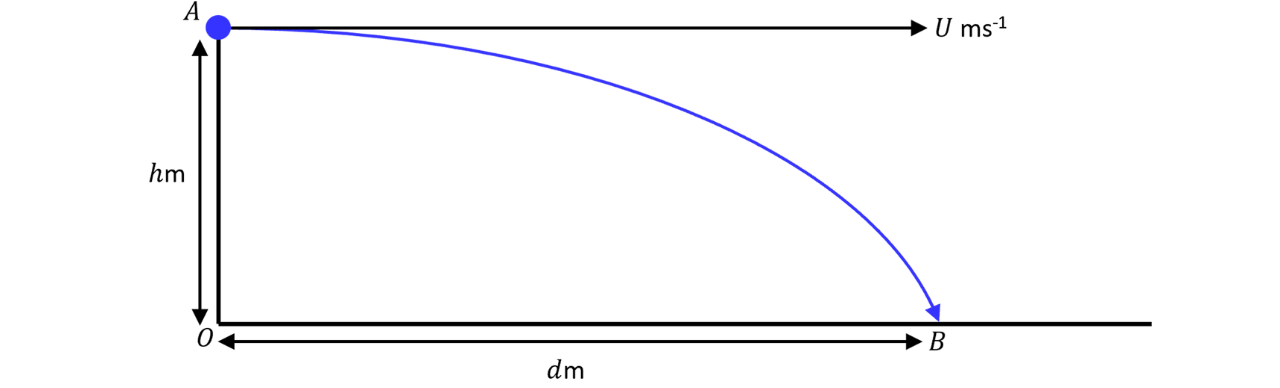
The diagram below illustrates a general case of a horizontal projection, where a particle is projected from a point , which is metres above level horizontal ground, with initial horizontal velocity
ms, and lands at a point on the ground, which is at a horizontal distance of metres from the starting position.
Vertical Axis
• For vertical motion, the particle moves under the influence of gravity. Since the direction of projection is usually above the horizontal, we take upwards as positive. Therefore, acceleration due to gravity is taken as negative: ms.
• We model the particle’s vertical motion using the SUVAT equations.
Horizontal Axis
• For horizontal motion, we ignore any external forces such as air resistance and rotational forces. Using Newton’s second law, , and noting that there are no external horizontal forces, we have (the mass cannot be ). This means that the horizontal velocity remains constant because the horizontal acceleration is .
• We model the particle’s horizontal motion using , where is the distance, is the constant speed, and is the time.
Example 1:
A particle is projected horizontally at a speed of ms from a point , which is m above horizontal ground.
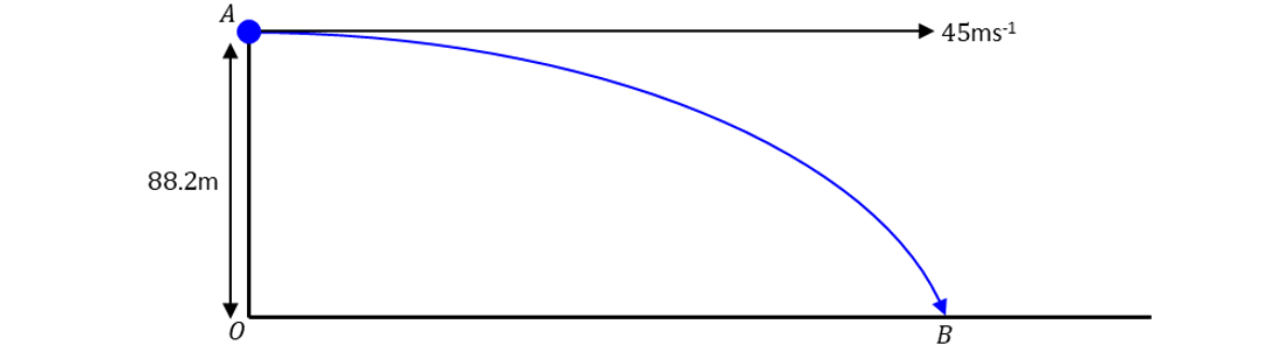
a) Find the time taken for the particle to reach the ground at .
Step 1: Label the vertical and horizontal axes separately.
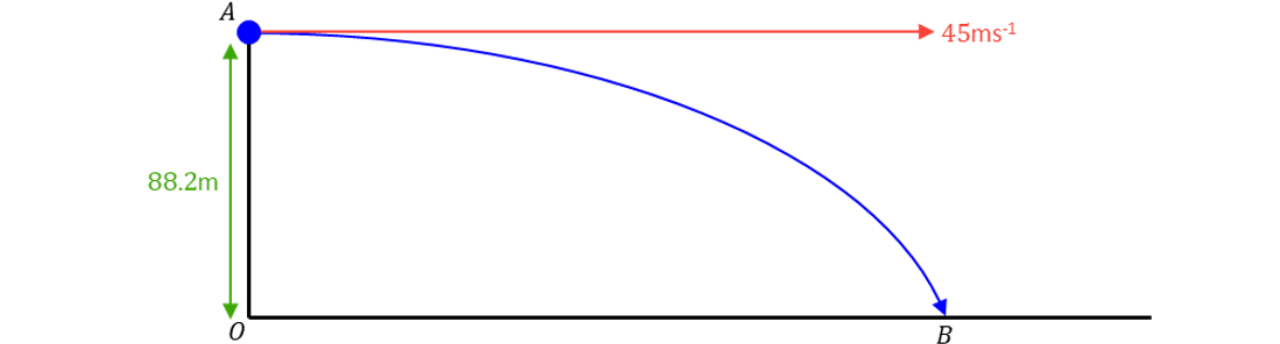
Suppose that is the time taken for the particle to reach . The vertical motion is modelled by SUVAT, and the horizontal motion is modelled by Distance Speed Time. As we are projecting horizontally, the initial vertical velocity is .
VerticalHorizontal
Note: Time is what will always connect
the vertical and horizontal components
as time is dimensionless.
Note: As our positive direction is upwards, the displacement and acceleration will be negative as we’re going downwards. Since we are taking upwards to be positive, the particle is m below our point of projection, which is why we are setting the displacement here to be negative. Think of it as our point of projection is the origin of an axes and where it hits the ground has a negative value.
Step 2: Use SUVAT to find .
s sf
To note, we round our answers to significant figures because we used ms.
b) Find The horizontal distance travelled in that time.
Single Step: Find the horizontal distance using .
Suppose the horizontal distance is . The time taken is seconds and the horizontal speed remains constant at ms.
m
c) Find the distance of from .
Note: For these questions, we will need to find the shortest distance from to . We draw a straight line connecting the two points on our diagram. This will form a right-angled triangle.
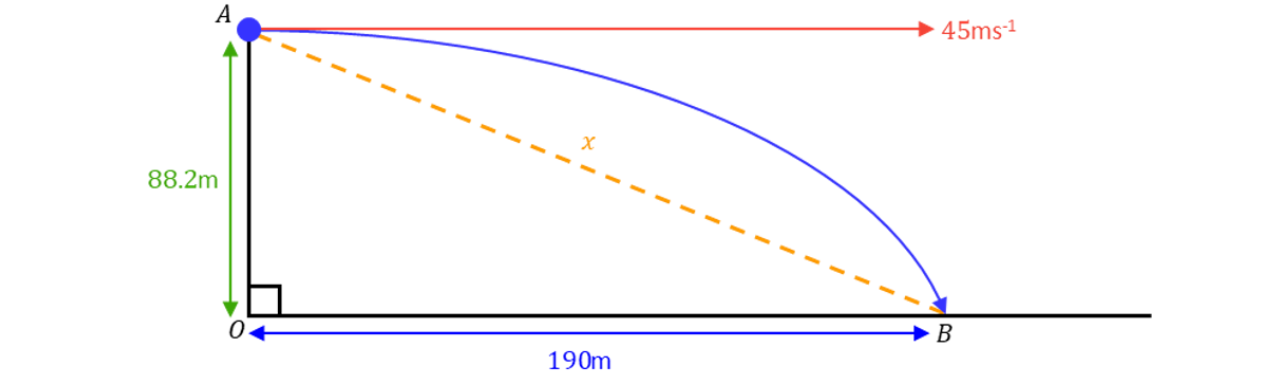
Single Step: Use Pythagoras’ Theorem to find .
m sf
No answer provided.
Example 2:
A stone is projected horizontally with a speed of ms and at a height of m. There is a wall that is m high and m away.
Will the stone clear the wall and if so, by how much?
Step 1: Sketch a diagram to visualise the motion of the stone.
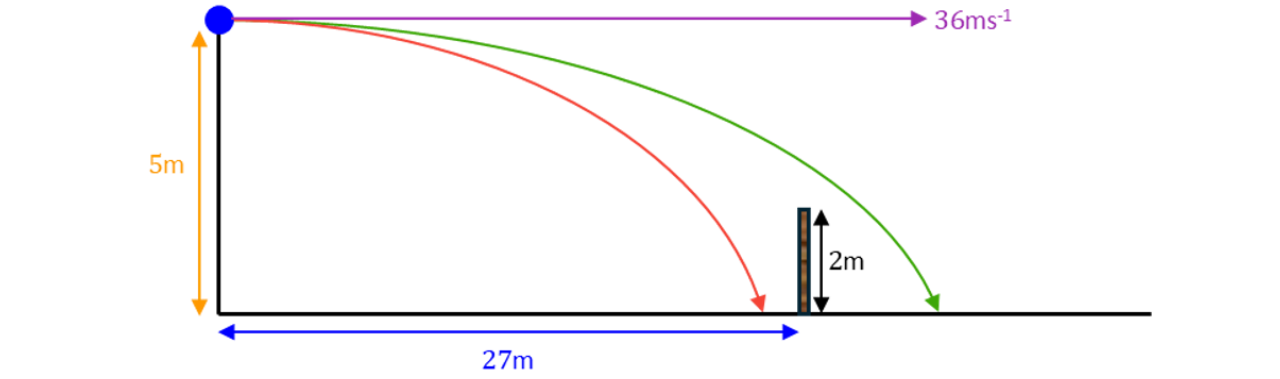
Note: the red and green arrows are examples of potential pathways the stone could take.
Step 2: Label the vertical and horizontal axes separately.
Suppose that is the time taken for the stone to reach the wall. The vertical motion is modelled by SUVAT, and the horizontal motion is modelled by Distance Speed Time. As mentioned before, we are projecting horizontally so the initial vertical velocity is .
VerticalHorizontal
Note: Remember, represents the displacement relative to the projection point. If is positive, the stone is above the projection point, and if is negative, the stone is below. In our case, will clearly be negative as the whole journey is below the point of projection.
Step 3: Find the time taken to reach the wall using .
s
Step 4: Using the value of we obtained, find using SUVAT.
m sf
Step 5: Compare the height of the wall with the height of the stone above the ground at the point where it reaches the wall. If the stone’s height is greater than the wall’s height, it clears the wall, and the difference between the two heights gives the amount by which the stone clears it.
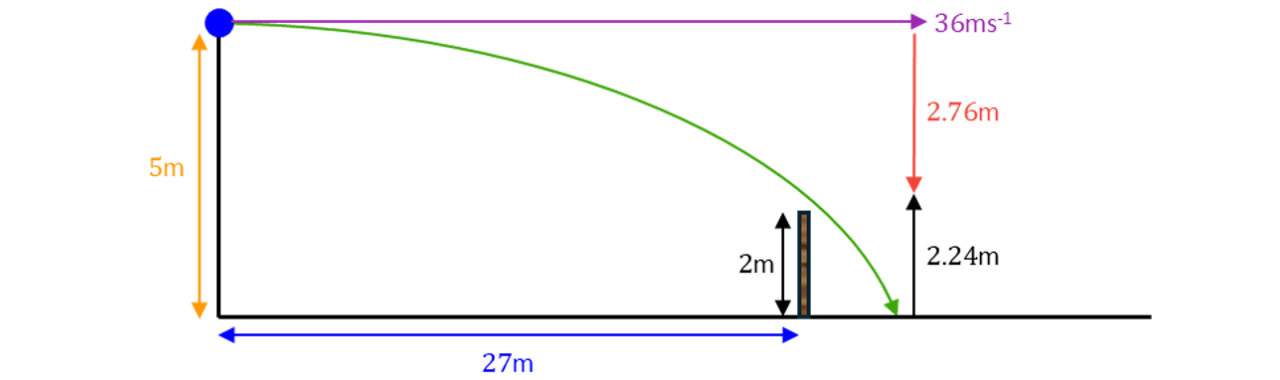
We found in step the height by which the stone had dropped (it’s negative because the displacement is downwards, while the positive direction is upwards). Therefore, the stone’s height above the ground at this instant is m. The wall’s height is m. Since , the stone clears the wall. The wall is cleared by m.
Here’s a diagram to illustrate this.
No answer provided.
Challenging Question