Acute Angle Projections
Neil Trivedi
Teacher

Acute Angle Projections
In this note, we’ll explore acute angle projections under the influence of gravity from either the ground or at a height above the ground. Like forces, we do not like to observe speeds at random angles, so we resolve the speed into its horizontal and vertical components.
The diagram below illustrates a general case of projectile motion. A particle is projected from a point , which is metres above level horizontal ground at a fixed origin , with an initial velocity of
ms, and at an angle of elevation .
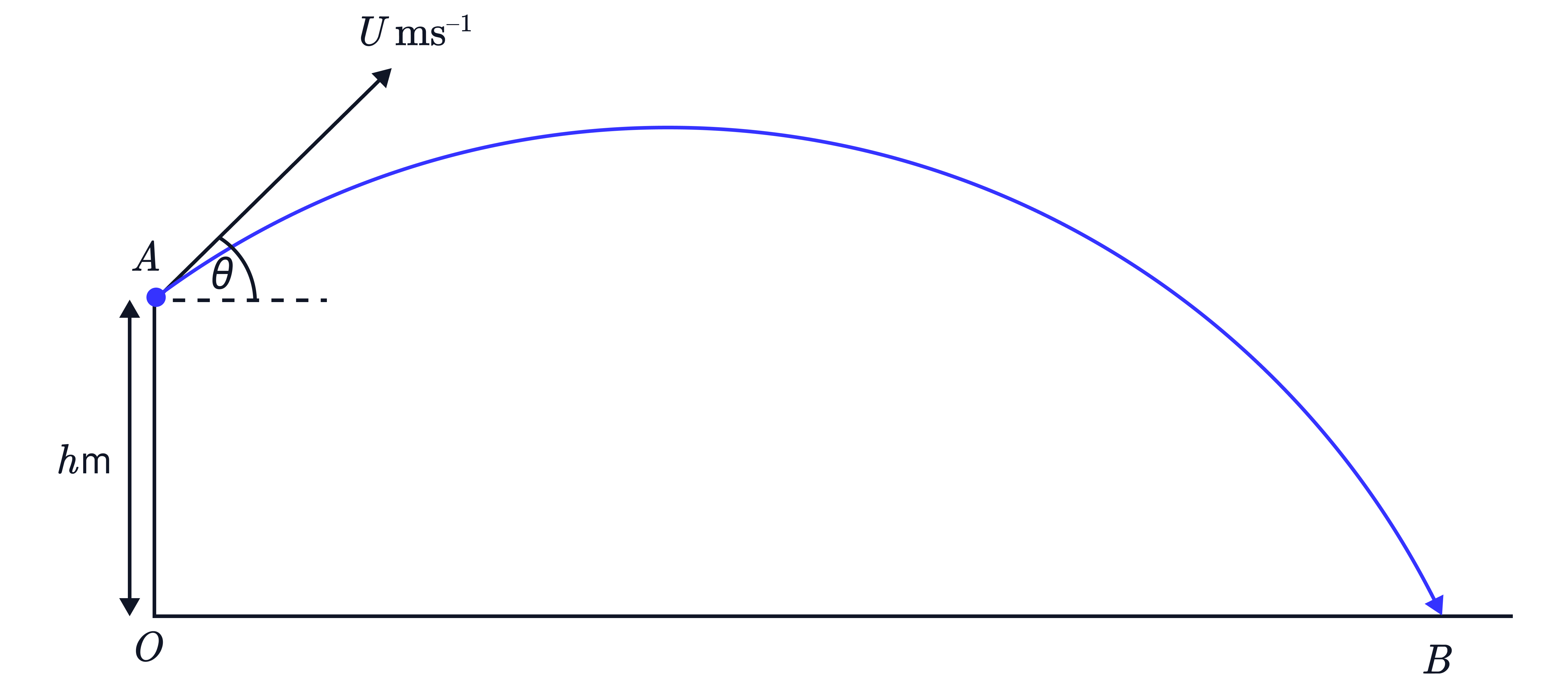
The horizontal component of the initial velocity is , while the vertical component is . This can be verified using SOHCAHTOA.
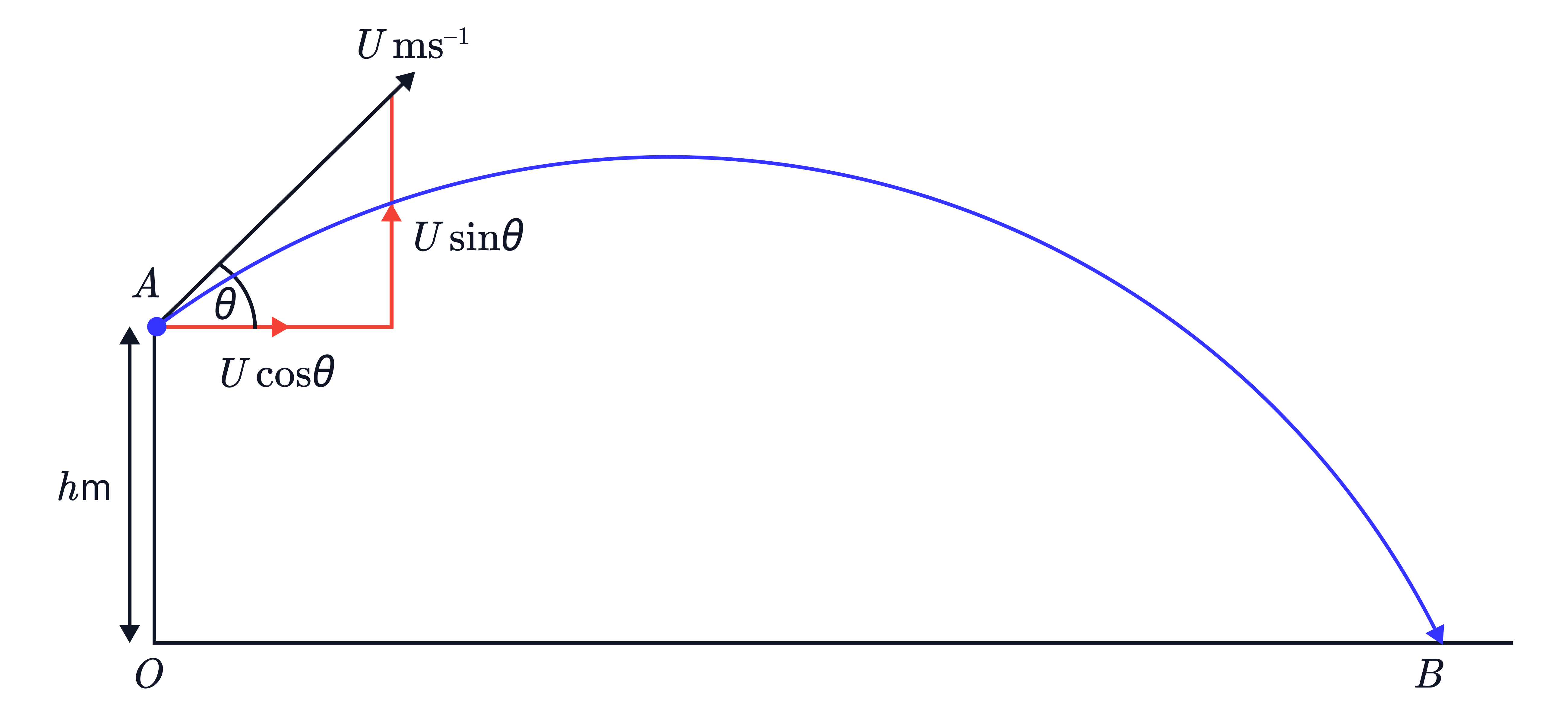
Vertical Axis
• For vertical motion, the particle moves under the influence of gravity. We take the positive direction as the direction of projection, which is usually upwards. Therefore, acceleration due to gravity is taken as negative: ms.
• We model the particle’s vertical motion using the SUVAT equations.
Horizontal Axis
• For horizontal motion, we ignore any external forces such as air resistance and rotational forces. Using Newton’s second law, , and noting that there are no external horizontal forces, we have (the mass cannot be ). This means that the horizontal velocity remains constant because the horizontal acceleration is .
• We model the particle’s horizontal motion using , where is the distance, is the constant speed, and is the time.
Example 1:
A particle is projected from a point , on level horizontal ground, with speed ms and at an angle of elevation of . The particle moves freely under gravity.
Find the length of time for which the particle is m or more above .
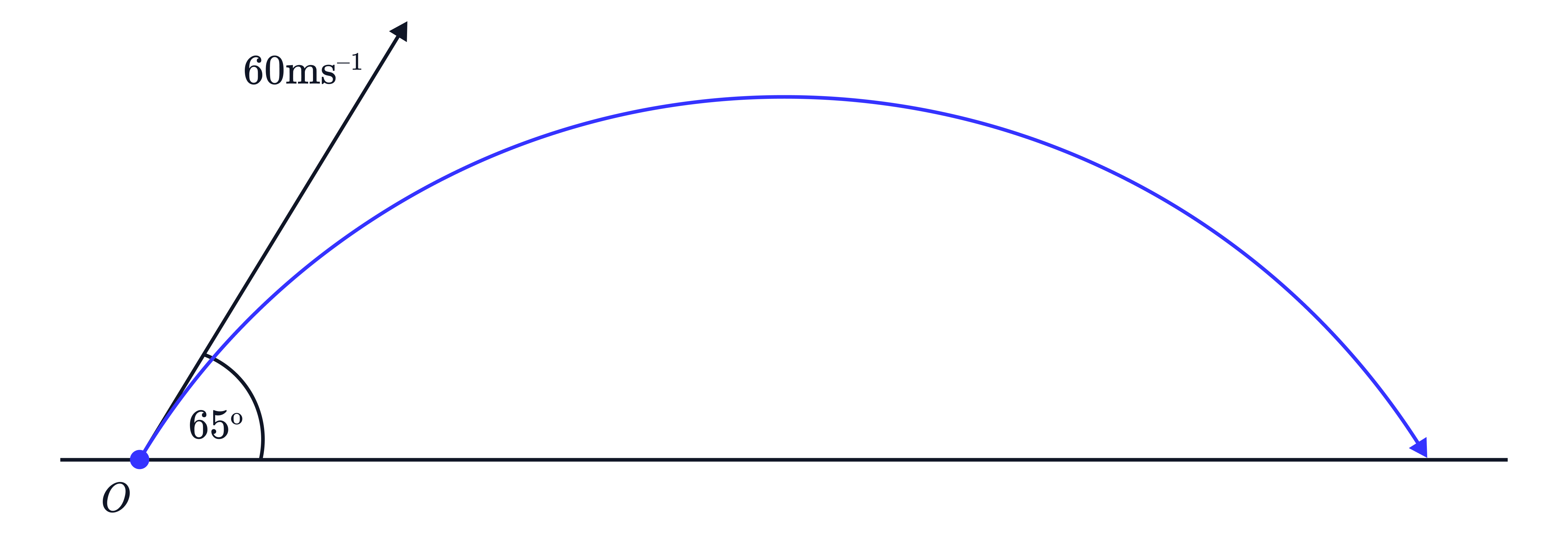
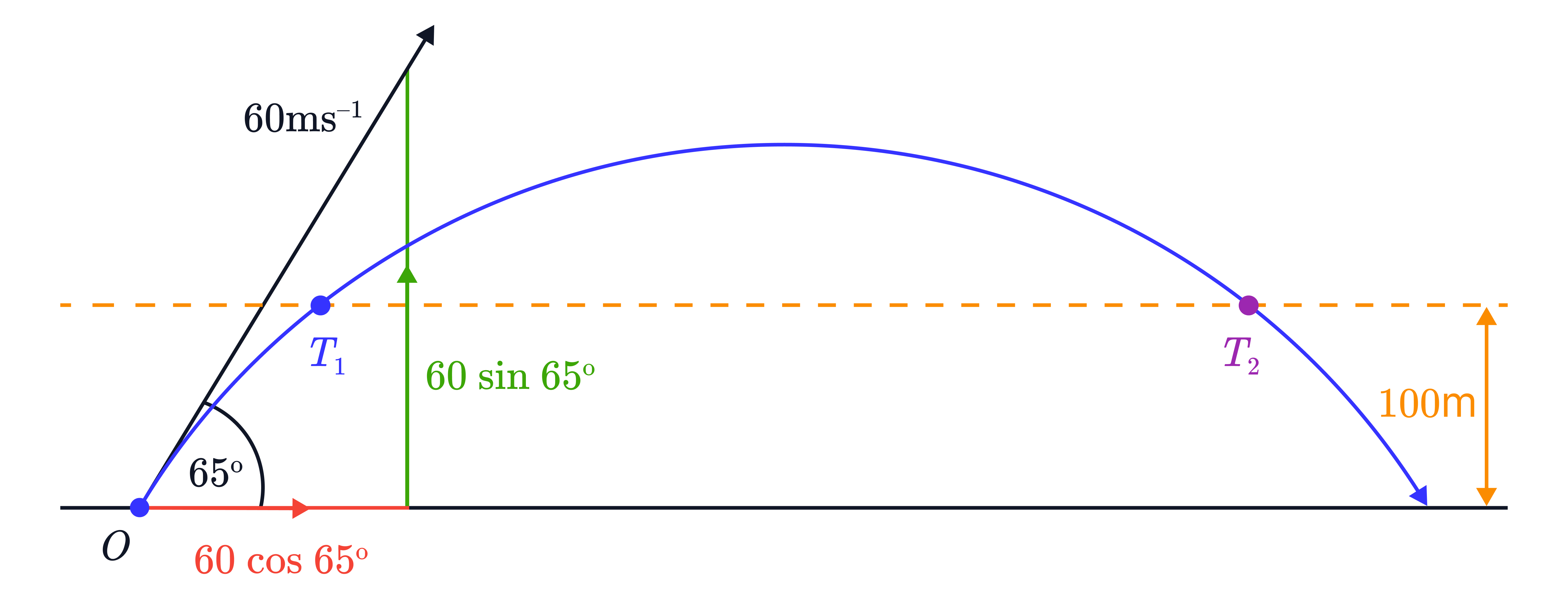
Step 1: Annotate the diagram by resolving and adding extra information from the question.
In the diagram, we resolve the velocity into its vertical and horizontal components.
Step 2: Label the vertical and horizontal axes separately. The vertical motion is modelled by SUVAT, and the horizontal motion is modelled by Distance Speed Time.
Let be the times at which the particle is m above the ground.
VerticalHorizontal
Note: Time is what will always connect
the vertical and horizontal components
as time is dimensionless.
Step 3: Use SUVAT to find the two times at which the particle is m above and the length of time the particle is m or more above is the difference between these two times.
Only the vertical components give us enough information to solve this problem so we can ignore the horizontal plane.
Use the quadratic formula to solve for .
Therefore, the length of time the particle is m or more above is seconds to significant figures.
No answer provided.
Example 2:
A particle is projected from a point , which is m above level horizontal ground, with speed ms at an angle of elevation , where . The particle’s path is shown in the diagram and moves freely under gravity. The particle passes through a point , which is m above the ground, and hits the ground at a point .
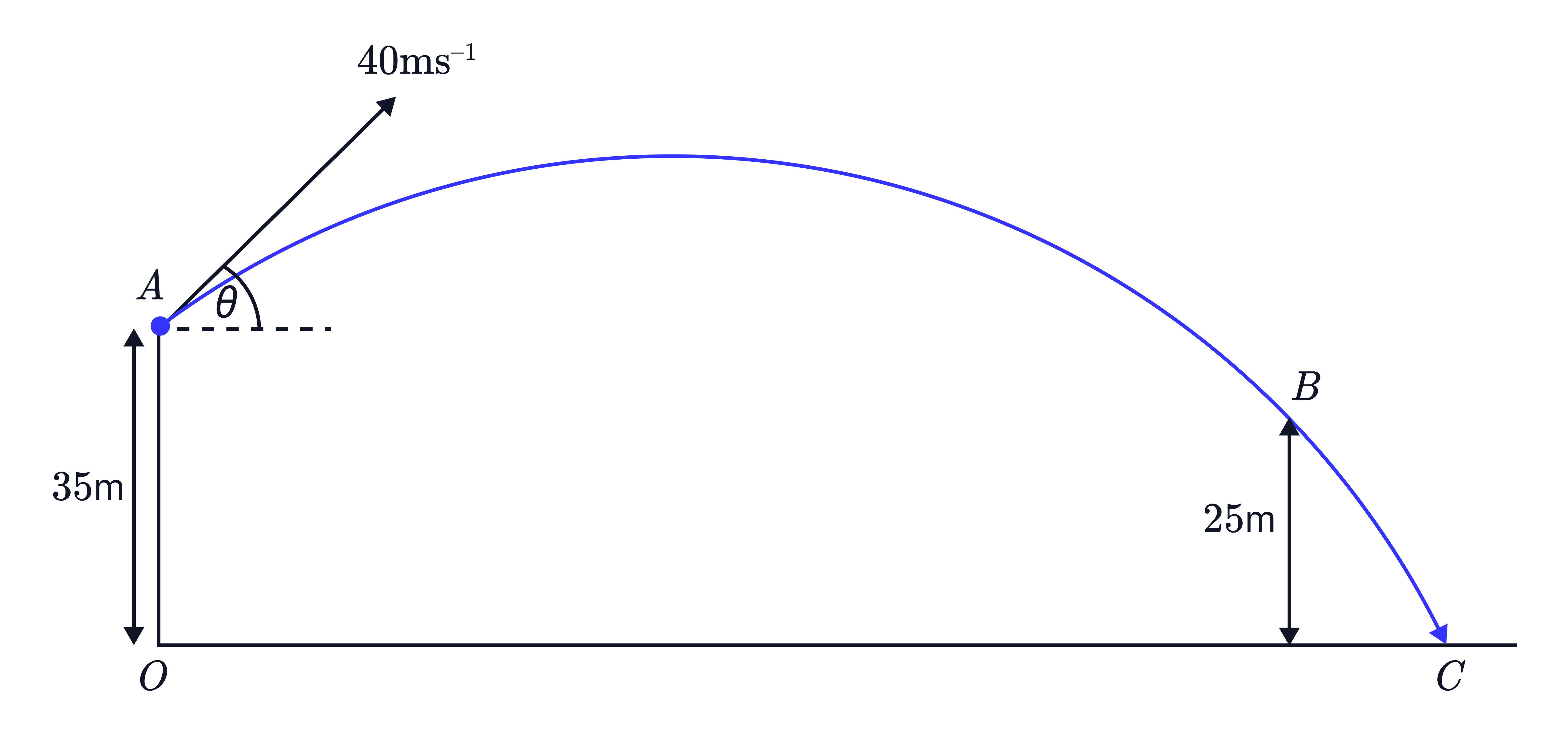
a) Find the time of flight from to .
Step 1: Resolve the vertical and horizontal components of the initial velocity.
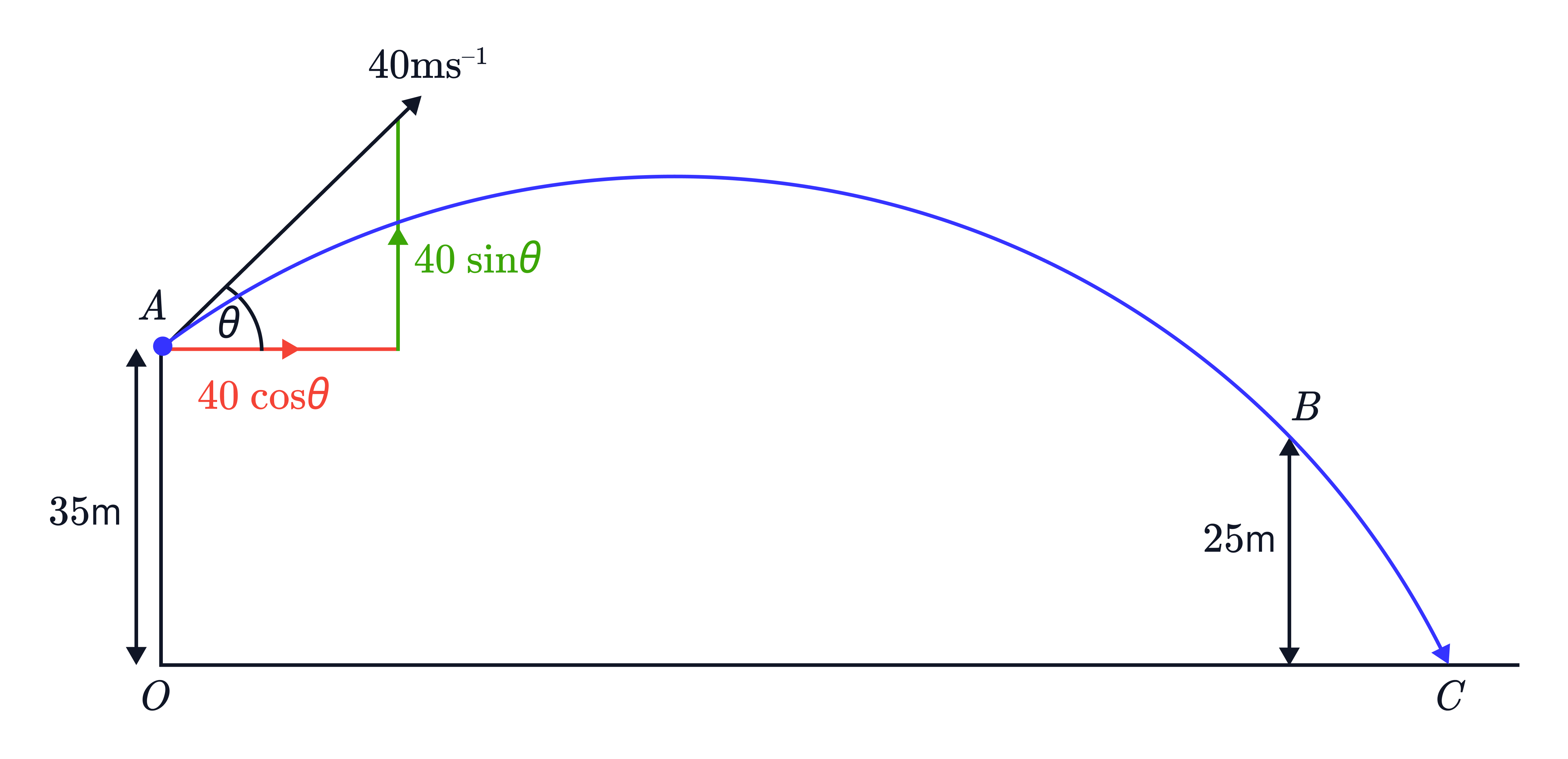
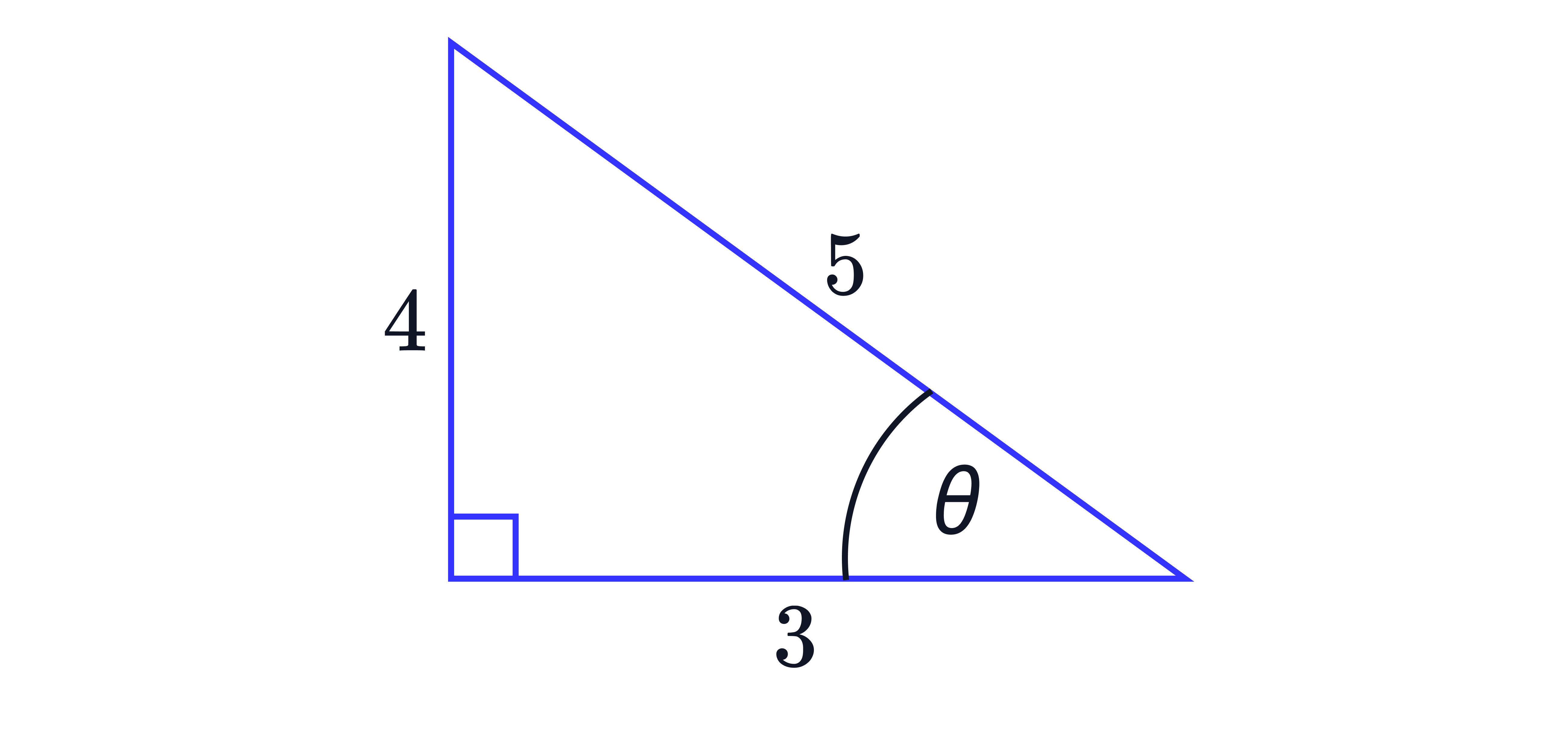
The horizontal component is and the vertical component is (the diagram below illustrates this). Then, we find and using SOHCAHTOA. The triangle helps us visualise this too.
Given we can use SOHCAHTOA and the triangle to find that and . Therefore:
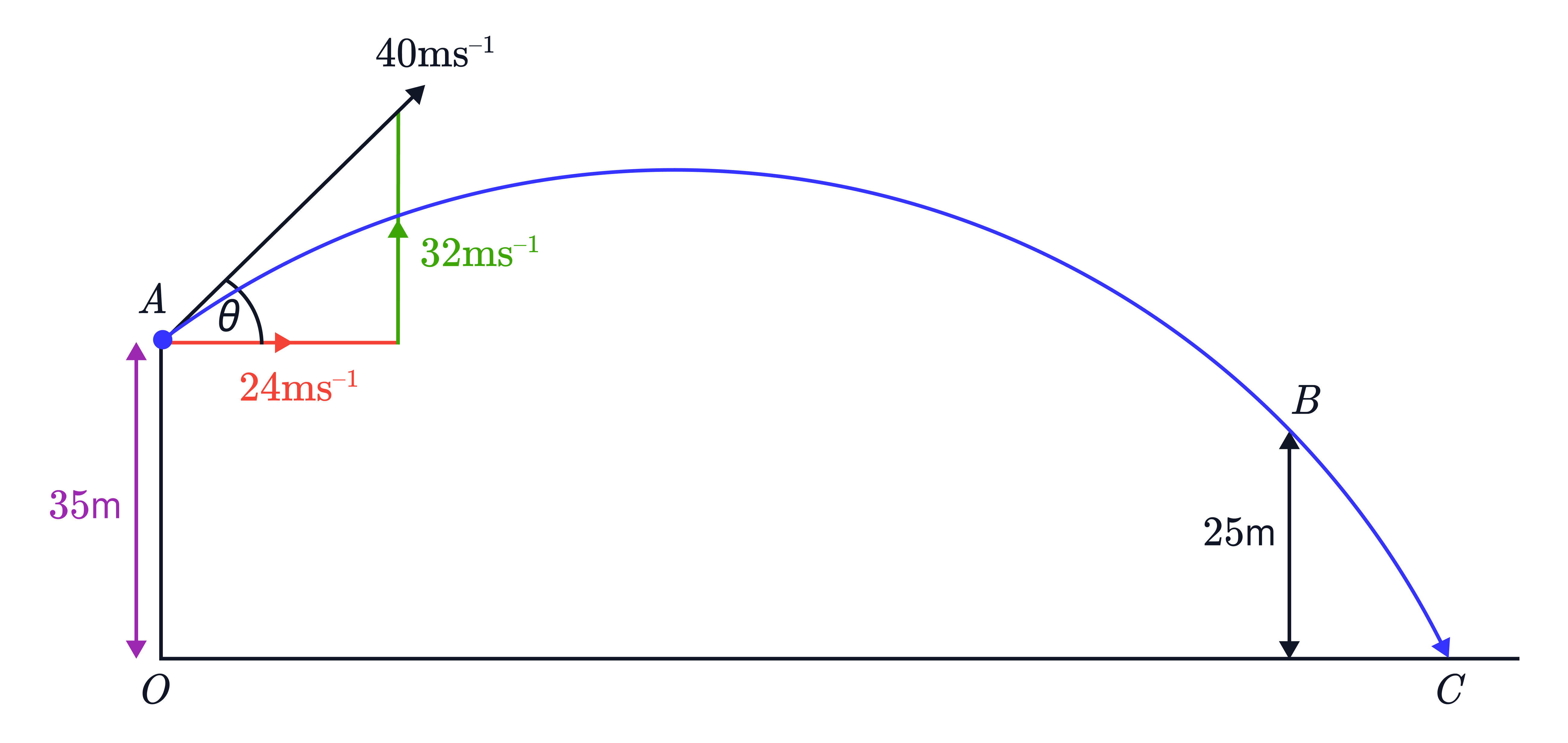
Step 2: Label the vertical and horizontal axes separately. The vertical motion is modelled by SUVAT, and the horizontal motion is modelled by Distance Speed Time.
VerticalHorizontal
Note: Since we are taking upwards to be positive, the particle is m below our point of projection, which is why we are setting the displacement here to be negative. Think of it as your point of projection is the origin of an axes and where it hits the ground has a negative
value.
Step 3: Use SUVAT to work out the value of .
Solve for using the quadratic formula.
cannot be negative so the time of flight from to is approximately seconds to two significant figures.
b) Find the distance .
Single Step: Find the horizontal distance using .
m
Use the rounded value from part a) for time, not the exact
value calculated when computing the quadratic formula.
c) Find the speed of the particle at .
The following diagram illustrates the particle’s motion at .
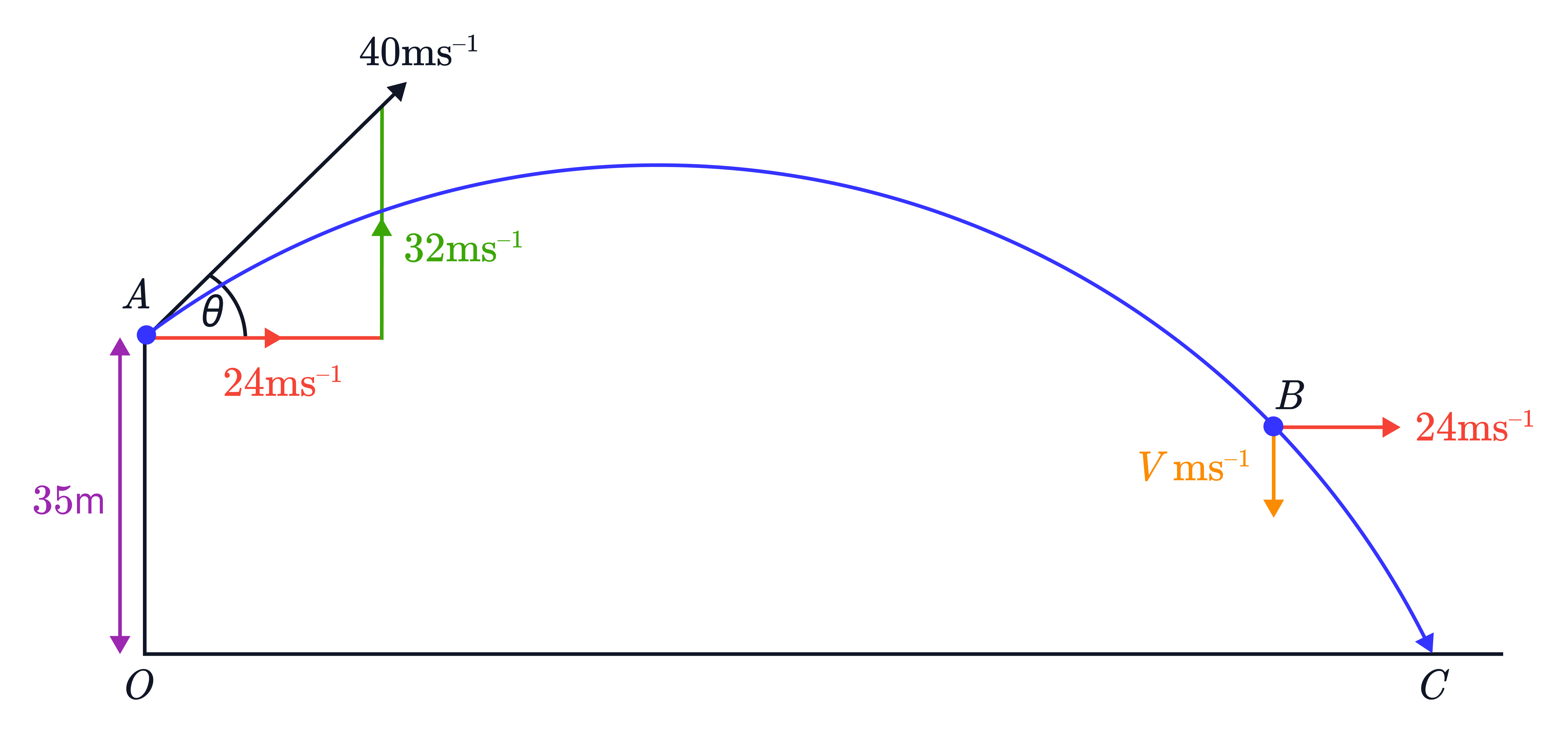
Step 1: The horizontal component of the velocity is constant at ms, so we only need to find the vertical component, denoted by , at this point. Use SUVAT.
At the particle is m above horizontal ground which is m below the point of projection so its displacement is m.
As is pointing downwards, so the velocity is ms. However, we’re looking for the speed, so the direction doesn’t matter, only the magnitude.
Step 2: To find the speed at , we use Pythagoras’ Theorem with the horizontal and vertical components of the velocity.
ms
d) Find the angle that the velocity of the particle at makes with the horizontal.
Single Step: Use SOHCAHTOA to find the angle.
The following diagram illustrates the angle that the velocity makes with the horizontal.
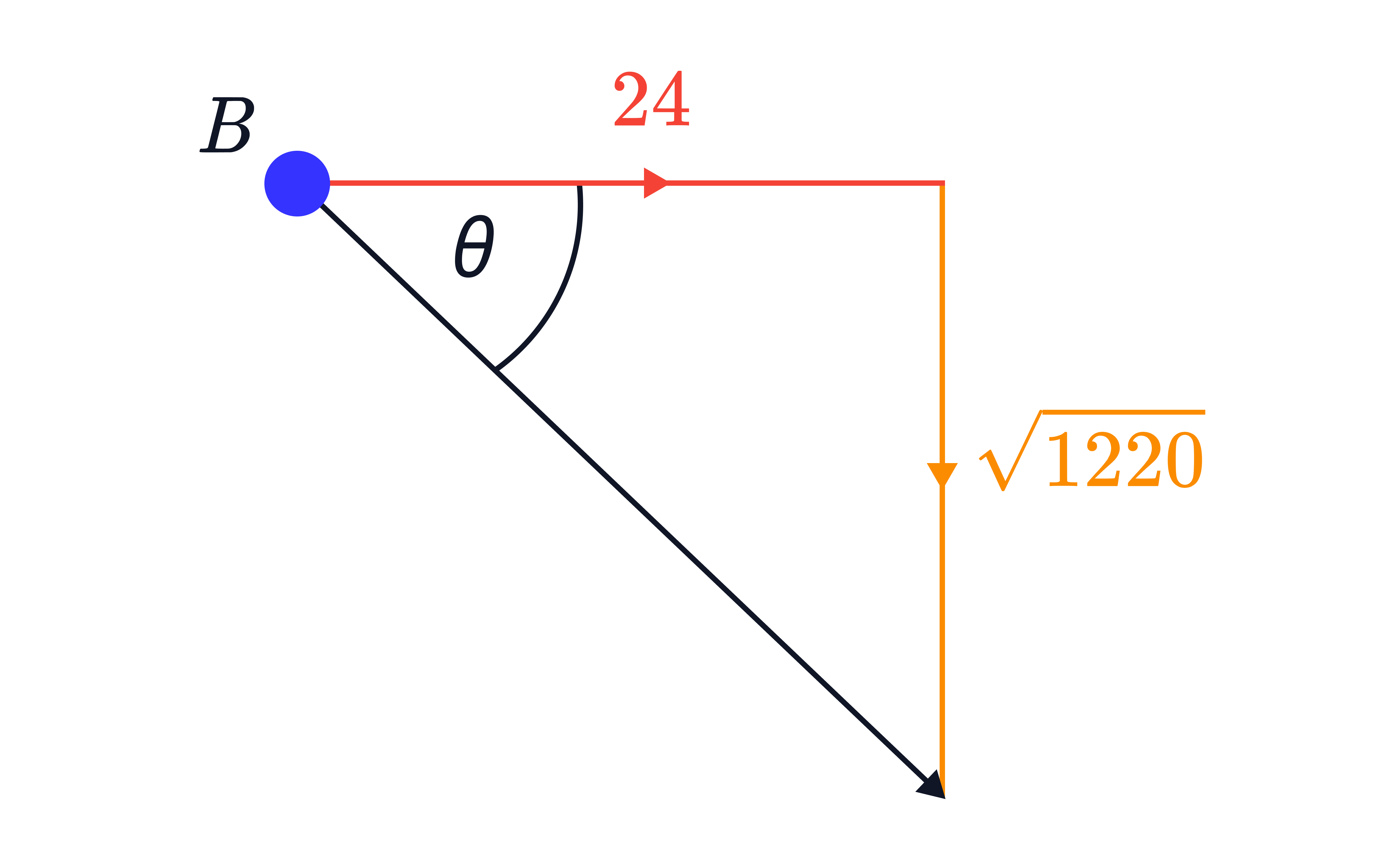
Therefore, the velocity of the particle at is in the direction of approximately below the horizontal.
No answer provided.
Challenging Question