Projectile Motion and Vectors
Neil Trivedi
Teacher

Projectile Motion and Vectors
In this note, we’ll explore projectile motion with vectors. Since displacement, velocity, and acceleration are all vector quantities (each having both magnitude and direction), they can be represented in vector form as or , where represents the horizontal component, and represents the vertical component.
The diagram below shows a general case of a projectile's motion. A particle is projected from a point , which is metres above a fixed origin , which is on level horizontal ground, with an initial velocity of ms.
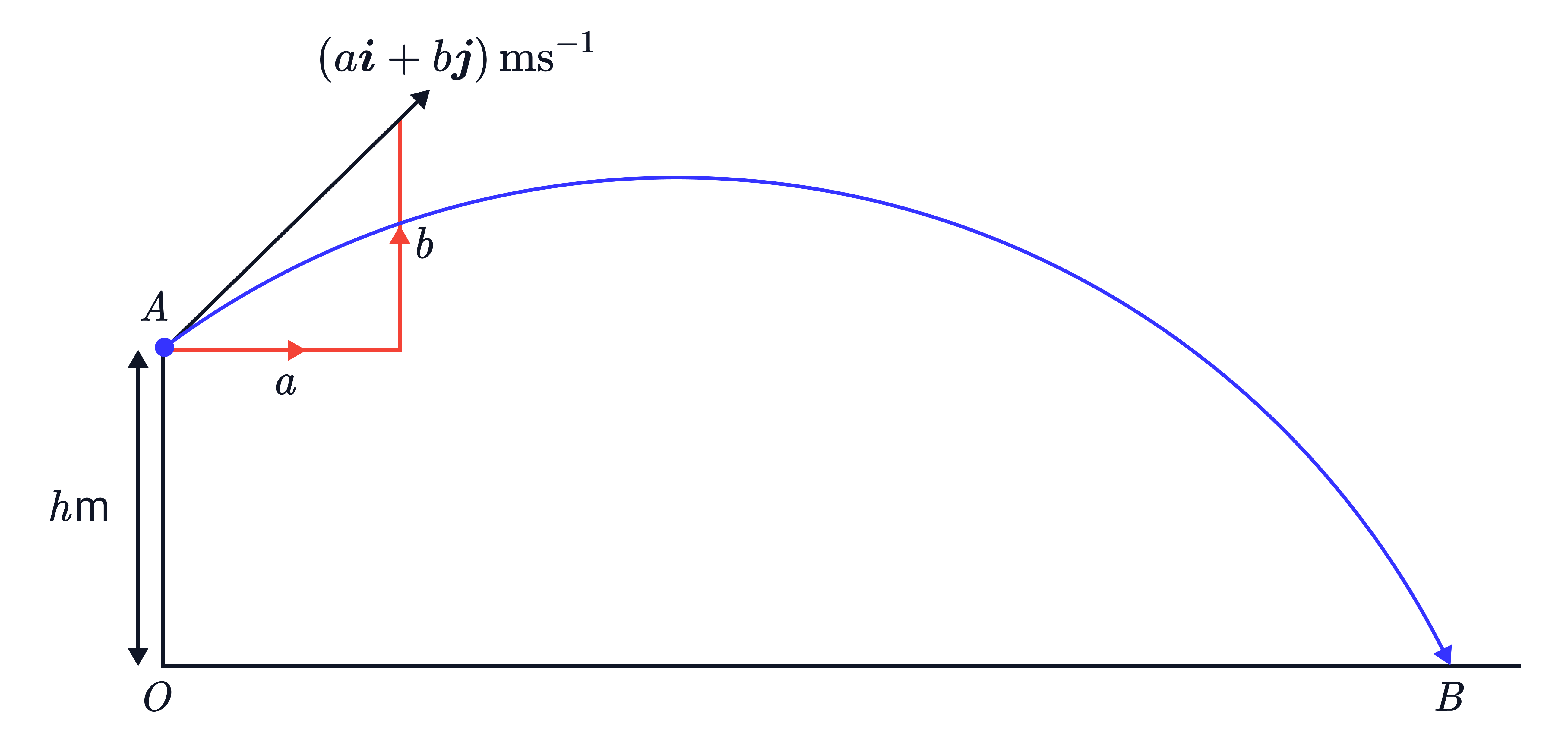
The displacement (or position), , is always measured relative to the fixed origin . In this example, the particle’s initial position is metres above , so its initial position vector is
m
When finding the new vertical component of displacement during motion, we must therefore include this initial height in addition to the displacement obtained from the SUVAT equations.
Vertical Axis
• For vertical motion, the particle moves under the influence of gravity. Since the direction of projection is usually above the horizontal, we take upwards as positive. Therefore, acceleration due to gravity is taken as negative: ms.
• We model the particle’s vertical motion using the SUVAT equations.
Horizontal Axis
• For horizontal motion, we ignore any external forces such as air resistance and rotational forces. Using Newton’s second law, , and noting that there are no external horizontal forces, we have (the mass cannot be ). This means that the horizontal velocity remains constant because the horizontal acceleration is .
• We model the particle’s horizontal motion using , where is the distance, is the constant speed, and is the time.
Example:
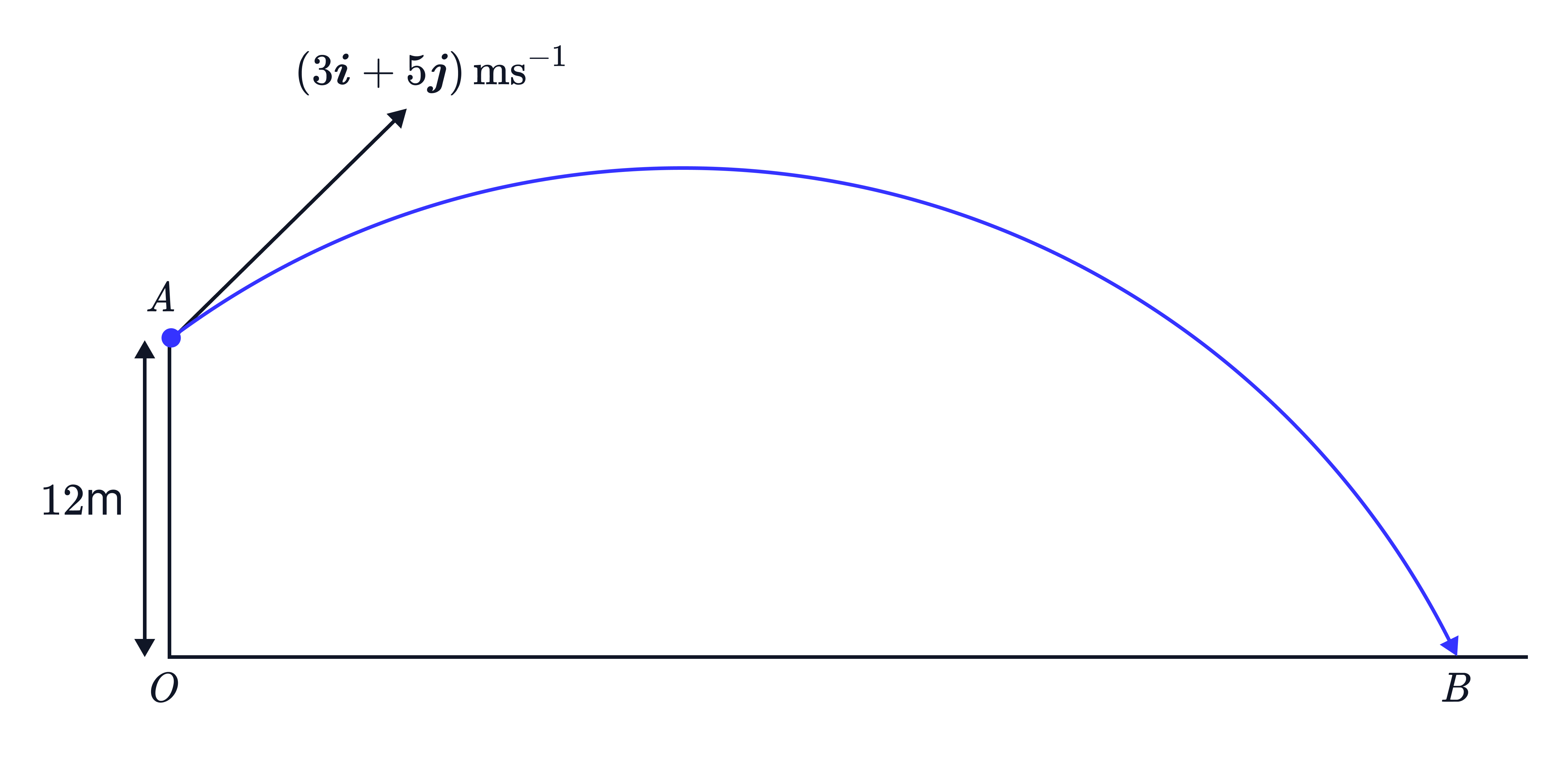
At time , a particle is projected from , which has position vector metres with
respect to a fixed origin on horizontal ground. The velocity of projection of the particle is ms. The particle moves freely under gravity and reaches the ground at after seconds.
a) For , show that, with respect to , the position vector, m, of at time seconds is given by
m
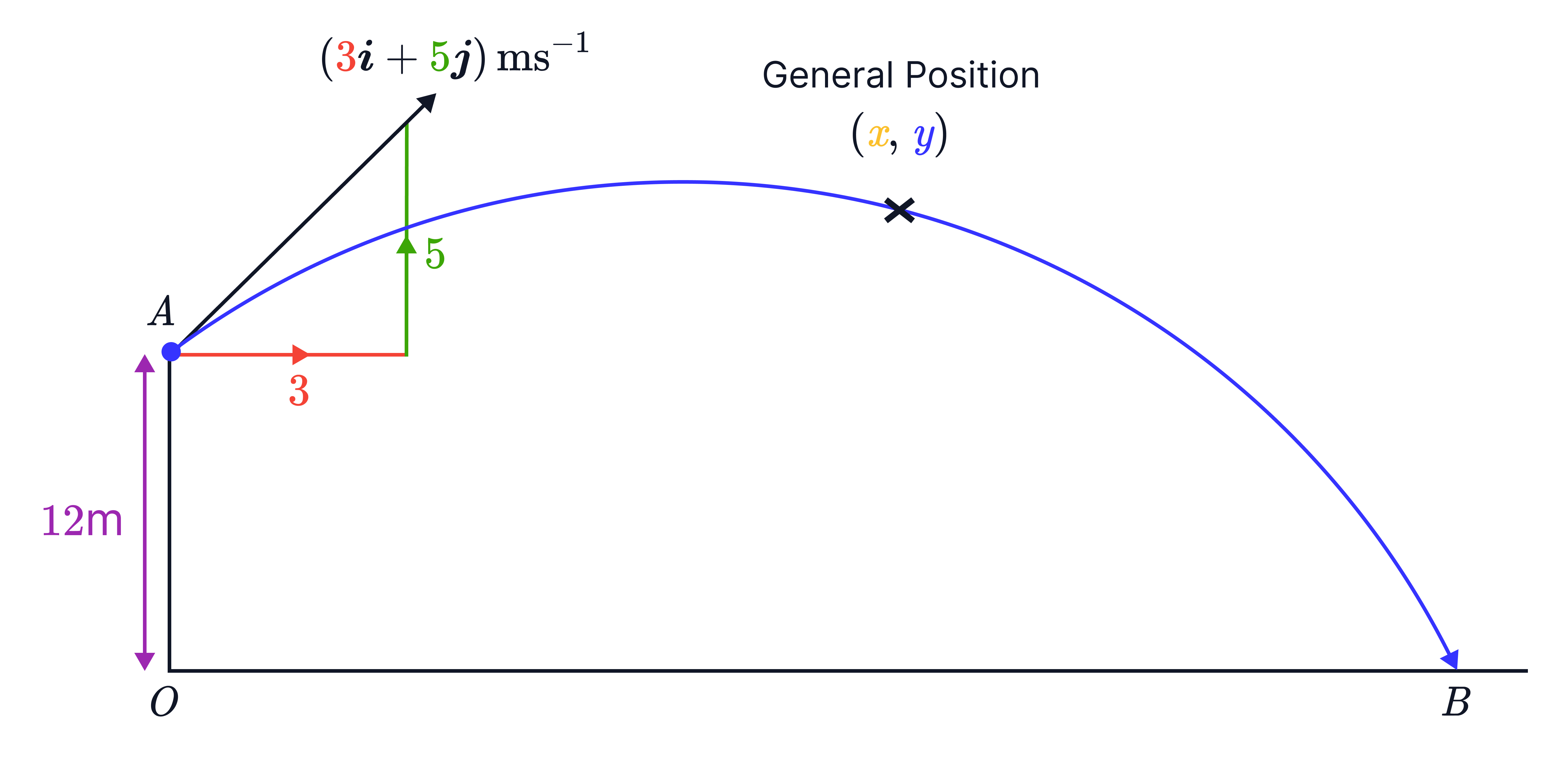
Step 1: Resolve the vertical and horizontal components of the initial velocity.
We see from the velocity vector that the horizontal component is ms while the vertical component is ms. The annotated diagram below illustrates these components.
Step 2: Label the horizontal and vertical axes separately.
VerticalHorizontal
Note: Time is what will always connect
the vertical and horizontal components
as time is dimensionless.
Step 3: Find a formula for the position vector (i.e. the displacement).
We now need to find expressions for the horizontal and vertical components of the position vector separately.
Firstly, work out the horizontal component using .
Now, use SUVAT to work out the vertical displacement relative to .
Then, we adjust it so that we have the vertical displacement relative to by including the initial height of m.
Hence, the position vector with respect to the origin is m.
b) Find the value of .
Single Step: Find the time when the particle hits the ground using the quadratic formula.
To note, when the particle hits the ground, the vertical component of the position at this instant is .
Using the quadratic formula to find ,
s sf
c) Find the velocity of the particle at time seconds.
Single Step: Find the horizontal and vertical components of the velocity separately.
We know that the horizontal component of the velocity remains constant at ms. So, we only need to find the vertical component using SUVAT.
ms
When the particle is at the point , the direction of motion of the particle is below the horizontal.
d) Find the time taken for the particle to move from to .
Single Step: Find the value of .
As before, the horizontal component of the velocity is constant, so it remains at ms.
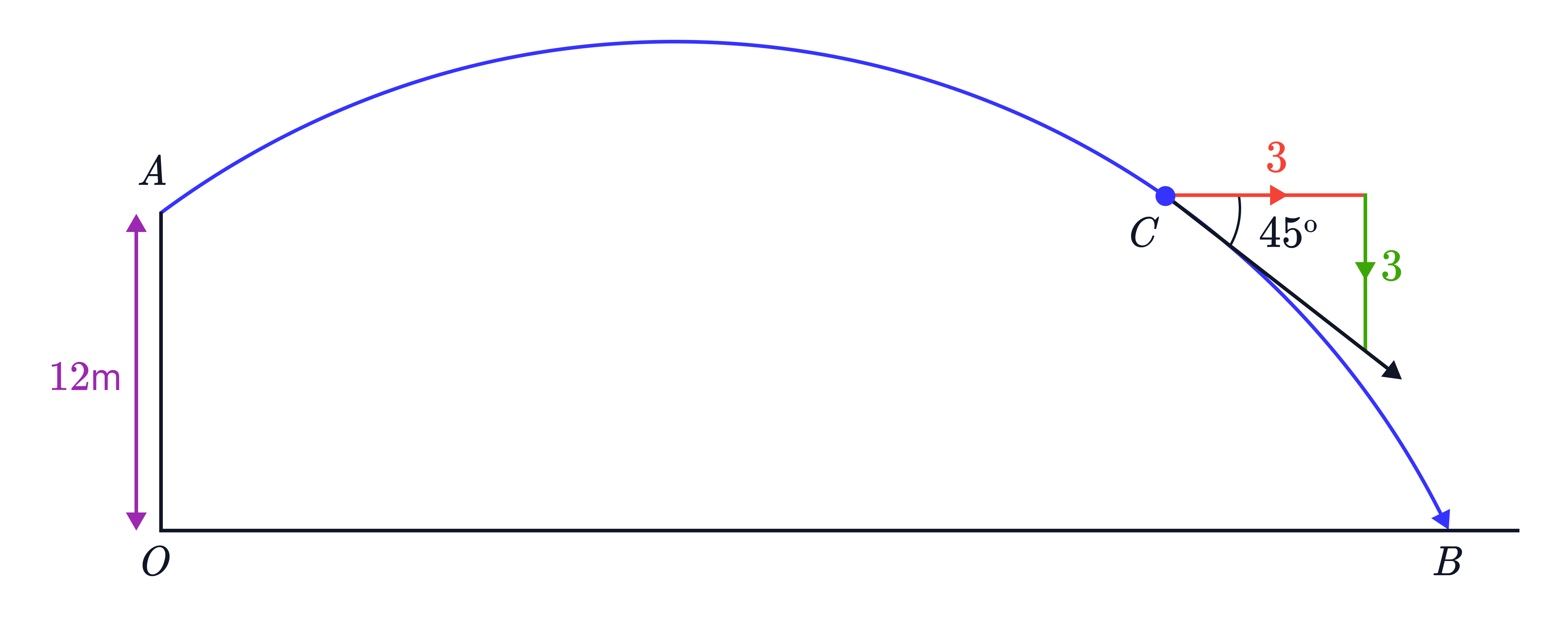
From the diagram, since the direction of motion is below the horizontal, we have an isosceles right-angled triangle, meaning the vertical and horizontal components must be equal. Because the particle is moving downwards, the vertical velocity is ms.
Substitute into the equation .
s sf
e) Find the speed of as it passes through .
Single Step: Use Pythagoras’ Theorem with the horizontal and vertical components of the velocity to find the magnitude of the speed.
ms
No answer provided.
Challenging Question