Hypothesis Testing on the Normal Distribution
Neil Trivedi
Teacher

Hypothesis Testing on the Mean
If we have a population with mean and variance , and we take a sample of sample size from that population, the sampling mean will also be , but the variance will be .
So, if we have a random variable then the underlying distribution of sample means also follows a normal distribution such that .
The reasons as to why the mean remains the same and the variance decreases by a scale factor of are explored in our main course lessons. However, the theory is not examined in A-Level Mathematics.
Example 1:
Test results are normally distributed with a mean of and standard deviation . After the introduction of a new Maths teacher, the results for a group of students had a mean of .
Is there evidence that the results have improved? Test at a level of significance.
Step 1: Set up the hypothesis.
Let denote the mean of the test results. We have
It is a one-tailed test testing whether there is evidence that the results have improved, so
Step 2: Set up a sampling distribution.
Let denote the sampling distribution of the mean of the test results.
Remember we divide the variance by the sample size.
Step 3: Find the critical region.
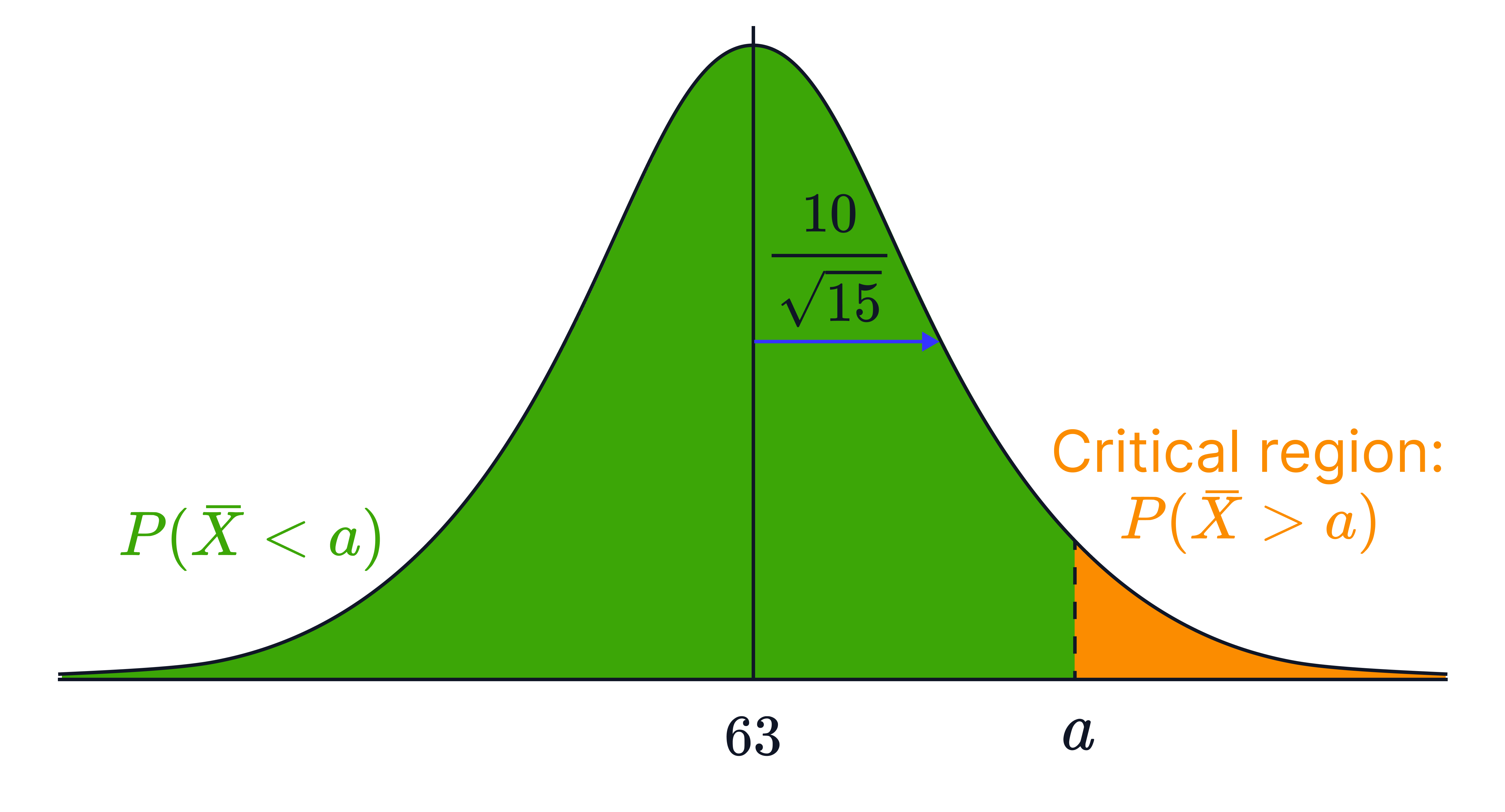
Our critical region is the region such that .
To find a using the inverse normal distribution function on the calculator, we must convert our probability to a cumulative probability, meaning . Remember the area under the curve is .
We input the area to be , to be and to be , remember sigma is the root of the varience so , which gives
So, our critical region is
Step 4: Draw conclusions by comparing our results
We do not reject . There is insufficient evidence to suggest that the results have improved.
No answer provided.
Example 2:
A factory produces bottles of olive oil. The volume of oil in each bottle is normally distributed with a claimed mean of ml and a standard deviation of ml. A random sample of bottles is taken to check whether the mean volume has changed from ml. Using a significance level, determine the critical region for this test, clearly stating your hypotheses.
Step 1: Set up the hypothesis.
Let denote the volume of each bottle. We have
It is a two-tailed test, so
Step 2: Set up a sampling distribution.
Let denote the sampling distribution of the volume of each bottle.
Remember we divide the variance by the sample size.
Step 3: Find the critical region.
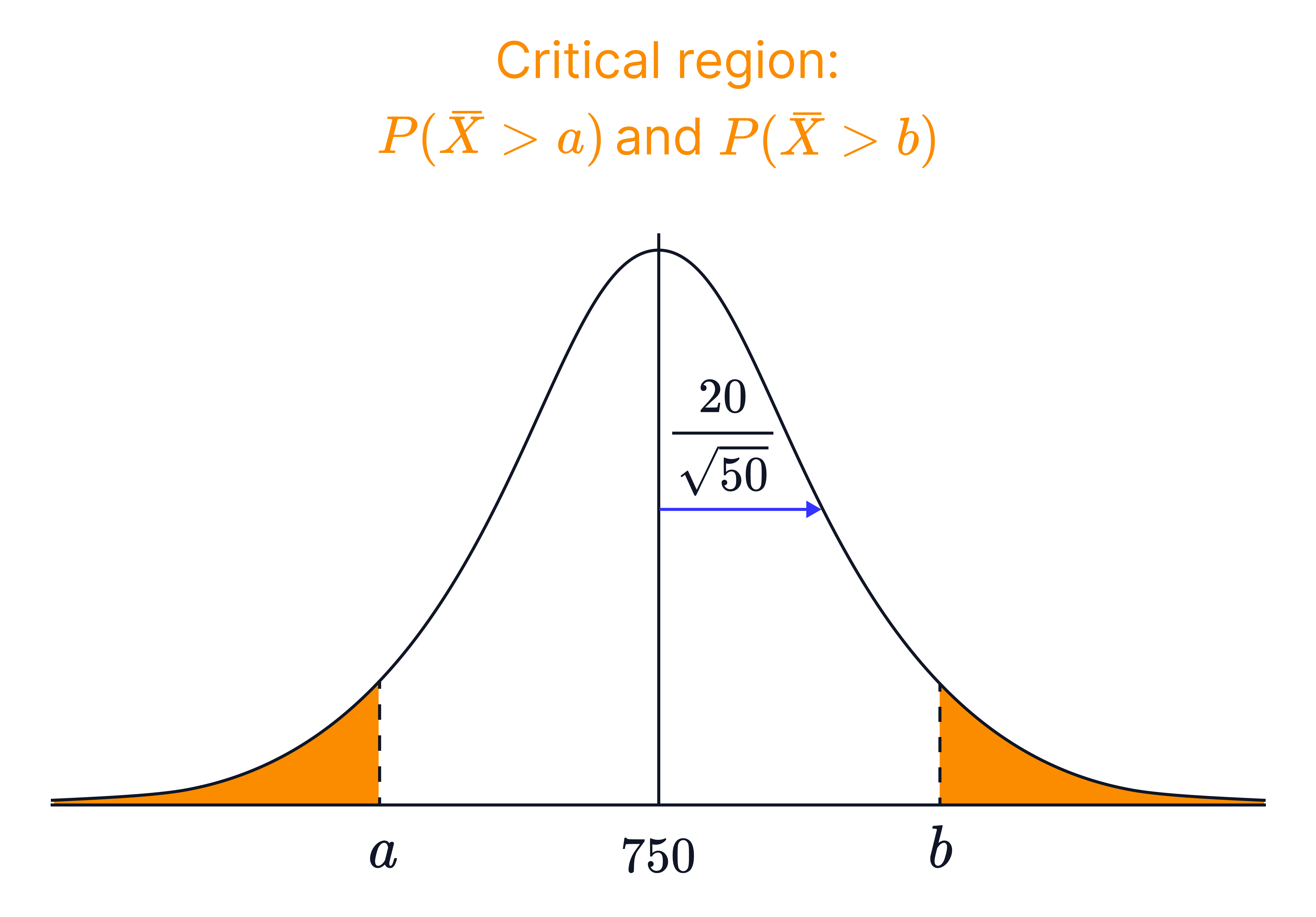
Since this is a two-tailed test at the significance level, each tail has an area of . Therefore, our critical region is the region and , such that and .
To find using the inverse normal distribution function on the calculator, we must convert our probability to a cumulative probability, meaning . Remember the area under the curve is .
To find using inverse normal distribution function on the calculator, we convert the equation to
We input area to be and , to be and to be , remember sigma is the root of the varience so , we get and
So, our critical region is to significant figures.
No answer provided.
Challenging Question