Inflection Points and Concavity
Neil Trivedi
Teacher

Inflection Points and Concavity
represents the gradient of the function . In other words, it tells us the rate at which the
values are changing for different values of .
Similarly, tells us how is changing. It tells us the rate at which the gradients are changing for different values of .
So, tells us whether the function is curving upwards or downwards (i.e. its concavity). Here are some graphs showing this idea. We draw tangents at various points along the curve to show how the gradient changes along the curve.
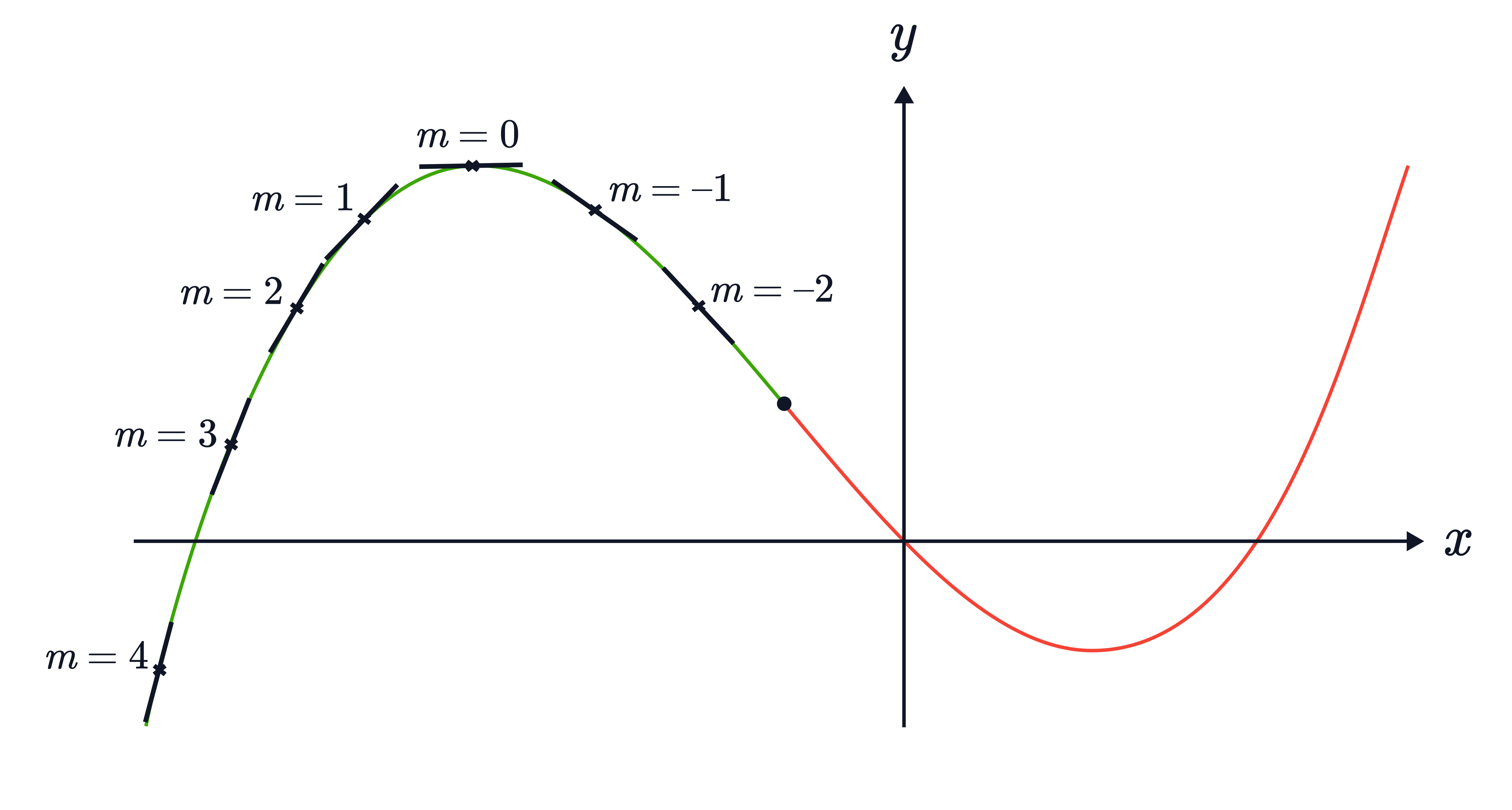
For the green region of the graph, notice how the gradients are getting smaller. This means that the rate of change of the gradients is negative or that . This is the concave part of the function.
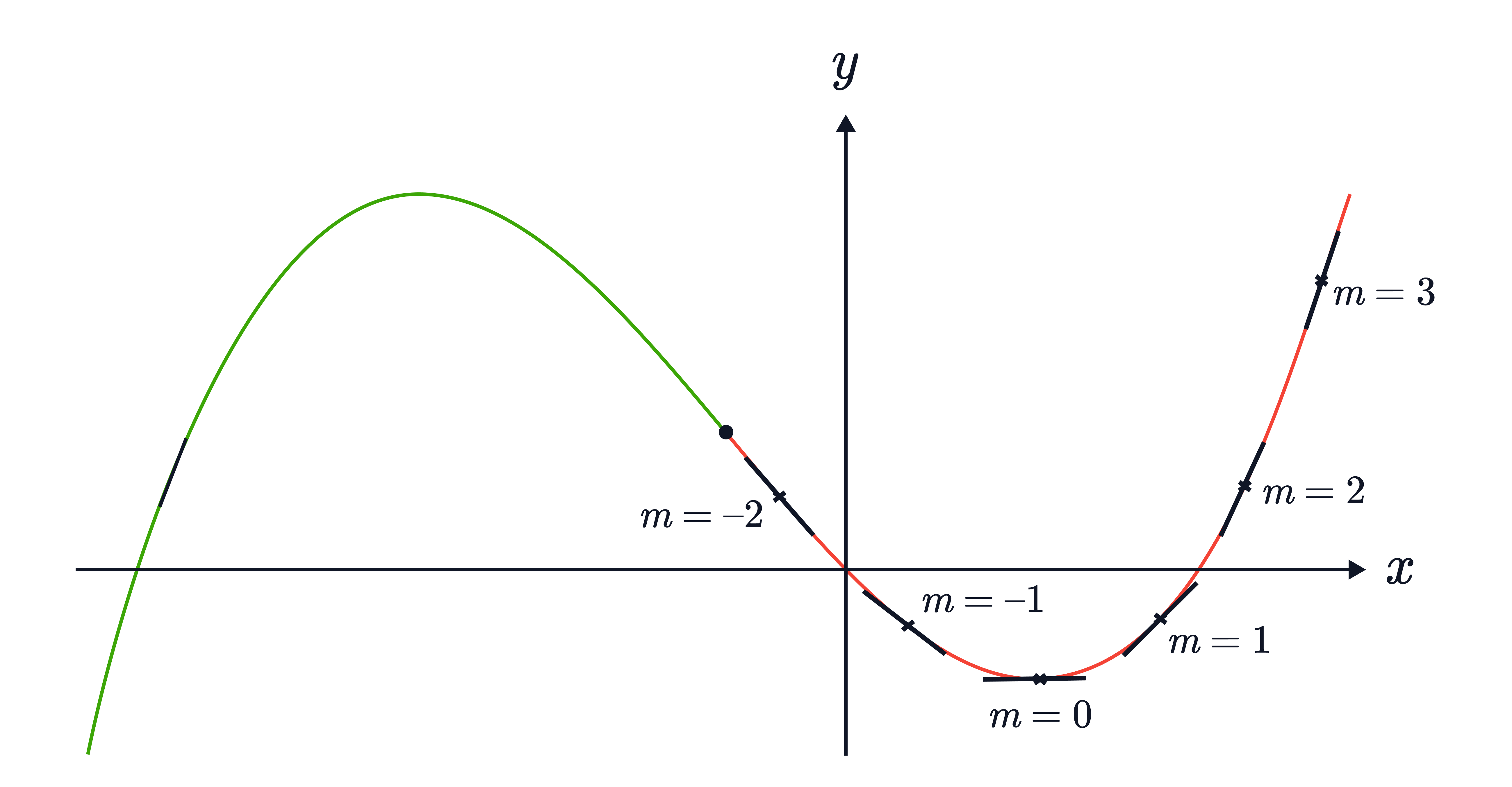
For the red region of the graph, notice how the gradients are getting larger. This means that the rate of change of the gradients is positive or that . This is the convex part of the function.
A change in concavity occurs when changes from positive to negative or vice versa, which means we have a point where . This is known as our inflection point.
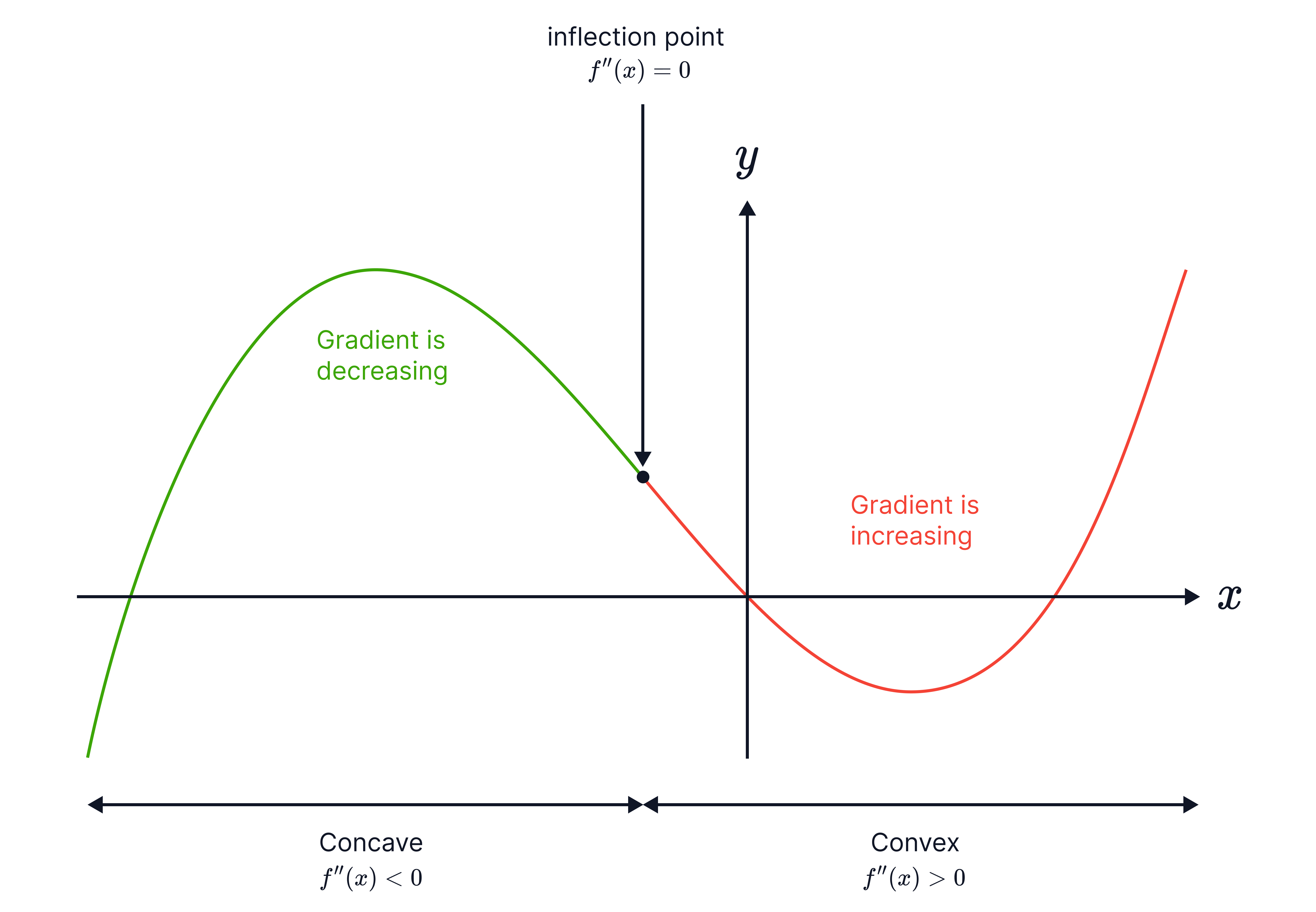
• A function is concave if .
• A function is convex if .
• At an inflection point, .
• To prove a point is an inflection point, we must first set to find the coordinate. Then, we must check on either side of to see if there is a change in sign.
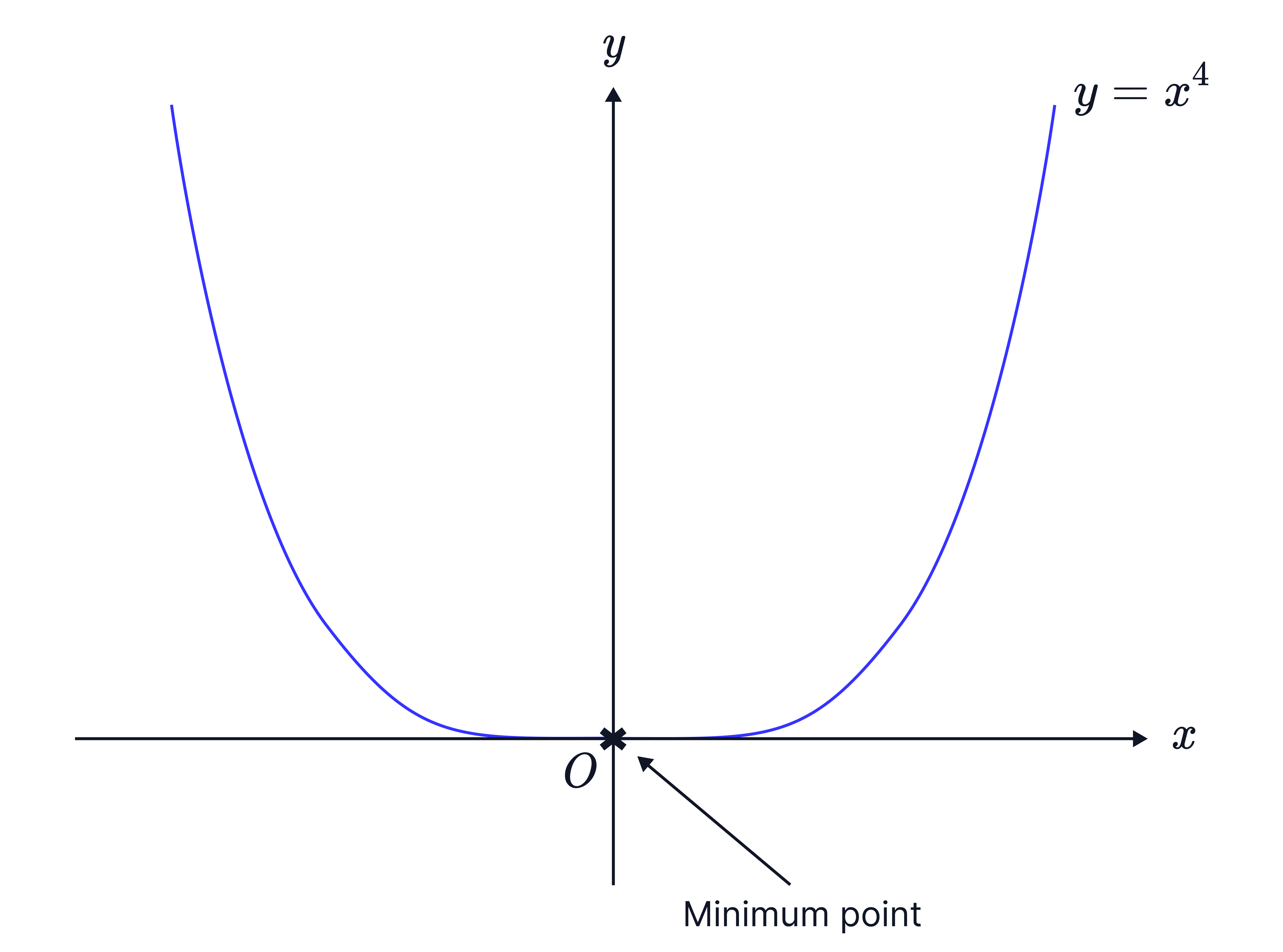
Important: All inflection points satisfy , but the reverse is not always true. If , it is not necessarily an inflection point. An example of a curve where this is true is whereby at
, , but it is actually the minimum point of the graph. Here’s the graph of to show this.
Example 1:
Find the interval on which the function is concave.
Step 1: Differentiate the function twice to get .
Step 2: Find the interval where .
Therefore, is concave when .
No answer provided.
Example 2:
The curve has equation .
Find the coordinates of the point of inflection and verify it is an inflection point.
Step 1: Differentiate the equation twice to find the point of inflection.
Setting ,
Substituting into to find the coordinate,
Step 2: Check on either side of and show that there is a change in sign.
We pick and
So, the function is convex when .
So, the function is concave when .
There is a change in concavity, going from concave to convex, so is an inflection point.
No answer provided.
Challenging Question