Related Rates of Change
Neil Trivedi
Teacher

Related Rates of Change
At A-Level, related rates of change are problems where two or more quantities are linked by an equation, and you are asked to find the rate of change of one quantity with respect to time given the rate of change of another. A typical exam question is to find the rate of leakage of water in a container.
In a related rate of change question, you will be:
• Given the rate of change of one variable
• Asked to find the rate of change of another variable
• You will then be required to form a relationship between the two independent variables of what you were given and what you were asked to find
To find this relationship between the two independent variables, we will use the chain rule. The same chain rule formula from when we started differentiating power functions in an earlier section.
You may have seen NeilDoesMaths refer to this as:
want got need
Example 1:
The variables and are related by the equation .
Given that is increasing at the rate of units per second when , find the rate at which is increasing at this instant.
Step 1: Identify the components we want, got, and need.
Want: the rate at which is increasing.
Got: the rate at which is increasing.
want got need
need
To find the "need" we have to balance the right side which can only be done with .
Step 2: Find by applying the product rule.
First, can be rewritten as . This is a power function. The angle is what’s inside the bracket, which is in this case. The angle differentiates to . Then, for the power function, we bring down the power, knock off the power, then the angle inside stays the same.
Angle stays the same
Differentiated angleDifferentiated power function
So, using the product rule,
Step 3: Find the value of when .
Step 4: Substitute the values we obtained to find .
want got need
Therefore, the rate of increase of is units per second.
No answer provided.
Example 2:
The volume of a cube is decreasing at a constant rate of cms.
a) Find the rate at which the length of one side of the cube is decreasing when the volume is cm, giving your answer to significant figures.
Step 1: Identify the components we want, got, and need.
Want: the rate at which is increasing.
Got: the rate at which the volume is increasing (by a negative value i.e. decreasing).
want got need
Step 2: Find when .
We did not get given an equation so we must construct one ourselves.
The question is asking about the volume of a cube. The formula for the volume of a cube may be given by , where we let the side length be .
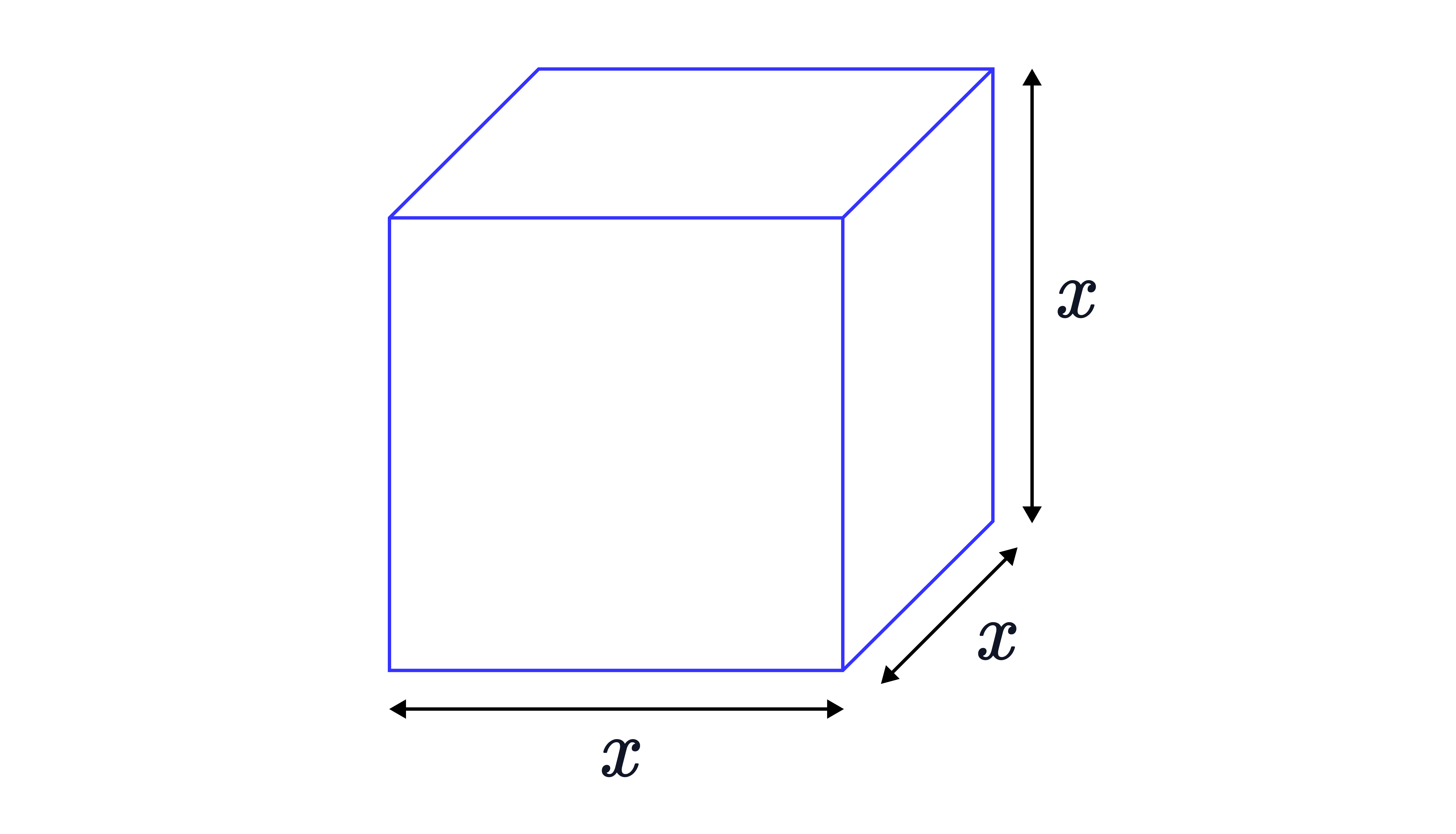
Differentiating with respect to gives
To find , we reciprocate , giving
When , .
So,
Step 3: Substitute the values we obtained to find .
want got need
Reminder: In general, means the rate of increase of . When it’s negative, then it signifies that is instead decreasing.
Therefore, the rate at which the length of one side of the cube is decreasing is approximately cms, correct to significant figures.
b) Find the volume of the cube when the length of one side is decreasing at the rate of
mms.
Step 1: Find the side length when one side is decreasing at the rate of mms.
We rewrite in the correct unit to start with. We know that to convert from mm to cm, we divide by .
mms cms
Multiplying both sides by ,
Dividing both sides by ,
Step 2: Find the volume when .
cm
No answer provided.
Example 3:
The variables , , and are related by the equations:
and,
Find the value of , when .
Leave your answer correct to significant figures.
Step 1: Identify the components we want, got, and need.
Want: the rate at which is increasing.
Got: the rate at which is increasing.
want got need
This is a unique question in that they haven't given us a rate of change, but instead two equations in three variables.
Therefore, we need to find both and .
Step 2: Differentiate both the equation with respect to and the equation with respect to to get and , respectively.
is a power function and can be rewritten as . The angle is what’s inside the bracket, which is in this case. The angle differentiates to . Then, for the power function, we bring down the power, knock off the power, and then the angle inside stays the same.
Angle stays the same
Differentiated angleDifferentiated power function
is an exponential function. The angle is what’s in the power, which is in this case. The angle differentiates to . Then, the function of stays the same in differentiation as well as its power. The is a multiplier so we can write that down first.
MultiplierAngle stays the same
Differentiated angle
Step 3: Find and when .
Notice how the question gives us , but our formula is in terms of . We substitute into our equation to find the value of .
When ,
We have , so we substitute that into .
Step 4: Find when .
Step 5: Substitute the values we obtained to find .
want got need
To significant figures, .
No answer provided.
Challenging Question