Integration by Parts
Neil Trivedi
Teacher

General Rule
Just as the Product Rule was used to differentiate the product of two expressions, we can often use ‘Integration by Parts’ to integrate a product. Integration by parts doesn't directly find the integral, it re-writes the problem to give us an integral that hopefully we can integrate fully.
Here is the general rule:
(Leave term) (Integrate term) (Differentiate term) (Integrate term)
Note: You may have seen NeilDoesMaths use LIDI to help you remember the order. We will use that analogy to answer questions in this study note.
The most important bracket in this process is D since we are usually differentiating the term that is preventing us from computing the integral. Notice also that the second and fourth bracket are exactly the same.
Where does this rule come from?
As stated in the first paragraph, it has connections with the product rule and is in fact just a rearranged version. Let's see how:
by the product rule.
Rearrange for
Then integrate each term.
Then the integral in cancels the differential which leaves us with
Which is the parts formula! Cool right?
Example 1:
Use integration by parts to find:
Step 1: Use integration by parts to find the integral.
We pick to be the first term and to be the second term.
The derivative of is and the integral of is . So,
Step 2: Simplify the expression.
No answer provided.
Example 2:
Use integration by parts to find, with respect to , the integral of .
Single Step: Use integration by parts to find the integral.
We pick to be the first term and to be the second term.
The derivative of is and the integral of is using the reverse chain rule.
Sometimes examiners will want you to factorise your expression completely. Let's go through the process:
First write each fraction so the denominators are the same.
Factorise and . Remember we always factorise the smallest power in algebra then subtract the powers.
No answer provided.
Cyclic Integrals
Sometimes integrals just keep going round in circles, we will address what to do in those situations here.
Example 3:
Find the integral of the following function, with respect to :
Step 1: Use integration by parts.
We pick to be the first term and to be the second term.
The integral of is . The derivative of is .
Step 2: Integrate using integration by parts again.
Again, we pick to be the first term and this time, we pick to be the second term.
The integral of is . The derivative of is .
Step 3: Substitute back into equation .
Here we see that there is a on both sides. If we keep on using integration by parts we are going round the loop from step 1 to 3 again and again, which is why these integrals are called cyclic integrals.
Instead of using integration, we can solve the problem much easier by simply rearranging the equation.
Step 4: Rearranging the equation.
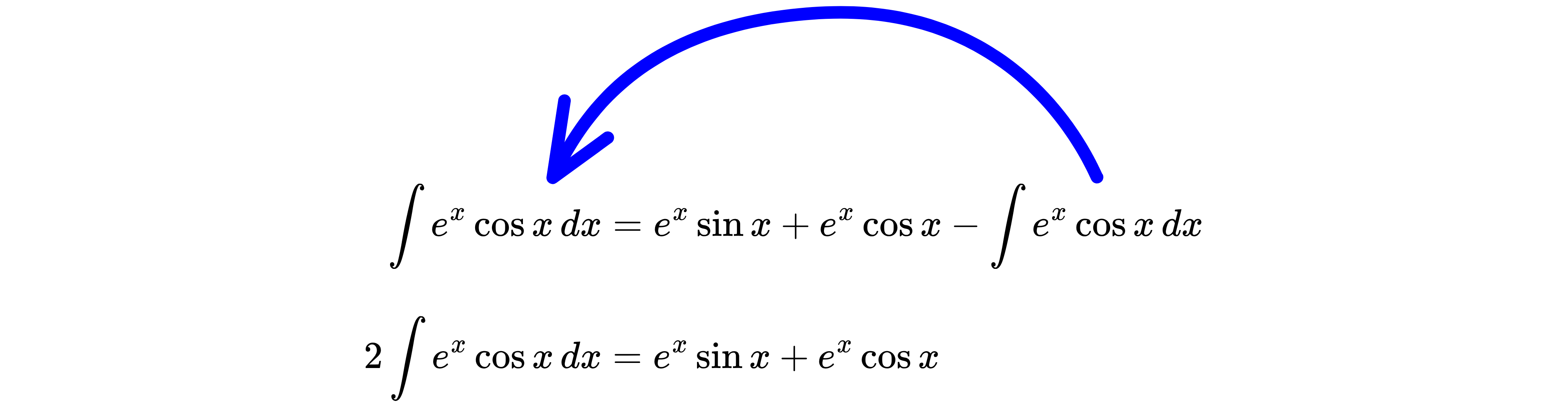
Divide both sides by two and factorise . Don’t forget to add the at the end as we are working on indefinite integrals.
This is a good example as to why we do not teach LIATE or ILATE as it isn't applicable to this question and many many others. However, using it as a general guide is okay.
No answer provided.
Natural Logarithms
Integrating functions involving require an extra layer of understanding.
Example 4:
Use integration by parts to find, with respect to , the integral of the following:
a)
Step 1: Notice that if we leave , we will have to integrate however we do not have a direct result for the integral of through reverse chain rule. We can simply swap the terms around. This will always happen when integrating functions involving .
differentiates to and integrates to .
Step 2: Simplify and apply general rules of integration.
b)
Step 1: In part a we said that has no direct integral through reverse chain rule, however you are expected to know how to integrate it.
It looks like there is only one term here, but there is also an invisible as the coefficient of , which we can include so we can apply parts. Then, like before, we need to be our first term so we just switch it with the .
Step 2: Apply integration by parts.
No answer provided.
Challenging Question