Introduction to Moments
Neil Trivedi
Teacher

Introduction to Moments
A moment tells us how a rigid body is rotating around a given point. A rigid body is an object that does not deform or change shape when acted upon by external forces. When describing a moment, we specify whether the body is rotating clockwise or anti-clockwise, and name them the clockwise and anti-clockwise moment, respectively. The units for moments are Newton metres (Nm).
Moment of Force Force Perpendicular Distance
The perpendicular distance is the shortest distance from a point to the force.
Here are some general examples where we will take moments about .
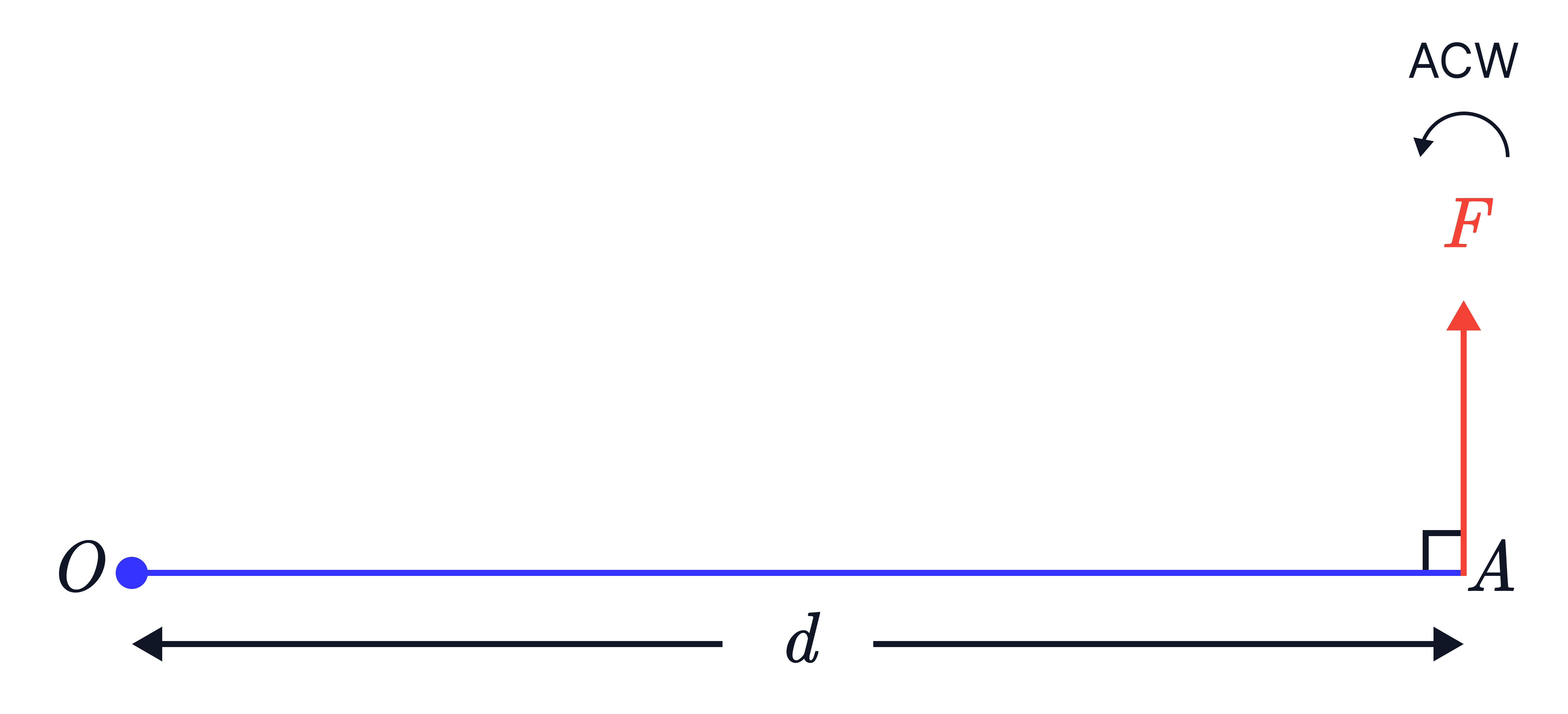
Here, the rod will rotate anti-clockwise about . The force is and the perpendicular distance is , so the moment about is .
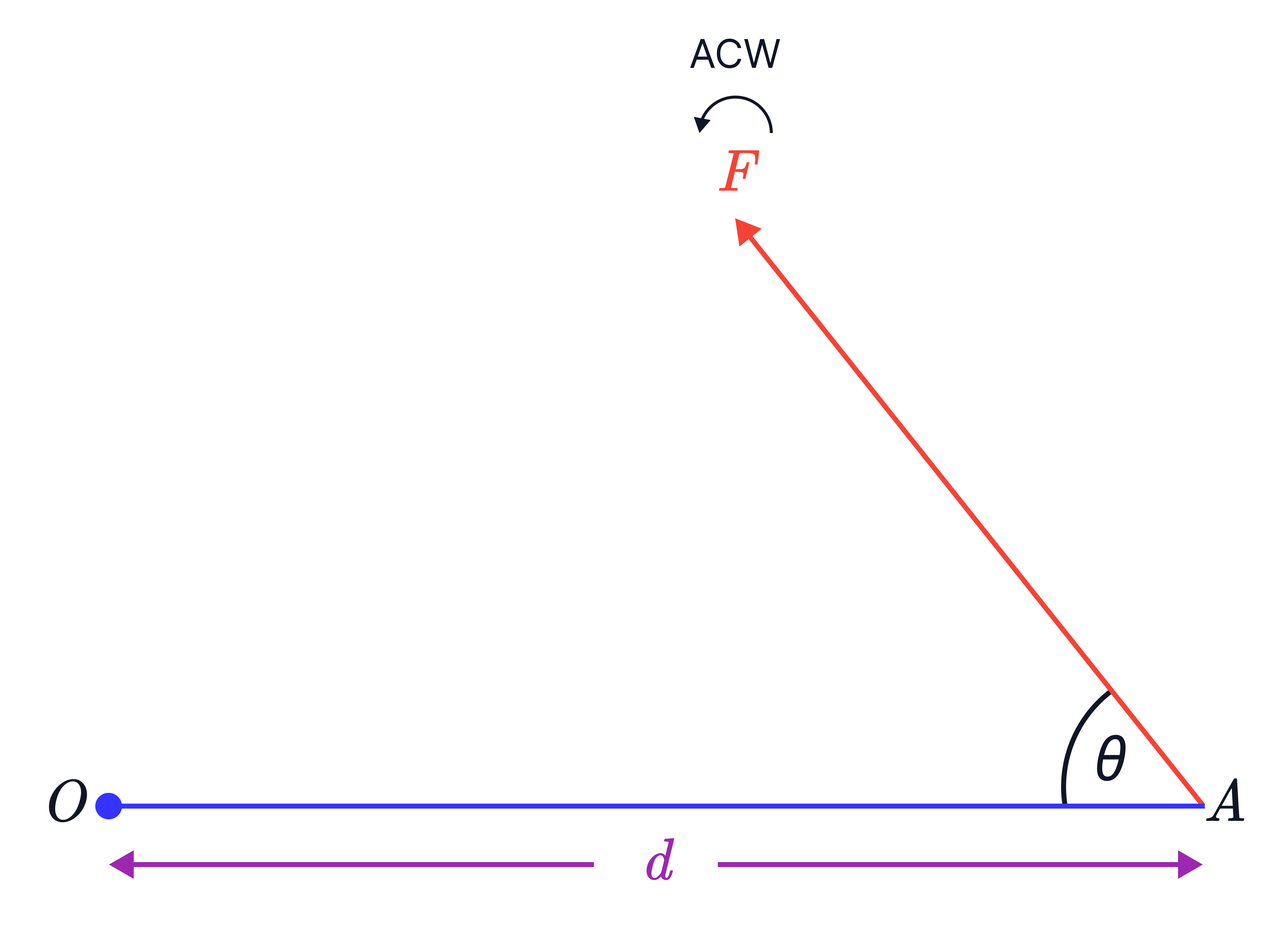
Here, the rod will still rotate anti-clockwise about . However, is not acting perpendicularly to the rod, meaning the shortest distance from the pivot to the force is no longer . We draw a new line, in green, that shows the perpendicular distance and we will use SOHCAHTOA to find its distance.
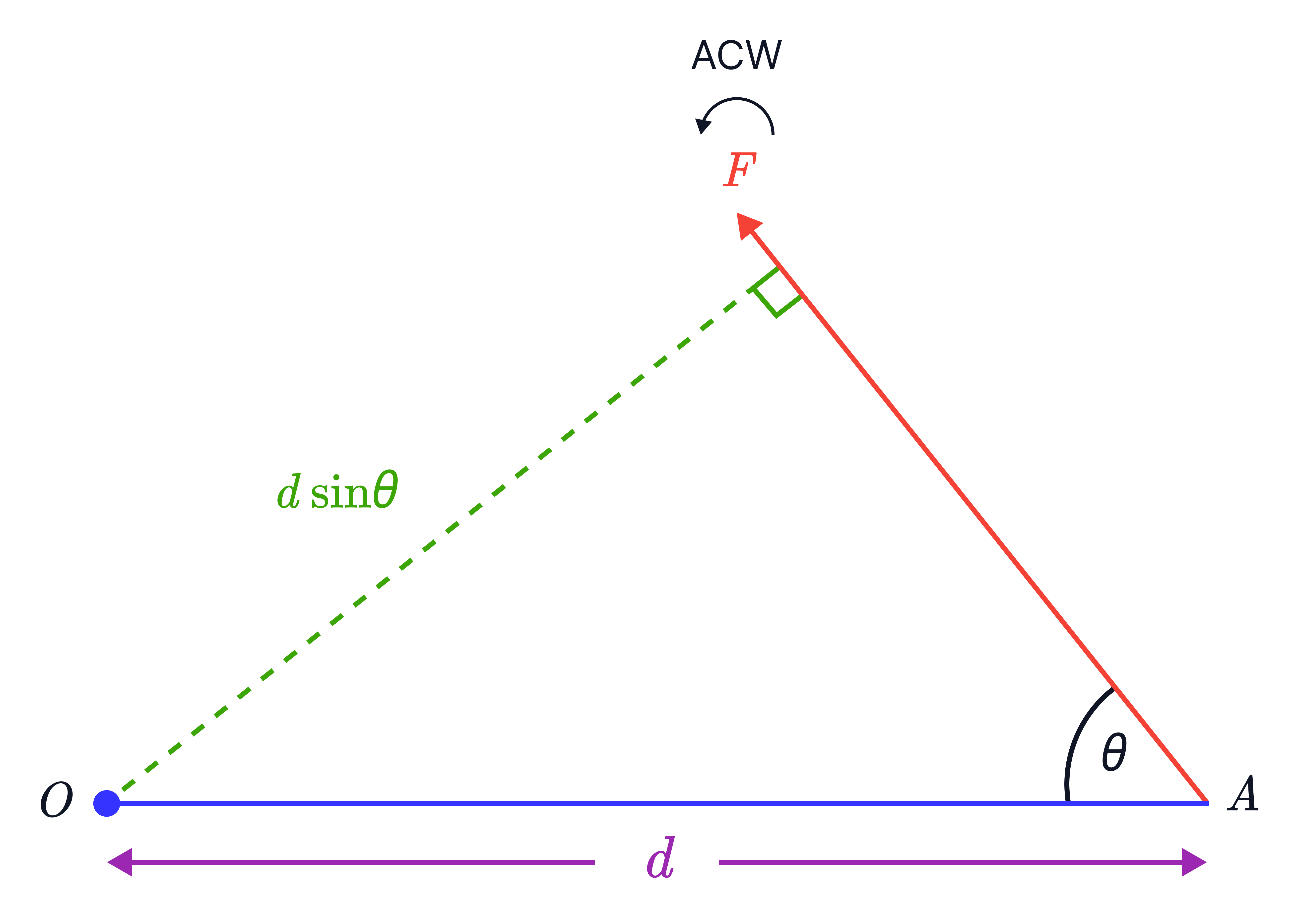
Therefore, our perpendicular distance is . So, the moment about is .
General steps when working out the sum of moments about a point
1) For each force, determine whether they’d make the rigid body rotate clockwise or anti-clockwise about the point.
2) Find the perpendicular distance from the point to each force. If the force is not perpendicular,
draw a line from the point to the line of action of the force such that the line meets the force at a
right-angle. Then, use SOHCAHTOA to find the distance.
3) Use the formula for the moment of force to work out the clockwise and anti-clockwise moments separately.
4) To find the net moment, take the smaller moment and subtract it from the larger moment.
Example 1:
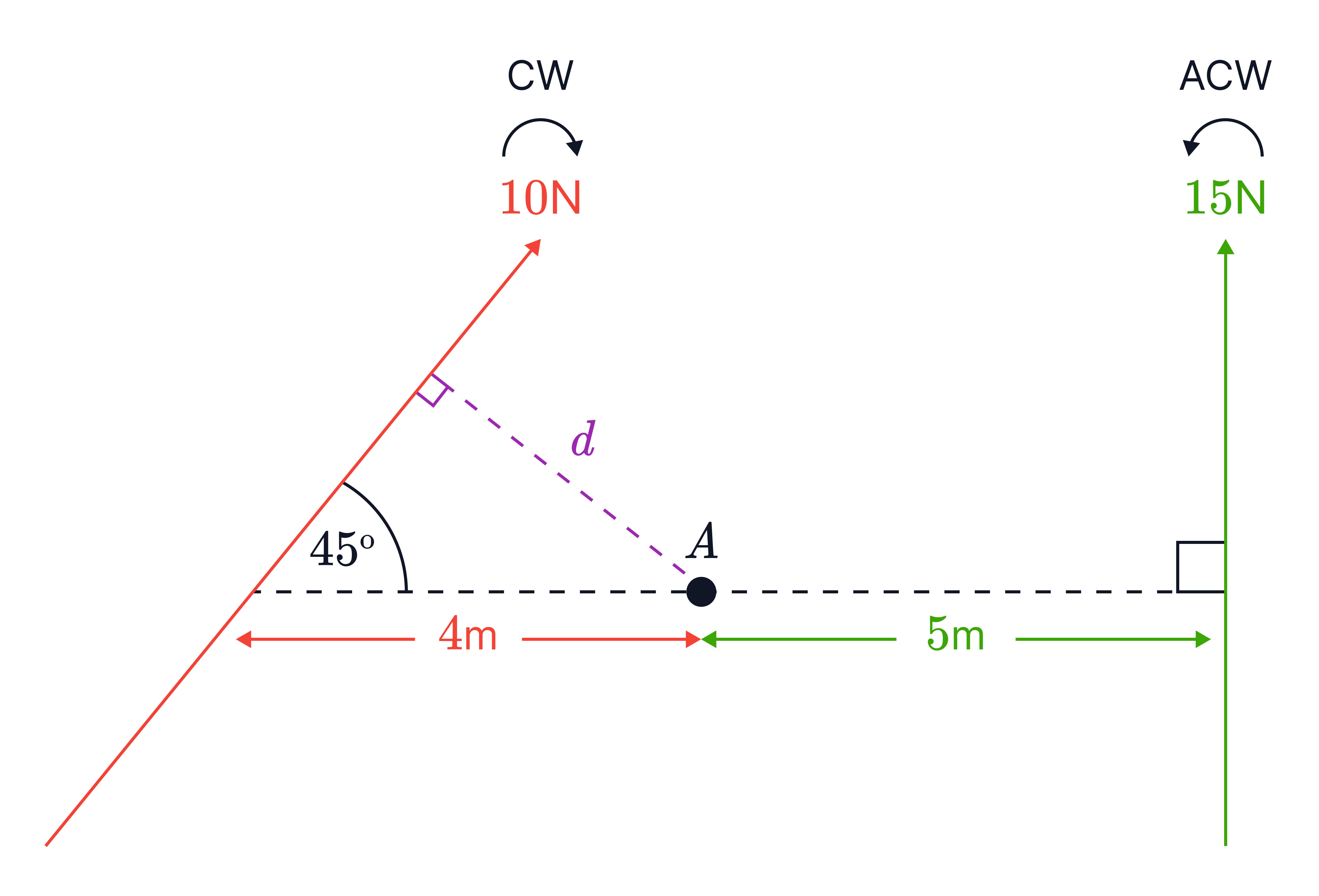
Find the sum of the moments about given the forces shown.
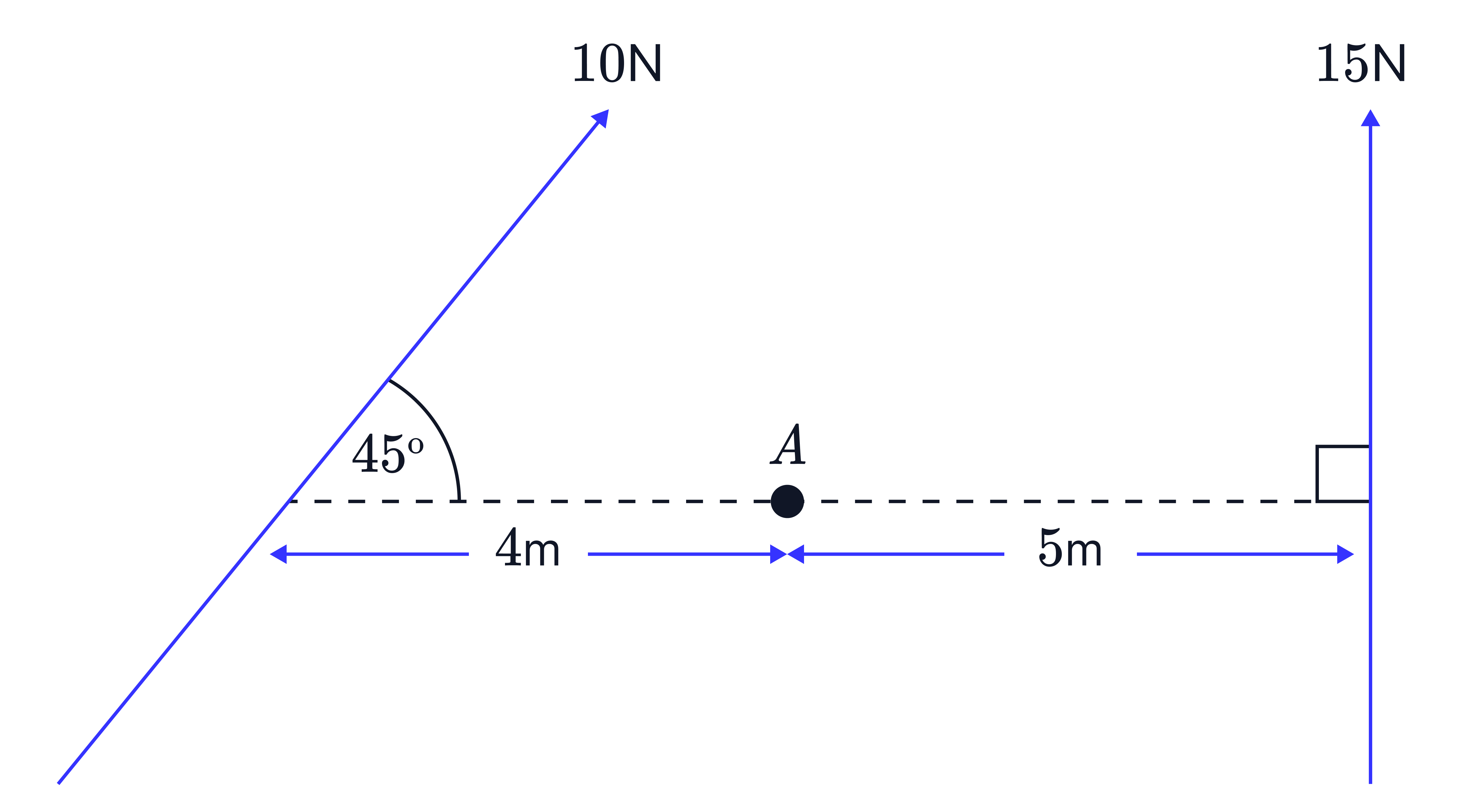
Step 1: For each force, determine whether it would cause to rotate clockwise or anti-clockwise.
The N force causes anti-clockwise rotation, while the N force causes clockwise rotation.
Step 2: Find the perpendicular distances from .
The N force acts at a perpendicular distance of m. The N force is not perpendicular so draw a straight line from to the line of action of the N force, ensuring it meets at a right angle. Then, use SOHCAHTOA to calculate the distance. In this case, the hypotenuse is m, and the opposite side, , is the distance we want to find.
Step 3: Find the clockwise and anti-clockwise moments separately.
Clockwise moment: Nm
Anti-clockwise moment: Nm
Step 4: Find the net moment.
The anti-clockwise moment is larger so the net moment will be anti-clockwise.
Nm anti-clockwise
No answer provided.
Example 2:
Find the sum of the moments about of the forces shown.
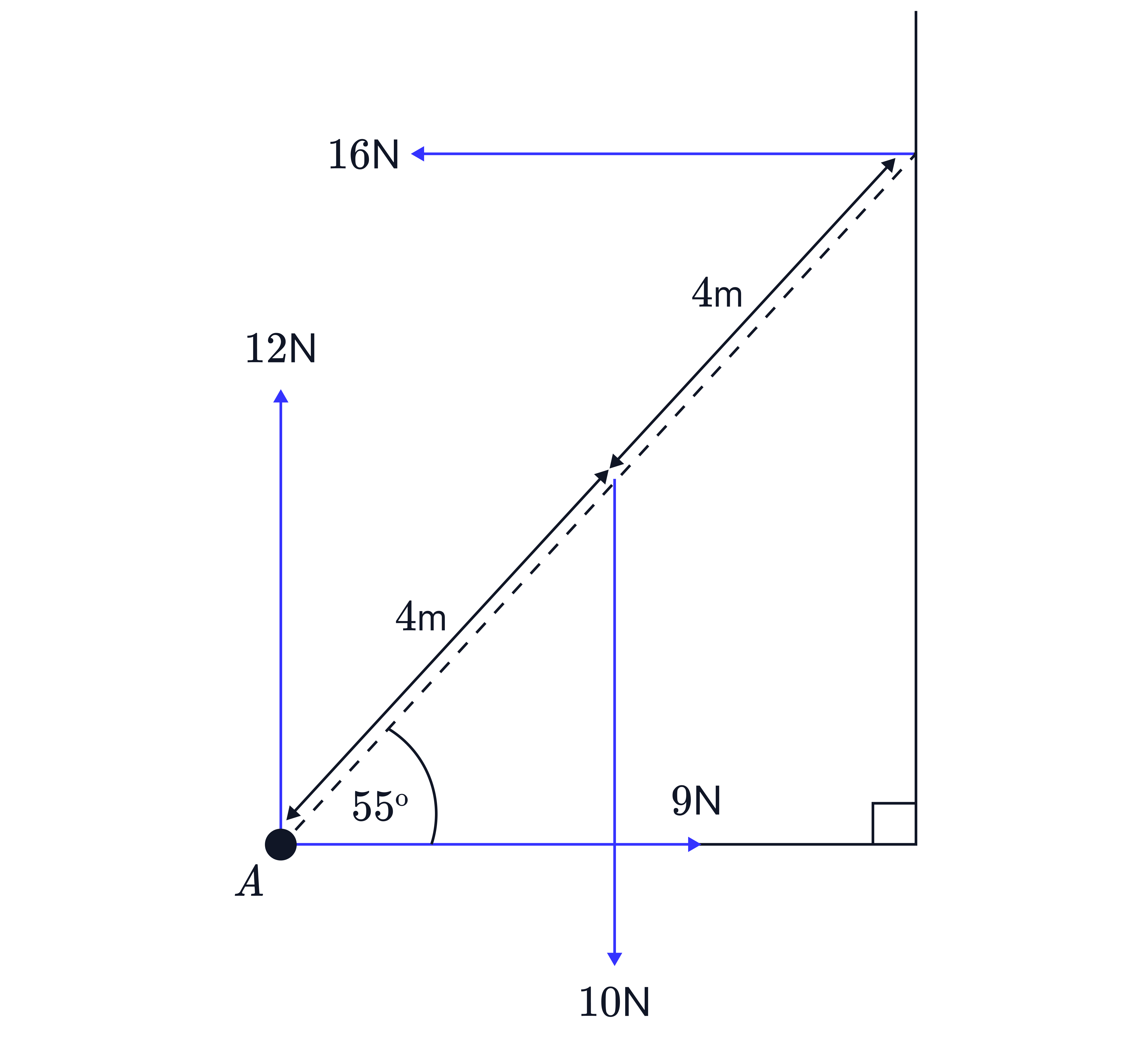
Step 1: For each force, determine whether it would cause clockwise or anti-clockwise rotation about .
• The N force causes anti-clockwise rotation, while the N force causes clockwise rotation.
• The N and N forces act directly on so the perpendicular distance from these forces to is .
Therefore, there are no moments generated by these forces and we can ignore them in this calculation.
Step 2: Redraw the diagram and work out the perpendicular distances between and the
N and N forces. Draw a straight line from to each force to ensure they meet at a right angle. Then, use SOHCAHTOA to find the distances.
Notice that N is not long enough in the diagram to see its perpendicular distance from . Extend the line when this happens. We have a famous saying here at MyEdSpace: When in doubt, extend it out.
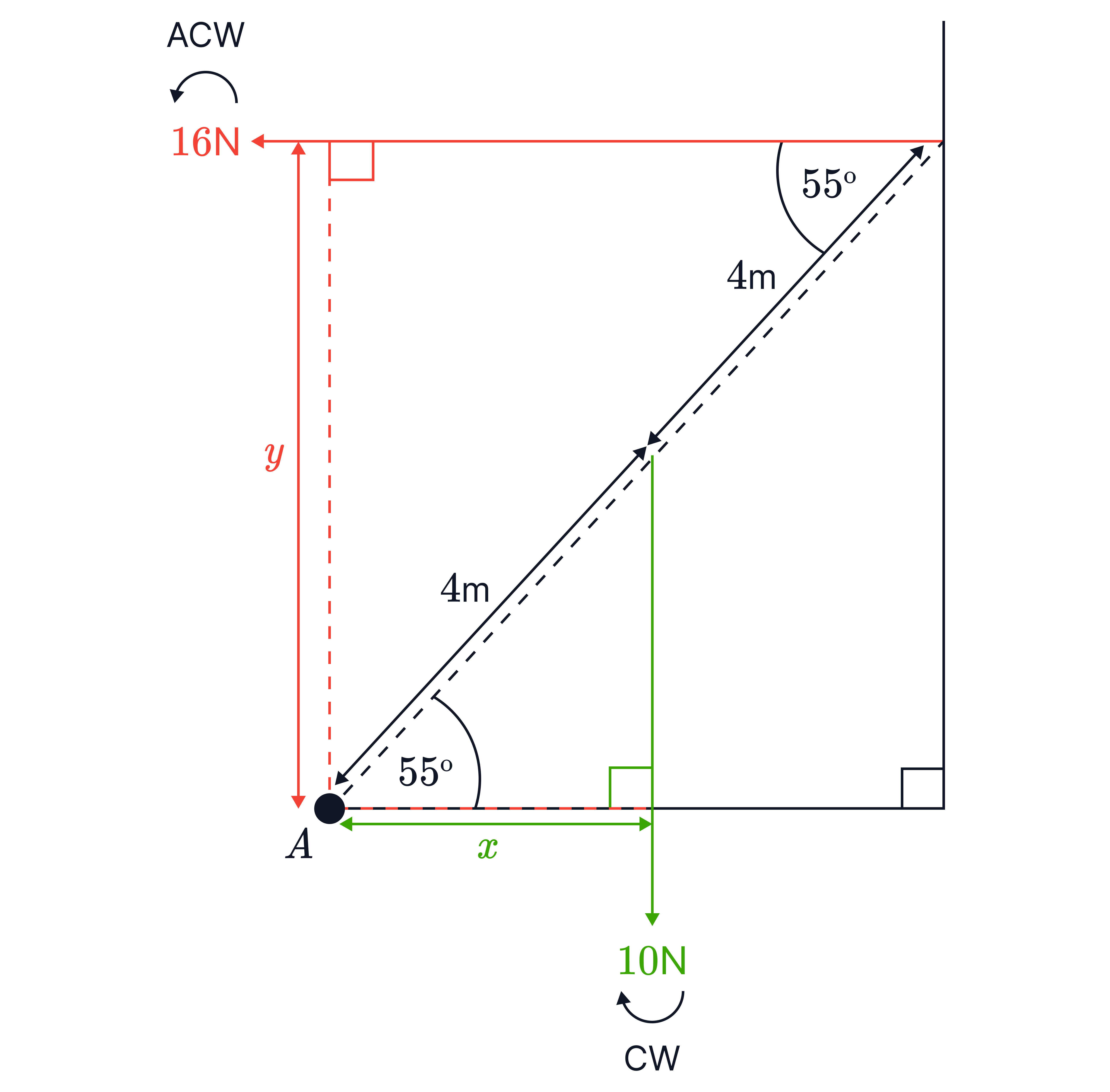
For the N force, whose perpendicular distance is :
For the N force, whose perpendicular distance is :
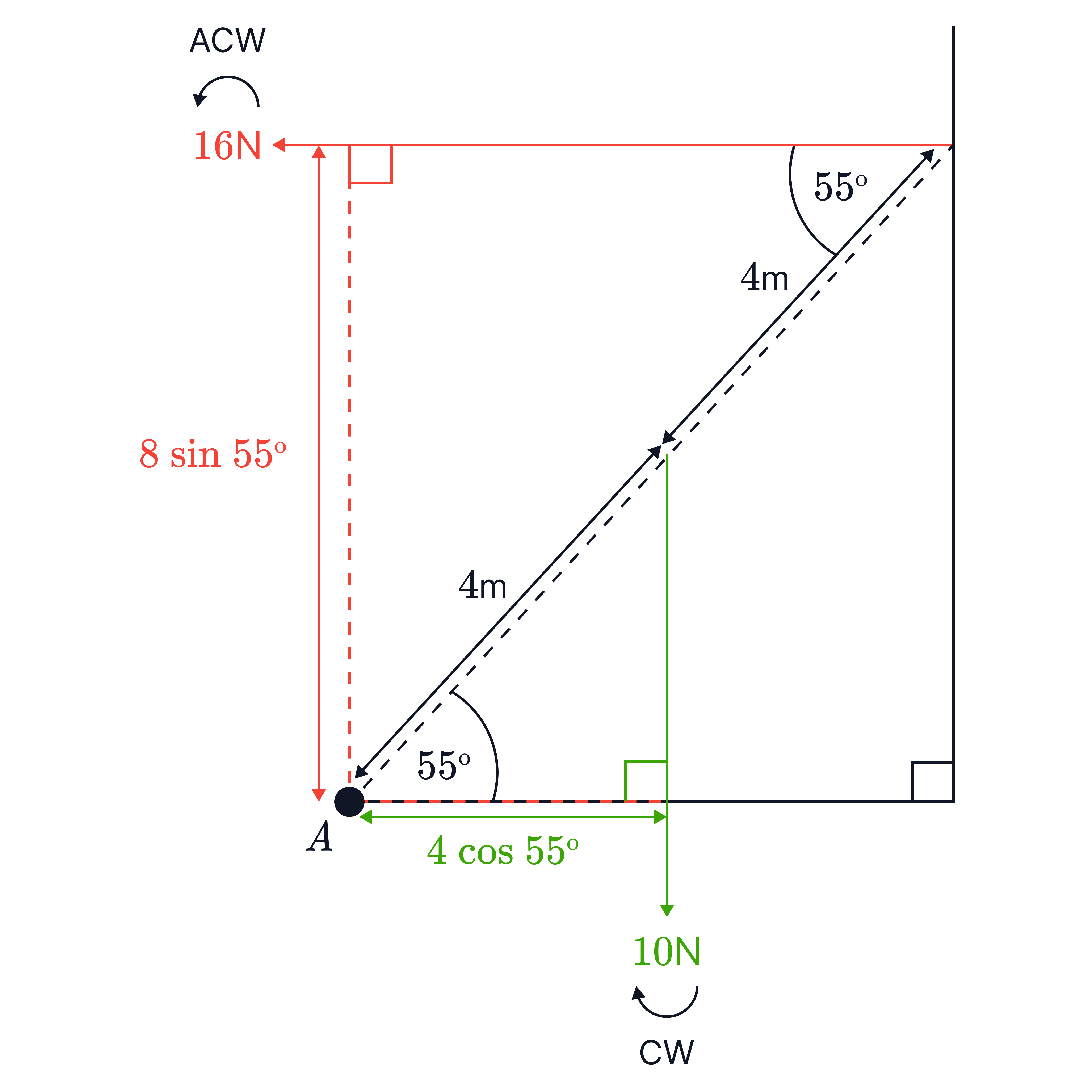
Step 3: Find the clockwise and anti-clockwise moments separately.
Clockwise moment:
Nm
Anti-clockwise moment:
Nm
Step 4: Find the net moment.
The clockwise moment is larger so the net moment will be clockwise.
Nm clockwise
No answer provided.
Challenging Question