Moment of Forces Acting on a Uniform Rod
Neil Trivedi
Teacher

Moment of Forces Acting on a Uniform Rod
Moment of Force Force Perpendicular Distance
The perpendicular distance is the shortest distance from a point to the force.
In this note, we’ll explore how moments act when forces are applied to a uniform rod - a long, rigid body that can rotate about a fixed point or pivot.
Because the rod is uniform, its weight is evenly distributed and acts vertically downward through its midpoint, also known as its centre of mass.
General Steps for Calculating the Moment about a Fixed Pivot on a Uniform Rod
1) Identify and label all forces acting on the rod (e.g. tensions, weights and reactions), drawing a diagram if necessary.
2) Find the perpendicular distances from the pivot to each force’s line of action. If you cannot draw a perpendicular line from the pivot point to the force, extend the force line on your diagram.
3) Determine whether each force would cause the rod to rotate clockwise or anti-clockwise about the pivot.
4) Calculate the clockwise and anti-clockwise moments separately.
5) Find the resultant (net) moment by subtracting the smaller moment from the larger moment.
6) If we have a question where the system is in equilibrium with unknown forces and distances, we will set all upward forces to equal all downward forces, and that the clockwise moment is equal to the anti-clockwise moment.
Example 1:
The diagram shows a uniform rod of weight N. Find the resultant moment about the pivot .
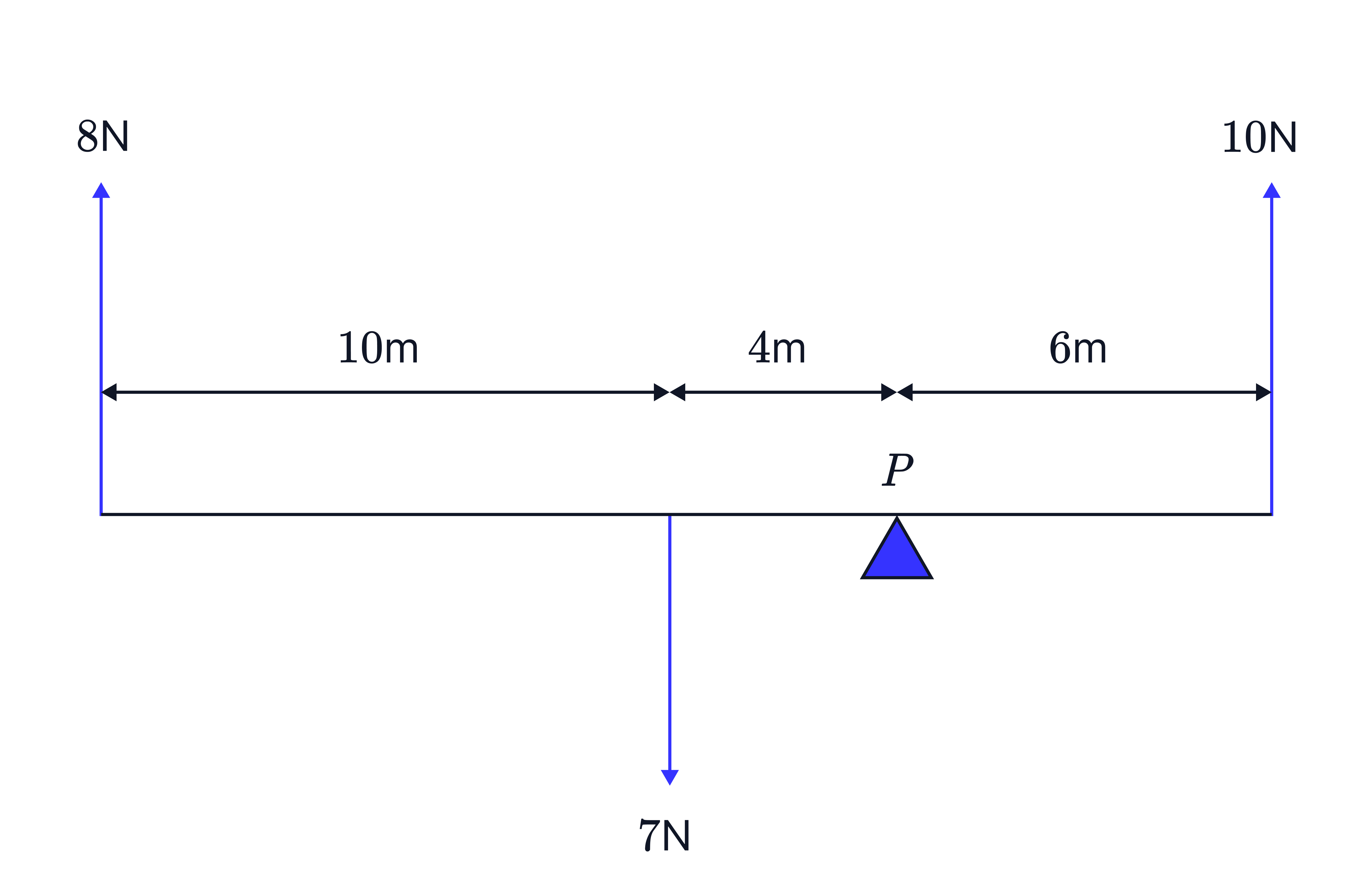
Step 1: Identify and label the forces on the diagram.
In this example, the rod is acted upon by N and N forces. The rod is uniform, so its weight of N acts vertically downward through its midpoint (can check because it’s m away from either end of the rod). A reaction force is also exerted by on the rod.
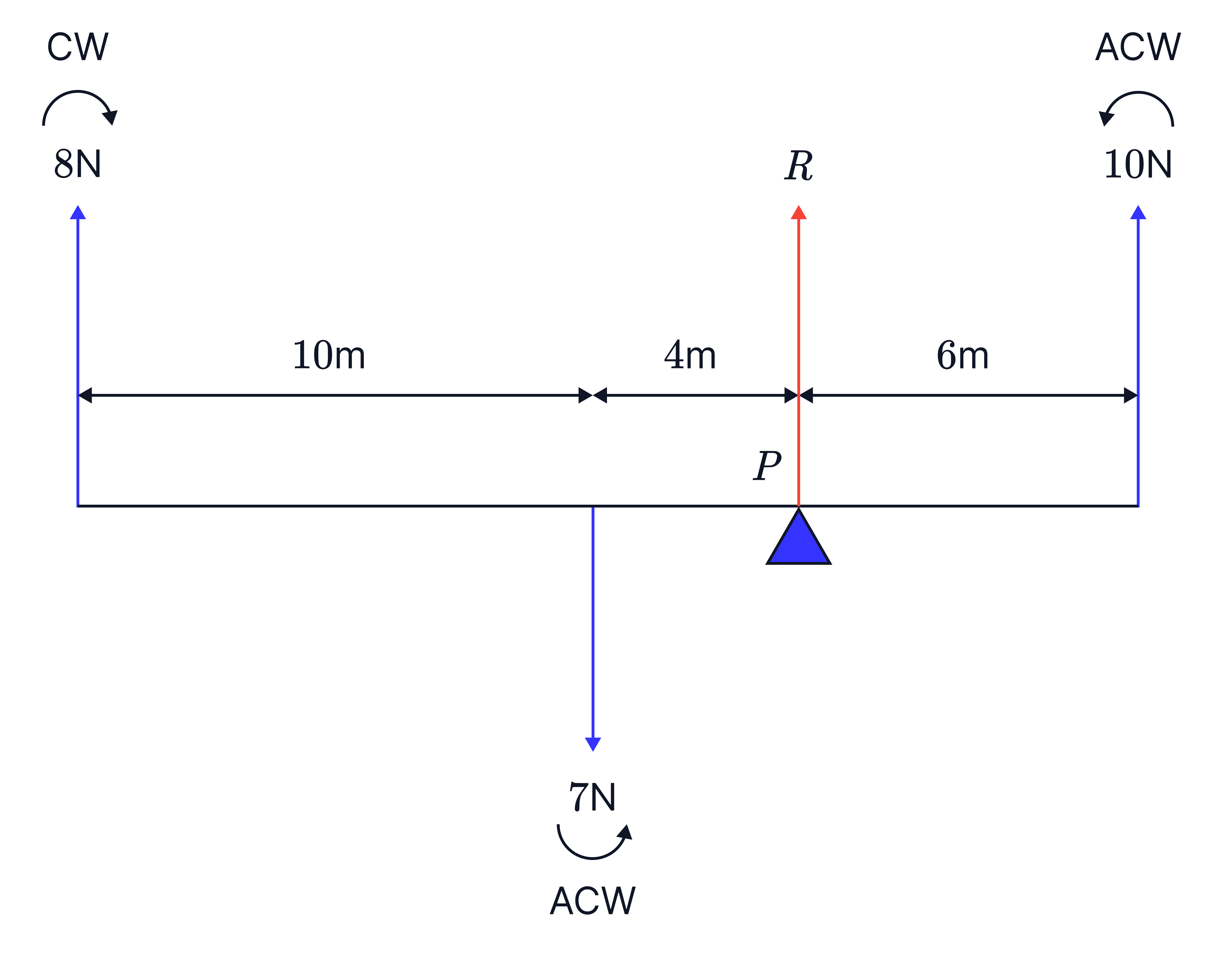
Step 2: We can see the perpendicular distances from to all forces’ lines of action on the diagram. For each force, determine whether it would cause the rod to rotate clockwise or anti-clockwise about the pivot .
• The N force would cause the rod to rotate clockwise (the perpendicular distance from is m).
• The N (the perpendicular distance from is m) and N (the perpendicular distance from is m) forces would cause the rod to rotate anti-clockwise about .
• The reaction force acts directly on , so it produces no moment as its perpendicular distance from the pivot is .
All of this is illustrated in the annotated diagram below.
Step 3: Calculate the clockwise and anti-clockwise moments separately.
Clockwise moment Nm
Anti-clockwise moment Nm
Step 4: Find the resultant moment.
Nm clockwise
No answer provided.
Example 2:
The diagram shows a light rod , which is supported on a smooth pivot . Two people stand at opposite ends of the rod. The person at has a mass of kg, while the person at has a mass of kg. The people are modelled as particles. Find the resultant moment about .
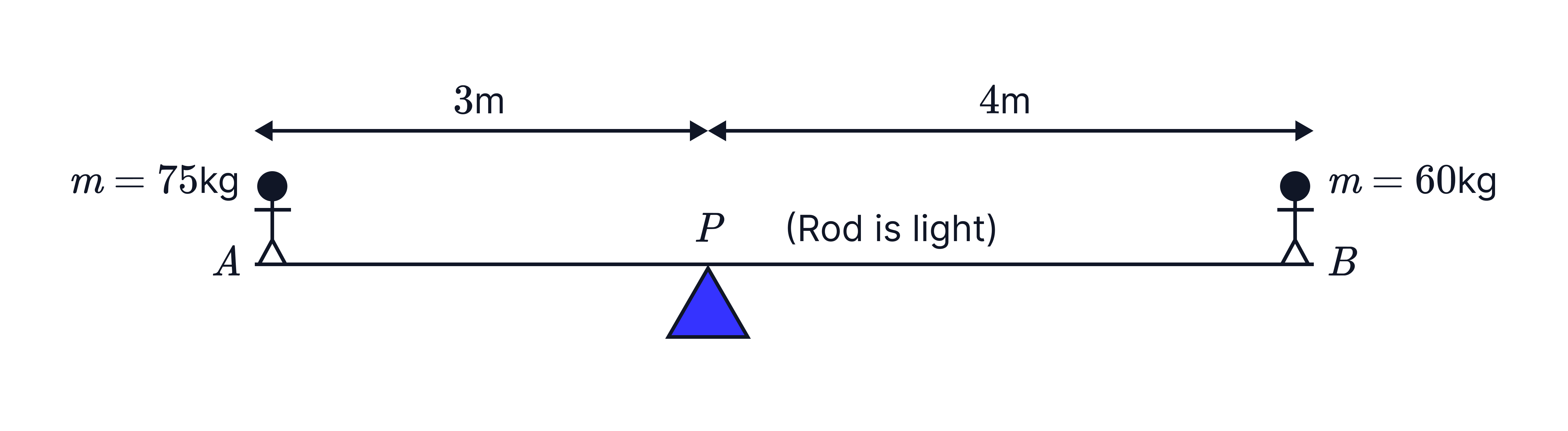
Step 1: Identify and label the forces on the diagram.
In this example, the person with the mass of kg exerts a downward force of , and the person with the mass of kg exerts a downward force of . The rod is light, so its own weight is negligible. Both people exert reaction forces.
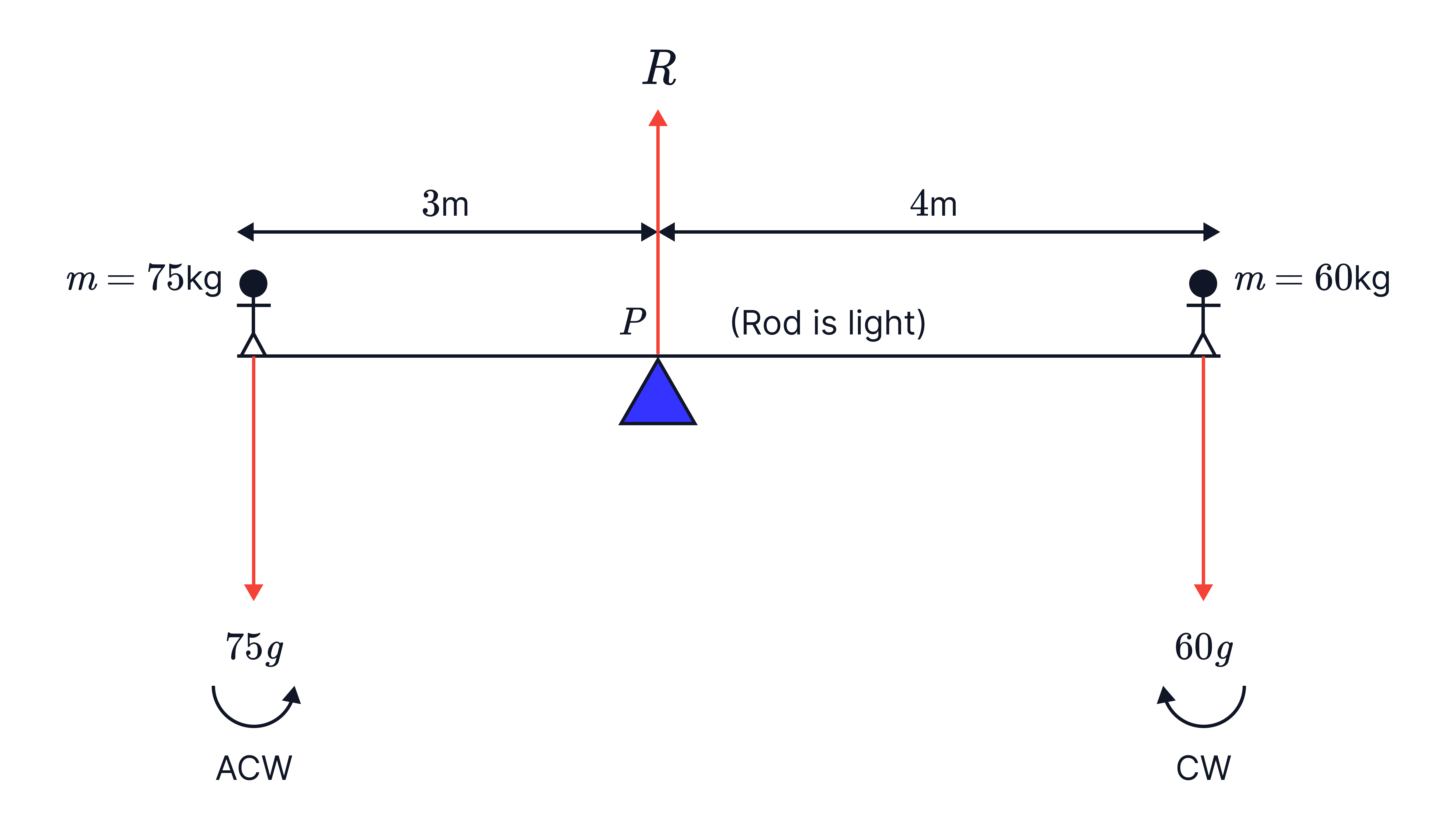
Step 2: We can see the perpendicular distances from to all forces’ lines of action on the diagram. For each force, determine whether it would cause the rod to rotate clockwise or anti-clockwise about the pivot .
• The force would cause the rod to rotate anti-clockwise (the perpendicular distance from is m)
• The force would cause the rod to rotate clockwise (the perpendicular distance from is
m).
• The reaction force acts directly on , so it produces no moment as its perpendicular distance from the pivot is .
• The rod doesn’t experience the reaction forces exerted by the people, only their weights, so we don’t consider them in the calculation.
All of this is illustrated in the annotated diagram below.
Step 3: Calculate the clockwise and anti-clockwise moments separately.
Clockwise moment: Nm
Anti-clockwise moment: Nm
Step 4: Find the resultant moment.
Nm clockwise.
No answer provided.
Example 3:
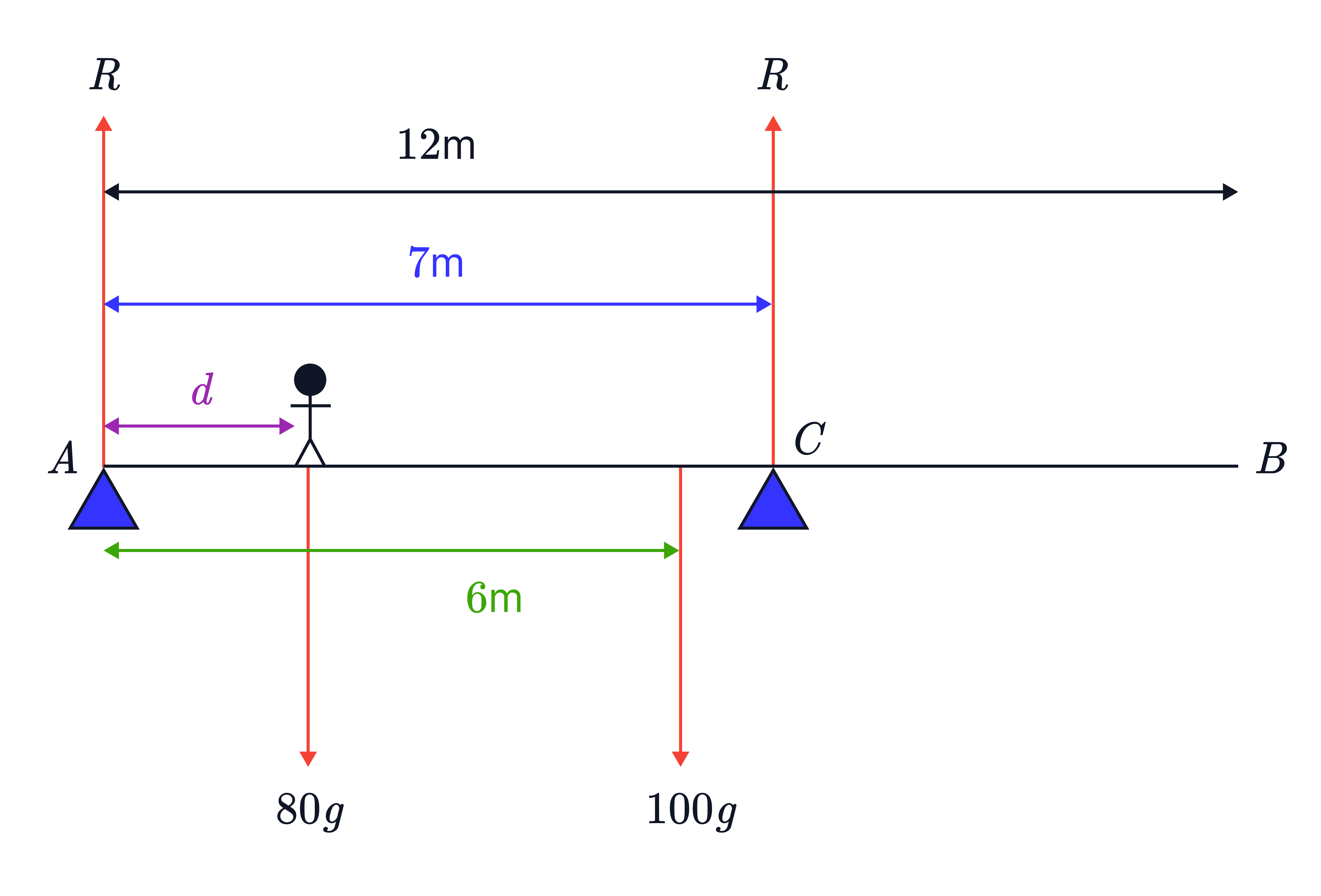
A beam has a mass of kg and a length of m. It is supported in a horizontal position by two smooth pivots, one at and the other at a point where m. A man of mass kg stands on the beam which remains at horizontal equilibrium. The magnitudes of the reactions at the two pivots are each equal to Newtons.
The beam is modelled as a uniform rod, and the man is modelled as a particle.
Find the value of and the distance of the man from .
Step 1: We draw a diagram to illustrate the situation with all the forces and distances.
To note:
• Because the beam is modelled as uniform, its weight is and acts at its midpoint which is m away from either end of the beam.
• The question doesn’t tell us where the man is standing on the beam, so we place him at some point along the beam at a distance from . To note, we have chosen since the question has given all distances relative to .
• We don’t consider the reaction force of the man in the calculation because just like in the previous example, the beam doesn’t experience the man’s reaction force, only his weight.
Step 2: Equate the upward/downward forces and solve for .
Because the beam is in horizontal equilibrium, the sum of the upward forces equals the sum of the downward forces.
Upward forces:
Downward forces:
We have worked out the value of to be . Now, we need to determine the distance . To do this, we take moments about .
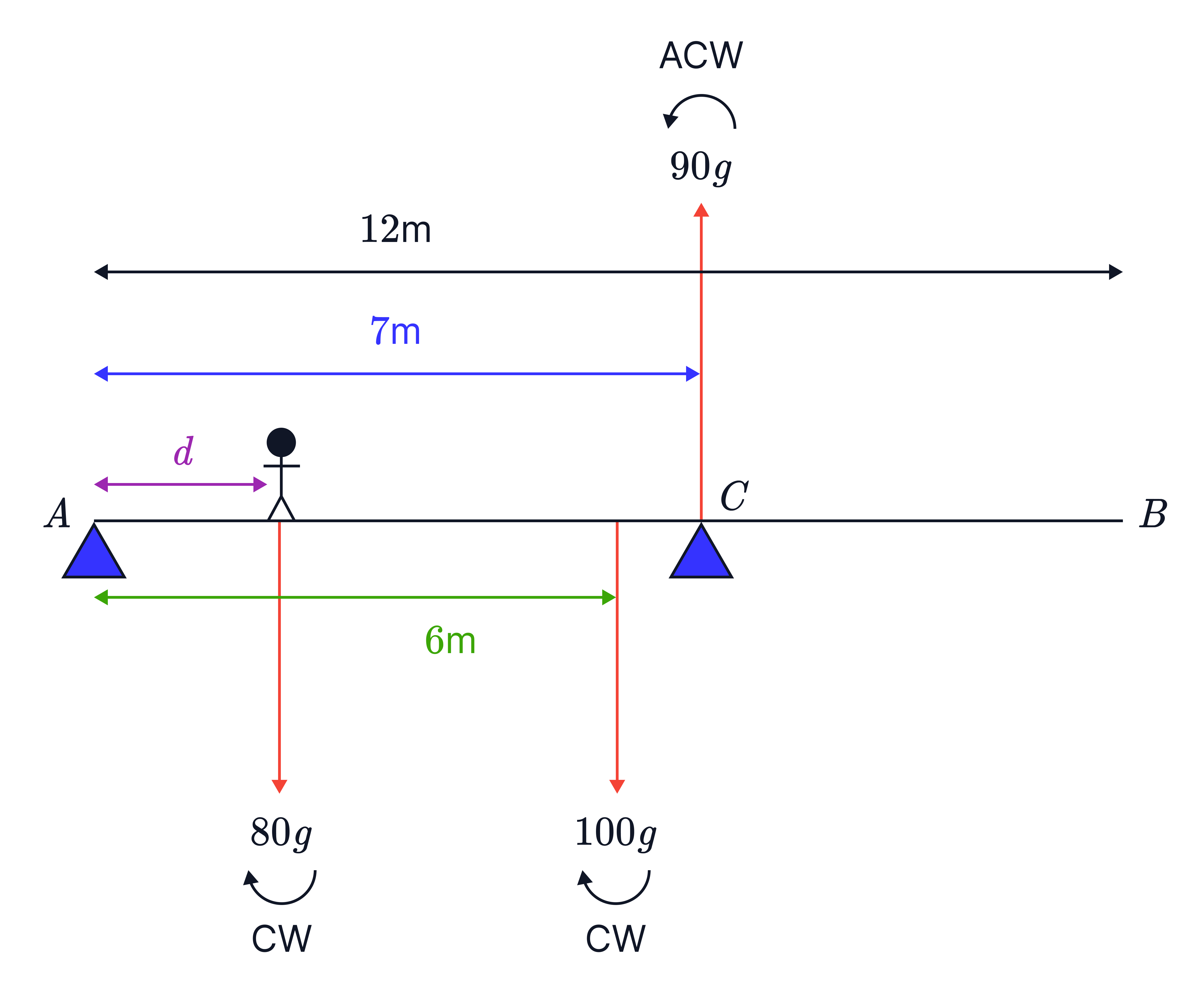
Step 3: Find the perpendicular distances between and the line of action of each force.
• The force acts at a perpendicular distance of m.
• The force at acts at a perpendicular distance of m.
• The force acts at a perpendicular distance of .
• The force at acts directly on the pivot, so the perpendicular distance is . Therefore, we can exclude this from our diagram and calculation.
Step 4: Determine whether each force would cause the beam to rotate clockwise or anti-clockwise about .
• The and forces would cause the beam to rotate clockwise.
• The force at would cause the beam to rotate anti-clockwise.
All of this is illustrated in the annotated diagram below.
Step 5: Calculate the clockwise and anti-clockwise moments.
Clockwise moment: Nm
Anti-clockwise moment: Nm
Step 6: Solve for .
Because the beam is in horizontal equilibrium, the net moment is , meaning that it isn’t rotating in any direction. Therefore, we equate the clockwise and anti-clockwise moments.
m
No answer provided.
Challenging Question