Resolving Forces
Neil Trivedi
Teacher

Contents
Resolving Forces
When forces act in many directions, analysing them directly can be difficult. Instead, we resolve each force into components that are parallel and perpendicular to the plane on which the object rests on.
For example, if an object rests on an axis, the parallel and perpendicular components would be horizontal and vertical, respectively.
If the object rests on an inclined plane (slope), the parallel and perpendicular components act along the plane (up the plane/down the plane) and into/out of the plane, respectively.
When resolving, it is easier to rewrite the forces in vector/component form:
where represents the component parallel to the plane and represents the component perpendicular to it.
If a force acts at an angle measured from the axis, its components form a right-angled triangle. Using SOHCAHTOA, we can write:
where is the parallel component and is the perpendicular component.
Note: If the angle is measured from a different direction (such as the vertical or the plane), the sine and cosine components may swap. We use SOHCAHTOA and the right-angled triangle to check.
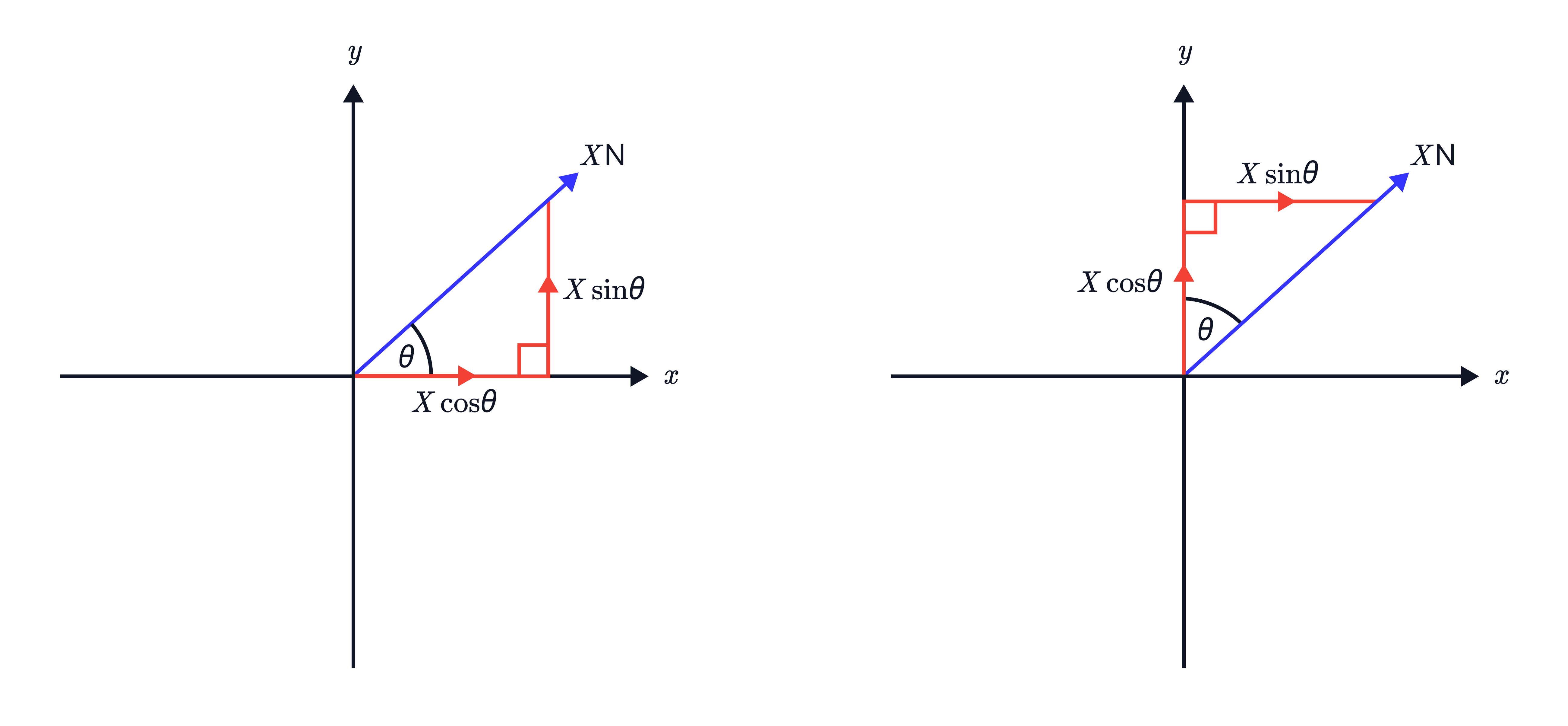
When solving problems, we usually take positive directions to be up and to the right along the chosen axes. If a force acts in the opposite direction (e.g. down or left), the magnitude of the component remains the same, but its value becomes negative in the vector form.
General Steps on Resolving Forces
1) Draw or annotate a force diagram, indicating the parallel and perpendicular components of each force.
2) Rewrite all forces in vector form, showing the parallel and perpendicular components (parallel at the top and perpendicular at the bottom).
3) Find the resultant vector by adding all force vectors together. This represents the resultant force acting on the object.
4) If needed, use these vectors to work out values such as the magnitude (using Pythagoras’ Theorem with the parallel and perpendicular components) and the direction of the force (using SOHCAHTOA) with the components to find the angle the force makes with the axis. We can also find unknown forces and angles by resolving and then forming and solving equations.
Example 1:
What single force can replace the following system of forces?
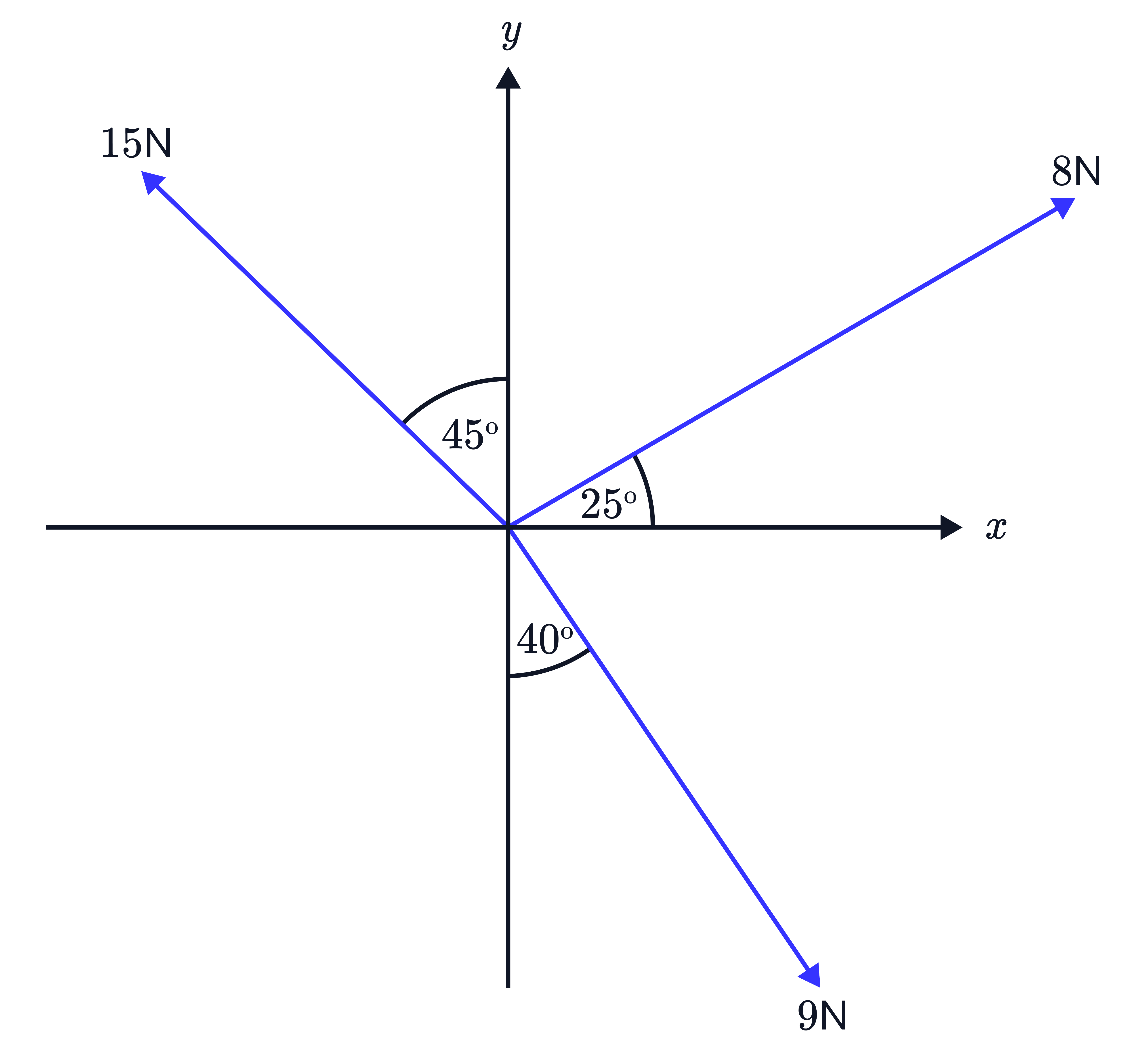
Step 1: Annotate the force diagram to show the horizontal and vertical components of the forces.
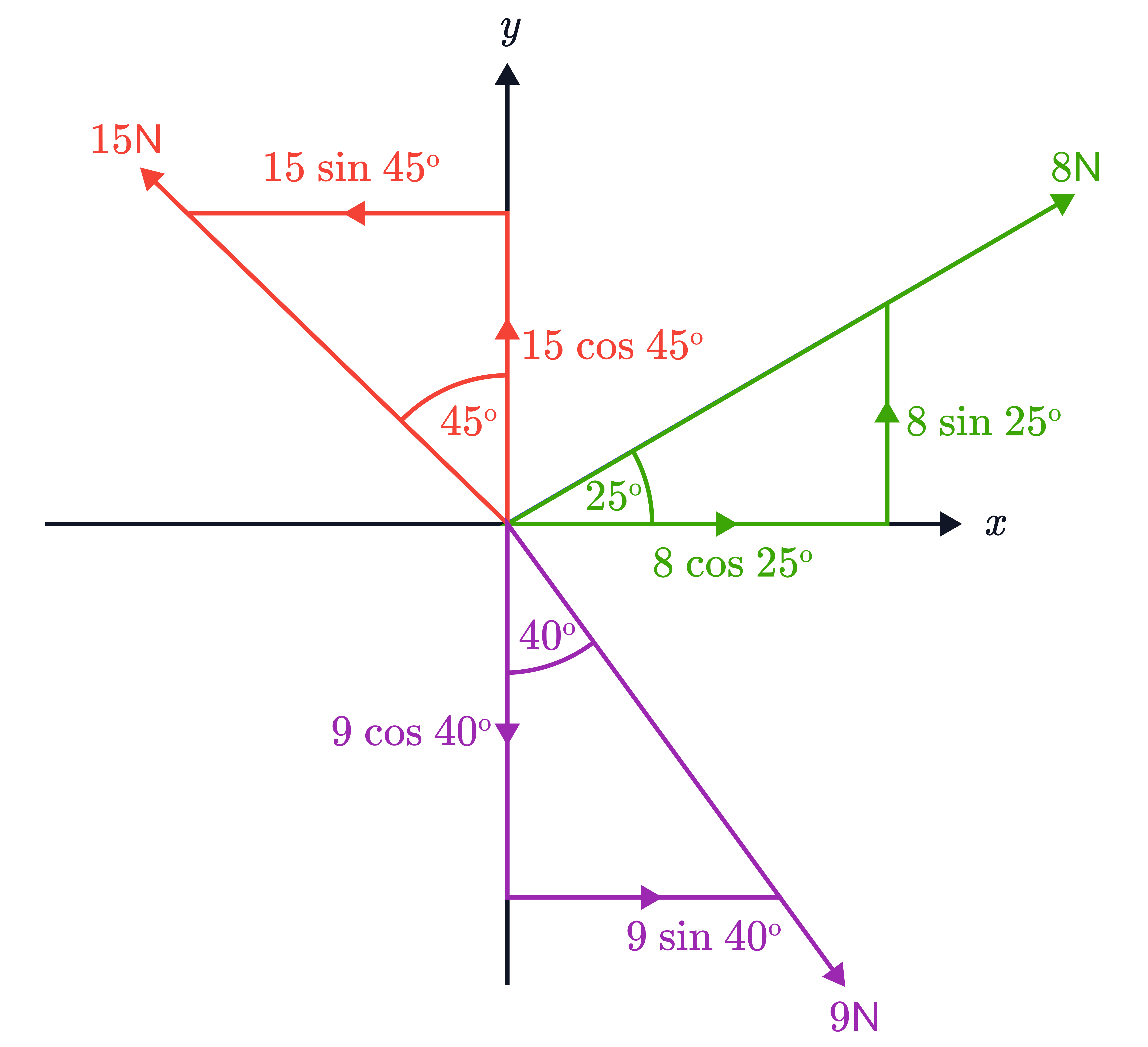
Step 2: Find the resultant vector by summing all the forces in vector form.
N
No answer provided.
Example 2:
The diagram shows three forces acting on a particle in equilibrium. Find the unknown force and the angle . Give your answers to decimal place.
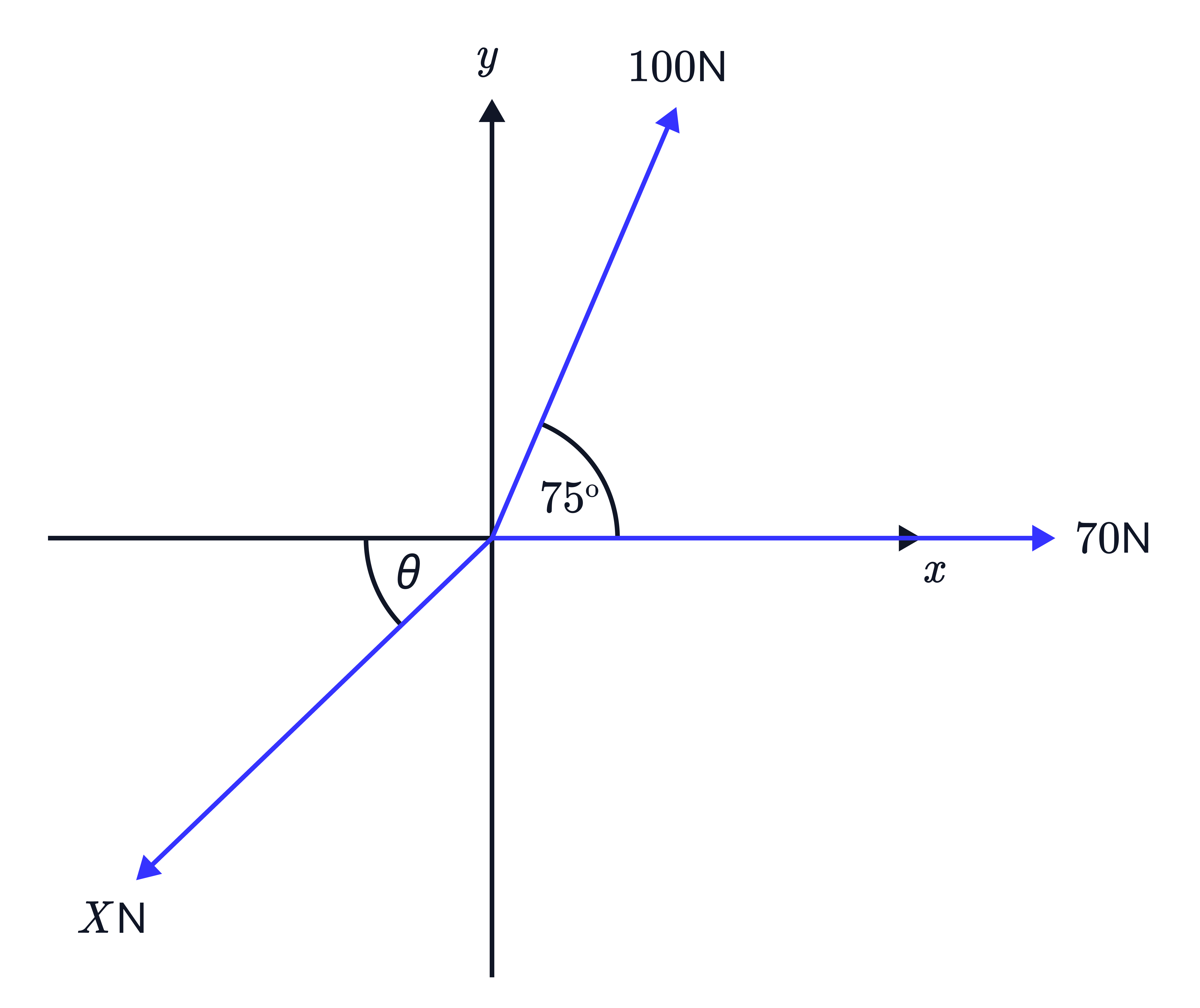
Step 1: Annotate the force diagram to show the horizontal and vertical components of the forces.
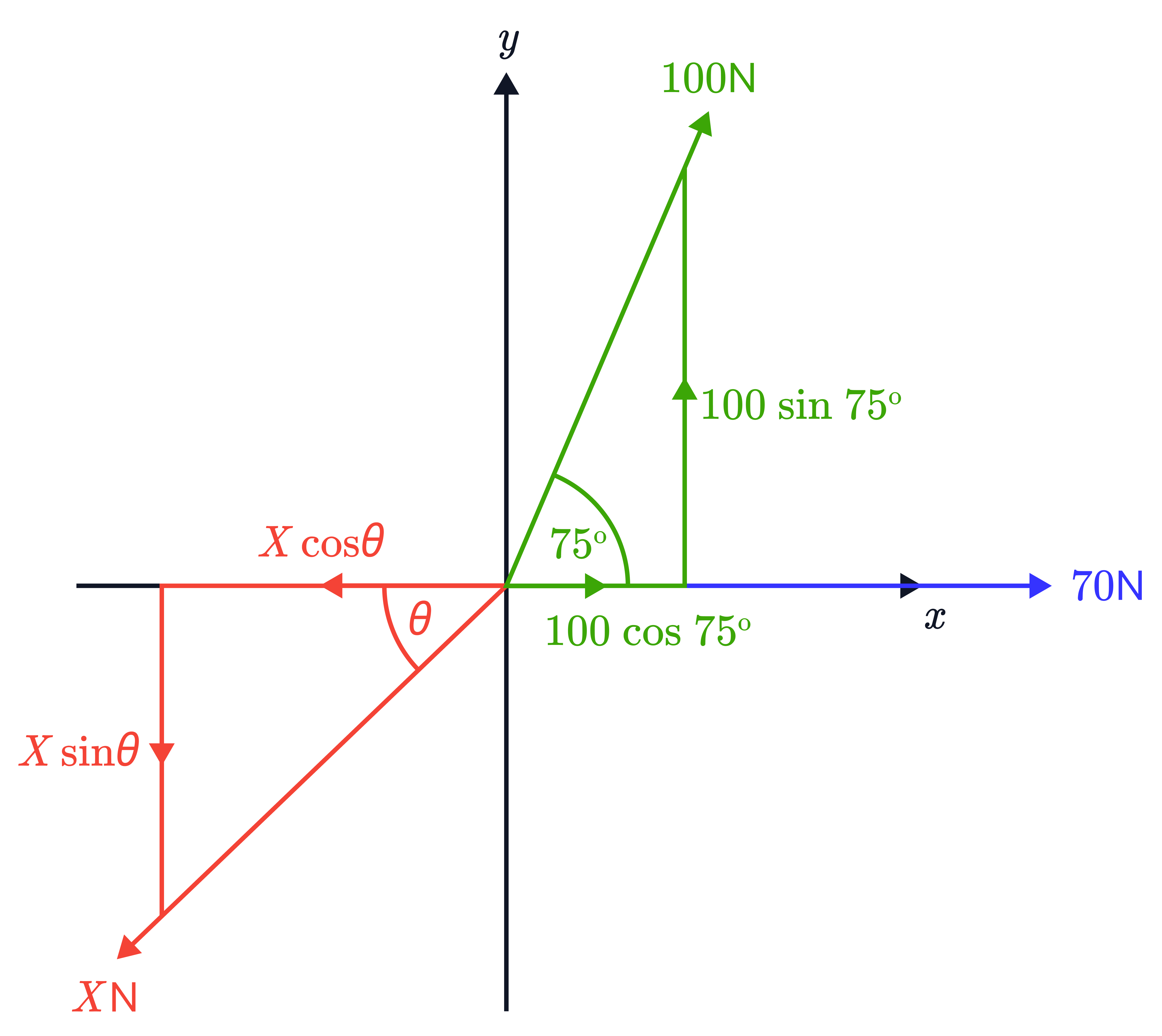
Step 2: Sum all the forces in vector form to get the resultant force.
Because the system is in equilibrium, there is no net force, so the resultant force is . We can use this to form equations for and .

Hence, we obtain the following equations:
Step 3: Solve for .
We divide the second equation by the first equation.
Step 4: Solve for .
We use Pythagoras’ Theorem with the parallel and perpendicular components, which are and , respectively.
N
No answer provided.
Example 3:
A particle sliding on a slope is subjected to the forces shown in the diagram.
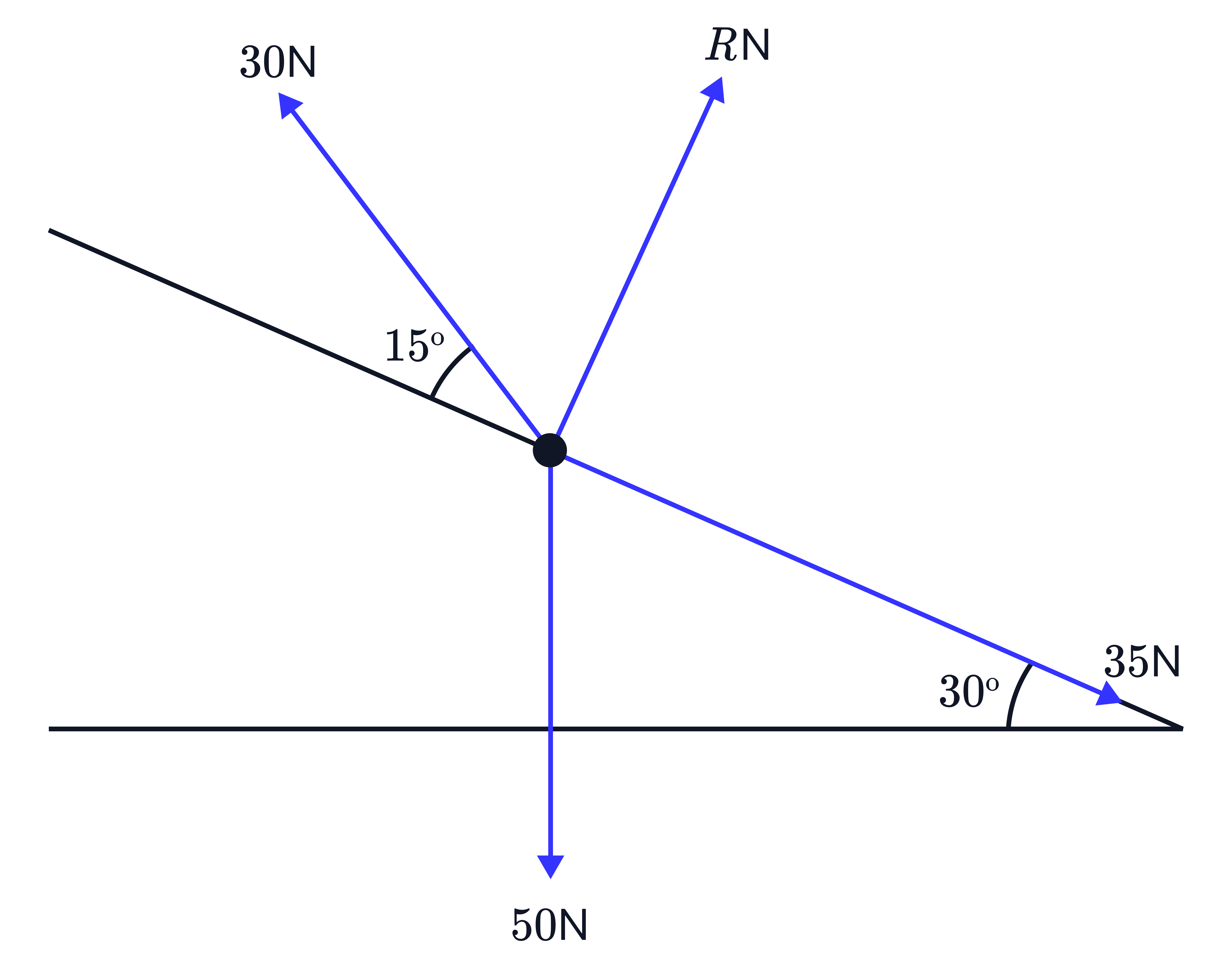
a) Resolve all the forces parallel and perpendicular to the slope to determine if the particle rolls up or down the plane.
Note: Here, we are resolving parallel and perpendicular to the plane.
Step 1: Annotate the force diagram to show the horizontal and vertical components of the forces.
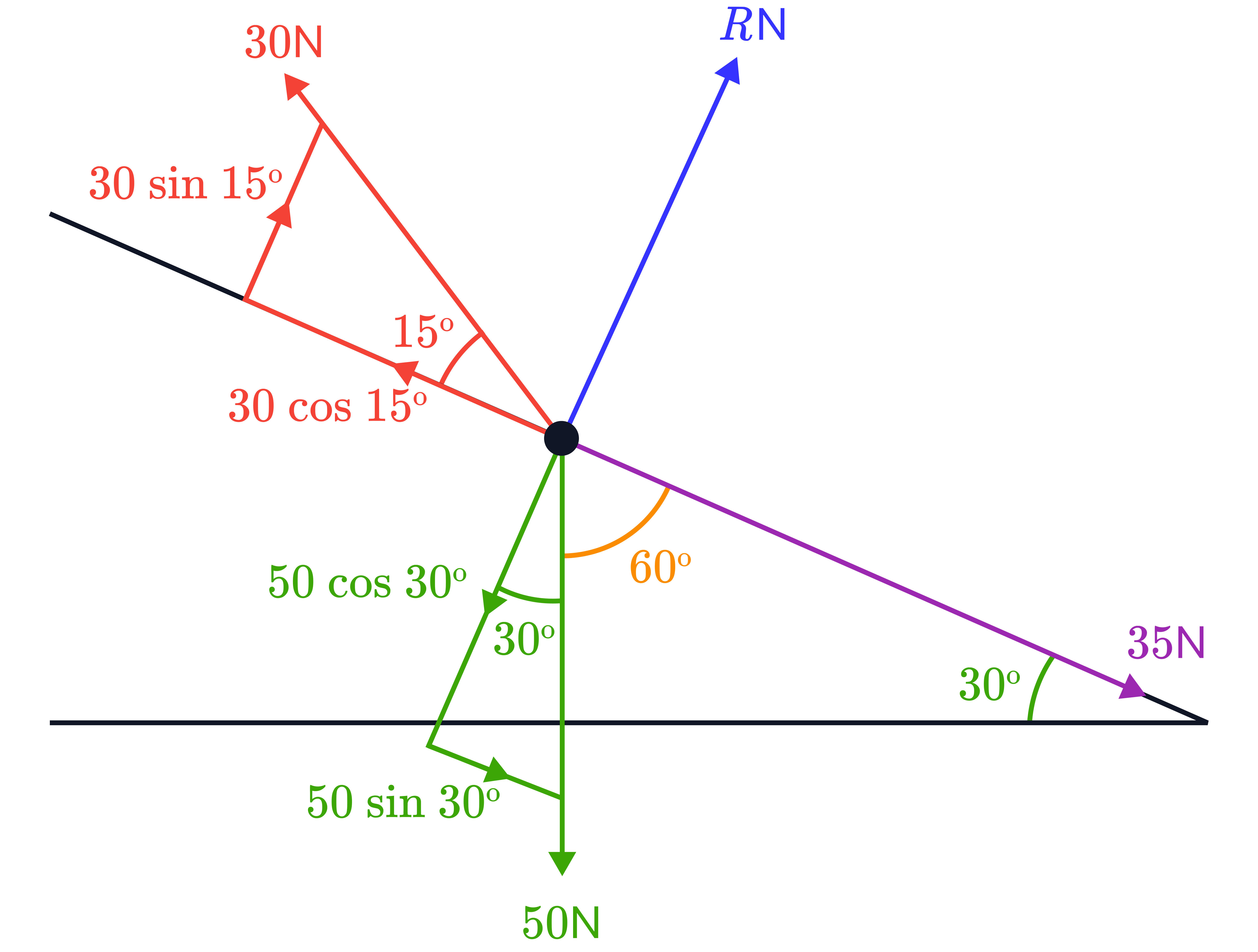
To note, the weight of the object N acts vertically downward, and the plane is inclined at to the horizontal. Because the normal to the plane is at to the horizontal, the angle between the weight and the line perpendicular to the plane is . Hence, when resolving the weight, the angle between the weight and the perpendicular component is . We don’t need to show this every time. We just need to know that the angle made when resolving the weight is always equal to the incline of the plane.
Step 2: Work out the total magnitude of the forces acting up the plane and down the plane, then compare them.
Up the plane:
Down the plane:
Therefore, the particle slides down the plane.
b) Find the magnitude of the normal reaction, giving your answer to significant figures.
Single Step: Set all the forces acting into the plane equal to those acting out of the plane.
Since the particle is remaining in contact with the ground the whole time, the forces pointing out the ground and the forces pointing into the ground must be equal.
Out of the plane:
Into the plane:
Equating them,
N
No answer provided.
Practice Question